MRCP (Magnetic Resonance Cholangiopancreatography): Purpose, Preparation and What to Expect

Updated: 2 days ago
Written and medically reviewed by Dr. Baraa Alnahhal, MD · Last reviewed: November 2026 · How we review
Quick Answer: What is MRCP?
Magnetic resonance cholangiopancreatography (MRCP) is a type of MRI scan that creates detailed pictures of the bile ducts, gallbladder and pancreas. It uses a magnetic field and radio waves instead of X-rays. Providers order it to check for gallstones, blocked or narrowed ducts, pancreatitis, cysts and tumors. The scan takes about 15 minutes and does not involve an endoscope. [1]
What the research says
MRCP finds bile duct stones accurately when it is used to check suspected cases. In a review of 7 studies with 996 people, MRCP correctly detected 93% of common bile duct stones and correctly ruled them out in 96% of people who did not have them. (Giljaca et al., Cochrane Database of Systematic Reviews, 2015) [2]
Endoscopic ultrasound may pick up slightly more stones. Pooling 12 studies that compared the two tests head to head, MRCP had a sensitivity of 85% and specificity of 90% for bile duct stones, while endoscopic ultrasound reached 96% and 92%. (Afzalpurkar et al., Surgical Endoscopy, 2023) [3]
MRI with MRCP helps spot bile duct cancer in people with PSC. Across 8 studies including 531 people with primary sclerosing cholangitis who had MRI/MRCP, the scans detected cholangiocarcinoma with a pooled sensitivity of 98.9%, missing 3 of 36 cancers. (Satiya et al., Clinical and Experimental Hepatology, 2020) [4]
Key takeaways
MRCP is an MRI scan focused on the bile ducts, gallbladder and pancreas. [1]
It uses magnets and radio waves, so there is no X-ray radiation. [1]
It is commonly used to investigate unexplained abdominal pain, gallstones, blocked ducts and pancreatitis. [1]
The MRCP scans take about 15 minutes; a full abdominal MRI can add about 30 minutes. [1]
Tell your provider about metal implants, allergies, kidney disease or pregnancy before the test. [1]
Unlike ERCP, MRCP only takes pictures; it cannot remove stones or place stents. [1]
What is an MRCP?
An MRCP is an imaging test of your biliary system (the ducts that carry bile from the liver and gallbladder to the small intestine) and your pancreas. It is a form of magnetic resonance imaging (MRI) in which the fluid inside the bile ducts and pancreatic duct shows up brightly on its own. A contrast dye given through a vein is sometimes added to look at nearby organs. [1]
Because it relies on a strong magnetic field and radio waves, MRCP produces detailed pictures of organs and ducts without exposing you to ionizing radiation. [1]
Why is MRCP done?
The most common reason for an MRCP is belly pain that does not have a clear cause. The detailed images help your provider look for problems in the liver's drainage system and the pancreas. [1]
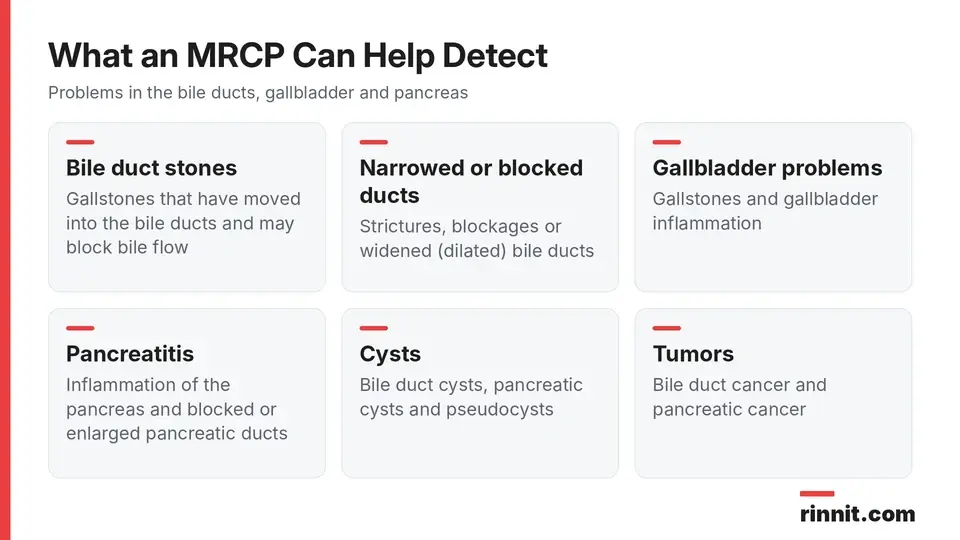
MRCP can show problems in the bile ducts, gallbladder and pancreas.
Area | Conditions MRCP can help diagnose |
Bile ducts | Bile duct stones, bile duct cysts, narrowed (strictured) or blocked ducts, widened (dilated) ducts, bile duct cancer |
Gallbladder | Gallstones, gallbladder inflammation (cholecystitis) |
Pancreas | Blocked or enlarged pancreatic ducts, pancreatitis, pancreatic cysts and pseudocysts, pancreatic cancer |
Sources: [1]
Who performs an MRCP?
A radiology technologist usually runs the scanner, and a radiologist, a doctor trained to read medical images, interprets the pictures. MRCP is an outpatient test, so you go home the same day. It is done in a hospital or imaging clinic. [1]
What types of MRI scanners are used?
How do I prepare for an MRCP?
Your care team will give you specific instructions. Common steps include: [1]
Fasting: you may be asked not to eat or drink for a period before the scan
Metal implants: tell your provider about any implanted devices, such as a pacemaker, cochlear implant or joint replacement
Metal objects: remove jewelry, piercings, hearing aids, dentures and anything else containing metal
Medicines and supplements: you may need to pause NSAIDs, vitamins or herbal supplements beforehand
Allergies: mention hay fever, asthma, food allergies or hives, which slightly raise the chance of a reaction to contrast dye
Anxiety: ask about a sedative if you feel nervous in enclosed spaces, and arrange for someone to drive you home if you take one
What happens during an MRCP?

What to expect on the day of your MRCP scan.
The scan follows a set routine: [1]
You get earplugs or headphones, because the scanner makes loud knocking and buzzing sounds.
You lie on your back on the exam table; straps or cushions may help you stay in position.
The technologist places coils on your body, which send and receive radio waves.
The contrast dye goes in through an IV line, and you may feel a brief cool sensation.
The table slides into the scanner, or you stay on the table of an open scanner.
The technologist steps into the next room but can see you through a window and talk with you over an intercom.
The scanner takes a series of images. You may feel slightly warm, and you need to keep still and hold your breath when asked.
How long does an MRCP take?
The MRCP part of the scan takes about 15 minutes. If your provider also orders a standard MRI of the abdomen, the visit may take about 30 minutes longer. [1]
What happens after an MRCP?
Once your vital signs are stable and any sedative has worn off, you can go home, ideally with someone else driving. Most people go back to their usual diet and activities right away. Let your provider know if you develop nausea, a headache or any signs of an allergic reaction. [1]
What are the benefits and risks of MRCP?
The main benefit is a detailed view of your bile ducts and pancreas without radiation or an invasive procedure. Risks are low, but they include: [1]
Allergic reaction to contrast: reactions are rare, though they can occasionally be severe; MRCP uses gadolinium-based dye, which is less likely to cause reactions than the iodine-based dye used in some X-ray tests [1]
Claustrophobia: about 1 in 8 people feel uncomfortable in enclosed spaces; a sedative or an open scanner can help [1]
Who should not have an MRCP?
MRCP may not be right for everyone. People with kidney disease or kidney failure may not be good candidates, because the kidneys clear the contrast dye from the body, and small amounts of the metal can stay in the body for months or years, although most people have no side effects. If you are or might be pregnant, tell your provider. MRI without contrast dye can usually be done in pregnancy when needed, but gadolinium dye is generally avoided. [1]
When will I get my MRCP results?
A radiologist reviews your images and sends a report to the provider who ordered the scan. It can take one to two weeks for the results to reach your provider, who will then go over them with you. Depending on what the scan shows, you may need further treatment, a procedure or surgery. [1]
When should I call my provider after an MRCP?
Contact your provider if you notice hives or other allergy symptoms after the scan, or if your belly pain gets worse. [1]
What is the difference between MRCP and ERCP?
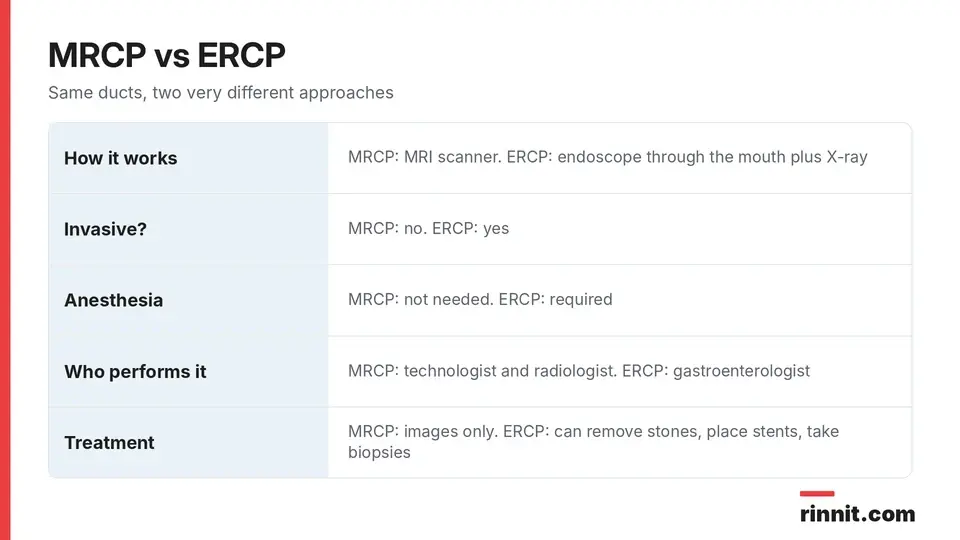
MRCP and ERCP look at the same ducts in very different ways.
Both tests evaluate the same bile duct and pancreas conditions, but they work very differently. [1]
Feature | MRCP | ERCP |
How it works | MRI scanner with magnets, radio waves and IV contrast | Endoscope passed through the mouth to the small intestine, with dye injected into the ducts and real-time X-ray (fluoroscopy) |
Invasive? | No | Yes |
Anesthesia | Not needed (optional sedative for anxiety) | Required |
Who performs it | Technologist runs it; radiologist reads it | Gastroenterologist |
Can it treat problems? | No, it only takes images | Yes, it can remove stones, place stents and take biopsies |
Sources: [1]
Because MRCP is non-invasive, it is often used to look for a problem first, while ERCP is used when a problem may need treatment during the same procedure. [1]
Conclusion
MRCP gives your care team a clear, radiation-free look at your bile ducts, gallbladder and pancreas. It is a relatively low-risk test that helps find gallstones, blocked ducts, pancreatitis, cysts and tumors, and different scanner types can make the experience more comfortable.
Before your scan, tell your provider about any metal implants, allergies, kidney problems or pregnancy, and ask what the results mean for your next steps.
Keep learning: Read our ERCP guide or our MRI guide. For more background, see RadiologyInfo on MRCP.
FAQ
What does MRCP stand for?
Magnetic resonance cholangiopancreatography, an MRI scan of the bile ducts, gallbladder and pancreas.
Why would a doctor order an MRCP?
Most often to find the cause of unexplained belly pain or to check for gallstones, blocked bile ducts, pancreatitis, cysts or tumors.
How long does an MRCP take?
The MRCP scans take about 15 minutes, and a standard abdominal MRI can add about 30 minutes.
Do I need to fast before an MRCP?
You may be asked not to eat or drink for a while beforehand, so follow your care team's instructions.
Is MRCP done with contrast?
Not always; the fluid in the ducts shows up on its own, and a gadolinium-based dye is sometimes added to look at nearby organs.
Does an MRCP use radiation?
No. It uses a magnetic field and radio waves rather than X-rays.
Is an MRCP painful?
No. You may feel a brief coolness from the dye and some warmth during scanning, and you need to lie still.
Can MRCP detect pancreatic cancer?
Yes, MRCP can help show pancreatic cancer, as well as bile duct cancer and pancreatic cysts.
What is the difference between MRCP and ERCP?
MRCP is a non-invasive scan that only takes pictures, while ERCP uses an endoscope and can also remove stones or place stents.
How long do MRCP results take?
Results may take one to two weeks to reach your provider, who will review them with you.
Related Reading
Choledocholithiasis: What a Bile Duct Gallstone Is, How It's Found, and How It's Removed explains bile duct stones, one of the most common findings on MRCP.
Cholangitis: What It Is, Why It Happens, and When It's an Emergency covers the bile duct infection that can follow a blocked duct seen on imaging.
Primary Sclerosing Cholangitis (PSC): Complete Guide to Symptoms, Causes, Diagnosis, and Treatment describes a condition that causes narrowed bile ducts, often diagnosed and monitored with MRCP.
Pancreatitis: Symptoms, Causes, and Treatment — A Clear Guide to Understanding and Managing the Condition explains pancreatic inflammation that MRCP can help evaluate.
Cholangiocarcinoma (Bile Duct Cancer): Symptoms, Causes, and Treatment covers a cancer that can show up as a narrowed or blocked duct on MRCP.
Pancreatic Cancer: Symptoms, Causes, and Treatment — A Clear Guide for Patients and Families describes a cancer MRCP can help detect.
References
Cleveland Clinic. Magnetic Resonance Cholangiopancreatography (MRCP). Cleveland Clinic. Last updated November 17, 2022. https://my.clevelandclinic.org/health/diagnostics/24457-magnetic-resonance-cholangiopancreatography-mrcp
Giljaca V, Gurusamy KS, Takwoingi Y, et al. Endoscopic ultrasound versus magnetic resonance cholangiopancreatography for common bile duct stones. Cochrane Database Syst Rev. 2015;2015(2):CD011549. PMID 25719224. https://doi.org/10.1002/14651858.CD011549
Afzalpurkar S, Giri S, Kasturi S, et al. Magnetic resonance cholangiopancreatography versus endoscopic ultrasound for diagnosis of choledocholithiasis: an updated systematic review and meta-analysis. Surg Endosc. 2023;37(4):2566-2573. PMID 36344899. https://doi.org/10.1007/s00464-022-09744-3
Satiya J, Mousa OY, Gupta K, et al. Diagnostic yield of magnetic resonance imaging for cholangiocarcinoma in primary sclerosing cholangitis: a meta-analysis. Clin Exp Hepatol. 2020;6(1):35-41. PMID 32166122. https://doi.org/10.5114/ceh.2020.93054
Medical disclaimer
This article is for general education only and does not replace advice from a qualified healthcare professional. Talk to your doctor about your own diagnosis and treatment, and seek emergency care right away for severe or sudden symptoms.



Comments