Cholangitis: What It Is, Why It Happens, and When It's an Emergency

Updated: 3 days ago
Medically reviewed by Dr. Baraa Alnahhal, MD · Last reviewed: October 2026
Quick Answer
Cholangitis is inflammation of the bile ducts, which become irritated, swollen and possibly infected. The acute form is usually caused by a blockage such as a gallstone followed by infection, and it is an emergency because infection can become life-threatening. Key symptoms are upper right belly pain, fever and jaundice. Treatment includes endoscopic biliary drainage and antibiotics.
What the research says
According to PubMed:
Early drainage may improve survival. In a Danish study of 166 patients with acute cholangitis who had ERCP, 30-day mortality was 8% among those who had the procedure within 24 hours of hospitalization versus 19% among those treated later; after adjusting for other factors, early ERCP was associated with lower 30-day mortality (odds ratio 0.23, 95% CI 0.05–0.95) (Tan et al., Gastrointest Endosc, 2018 [1]).
Severity grading helps decide who needs drainage urgently. A systematic review underlying the Tokyo Guidelines 2018 found that 30-day mortality was significantly lower with early or urgent biliary drainage in patients with Grade II (moderate) acute cholangitis, with no difference for Grade I or Grade III, and that the diagnostic and severity criteria are quick, minimally invasive, and inexpensive (Kiriyama et al., J Hepatobiliary Pancreat Sci, 2018 [2]).
Bacterial infection is the most common cause of acute cholangitis, and imaging guides care. A review of the diagnosis, treatment, and prognosis of cholangitis noted that endoscopic retrograde cholangiography, MRCP, and endoscopic ultrasound serve as both diagnostic and therapeutic tools, that biliary drainage is necessary to control progression, and that surgery is generally limited to people in whom other approaches have failed (Mohammad Alizadeh, J Clin Transl Hepatol, 2017 [3]).
Study details are from PubMed abstracts.
What Is Cholangitis?
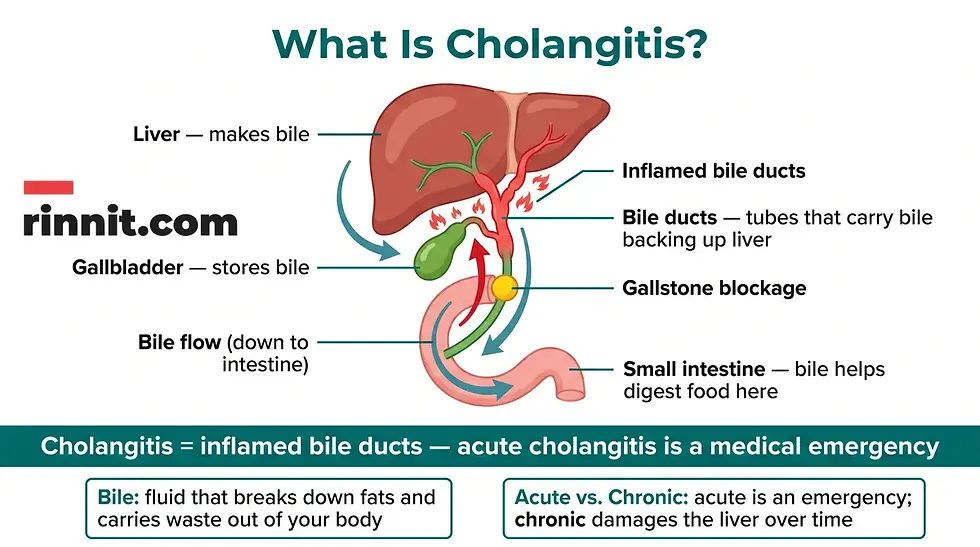
Cholangitis means inflammation in your bile ducts — the tubes that carry bile from your liver to other organs in your digestive system.
Your liver makes bile and sends it to your gallbladder for storage. From there, bile travels to your small intestine to help with digestion. Bile is made up of waste products from your blood and bile acids that help break down fats. It helps digest food in your small intestine and carries waste products out of your body through your large intestine.
If your bile ducts are inflamed, they're irritated, swollen and possibly infected. Infection is the most common cause of cholangitis, but not the only cause.
Key terms at a glance: Bile is the fluid that breaks down fats and carries waste out of your body. The gallbladder stores bile. The bile ducts are the tubes that carry it. Inflammation means the tissue is irritated and swollen.
Type | What It Means |
|---|---|
Acute cholangitis (ascending cholangitis) | A temporary immune response, usually from infection or a blockage like a gallstone — this is an emergency |
Chronic cholangitis | Inflammation that doesn't go away, usually from chronic diseases — damaging to your liver over time |
What Happens When You Have Cholangitis?
Inflammation in your bile ducts can set off a chain of serious complications. Understanding this chain helps explain why cholangitis needs prompt treatment.
The chain typically works like this: swelling obstructs the flow of bile, causing bile to back up into your organs. Backed-up bile then causes inflammation in those organs. Because bile that doesn't flow is a breeding ground for bacteria, an infection can take hold — and an infection in your bile ducts can spread to your bloodstream, which is life-threatening. If the inflammation is chronic, it causes scarring. Scar tissue in your bile ducts can corrode them, and narrowed, corroded ducts permanently obstruct bile flow.
Is Cholangitis Life-Threatening?
Cholangitis can be life-threatening, most immediately when a bacterial bile duct infection spreads and causes sepsis, while chronic cholangitis can eventually lead to liver failure. Different types are dangerous in different ways. The most immediate threat comes from a bacterial infection in your bile ducts. If the bacteria spreads to your liver, it could enter your bloodstream through the blood vessels in your liver. This would cause a systemic infection (septicemia), which could lead to sepsis — a whole-body shock reaction that shuts down your vital organs.
Sometimes acute inflammation is caused by a blockage in your bile ducts, like a gallstone. The blockage causes bile flow to stall (cholestasis), and this can lead to secondary infection. If you have chronic cholangitis, it can slowly destroy your bile ducts over many years. This affects your liver. When chronic inflammation causes scarring in your liver, it slowly stops functioning. Liver failure is life-threatening.
What's the Difference Between Cholangitis and Cholecystitis?
Cholangitis and cholecystitis look and sound similar because they both begin with the prefix "chole-," which means bile. ("Gall-" also means bile, so gallbladder actually means bile bladder.) The suffix "-itis" means inflammation.
Condition | What's Inflamed |
|---|---|
Cholangitis | Your bile ducts |
Cholecystitis | Your gallbladder |
Bile flows through your bile ducts to and from your gallbladder, and inflammation in one can affect the other.
What Causes Cholangitis?
Acute causes include infection from bacteria, a virus, or parasite; blockages such as gallstones, strictures, and tumors; and cholestasis (stalled bile flow).
In most cases — about 90% — these three factors work together. A blockage, usually a gallstone in the common bile duct (a condition called choledocholithiasis), causes bile flow to stall, and infection follows. Bile is supposed to flow one way into your gallbladder, and from there, into your small intestine. But internal pressure from stalled bile can cause bacteria to backwash into the bile ducts from these organs.
That said, each factor can act alone. A blockage can cause cholestasis and cholangitis without a bacterial infection. You can have cholestasis without a blockage — certain diseases, medications, or long-term IV feeding can cause it. And you can get an infection without a blockage, though it's less likely — it could come through your blood or from a medical instrument introduced during a test or procedure.
Acute Cause | How It Leads to Cholangitis |
|---|---|
Infection | Bacteria, a virus, or parasite infect the bile ducts |
Blockage (gallstone, stricture, tumor) | Stalls bile flow; about 90% of cases involve this plus stalled flow plus infection working together |
Cholestasis | Stalled bile flow can occur with or without a blockage — from diseases, medications, or long-term IV feeding |
What Causes Chronic Cholangitis?
Autoimmune diseases cause chronic cholangitis. These conditions make your immune system mistakenly attack cells in your body as foreign invaders. The constant immune response causes constant inflammation in your bile ducts. It's usually not as severe as acute cholangitis, and you may not become aware of it for years — but over time, it causes scarring in your bile ducts, which may lead to obstruction, cholestasis, and acute cholangitis.
Autoimmune Disease | Type |
|---|---|
Primary sclerosing cholangitis | Chronic cholangitis |
Primary biliary cholangitis (PBC) | Chronic cholangitis |
IgG4-associated cholangitis | Chronic cholangitis |

What Does Cholangitis Feel Like?
You might not notice chronic cholangitis for years. Many people aren't diagnosed until chronic cholangitis has become advanced enough to affect their livers, causing symptoms of liver disease.
Acute cholangitis will make itself known, though. You'll almost certainly feel pain in your upper right abdomen, which might radiate to your right shoulder blade or back. It may be sharp or dull, and it may come and go.
If your bile ducts are obstructed, you may experience what's known as "biliary colic." This abdominal pain comes in episodes, typically after a heavy meal. It's triggered by your gallbladder contracting to push bile out to your small intestine to help with digestion. Pushing bile against the obstruction causes pressure and pain, often with nausea. It builds quickly to a peak and then gradually wanes after that.
What Are the Symptoms of Cholangitis?
The most common symptoms of acute cholangitis are known as Charcot's Triad. They include upper right quadrant abdominal pain (the upper right is where your biliary system is located), fever (which typically accompanies inflammation when your immune system is activated), and jaundice — the yellow tint to your skin and eyes that comes from bile leaking into your bloodstream, a sign that your bile ducts are backed up.
Symptom | What It Is |
|---|---|
Upper right abdominal pain | May radiate to the right shoulder blade or back; sharp or dull; can come and go |
Fever | Accompanies inflammation when the immune system activates |
Jaundice | Yellow tint to skin and eyes from bile leaking into the bloodstream |
Depending on how severe your condition is, you might have other symptoms related to backed-up bile leaking into your bloodstream:
Symptom | What Causes It |
|---|---|
Pruritus (skin itching) | Bile acids in your bloodstream |
Hepatic encephalopathy | Toxins from bile in your bloodstream cause mild cognitive impairment, such as confusion and disorientation |
Fast heart rate (tachycardia) | A sign the infection has entered your bloodstream and shock is developing |
Low blood pressure (hypotension) | A sign the infection has entered your bloodstream and shock is developing |
If you have Charcot's Triad of symptoms plus signs of confusion and signs of shock, it's known as Reynolds' pentad. This combination signifies to your healthcare provider that your condition is critical.
If you have chronic cholangitis, you may not have symptoms until your condition is advanced. Symptoms may include all of the above, as well as:
Chronic Symptom | Description |
|---|---|
Fatigue | Ongoing tiredness |
Swollen abdomen | Fluid or organ enlargement in the belly |
Swollen legs and feet | Fluid pooling in the lower body |
Fat deposits under the skin | Fatty deposits visible beneath the skin |
Large, visible veins across the abdomen | Enlarged surface veins |
Spider veins | Small, branching veins on the skin |
Dark-colored pee and light-colored poop | Changes from backed-up bile |
Diarrhea | Digestive upset |
How Is Cholangitis Diagnosed?
Your healthcare provider will examine you for typical symptoms, then take blood tests and imaging tests of your biliary system. Blood tests can identify an infection if you have one and tell your provider how much bile is circulating in your bloodstream. They can also measure liver enzymes and proteins to check how your liver is doing. Imaging tests can show whether your bile ducts are obstructed, and where.
Test Type | Tests | What They Check |
|---|---|---|
Blood tests | Complete blood count (CBC); liver function tests | Infection, bile in the bloodstream, liver enzymes and proteins |
Imaging tests | MRCP (magnetic resonance cholangiopancreatography); abdominal ultrasound | Whether bile ducts are obstructed, and where |
How Is Cholangitis Treated?
The primary treatment for both acute and chronic cholangitis is endoscopic biliary drainage. This mainly applies to acute cholangitis and to blocked or narrowed ducts in chronic cholangitis; chronic forms such as primary biliary cholangitis are mainly treated with medicines such as ursodiol. Once your healthcare provider has identified the source of the problem, they'll work to relieve pressure and restore flow through your bile ducts. They can usually do this during an endoscopy — a procedure that involves passing a long, thin tube with a camera attached down your throat and into your bile ducts.
Providers can drain excess bile through the tube to relieve pressure. If necessary, they can also remove blockages and place stents to prop open the bile ducts, using tiny tools passed through the tube. If you have an endoscopic procedure to diagnose cholangitis, your provider can treat it at the same time. If you have chronic cholangitis, you might need repeat procedures to relieve symptoms from time to time.
Treatment | Used For | What It Does |
|---|---|---|
Endoscopic biliary drainage | Acute and chronic (primary treatment) | Drains excess bile, removes blockages, and places stents to prop open the ducts |
IV fluids | Acute | Supports hydration and circulation |
Pain relief | Acute | Eases abdominal pain |
Antibiotics | Acute | Fights the infection |
Antihistamines | Chronic | Treat itching |
Vitamin supplements | Chronic | Treat vitamin deficiencies |
Ursodeoxycholic acid (UDCA) | Chronic | Slows progression of primary biliary cholangitis |
How Do I Take Care of Myself While Living With Chronic Cholangitis?
If you have chronic biliary disease, it's important to take care of your liver in the ways that you can. A healthy diet and lifestyle can minimize the damage and help extend the life of your liver.
Try to avoid toxins that stress your liver, including alcohol, drugs, smoke, and other environmental chemicals. Try to minimize saturated fats and sugar in your diet. Get some exercise and reduce stress as much as possible.

What Is the Outlook for People With Cholangitis?
Whether you have acute or chronic cholangitis, it's a scary position to be in. Both can be life-threatening, either sooner or later. But acute cholangitis is usually brief. With timely treatment, most people recover completely. Without treatment, acute cholangitis has a high mortality rate.
If you have chronic cholangitis, you may live without complications for years. Medications are often effective in treating symptoms. You may need periodic biliary drainage procedures. In some people, liver disease can progress to liver failure. If this happens, you might eventually need a liver transplant.
What is the bottom line on cholangitis?
Cholangitis is inflammation of the bile ducts — the tubes that carry digestive fluid from your liver to your gut. The acute form is usually triggered when a blockage (most often a gallstone) stalls bile flow and infection follows, and it is a medical emergency: Charcot's Triad of upper right belly pain, fever, and jaundice means you need treatment right away. The main fix is endoscopic biliary drainage, which relieves pressure and restores flow, plus antibiotics, IV fluids, and pain relief. With timely treatment, most people recover completely — but without it, acute cholangitis is highly dangerous. Chronic cholangitis, driven by autoimmune disease, needs long-term care: medications, periodic drainage, and a liver-protective lifestyle, and in some cases eventually a liver transplant.
Frequently Asked Questions
What is cholangitis?
Cholangitis is inflammation in your bile ducts — the tubes that carry bile from your liver to other organs in your digestive system. The ducts become irritated, swollen, and possibly infected.
Is cholangitis an emergency?
Acute cholangitis is an emergency. It's usually caused by an infection or a blockage such as a gallstone, and the infection can spread to the bloodstream and become life-threatening.
What are the most common symptoms?
The three most common symptoms of acute cholangitis are called Charcot's Triad: upper right abdominal pain, fever, and jaundice (yellow tint to the skin and eyes).
What is Charcot's Triad?
Charcot's Triad is the classic set of three symptoms of acute cholangitis: upper right quadrant abdominal pain, fever, and jaundice. Jaundice is a sign your bile ducts are backed up and bile is leaking into your bloodstream.
What is Reynolds' pentad?
Reynolds' pentad is Charcot's Triad plus signs of confusion and signs of shock (fast heart rate and low blood pressure). This combination tells your provider your condition is critical.
What causes acute cholangitis?
In most cases (about 90%), a blockage — usually a gallstone in the common bile duct — stalls bile flow, and infection from bacteria, a virus, or a parasite follows.
Can you get cholangitis without a blockage?
Yes, though it's less likely. An infection can come through your blood or from a medical instrument introduced during a test or procedure.
What causes chronic cholangitis?
Autoimmune diseases — primary sclerosing cholangitis, primary biliary cholangitis, and IgG4-associated cholangitis — cause your immune system to mistakenly attack your body's own cells, creating constant inflammation in the bile ducts.
What is the difference between cholangitis and cholecystitis?
Cholangitis is inflammation in the bile ducts; cholecystitis is inflammation in the gallbladder. Both involve "chole-" (bile) plus "-itis" (inflammation), and because bile flows between the two, inflammation in one can affect the other.
What does biliary colic feel like?
Biliary colic is abdominal pain in episodes, typically after a heavy meal, when your gallbladder contracts to push bile out and presses it against an obstruction. The pain builds quickly to a peak and then gradually wanes, often with nausea.
Can cholangitis cause itching?
Yes. Bile acids in your bloodstream can cause pruritus — skin itching.
Can cholangitis affect your thinking?
Yes. Hepatic encephalopathy can occur when toxins from backed-up bile in your bloodstream cause mild cognitive impairment, such as confusion and disorientation.
How is cholangitis diagnosed?
Your provider examines you for typical symptoms, then orders blood tests (complete blood count, liver function tests) and imaging tests (MRCP or abdominal ultrasound) to identify infection and locate any blockage.
How is cholangitis treated?
The primary treatment for both acute and chronic cholangitis is endoscopic biliary drainage — a tube with a camera is passed down your throat to drain bile, remove blockages, and place stents. Chronic forms such as primary biliary cholangitis are mainly treated long term with medicines such as ursodiol. Acute cases also get IV fluids, pain relief, and antibiotics.
What are stents for?
Stents prop open narrowed bile ducts. Providers place them using tiny tools passed through the endoscopy tube.
Do I need more than one treatment for chronic cholangitis?
You may. Chronic cholangitis can require repeat drainage procedures from time to time, plus medications like antihistamines for itching, vitamin supplements, and ursodeoxycholic acid (UDCA) to slow primary biliary cholangitis.
What is the outlook after acute cholangitis?
Acute cholangitis is usually brief, and with timely treatment most people recover completely. Without treatment, acute cholangitis has a high mortality rate.
Can chronic cholangitis lead to liver failure?
Yes. It can slowly destroy your bile ducts over many years, causing scarring that eventually stops the liver from functioning. If that happens, you might eventually need a liver transplant.
How can I take care of my liver with chronic cholangitis?
Avoid liver-stressing toxins like alcohol, drugs, smoke, and environmental chemicals; minimize saturated fats and sugar; exercise; and reduce stress as much as possible.
When should I seek care for biliary pain?
Right away. Bile only works when it can flow freely — when it can't, it leaks into your bloodstream and backs up into your organs. If you have biliary pain and suspect cholangitis, earlier treatment has the best results.
Related Reading
ERCP (Endoscopic Retrograde Cholangiopancreatography): Why It's Done, What Happens and Risks explains the endoscopic procedure used to diagnose and treat bile duct problems.
MRCP (Magnetic Resonance Cholangiopancreatography): Purpose, Preparation and What to Expect explains the MRI scan used to image the bile and pancreatic ducts.
References
Tan M, Schaffalitzky de Muckadell OB, Laursen SB. Association between early ERCP and mortality in patients with acute cholangitis. Gastrointest Endosc. 2018;87(1):185-192 (published online April 20, 2017). PMID 28433613. https://doi.org/10.1016/j.gie.2017.04.009
Kiriyama S, Kozaka K, Takada T, et al. Tokyo Guidelines 2018: diagnostic criteria and severity grading of acute cholangitis (with videos). J Hepatobiliary Pancreat Sci. 2018;25(1):17-30. PMID 29032610. https://doi.org/10.1002/jhbp.512
Mohammad Alizadeh AH. Cholangitis: diagnosis, treatment and prognosis. J Clin Transl Hepatol. 2017;5(4):404-413 (published online September 7, 2017). PMID 29226107. https://doi.org/10.14218/JCTH.2017.00028
Cleveland Clinic. Cholangitis. Cleveland Clinic. Last updated December 11, 2023. https://my.clevelandclinic.org/health/diseases/cholangitis
Medical disclaimer
This article is for general informational purposes only and does not constitute medical advice, diagnosis, or treatment. Always seek the guidance of a physician or other qualified health provider with any questions you have about a medical condition. Never disregard professional medical advice or delay seeking it because of something you read here. Acute cholangitis is a medical emergency: if you have upper right abdominal pain, fever, jaundice, confusion, or signs of shock (fast heart rate or low blood pressure), seek emergency medical care immediately or call your local emergency number (in the U.S., 911).



Comments