Choledocholithiasis: What a Bile Duct Gallstone Is, How It's Found, and How It's Removed

Updated: 3 days ago
Medically reviewed by Dr. Baraa Alnahhal, MD · Last reviewed: October 2026
Quick Answer
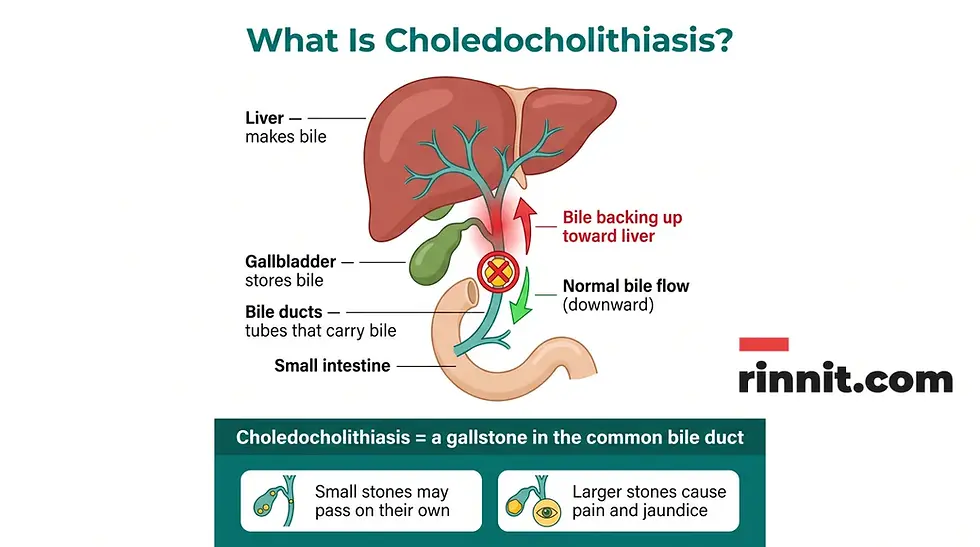
Choledocholithiasis is having one or more gallstones in the common bile duct, usually stones that formed in the gallbladder and traveled there. [4] [7] Symptoms include upper right abdominal pain after meals, nausea, vomiting and jaundice. [4] [6] Because a blockage can cause infection and life-threatening complications, stones are removed promptly, usually during an ERCP, often followed by gallbladder removal. [4]
What the research says
According to PubMed:
Removing the gallbladder after the duct is cleared lowers repeat biliary problems. A meta-analysis of 13 studies (2,598 patients, mostly observational) found that cholecystectomy after ERCP stone clearance was linked to lower odds of cholecystitis (OR 0.15; 95% CI 0.07–0.36) and death (OR 0.38; 95% CI 0.16–0.9), with a borderline reduction in cholangitis (OR 0.51; 95% CI 0.26–1.00) compared with leaving the gallbladder in place (Mc Geehan et al., Eur J Trauma Emerg Surg, 2023) [1].
Endoscopic ultrasound finds duct stones slightly better than MRCP. Across 12 studies, pooled sensitivity was 96% for endoscopic ultrasound versus 85% for MRCP, while specificity was similar (92% versus 90%) (Afzalpurkar et al., Surg Endosc, 2023) [2].
Endoscopic sphincterotomy clears the duct in about 9 of 10 patients, and timing affects complications. In 5 randomized trials (629 patients), duct clearance was 93% when sphincterotomy was done during gallbladder surgery versus 92% when done before it, but post-procedure pancreatitis was 0.6% versus 4.4% (Tan et al., Surg Endosc, 2018) [3].
What Is Choledocholithiasis?
Choledocholithiasis is the condition of having a gallstone (or stones) in your common bile duct. That is the duct that carries bile from your gallbladder. [4] The word comes from Latin: "choledocho" is the term for the common bile duct, and "lithiasis" means stones. [4]
Gallstones are pebble-like pieces of concentrated bile materials. [4] They can develop in any place bile flows through. [4]
Key terms at a glance: The common bile duct carries bile from the gallbladder toward the small intestine. A gallstone is a pebble-like piece of hardened bile material. Bile is the digestive fluid made by your liver that breaks down fats and carries waste out of your body.
Gallstones may develop in your gallbladder, your bile ducts, or both. [4] A gallstone that develops in your gallbladder may also travel to your common bile duct. [4]
Is Choledocholithiasis an Emergency?
A gallstone — or several — in your common bile duct is not necessarily an emergency, but it is a risk. However, belly pain with fever, chills, or yellowing of the skin or eyes can mean a blocked, infected bile duct (cholangitis), which needs emergency care right away. Smaller gallstones may pass safely through your common bile duct to your intestines and out of your body. [4] [8] The risk is that they will become stuck there and grow large enough over time to cause a blockage. [4]
Because of this risk, healthcare providers prefer to treat common bile duct stones immediately when they find them. [4] They will recommend an endoscopic procedure to examine and, most likely, remove the stones. That means a gastroenterologist will access your bile ducts via a catheter passed down your throat. [4]
What Can Choledocholithiasis Lead To?
If a gallstone stays in your common bile duct and grows large enough to block the flow of bile through the duct, it endangers your entire biliary system — the network of organs and vessels that bile travels through. A blockage can cause inflammation, infection, and life-threatening complications.

What are the possible complications?
A gallstone that blocks your common bile duct will cause bile to back up behind the blockage. This can affect all of your ducts and organs connected to it, including your gallbladder, pancreas, and liver. It causes inflammation, breeds infection, and can lead to long-term tissue damage.
Complication | What happens |
Infection | A blocked bile duct is an easy breeding ground for bacteria; infection can spread to your liver and bloodstream — a bloodstream infection (septicemia) can lead to life-threatening sepsis [4] |
Cholangitis | |
Cholecystitis | Bile backing up into your gallbladder causes it to swell; it is painful, stops the gallbladder functioning well, and eventually damages the organ; the most common cause of gallbladder disease |
Gallstone pancreatitis | Your bile ducts share the same exit channel into your intestines as your pancreas; stones blocking this channel also block pancreatic secretions — potent enzymes back up into your pancreas, causing severe inflammation; gallstones are the most common cause of non-alcohol-related pancreatitis [4] |
How Common Is Choledocholithiasis?
About 10% of people have gallstones, but most of them form in their gallbladder. [4] About 15% of people with gallstones have them in their common bile duct. [4] [6] Gallstones will never bother most people — only 20% of people with gallstones will have complications that require treatment. [4]
What Causes Choledocholithiasis?
Your liver makes bile out of materials it filters from your blood. [4] These materials include cholesterol, bilirubin, bile salts, and lecithin. [4] Gallstones occur when there is too much of one of these — usually cholesterol, but sometimes bilirubin — and the excess materials turn into a kind of sediment. [4]
The sediment collects at the bottom of your gallbladder or your common bile duct and eventually hardens. The stones gradually grow as sediment continues to wash over them. This takes many years. [4] Most gallstones form in your gallbladder and travel with the flow of bile into your common bile duct. [4] [7]
Step | What happens |
1. Imbalance | Too much of a bile ingredient — usually cholesterol, sometimes bilirubin |
2. Sediment | Excess material turns into sediment |
3. Collection | Sediment collects at the bottom of the gallbladder or common bile duct |
4. Hardening | Sediment hardens into a pebble-like stone over many years |
5. Travel | Most stones form in the gallbladder and travel with bile flow into the common bile duct |
What Risk Factors Are Associated With Choledocholithiasis?

You may be more likely to get a gallstone in your common bile duct if you have chronic cholangitis — choledocholithiasis is a major cause of cholangitis, but it can also work the other way around. If you have inflammation in your bile ducts from another cause, it may cause bile to slow and stall in your bile ducts, leading to sedimentation and gallstones. [4] You are also at higher risk if you have had gallstones before — people who have had them before are more likely to have them again. [4] Even if you have had your gallbladder removed to treat gallstones, rarely you may still develop new stones in your bile ducts. [4] [6]
You may be more likely to have gallstones in general if you have high cholesterol — most (about 75%) of gallstones are made mainly of cholesterol, which forms when bile holds more cholesterol than it can dissolve. [4] Other bile ingredients (bile salts and lecithin) are supposed to help emulsify the cholesterol, but if there is an imbalance between them, this does not work. You are also at higher risk if you have female hormones — estrogen increases cholesterol, and progesterone slows gallbladder contractions, which increases sedimentation. [4] [5] Both hormones are higher during certain periods in female reproductive life, and hormone replacement therapy can also elevate them. [4]
Risk factor | Why it raises your risk |
Chronic cholangitis | Slow, stalled bile leads to sedimentation and gallstones in the ducts |
Previous gallstones | Stones tend to recur; rarely, new stones form even after gallbladder removal |
High cholesterol | About 75% of gallstones are cholesterol stones, formed when bile carries too much cholesterol [4] |
Female hormones |
What Are the Symptoms of Choledocholithiasis?
Choledocholithiasis may cause no symptoms at all, but a stone blocking the common bile duct first causes the symptoms of biliary colic. Unless your gallstones cause a blockage, you may never even know they are there. If you do have symptoms, it means that a stone is blocking your common bile duct. The first sign of a blockage will be the symptoms of biliary colic. [4] These can include:
Symptom | What it is like |
Abdominal pain | Occurs in episodes lasting one to several hours, usually after a meal; grows for the first 20 minutes, then gradually declines; felt in the upper right abdomen; may radiate to the right side or shoulder blade [4] |
Nausea and vomiting | Often accompany biliary colic; vomiting does not relieve the pain (unlike with migraines); milder cases may only have a general lack of appetite [4] |
Jaundice | Backed-up bile leaking into the bloodstream shows as a yellow tint to the skin or whites of the eyes; may darken urine; comes and goes like biliary colic but keeps returning until the blockage is cleared [4] |
Fever | Severe inflammation may cause fever; it may also signal infection — when bile ducts are blocked, bacteria are not flushed out as usual [4] |
How Is Choledocholithiasis Diagnosed?
Gallstones in your bile duct usually are not discovered unless they cause symptoms. If you seek healthcare for symptoms of biliary colic or jaundice, your healthcare provider will investigate with blood tests and imaging tests. Blood tests will show the buildup of bile, and imaging will find the blockage. [4]
Test type | What it checks |
Blood tests — complete blood count (CBC), bilirubin test, pancreas function tests, liver function tests | |
Abdominal ultrasound — a noninvasive first test | Reveals gallstones in the gallbladder; shows if the common bile duct is dilated (indicating blockage); may show shadowing at the blockage [4] |
Endoscopic ultrasound — ultrasound combined with upper endoscopy | A clearer picture of the bile ducts using sound waves from an ultrasound probe at the end of a camera tube [4] |
MRCP — a type of MRI that visualizes the bile ducts | Very clear, noninvasive images of the biliary system, including the common bile duct [4] |
ERCP — an endoscopic procedure combining X-rays and endoscopy | Finds gallstones and can remove them at the same time; dye injected into the ducts is tracked with video X-rays (fluoroscopy) [4] |
How Are Gallstones in the Common Bile Duct Removed?
They are usually removed during an ERCP exam. Doctors can attach special tools to the endoscope to break up and remove the stones when they find them. [4] Sometimes, they make a surgical cut into the muscle of the duct to open it up and allow stones to pass. This is called a sphincterotomy. [4] [6]
Does Choledocholithiasis Require Surgery?
The endoscopic procedure (ERCP) does not require cutting into your abdomen to access the bile ducts. [4] However, after removing gallstones from your bile ducts, doctors often recommend surgery to remove your gallbladder. This is to prevent more gallstones from exiting your gallbladder and causing choledocholithiasis again. [4] [8]
Treatment step | What it does |
ERCP with stone removal | Endoscopic procedure that finds and removes the stones using special tools; the primary treatment |
Sphincterotomy | A small surgical cut into the duct muscle to open it and let stones pass, done during ERCP |
Antibiotics | Treat infection before stones can be removed [4] |
Biliary drainage | Removes backed-up bile before stones can be removed [4] |
Gallbladder removal | Prevents more gallstones from exiting the gallbladder and causing the problem again |
What are the complications of the treatment?
Short-term complications of endoscopic gallstone removal may include bleeding, infection, and pancreatitis. [4] [7] Long-term complications may include gallstone recurrence — even after removing all the gallstones in your bile ducts, it is possible for new ones to form there later, since people who have had them are more likely to get them again — and bile duct fibrosis, where cutting into your bile duct can cause scarring that narrows the passageway (biliary stricture), a different kind of obstruction that may require another procedure. [4] [7]
What Is the Outlook After Treatment?
Treatment is simple and effective for most people. [4] If you are among the few who have complications afterward, these complications are also treatable. [4] Between 5% and 25% of people may develop new gallstones in their bile ducts within 10 to 20 years. [4] The risk is less if you have your gallbladder removed. [4]
Can Choledocholithiasis Be Prevented?
As cholesterol gallstones are the most common type, you may be able to reduce your risk by reducing cholesterol in your blood through dietary and lifestyle changes. [4] Healthcare providers also recommend that you avoid "yo-yo" dieting and lose weight gradually. Losing too quickly can encourage gallstones. [4]
What is the bottom line on choledocholithiasis?
Choledocholithiasis is a gallstone — or stones — lodged in the common bile duct, the tube that carries bile from your gallbladder. Stones form over years when excess cholesterol or bilirubin hardens into sediment, most often in the gallbladder before traveling into the duct. A tiny stone may pass harmlessly, but a stone that blocks the duct causes biliary colic and jaundice and can lead to serious complications including infection, cholangitis, cholecystitis, and gallstone pancreatitis. Because the risk only grows, providers usually remove duct stones promptly — most often during an ERCP, a tube-through-the-throat procedure that finds and removes the stones, sometimes with a small cut in the duct muscle. Afterward, removing the gallbladder is commonly recommended to stop new stones from forming and traveling. Treatment is simple and effective for most people, and the outlook is good — especially if you take biliary pain seriously and seek care early.
Frequently Asked Questions
What is choledocholithiasis?
Choledocholithiasis is the condition of having a gallstone (or stones) in your common bile duct — the duct that carries bile from your gallbladder.
What is the difference between choledocholithiasis and cholelithiasis?
Choledocholithiasis means gallstones in the common bile duct; cholelithiasis means gallstones in the gallbladder. A gallbladder stone can also travel into the common bile duct.
What are the symptoms?
The first signs of a blockage are biliary colic symptoms: episodes of upper right abdominal pain (usually after a meal), nausea and vomiting that does not relieve the pain, jaundice (yellow skin or eyes), and sometimes fever.
Is choledocholithiasis an emergency?
Choledocholithiasis is not necessarily an emergency, but it is a risk. Because a stone can become stuck and block the duct, providers prefer to treat and remove common bile duct stones promptly when found.
What causes gallstones?
Gallstones form when there is too much of one of the materials in bile — usually cholesterol, sometimes bilirubin. The excess turns into sediment that collects, hardens, and gradually grows into a stone over many years.
Can a bile duct stone pass on its own?
Yes. Smaller gallstones may pass safely through the common bile duct to your intestines and out of your body.
What is biliary colic?
Intermittent pain from gallstones that obstruct your biliary system off and on. With a bile duct stone, it happens when the stone moves in and out of the duct. Pain episodes last one to several hours, usually after a meal.
What complications can a blocked bile duct cause?
Infection (which can spread to the liver and bloodstream, causing septicemia or sepsis), cholangitis (inflammation of the bile duct), cholecystitis (a swollen, damaged gallbladder), and gallstone pancreatitis (pancreatic enzymes backing up into the pancreas).
What is gallstone pancreatitis?
Your bile ducts and pancreas share the same exit channel into the intestines. Stones blocking that channel also block pancreatic secretions, so potent enzymes back up into the pancreas, causing severe inflammation. Gallstones are the most common cause of non-alcohol-related pancreatitis.
How is choledocholithiasis diagnosed?
Blood tests (CBC, bilirubin, liver and pancreas function tests) show the buildup of bile, and imaging tests — abdominal ultrasound, endoscopic ultrasound, MRCP, or ERCP — find the blockage.
What is ERCP?
Endoscopic retrograde cholangiopancreatography — an endoscopic procedure that combines X-rays and endoscopy. A smaller tube is passed into the endoscope to reach the bile ducts, dye is injected and tracked with video X-rays, and stones can be found and removed in the same procedure.
What is MRCP?
Magnetic resonance cholangiopancreatography — a type of MRI that specifically visualizes the bile ducts. It is noninvasive and creates very clear images.
How are bile duct stones removed?
Usually during an ERCP — doctors attach special tools to the endoscope to break up and remove the stones. Sometimes they cut into the duct muscle (sphincterotomy) to let stones pass.
Do I need gallbladder removal surgery?
Often, yes. After removing duct stones, doctors usually recommend gallbladder removal to prevent more gallstones from exiting the gallbladder and causing choledocholithiasis again.
What are the risks of the treatment?
Short-term: bleeding, infection, pancreatitis. Long-term: gallstone recurrence and bile duct fibrosis (scarring that narrows the duct, called biliary stricture).
Can new stones form after treatment?
Yes. Between 5% and 25% of people may develop new gallstones in their bile ducts within 10 to 20 years — the risk is lower if your gallbladder is removed.
Who is at higher risk?
People with chronic cholangitis, previous gallstones, high cholesterol (about 75% of gallstones are cholesterol stones), and female hormones (estrogen raises cholesterol; progesterone slows gallbladder contractions).
Can choledocholithiasis be prevented?
You may reduce your risk by lowering blood cholesterol through dietary and lifestyle changes, avoiding "yo-yo" dieting, and losing weight gradually — losing weight too quickly can encourage gallstones.
What is the outlook?
Treatment is simple and effective for most people, and any complications that do occur are also treatable.
Should I take biliary pain seriously even if it goes away?
Yes. An obstruction in your bile duct will only get worse until it is removed. Always take biliary colic seriously, even if it goes away or is not yet severe.
This article is for general informational purposes only and does not constitute medical advice, diagnosis, or treatment. Always seek the guidance of a physician or other qualified health provider with any questions you have about a medical condition. Never disregard professional medical advice or delay seeking it because of something you read here. A gallstone in your bile duct is a risk that only grows — if you have upper right abdominal pain, jaundice, fever, or signs of infection, seek medical care promptly, or seek emergency care immediately for severe symptoms.
Related Reading
Cholecystectomy (Gallbladder Removal): Surgery, Recovery and Risks explains gallbladder removal surgery, how bile ducts are checked and life without a gallbladder.
ERCP (Endoscopic Retrograde Cholangiopancreatography): Why It's Done, What Happens and Risks explains the endoscopic procedure used to diagnose and treat bile duct problems.
Learn more in our guide to Ultrasound: Types, How It Works, Preparation and Results.
HIDA Scan (Hepatobiliary Scan): Purpose, Preparation, Procedure and Results explains the nuclear scan that checks bile flow through the gallbladder and bile ducts.
MRCP (Magnetic Resonance Cholangiopancreatography): Purpose, Preparation and What to Expect explains the MRI scan used to image the bile and pancreatic ducts.
Learn more in our guide to Endoscopic Ultrasound (EUS): Uses, Procedure, Recovery and Risks.
References
Mc Geehan G, Melly C, O'Connor N, et al. Prophylactic cholecystectomy offers best outcomes following ERCP clearance of common bile duct stones: a meta-analysis. Eur J Trauma Emerg Surg. 2023;49(5):2257-2267 (published online September 2, 2022). PMID 36053288. https://doi.org/10.1007/s00068-022-02070-2
Afzalpurkar S, Giri S, Kasturi S, et al. Magnetic resonance cholangiopancreatography versus endoscopic ultrasound for diagnosis of choledocholithiasis: an updated systematic review and meta-analysis. Surg Endosc. 2023;37(4):2566-2573 (published online November 7, 2022). PMID 36344899. https://doi.org/10.1007/s00464-022-09744-3
Tan C, Ocampo O, Ong R, et al. Comparison of one stage laparoscopic cholecystectomy combined with intra-operative endoscopic sphincterotomy versus two-stage pre-operative endoscopic sphincterotomy followed by laparoscopic cholecystectomy for the management of pre-operatively diagnosed patients with common bile duct stones: a meta-analysis. Surg Endosc. 2018;32(2):770-778 (published online July 21, 2017). PMID 28733744. https://doi.org/10.1007/s00464-017-5739-y
Cleveland Clinic. Choledocholithiasis. Medically reviewed; last updated 09/19/2022. Accessed October 13, 2026. https://my.clevelandclinic.org/health/diseases/24210-choledocholithiasis
Cleveland Clinic. Gallstones. Medically reviewed; last updated 09/29/2026. Accessed October 13, 2026. https://my.clevelandclinic.org/health/diseases/7313-gallstones
MedlinePlus (National Library of Medicine). Choledocholithiasis. Review date April 21, 2025. Accessed October 13, 2026. https://medlineplus.gov/ency/article/000274.htm
Merck Manual Professional Version. Choledocholithiasis and Cholangitis. Saiman Y; peer reviewed by Nguyen M. Full review October 2025. Accessed October 13, 2026. https://www.merckmanuals.com/professional/hepatic-and-biliary-disorders/gallbladder-and-bile-duct-disorders/choledocholithiasis-and-cholangitis
Osmosis. Choledocholithiasis: What Is It, Causes, Diagnosis, Treatment, and More. Hernandez A. Published August 19, 2025. Accessed October 13, 2026. https://www.osmosis.org/answers/choledocholithiasis



Comments