HIDA Scan (Hepatobiliary Scan): Purpose, Preparation, Procedure and Results

Updated: 2 days ago
Written and medically reviewed by Dr. Baraa Alnahhal, MD · Last reviewed: November 2026 · How we review
Quick Answer: What is a HIDA scan?
A HIDA scan (hepatobiliary iminodiacetic acid scan) is a nuclear medicine test. A radioactive tracer is injected into a vein, and a camera follows it as it moves with bile from the liver into the gallbladder and small intestine. It shows how well the liver, bile ducts and gallbladder work and helps diagnose cholecystitis, bile leaks and biliary atresia. [1]
What the research says
It is the most accurate imaging test for acute cholecystitis. A meta-analysis of 57 studies and 5,859 patients found cholescintigraphy had 96% sensitivity and 90% specificity, compared with 81% and 83% for ultrasound. (Kiewiet et al., Radiology, 2012) [2]
Gallbladder ejection fraction helps predict surgery results. In a review of 24 studies and 1,710 patients with typical biliary pain, 81.4% of those with a reduced ejection fraction had complete relief after gallbladder removal, versus 69.5% of those with a normal result. (Alhayo et al., ANZ Journal of Surgery, 2020) [3]
Key takeaways
A HIDA scan follows a radioactive tracer through the liver, bile ducts, gallbladder and small intestine. [1]
The most common reason for the test is suspected acute cholecystitis. [1]
You need to fast for at least four hours before the scan. [1]
The scan usually takes one to four hours and is painless. [1]
A gallbladder ejection fraction above 30% to 35% is considered normal. [1]
How does bile flow, and what does a HIDA scan show?
Your liver makes bile, a digestive fluid that helps break down fat. Bile ducts carry it to your gallbladder, a small sac under your liver, for storage. When you eat, the gallbladder squeezes and releases bile into the first part of the small intestine (the duodenum). [1]

A HIDA scan tracks this flow, known as the biliary system. If any step is not working, the scan can show where. It is also called cholescintigraphy or hepatobiliary scintigraphy. [1]
What can a HIDA scan diagnose?
Condition | What it is |
Acute cholecystitis | Sudden gallbladder inflammation with severe right upper belly pain, sometimes fever. About 90% of cases are caused by gallstones blocking a duct. |
Chronic cholecystitis | Repeated attacks of gallbladder inflammation and pain, usually from gallstones blocking the cystic duct on and off. |
Sphincter of Oddi dysfunction | The muscle that controls bile and pancreatic juice flow does not open properly, causing severe pain. |
Biliary atresia | A blockage of bile flow in newborns that can cause serious jaundice and liver damage if not treated in the first two to three months. |
Biliary leak | Bile leaks from a duct, usually after gallbladder surgery, trauma or liver transplant. |
Sources: [1]
When would you need a HIDA scan?
Your provider may recommend one if you have: [1]
Severe abdominal pain, especially on the right side, the most common reason for the test
Pain or fever after gallbladder or upper gastrointestinal surgery, or after a liver transplant
Severe jaundice in a newborn, which may be due to biliary atresia
It may also be used to check that a biliary stent is working or to follow liver function after a transplant. [1]
How do you prepare for a HIDA scan?
Follow your care team's instructions. General guidelines include: [1]
Tell your provider if you are pregnant, might be pregnant or are breastfeeding.
List all your medicines, vitamins and supplements, since some can affect results.
Leave jewelry at home or remove it before the scan.
Mention any fear of tight spaces; the camera is open on two sides and usually sits over your stomach, not your face.
Fast (nothing except water) for at least four hours before the scan.
Newborns may need treatment for three to five days beforehand.
Opioid pain medicines such as morphine and codeine usually need to be stopped at least six hours before the scan because they change how the biliary system works. [1]
What happens during a HIDA scan?

You change into a gown and lie on your back on the exam table.
A nurse or technologist places an IV in your hand or arm and injects the radiotracer.
The camera is placed close over your belly and takes a series of images while you lie still. You may be asked to change position.
You may be given a medicine that makes your gallbladder empty, which can cause cramping, and more images are taken.
The scan ends once all images are taken, which can take up to four hours.
Sources: [1]
Does it hurt? The scan itself is painless; you may feel a brief pinch from the IV. You may still feel pain from the condition being checked. You usually stay awake, though a sedative may be given to children or people who cannot stay still. [1]
How long does it take? Usually one to four hours. Sometimes you need to return for more images up to 24 hours later. [1]
What should you do after the scan?
Drink plenty of fluids for 24 hours to help flush out the tracer, which leaves through urine and stool within about a day. Flush the toilet right after use and wash your hands well. The radiation dose is very small, so being around other people is safe. [1]
If you are breastfeeding, discard breast milk pumped for 24 hours after the scan, and consider pumping and storing extra milk beforehand. [1]
What are the risks?
Nuclear medicine scans are usually not done during pregnancy because of possible harm to the fetus. For people who are not pregnant, the benefits far outweigh the risks. [1]
What do HIDA scan results mean?
A radiologist reads the images and sends a report to your provider, usually within 24 hours. Your provider combines the results with blood tests and other findings to make a diagnosis. [1]
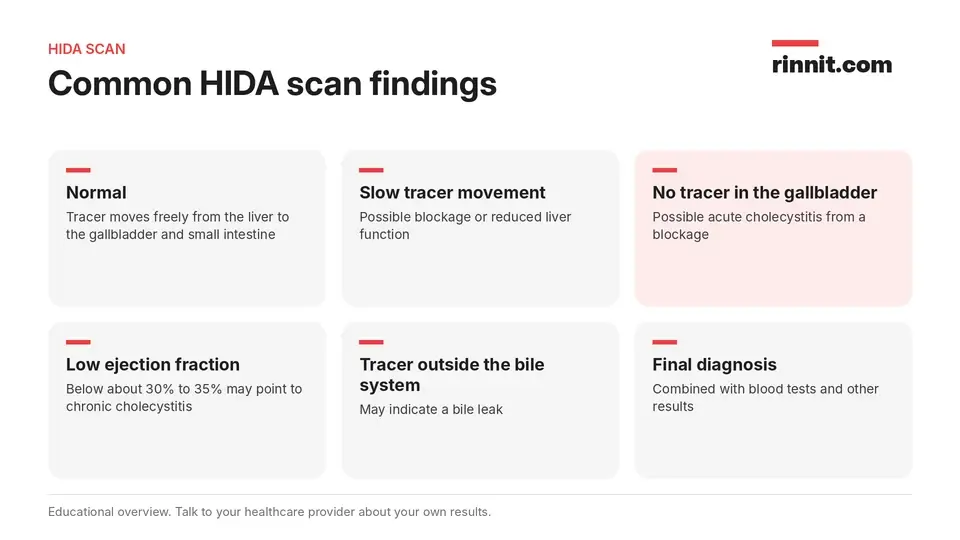
Finding | What it may mean |
Normal | Tracer moves freely from the liver into the gallbladder and small intestine |
Slow tracer movement | A blockage, or the liver is not working properly |
No tracer in the gallbladder | Acute cholecystitis due to a blockage |
Low gallbladder ejection fraction | Possible chronic cholecystitis; normal is above 30% to 35% |
Tracer outside the biliary system | A possible bile leak |
Sources: [1]
Conclusion
A HIDA scan is a painless nuclear medicine test that shows how bile moves from your liver through your gallbladder and into your intestine. It is especially useful for diagnosing gallbladder inflammation, bile leaks and biliary atresia in newborns.
Follow your fasting and medicine instructions closely, and ask your provider to walk you through your results.
Keep learning: Read our guide to gallbladder disease or learn about biliary dyskinesia. For more background, see RadiologyInfo.org on hepatobiliary scans.
FAQ
What is a HIDA scan?
It is a nuclear medicine test that tracks a radioactive tracer through the liver, bile ducts, gallbladder and small intestine. [1]
Why is a HIDA scan done?
It helps diagnose acute and chronic cholecystitis, sphincter of Oddi dysfunction, biliary atresia and bile leaks. [1]
How do I prepare for a HIDA scan?
Fast for at least four hours, share your medicine list, and tell your provider if you are pregnant or breastfeeding. [1]
How long does a HIDA scan take?
Usually one to four hours, and sometimes more images are taken up to 24 hours later. [1]
Is a HIDA scan painful?
The scan itself is painless, apart from a brief pinch when the IV is placed. [1]
Will I be put to sleep for a HIDA scan?
No. Anesthesia is not usually needed, though a sedative may be given to children or people who cannot stay still. [1]
What is a normal gallbladder ejection fraction?
A gallbladder ejection fraction above 30% to 35% is considered normal. [1]
What does it mean if the gallbladder does not show up?
No tracer in the gallbladder may indicate acute cholecystitis caused by a blockage. [1]
Is the radiation from a HIDA scan safe?
The dose is small, about a year of normal background radiation, and the tracer leaves the body within about a day. [1]
Can I breastfeed after a HIDA scan?
Discard breast milk pumped for 24 hours after the scan, because it may contain radiation from the tracer. [1]
Related Reading
Gallbladder Disease: Symptoms, Causes, Diagnosis, Treatment and Outlook — What You Need to Know explains the gallbladder problems a HIDA scan helps diagnose.
What Is Biliary Dyskinesia? Symptoms, Causes, Diagnosis, and Treatment Explained covers a condition diagnosed with the gallbladder ejection fraction from a HIDA scan.
Biliary Atresia in Newborns: Symptoms, Causes, and Treatment describes the newborn bile-duct condition a HIDA scan can detect.
Choledocholithiasis: What a Bile Duct Gallstone Is, How It's Found, and How It's Removed explains a gallstone blockage that can slow tracer flow on a HIDA scan.
References
Cleveland Clinic. HIDA Scan: What It Is, Purpose, Procedure & Results. Cleveland Clinic. Last updated May 10, 2022. https://my.clevelandclinic.org/health/diagnostics/17099-hida-scan
Kiewiet JJS, Leeuwenburgh MMN, Bipat S, et al. A systematic review and meta-analysis of diagnostic performance of imaging in acute cholecystitis. Radiology. 2012;264(3):708-720. PMID 22798223. https://doi.org/10.1148/radiol.12111561
Alhayo S, Eslick GD, Cox MR. Cholescintigraphy may have a role in selecting patients with biliary dyskinesia for cholecystectomy: a systematic review. ANZ J Surg. 2020;90(9):1647-1652. PMID 32479706. https://doi.org/10.1111/ans.16003
Medical disclaimer
This article is for general education only and does not replace advice from a qualified healthcare professional. Talk to your doctor about your own diagnosis and treatment, and seek emergency care right away for severe or sudden symptoms.



Comments