Gallbladder Disease: Symptoms, Causes, Diagnosis, Treatment and Outlook — What You Need to Know

Updated: 2 days ago
Medically reviewed by Dr. Baraa Alnahhal, MD · Last reviewed: September 2026
MEDICAL EMERGENCY WARNING Seek emergency medical care immediately if you experience intense, worsening abdominal pain, high fever with chills, or yellowing of the skin and eyes (jaundice). These can be signs of serious complications such as gallbladder gangrene, perforation, or life-threatening bile duct infections (cholangitis). Call 911 or go to the nearest emergency room.
TL;DR — Quick Answer
What is gallbladder disease?
Gallbladder disease refers to any condition affecting the gallbladder — a small organ that stores bile from the liver — or the bile ducts that transport it. The most common cause is gallstones (cholelithiasis), which can block bile flow and lead to painful inflammation known as cholecystitis. Other forms include functional motility disorders (biliary dyskinesia), bile duct diseases (cholangiopathy), and rare cases of gallbladder cancer. Symptoms typically involve intense upper right abdominal pain, nausea, and vomiting. While many people have gallstones without symptoms, complications like gangrene or perforation are medical emergencies. The primary treatment is surgical removal of the gallbladder (cholecystectomy), a common procedure that allows for normal digestion and a healthy life without the organ.

Gallbladder disease encompasses various conditions that disrupt the storage and transport of bile, often leading to inflammation and pain.
What Is Gallbladder Disease?
Gallbladder disease is an umbrella term for any condition that affects the health and function of the gallbladder or its connected bile ducts. The gallbladder is a small, pear-shaped organ located in the upper right abdomen, tucked beneath the liver. Its primary role is to store and concentrate bile — a digestive fluid produced by the liver — and release it into the small intestine to help break down fats during digestion.
Bile travels through a network of tubes called bile ducts. Gallbladder disease can originate within the organ itself or in these ducts. Because the biliary system is interconnected with the liver and pancreas, problems in the gallbladder can quickly affect these other vital organs.
While gallbladder problems can be intensely painful and potentially dangerous, they are highly treatable. Most conditions are resolved through surgery to remove the gallbladder, after which the liver sends bile directly to the small intestine, allowing the digestive process to continue normally.
How Does Gallbladder Disease Affect the Body?
When the gallbladder is diseased, it fails to store or release bile effectively. This can lead to a buildup of bile in the gallbladder or a backup into the liver and bloodstream. Because bile is essential for fat digestion, a malfunctioning gallbladder often causes digestive difficulties, particularly after eating fatty or greasy foods.
Furthermore, bile serves as a vehicle for the liver to flush toxins from the body. If bile backs up into the blood, it can cause systemic illness and jaundice. A diseased gallbladder is also a significant source of pain, often described as a sharp or cramping sensation in the upper right quadrant of the abdomen.
If left untreated, chronic inflammation can lead to severe complications, including:
Gangrene: Tissue death due to sustained swelling and lack of blood flow.
Perforation: A tear or burst in the gallbladder wall.
Peritonitis: A life-threatening infection of the abdominal cavity following a perforation.
Secondary Infections: Inflammation spreading to the liver (cholangitis) or pancreas (pancreatitis).
What Are the Different Types of Gallbladder Disease?
Gallbladder disease manifests in several forms, ranging from common stones to rare malignancies.
Condition | Description | Primary Cause |
Gallstones (Cholelithiasis) | Accumulation of bile products (usually cholesterol) into lumps. | Excess cholesterol or bilirubin in bile. |
Cholecystitis | Acute or chronic inflammation of the gallbladder. | Usually gallstones blocking bile flow. |
Biliary Dyskinesia | A functional motility problem where the gallbladder fails to empty. | Mechanical, muscle, or nerve issues. |
Cholangiopathy | Disease of the bile ducts, including inflammation and scarring. | Infection, autoimmune disorders, or blockages. |
Gallbladder Polyps | Growths or tumors on the inner lining of the gallbladder. | Mostly harmless; larger ones may be precancerous. |
Gallbladder Cancer | Rare but serious malignancy of the gallbladder or ducts. | Often asymptomatic until advanced stages. |
Gallstones are the most frequent cause of problems. While many people have "silent" stones that never cause symptoms, they become a disease when they block the flow of bile.
Cholecystitis is the most common symptom-producing condition. Chronic inflammation can lead to scarring of the gallbladder tissue and, eventually, gangrene.
Biliary Dyskinesia is a functional disorder. Even without stones, the gallbladder cannot move bile effectively, leading to the same backup and inflammation seen with physical obstructions.
What Are the Symptoms of Gallbladder Disease?
The hallmark of gallbladder disease is biliary colic — a specific type of intense pain. Symptoms can vary but often include:
Upper Right Abdominal Pain: Sharp, cramping, or dull pain that may radiate to the back or right shoulder.
Nausea and Vomiting: Often occurring after meals.
Digestive Distress: Gas, bloating, and discomfort after eating fatty foods.
Jaundice: Yellowing of the skin and the whites of the eyes.
Fever and Chills: Signs of an active infection or inflammation.
Changes in Stool/Urine: Tea-colored urine or light, clay-colored stools.

Recognizing the signs of gallbladder distress, such as biliary colic and jaundice, is crucial for timely diagnosis and treatment.
Who Is at Risk for Gallbladder Disease?
Gallstones affect approximately 15% of the population, though only 20% of those affected will experience complications. Several factors increase the likelihood of developing gallbladder problems.
The "5 Fs" of Gallbladder Risk
Healthcare providers traditionally used a mnemonic to remember the most common profile for gallbladder disease:
Fair: White populations (possibly due to genetics or Western diet).
Female: Women are twice as likely to develop stones due to estrogen.
Fat: Overweight or obesity (BMI > 30).
Fertile: Pregnancy or high estrogen levels.
Forty: Risk increases significantly after age 40.
Other Risk Factors
Risk Factor | Impact on Gallbladder |
High-Cholesterol Diet | Increases the concentration of cholesterol stones. |
Age > 60 | Accumulation of bile products over time. |
Family History | Approximately 25% of cases may be hereditary. |
Heritage | Native American and Mexican American heritage (30-70% likelihood). |
Diabetes | Higher levels of fatty acids contribute to stone formation. |
Crohn’s Disease | Reduced ability to absorb bile salts. |
Liver Cirrhosis | Slows the flow of bile from the liver. |
Rapid Weight Loss | Can trigger stone formation. |
How Is Gallbladder Disease Diagnosed?
Diagnosis begins with a physical exam and a review of symptoms. Healthcare providers use several tests to confirm gallbladder issues:
Imaging: Ultrasound is the most common tool for detecting stones and inflammation. CT scans or MRIs (MRCP) may be used for detailed views of the bile ducts.
HIDA Scan: A nuclear medicine test to check the gallbladder's function and ability to empty (essential for diagnosing biliary dyskinesia).
Blood Tests: To check for signs of infection, jaundice, or liver and pancreas involvement.
ERCP: A procedure that uses an endoscope and X-rays to look at the bile ducts and sometimes remove blockages.
How Is Gallbladder Disease Treated?
Most gallbladder diseases are treated proactively to prevent serious complications like gangrene or cancer.
Surgery (Cholecystectomy)
The most common treatment is the surgical removal of the gallbladder. This is typically performed using laparoscopic surgery, a minimally invasive technique with a quick recovery time. Once the gallbladder is removed, the liver's bile ducts are redirected to flow directly into the small intestine.
Other Treatments
Gallstone Removal: In some cases, stones can be removed from the bile ducts without removing the gallbladder, though they often recur.
Medications: Some drugs can dissolve cholesterol stones, but this process takes months or years and is rarely a permanent solution.
Management of Bile Duct Disease: Autoimmune or inflammatory bile duct conditions may require long-term medication or stenting to keep the pipes open.
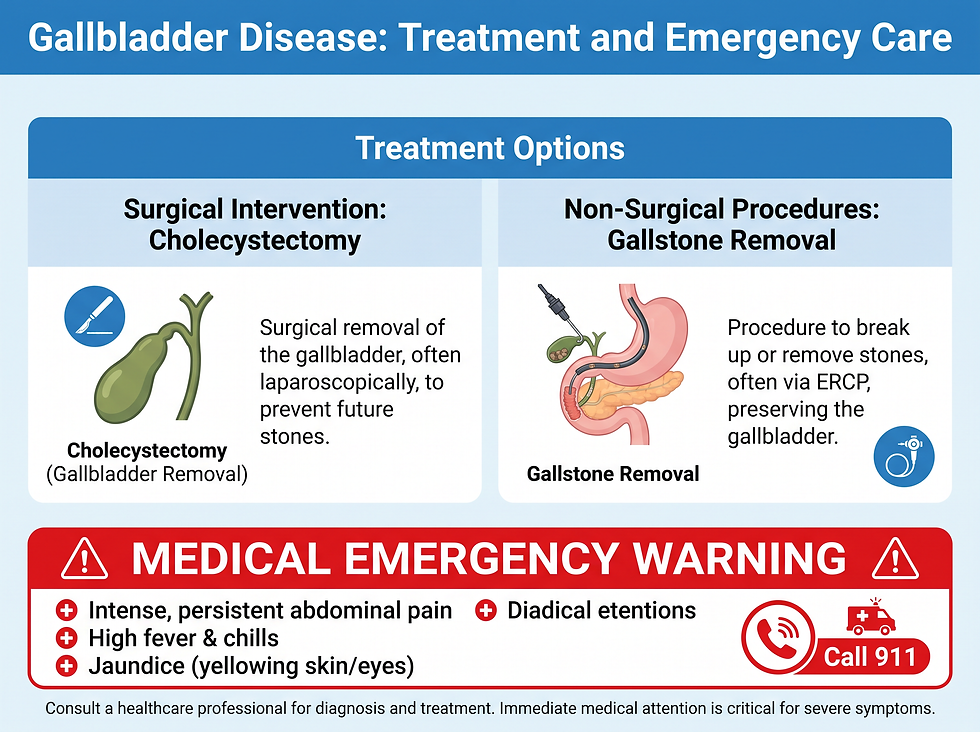
Cholecystectomy is the standard treatment for gallbladder disease, effectively resolving pain and preventing life-threatening complications.
What Is the Outlook for People with Gallbladder Disease?
The outlook for gallbladder disease is generally excellent. Most people who undergo gallbladder removal experience complete relief from pain and can return to a normal diet within weeks. The body adapts quickly to the absence of the gallbladder, and there are typically no long-term health consequences to living without it.
However, if complications like gangrene or peritonitis occur before treatment, the recovery can be much longer and more complex. This is why healthcare providers recommend proactive treatment once symptoms begin.
When Should You See a Healthcare Provider?
You should consult a healthcare provider if you experience recurring episodes of abdominal pain, especially after eating.
Seek immediate medical attention if you experience:
Severe abdominal pain that makes it difficult to sit still or find a comfortable position.
High fever with chills.
Yellowing of your skin or the whites of your eyes (jaundice).
Persistent nausea and vomiting.
Note: This article is for informational purposes only. All medical decisions should be made in consultation with a qualified healthcare provider.
Conclusion
Gallbladder disease is a common but manageable condition. Whether caused by gallstones or functional issues, the resulting inflammation and pain can significantly impact quality of life. By understanding the risk factors and recognizing the symptoms early, you can seek the necessary treatment to prevent serious complications.
What you can do now:
Monitor your symptoms: Keep a record of when pain occurs and if it is linked to specific foods.
Consult a specialist: Speak with a gastroenterologist if you suspect gallbladder issues.
Adopt a heart-healthy diet: Reducing cholesterol and maintaining a healthy weight can lower the risk of stone formation.
Frequently Asked Questions (FAQ)
Can you live without a gallbladder?
Yes. The gallbladder stores bile, but it doesn't produce it. After removal, the liver sends bile directly to the small intestine, and most people lead a perfectly normal life.
What causes gallstones?
Gallstones form when bile contains too much cholesterol or bilirubin, which crystallizes into hard lumps.
Is gallbladder disease hereditary?
Yes, approximately 25% of cases are believed to be linked to genetics.
What are the "5 Fs" of gallbladder disease?
The traditional risk factors are Fair, Female, Fat, Fertile, and Forty.
Can diet prevent gallbladder disease?
A low-cholesterol, high-fiber diet can help reduce the risk of stone formation, though it may not prevent all types of gallbladder disease.
What is cholecystitis?
Cholecystitis is the medical term for inflammation of the gallbladder, usually caused by a blockage.
How is a gallbladder removed?
Most are removed via laparoscopy, a minimally invasive surgery using small incisions and a camera.
What is biliary colic?
Biliary colic is the sharp, cramping pain caused by a gallstone temporarily blocking a bile duct.
Can children get gallbladder disease?
Yes, though it is much less common than in adults. It is often linked to underlying conditions like sickle cell disease.
What is a HIDA scan?
A HIDA scan is an imaging test used to see how well the gallbladder is functioning and emptying bile.
What happens if a gallbladder bursts?
A perforated (burst) gallbladder can leak bile and bacteria into the abdomen, causing a life-threatening infection called peritonitis.
Can gallstones be dissolved with medicine?
Some cholesterol stones can be dissolved, but it is a slow process and the stones usually come back once the medicine stops.
Does gallbladder removal cause weight gain?
There is no direct link between the surgery and weight gain, though some people find they can eat more comfortably afterward.
What is jaundice?
Jaundice is the yellowing of the skin and eyes caused by a buildup of bilirubin in the blood, often due to a bile duct blockage.
How long is recovery after gallbladder surgery?
Most people return to normal activities within one to two weeks after laparoscopic surgery.
References
Health information, not medical advice. This article is for general education and is not a substitute for professional diagnosis or treatment. Always consult a qualified healthcare provider about your own health, and seek emergency care for urgent symptoms.
Comments