Endoscopic Ultrasound (EUS): Uses, Procedure, Recovery and Risks

Updated: 2 days ago
Written and medically reviewed by Dr. Baraa Alnahhal, MD · Last reviewed: November 2026 · How we review
Quick Answer: What is an endoscopic ultrasound (EUS)?
An endoscopic ultrasound (EUS) is a procedure that combines an endoscope, a flexible tube with a light and camera, with an ultrasound probe. It lets a gastroenterologist see the digestive tract and nearby organs such as the pancreas, gallbladder and bile ducts, and it can guide a needle biopsy. It's an outpatient procedure done under sedation. [1]
What the research says
EUS-guided needle biopsy is highly accurate for pancreatic masses. A meta-analysis of 33 studies with 4,984 patients found that EUS-guided fine-needle aspiration identified pancreatic cancer with a pooled sensitivity of 85% and a specificity of 98%. (Hewitt et al., Gastrointestinal Endoscopy, 2012) [2]
Complications are uncommon and usually mild. A systematic review of 51 studies covering 10,941 patients found complications from EUS-guided fine-needle aspiration in 0.98% of patients, mostly mild to moderate. Pancreatitis occurred in 0.44% and deaths in 0.02%. (Wang et al., Gastrointestinal Endoscopy, 2011) [3]
Key takeaways
EUS combines an endoscope with an ultrasound probe to create images of your digestive tract, organs, tissues and blood vessels. [1]
It helps diagnose pancreatic cancer, pancreatic cysts, pancreatitis, gallbladder disease, colon cancer, IBD and cancer spread. [1]
An upper EUS goes in through your mouth; a lower EUS goes in through your anus. [1]
Your provider can take a tissue or fluid sample during EUS with a thin needle (EUS-guided fine-needle aspiration). [1]
You'll be sedated, so someone needs to drive you home and stay with you for the rest of the day. [1]
A sore throat or gas and bloating usually go away within 24 hours. [1]
What is an endoscopic ultrasound?
Endoscopic ultrasound (EUS) is a procedure to examine the inside of your digestive tract. A gastroenterologist, a doctor who specializes in the digestive system, performs it. An EUS test combines two tools: [1]
An endoscope: a long, thin, flexible tube with a camera and light on the end
An ultrasound probe: found on the end of the endoscope, it sends out sound waves that produce images of your organs, tissues and blood vessels
Because the ultrasound probe sits right next to the organs being examined, EUS gives a close look at the digestive tract wall and the structures around it. [1]
Why is an endoscopic ultrasound done?

Healthcare providers use EUS to evaluate or diagnose: [1]
Belly (abdominal) pain or chest pain
Cancer that has spread to other parts of the body (metastatic cancer)
Lumps, abnormal tissue (lesions) or growths seen on earlier CT scans or MRIs
Digestive tract problems such as inflammatory bowel disease (IBD), colon cancer and anal fissures
Gallbladder diseases, including gallstones and gallbladder inflammation (cholecystitis)
Lung diseases, such as lung cancer
Pancreatic diseases, such as pancreatic cancer, pancreatic cysts and pancreatitis
Swallowing disorders such as Barrett's esophagus
Upper EUS vs. lower EUS
There are two types of EUS, depending on which part of your digestive tract needs a closer look. [1]
Feature | Upper EUS | Lower EUS |
How the scope goes in | Through your mouth, esophagus and stomach to the top of the small intestine (duodenum) | Through your anus and rectum into the large intestine (colon) |
What it examines | Lining of the esophagus, stomach and small intestine; lymph nodes, blood vessels, cysts and tumors; the pancreas, gallbladder and bile ducts | The anal sphincter muscles; blood vessels, lymph nodes, cysts and tumors; the lining of the rectum and colon |
How long it takes | About 60 minutes | Less than 60 minutes |
Needle biopsy | Can be done if needed | Rarely done |
Bowel prep | Not needed | Prescription bowel prep |
Common aftereffect | Sore throat | Gas, bloating or cramping |
Sources: [1]
EUS-guided fine-needle aspiration
During an EUS, your provider may do an endoscopic ultrasound-guided fine-needle aspiration. They use the ultrasound images to guide a thin needle through the endoscope and remove a small sample of tissue or fluid. A lab specialist called a pathologist then examines the sample for signs of disease, such as abnormal or cancerous cells. [1]
How do you prepare for an EUS?
Your healthcare provider will tell you what you should and shouldn't do before the test. In general, you may need to: [1]
Adjust the dose of medicines such as insulin or blood thinners, as your provider recommends
Hold off blood-thinning medicines such as Coumadin® or Plavix®
Stop eating and drinking for a set period of time before the test
Use a prescription bowel prep to clean out your bowels (for a lower EUS only)
Because you'll receive a sedative, arrange for someone to drive you home and stay with you for the rest of the day. [1]
What happens during an upper EUS?
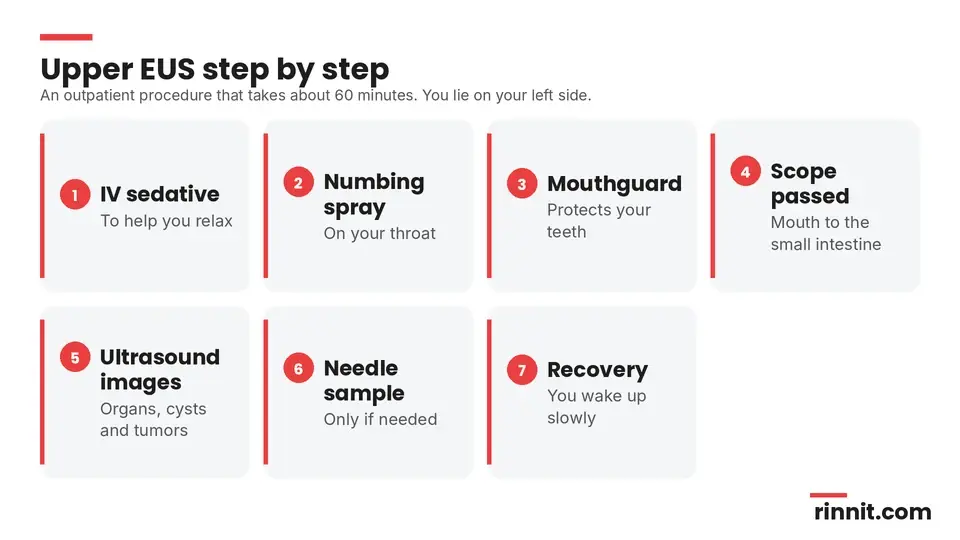
An upper EUS is an outpatient procedure, so you'll go home the same day. It takes about 60 minutes. You lie on your left side, and a healthcare provider: [1]
Gives you a sedative through an IV to help you relax
Sprays your throat with numbing medicine
Places a plastic mouthguard in your mouth to protect your teeth and keep you from biting the scope
Passes the ultrasound endoscope through your mouth, esophagus and stomach until it reaches the duodenum; you shouldn't feel pain and you can breathe as usual
Looks at ultrasound images on a monitor to examine your upper digestive tract, nearby organs, cysts or tumors
Uses the images to guide a thin needle through the scope and take a tissue or fluid sample, if needed
Gently removes the endoscope and stops the anesthesia, and you wake up slowly in a recovery room
What happens during a lower EUS?
A lower EUS is also an outpatient procedure and takes less than 60 minutes. You lie on your left side and receive an IV sedative. The provider inserts the ultrasound endoscope through your anus and rectum into your colon, examines your lower digestive tract and nearby organs, cysts or tumors on a monitor, then gently removes the scope and stops the anesthesia. You shouldn't feel pain or discomfort, and needle biopsies rarely happen during a lower EUS. [1]
What happens after an EUS?

The sedative should wear off within 30 minutes to an hour. Afterward, you may have: [1]
A sore throat after an upper EUS
Gas, bloating or cramping after a lower EUS
These symptoms should go away within 24 hours. Take it easy for the rest of the day; you can go back to work and other activities the next day. [1]
Time after EUS | What to expect |
30 to 60 minutes | The sedative wears off |
Rest of the day | Take it easy; someone should stay with you |
Within 24 hours | Sore throat, gas, bloating or cramping go away |
Next day | Back to work and usual activities |
A few weeks | Biopsy results, if a sample was taken |
Sources: [1]
What are the risks of an EUS?
An EUS is a relatively safe procedure. Possible complications include: [1]
An allergic reaction to the anesthesia
Damage to the digestive tract, or bleeding
Lung aspiration, when fluid from your mouth or stomach enters your lungs (after an upper EUS)
Pancreatitis (after an upper EUS with a needle biopsy)
A tear (perforation) in the intestinal wall
When will you get your results?
Your healthcare provider will review the EUS findings with you. If you had a biopsy, it may take a few weeks for the lab results to come back. [1]
When should you call your doctor?
Call your healthcare provider if you have any of the following after an EUS: [1]
Blood in your stool
Difficulty or pain when having a bowel movement
A fever or other signs of infection
Difficulty swallowing
Nausea and vomiting
Severe or ongoing belly pain or chest pain
Shortness of breath
Questions to ask your provider
Will I have an upper or a lower EUS, and why?
Will you take a biopsy during the procedure?
Which of my medicines should I stop or adjust beforehand?
How long should I avoid eating and drinking before the test?
When and how will I get my results?
Conclusion
An endoscopic ultrasound gives your provider a close, detailed view of your digestive tract and the organs around it, including the pancreas, gallbladder and bile ducts. It helps diagnose digestive problems, cancers and cancer spread, and a needle biopsy can be taken in the same procedure.
EUS is minimally invasive and done as an outpatient. Plan for a ride home, expect a sore throat or some bloating for up to a day, and call your provider if you notice bleeding, fever, trouble swallowing or severe pain.
Keep learning: Read our guides to endoscopy, ERCP, ultrasound, biopsy and the CT scan.
FAQ
What is an endoscopic ultrasound?
It's a procedure that combines an endoscope with an ultrasound probe to create images of your digestive tract and nearby organs, tissues and blood vessels. [1]
What does an endoscopic ultrasound diagnose?
EUS helps diagnose pancreatic cancer, pancreatic cysts, pancreatitis, gallstones, colon cancer, IBD, Barrett's esophagus and cancer spread. [1]
Are you asleep for an endoscopic ultrasound?
You receive a sedative through an IV so you're relaxed, and you wake up slowly in a recovery room afterward. [1]
How long does an endoscopic ultrasound take?
An upper EUS takes about 60 minutes, and a lower EUS takes less than 60 minutes. [1]
What is the difference between an upper and lower EUS?
An upper EUS goes through your mouth to examine the esophagus, stomach, small intestine and pancreas; a lower EUS goes through your anus to examine the rectum and colon. [1]
How do I prepare for an endoscopic ultrasound?
You may need to stop eating and drinking for a set time, adjust or hold certain medicines, and use a bowel prep for a lower EUS. [1]
Can a biopsy be done during an EUS?
Yes. Your provider can guide a thin needle through the scope to take a tissue or fluid sample. [1]
How long is recovery after an endoscopic ultrasound?
The sedative wears off within an hour, side effects fade within 24 hours, and you can return to normal activities the next day. [1]
What are the risks of an endoscopic ultrasound?
Risks include an allergic reaction to anesthesia, bleeding, lung aspiration, pancreatitis after a biopsy and a tear in the intestinal wall. [1]
When should I call my doctor after an EUS?
Call for blood in your stool, fever, trouble swallowing, nausea and vomiting, severe belly or chest pain, or shortness of breath. [1]
Related Reading
Learn more in our guide to Pancreatic Cancer: Symptoms, Causes, and Treatment — A Clear Guide for Patients and Families.
Learn more in our guide to Understanding Pancreatic Cysts: Types, Symptoms, and Management.
Learn more in our guide to Pancreatitis: Symptoms, Causes, and Treatment — A Clear Guide to Understanding and Managing the Condition.
Learn more in our guide to Choledocholithiasis: What a Bile Duct Gallstone Is, How It's Found, and How It's Removed.
Learn more in our guide to Cholangiocarcinoma (Bile Duct Cancer): Symptoms, Causes, and Treatment.
Pancreas Ultrasound: Abdominal vs Endoscopic Ultrasound, Prep and Results explains the abdominal and endoscopic ultrasound scans of the pancreas.
References
Cleveland Clinic. Endoscopic Ultrasound (EUS): Procedure, Test & What it Is. Cleveland Clinic. Last updated April 28, 2022. https://my.clevelandclinic.org/health/diagnostics/12025-endoscopic-ultrasound
Hewitt MJ, McPhail MJ, Possamai L, et al. EUS-guided FNA for diagnosis of solid pancreatic neoplasms: a meta-analysis. Gastrointest Endosc. 2012;75(2):319-331. PMID 22248600. https://doi.org/10.1016/j.gie.2011.08.049
Wang KX, Ben QW, Jin ZD, et al. Assessment of morbidity and mortality associated with EUS-guided FNA: a systematic review. Gastrointest Endosc. 2011;73(2):283-290. PMID 21295642. https://doi.org/10.1016/j.gie.2010.10.045
Medical disclaimer
This article is for general education only and does not replace advice from a qualified healthcare professional. Talk to your doctor about your own diagnosis and treatment, and seek emergency care right away for severe or sudden symptoms.



Comments