Understanding Pancreatic Cysts: Types, Symptoms, and Management

Updated: 2 days ago
Medically reviewed by Dr. Baraa Alnahhal, MD · Last reviewed: October 2026
A pancreatic cyst is a fluid-filled growth on or inside the pancreas. About 10% of CT and MRI scans find one by accident, but fewer than 1% are cancerous. Doctors sort cysts into neoplastic (could turn cancerous) and nonneoplastic (benign), and use regular surveillance to watch for changes. Care ranges from routine imaging to surgery if high-risk features appear [1].
Quick Answer: What is a pancreatic cyst?
A pancreatic cyst is a liquid-filled growth on the pancreas, often found by chance on a CT or MRI. Most are harmless and cause no symptoms, but some neoplastic types can become cancerous. Diagnosis uses imaging, endoscopic ultrasound and fluid analysis. Low-risk cysts are watched with periodic imaging, while cysts with high-risk features may need surgery. [1]
What the research says
Cysts are common, but worrisome ones are not. A meta-analysis of 17 studies (48,860 people) found incidental pancreatic cysts in a pooled 8% of people; 4.3% had mucinous lesions, and only 0.7% had worrisome features or high-risk signs (Zerboni et al., Pancreatology, 2019).
What Is a Pancreatic Cyst?
A pancreatic cyst is a fluid-filled growth that can form inside or outside the pancreas. These growths are fairly common: studies suggest they appear in about 10% of CT and MRI scans, often while doctors are looking into something else. They become more common with age and are estimated to affect about 25% of people in their 70s [1].
The main concern is the chance of cancer. Cysts are either neoplastic, meaning they can become cancerous, or nonneoplastic, meaning they are benign. Up to 30% of cysts have some potential for future cancerous change, but fewer than 1% actually develop into cancer [1].
What are the types of pancreatic cysts?
Knowing the exact type of cyst is key to choosing the right plan. Cysts are divided by their cell makeup and risk level [1].
Category | Type | Key characteristics |
Neoplastic | IPMN (intraductal papillary mucinous neoplasm) | Most common; grows on the pancreatic duct; contains mucin |
Neoplastic | MCN (mucinous cystic neoplasm) | Mostly affects women over 50; grows on the body of the pancreas |
Neoplastic | SPN (solid pseudopapillary neoplasm) | Rare; affects younger women (20s to 30s); has solid and liquid parts |
Nonneoplastic | Simple cyst | Benign; often affects children; grows apart from the duct |
Nonneoplastic | Serous cystadenoma | A benign neoplasm that almost never becomes cancer; can grow large enough to cause discomfort |
Nonneoplastic | Pseudocyst | A pocket of leaked pancreatic juice; not a true growth |
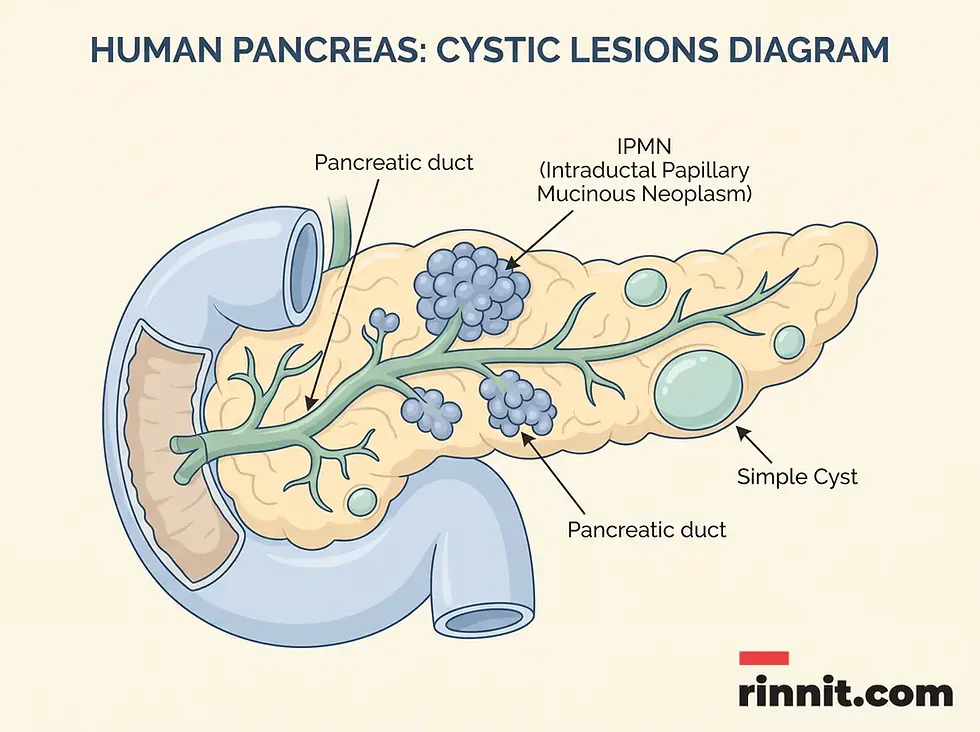
Different cyst types can sit on the pancreatic duct or within the body of the pancreas.
What are the symptoms and complications of pancreatic cysts?
Most pancreatic cysts cause no symptoms and stay unnoticed until a scan done for another reason finds them. If a cyst grows large enough to press on nearby structures, it can cause problems [1].
Common Symptoms
When symptoms appear, they often include abdominal or back pain, loss of appetite, and unexplained weight loss. Some people have bloating, indigestion, or nausea. If a cyst blocks the bile duct, jaundice (yellow skin and eyes) and light-colored, greasy stools can occur [1].
Potential Complications
Rarely, large or high-risk cysts cause serious problems [1]:
Blockages: a cyst can block the pancreatic duct (causing pancreatitis) or the bile duct (causing cholestasis).
Digestive problems: pressure on the stomach or intestines can stop food passing through.
Cancer: a small share of neoplastic cysts can turn into adenocarcinoma, a serious form of pancreatic cancer.
How are pancreatic cysts diagnosed and their risk assessed?
When a cyst is found, your care team decides whether its risk is low, medium, or high, which guides the next steps [1].
Diagnostic tool | Purpose |
Radiology (CT or MRI) | Shows whether a cyst is present, plus its size and location |
Endoscopic ultrasound (EUS) | Uses an endoscope to get a closer look at the cyst |
Fine needle aspiration (FNA) | Collects fluid and tissue samples for lab analysis |
Cytology and fluid analysis | Checks for mucin, tumor markers (CEA), and DNA changes |

From an incidental scan finding to EUS, fluid analysis, and a risk group that sets the plan.
How are pancreatic cysts managed and treated?
Care is highly individual and balances the chance of cancer against the risks of invasive procedures [1].
Surveillance and monitoring:
Most low-risk cysts are watched with periodic scans for changes in size or appearance. If a cyst stays stable, nothing more is usually needed.
Surgical intervention:
Surgery is generally kept for high-risk cysts or those causing severe symptoms. If a cyst moves from low to medium risk, a biopsy is often done. If it reaches high risk, a surgeon may remove the cyst and possibly part of the pancreas to prevent cancer [1].

Management runs from routine monitoring for low-risk cysts to surgery for high-risk ones.
What is the outlook for pancreatic cysts and can they be prevented?
The outlook is generally very good when you follow the recommended surveillance plan. Regular monitoring lets providers catch any cancerous change early, when it is most treatable.
The cause of most pancreatic cysts is unknown, but some are linked to inherited conditions such as cystic fibrosis, polycystic kidney disease, and Von Hippel-Lindau disease [1]. A healthy lifestyle and knowing your family history of pancreatic cancer can help spot risk early.
What is the bottom line on pancreatic cysts?
Pancreatic cysts are common, and in most cases they do not lead to serious problems. Because a small group of neoplastic cysts can turn cancerous, professional evaluation and regular monitoring are essential. If you have recently been diagnosed with a pancreatic cyst, talk to a specialist about your risk and a personal surveillance plan.
Frequently Asked Questions
Are all pancreatic cysts cancerous?
No. Less than 1% of pancreatic cysts are cancerous when they are found, although some neoplastic types can become cancerous later.
How are pancreatic cysts usually found?
Most are found by accident during CT scans or MRIs done for unrelated symptoms.
What is the difference between a cyst and a pseudocyst?
A true cyst is a growth with an outer lining, while a pseudocyst is a pocket of fluid formed from leaked pancreatic juices.
Do I need surgery for a small cyst?
Usually not. Small, low-risk cysts are normally monitored with regular imaging instead of surgery.
Can a pancreatic cyst cause back pain?
Yes. If a cyst grows large enough to press on nearby nerves or organs, it can cause pain in the abdomen or back.
Is there a specific diet for pancreatic cysts?
No specific diet has been established for pancreatic cysts. A healthy lifestyle is generally recommended for pancreatic health.
Who is most at risk for pancreatic cysts?
Risk rises with age, particularly after 70. A family history of pancreatic cancer and certain genetic syndromes also raise risk.
What is an IPMN?
IPMN stands for intraductal papillary mucinous neoplasm. It is the most common type of neoplastic pancreatic cyst and grows on the pancreatic duct.
How often is surveillance needed?
It depends on the cyst’s size and risk group, as decided by your healthcare provider.
Can pancreatic cysts be prevented?
Most occur for unknown reasons, but managing conditions such as pancreatitis and knowing your family history can help find problems early.
Related Resources
Related reading on Rinnit:
Related Reading
Learn more in our guide to Endoscopic Ultrasound (EUS): Uses, Procedure, Recovery and Risks.
Pancreas Ultrasound: Abdominal vs Endoscopic Ultrasound, Prep and Results explains the abdominal and endoscopic ultrasound scans of the pancreas.
References
Cleveland Clinic. Pancreatic cysts. Cleveland Clinic Health Library. Medically reviewed; last updated October 11, 2023. https://my.clevelandclinic.org/health/diseases/pancreatic-cyst
Zerboni G, Signoretti M, Crippa S, et al. Systematic review and meta-analysis: prevalence of incidentally detected pancreatic cystic lesions in asymptomatic individuals. Pancreatology. 2019;19(1):2-9. PMID: 30503370. DOI: 10.1016/j.pan.2018.11.014
Medical disclaimer
This article is for informational purposes only and is not a substitute for professional medical advice, diagnosis, or treatment. Always seek the advice of your physician or other qualified health provider with any questions you may have about a medical condition.



Comments