Pancreas Divisum: Symptoms, Causes, and Management

Updated: 2 days ago
Medically reviewed by Dr. Baraa Alnahhal, MD · Last reviewed: September 2026
Understanding Pancreas Divisum
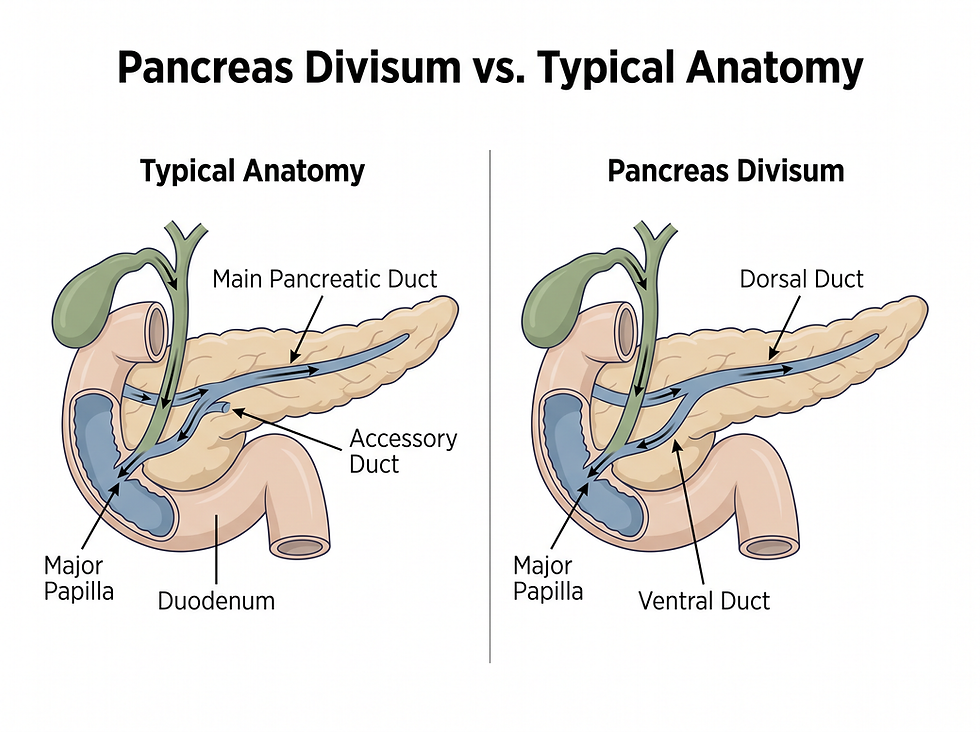
Pancreas divisum is the most common congenital malformation affecting the pancreas, occurring in approximately 10% of the general population. This condition develops during the seventh week of pregnancy when the two separate "buds" that form the pancreas—the ventral and dorsal buds—fail to fuse their respective ducts into a single main pipeline.
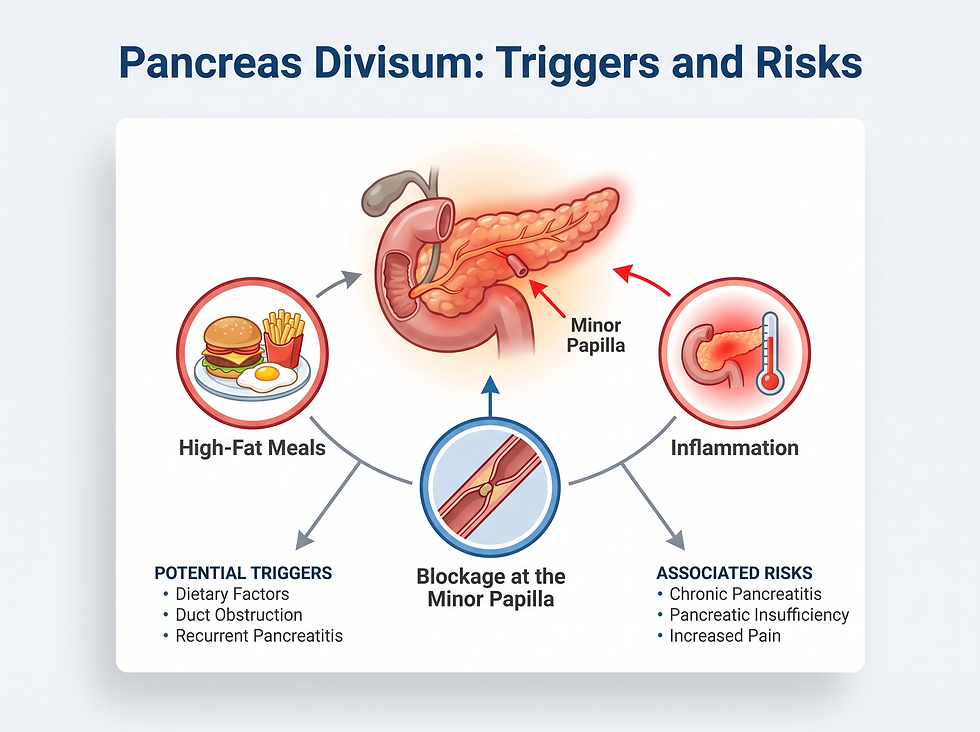
In a typical pancreas, these ducts join to form one major duct that empties digestive enzymes into the small intestine through a large opening called the major papilla. In individuals with pancreas divisum, these enzymes are forced to drain through two separate, smaller ducts. Most of the digestive fluid must pass through the minor papilla, which is significantly smaller and less efficient at handling high volumes of fluid.
Symptoms and Potential Complications
The vast majority of people—more than 95%—live their entire lives without knowing they have pancreas divisum. Because the condition typically does not limit the organ's ability to aid digestion, it is often discovered incidentally during imaging for unrelated health concerns.
However, a small percentage of individuals may experience symptoms if the digestive juices become backed up behind the narrow minor papilla. This backup can cause inflammation, leading to symptoms identical to those of pancreatitis.
Common Symptoms of Pancreas Divisum
Symptom Type | Description |
Primary Symptom | Persistent or recurring abdominal pain. |
Digestive Distress | Nausea, vomiting, indigestion, and loss of appetite. |
Systemic Signs | Fever, rapid heartbeat (tachycardia), and shallow breathing. |
Stool Changes | Fatty or oily stools (steatorrhea) due to malabsorption. |
Circulatory Effects | Lightheadedness or dizziness caused by low blood pressure. |
If left unmanaged, the primary complication is recurrent acute pancreatitis. While scientists are still researching the exact relationship, the leading theory suggests that the blockage at the minor papilla increases the likelihood of inflammation in susceptible individuals.
Diagnostic Procedures
Because pancreas divisum is often asymptomatic, it is frequently found during an abdominal CT scan performed for other reasons. When a patient presents with pancreatitis-like symptoms, specialists use more targeted imaging to map the pancreatic duct system.
Diagnostic Tools for Pancreatic Disorders
Test Name | Procedure Overview |
MRCP | A non-invasive MRI that visualizes the duct system, often enhanced by a secretin injection to highlight irregularities. |
Endoscopic Ultrasound | A scope-based procedure that uses sound waves to check for inflammation within the pancreatic tissue. |
ERCP | An invasive procedure using a scope and dye to record X-ray images; typically reserved for cases requiring immediate treatment. |
CT Scan | A standard imaging tool often used to first identify the malformation incidentally. |
Management and Treatment Options
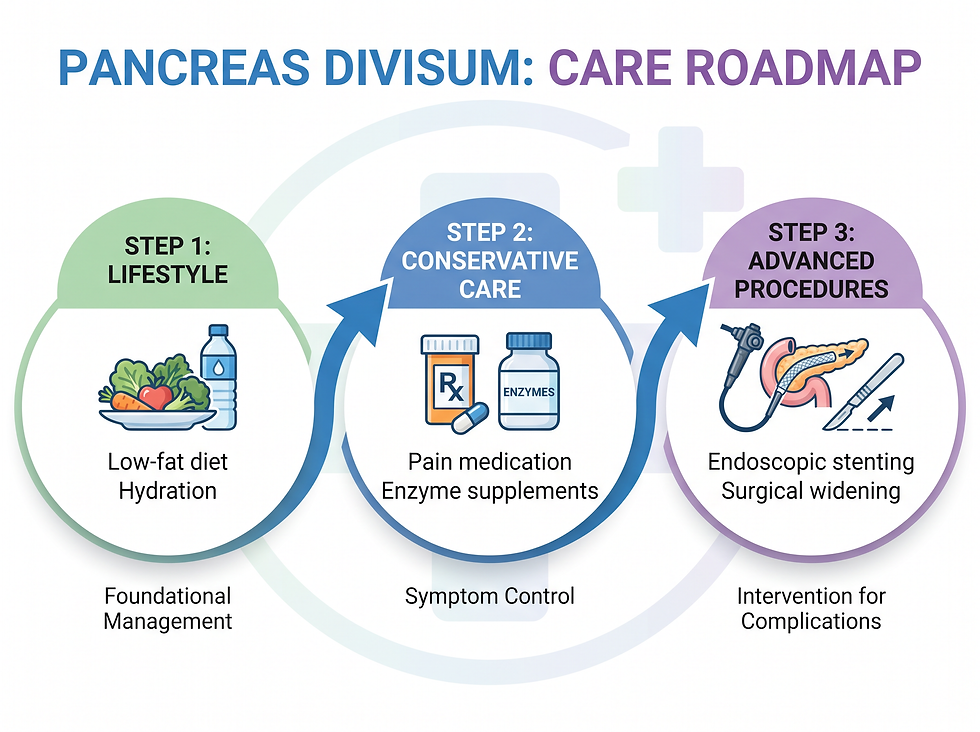
For the majority of patients, no treatment is necessary. When symptoms are mild to moderate, the focus shifts to reducing the workload on the pancreas and managing inflammation through conservative measures.
Conservative Management
Dietary Adjustments: Switching to low-fat meals helps the pancreas process food more easily, as fats are harder to digest.
Medications: Pain relievers (analgesics) are used to manage abdominal discomfort during flare-ups.
Supplements: Pancreatic enzyme supplements may be prescribed to assist the digestive process and reduce strain on the organ.
Advanced Procedures
If symptoms are severe, frequent, or impact quality of life, a procedure may be required to widen the drainage opening.
Endoscopy: During an ERCP, a provider can enlarge the minor papilla opening or place a temporary stent to ensure the duct remains open.
Surgery: Reserved for those ineligible for endoscopy or where endoscopic treatments have failed, surgical intervention involves making an abdominal incision to manually widen the duct.
Conclusion
Pancreas divisum is a common and usually harmless congenital condition. While it involves an atypical formation of the pancreatic ducts, it rarely interferes with daily life or digestive health for the vast majority of people. If you have been diagnosed with this condition, remember that prognosis is excellent, and most symptomatic cases can be managed effectively with lifestyle changes or minor medical interventions.
Call to Action: If you are experiencing persistent abdominal pain or symptoms of indigestion, consult with a gastroenterologist to determine if your pancreatic health requires further evaluation or management.
Frequently Asked Questions
What exactly is pancreas divisum?
It is a congenital disorder where the two ducts that drain the pancreas fail to fuse into one during fetal development.
How common is this condition?
It is the most common congenital disorder of the pancreas, affecting about 10% of the general population.
Will I have symptoms if I have pancreas divisum?
More than 95% of people with this condition never develop symptoms and may never know they have it.
What is the most common symptom for those who do have them?
Abdominal pain is the most frequently reported symptom among the small percentage of people who are symptomatic.
Can pancreas divisum cause pancreatitis?
Yes, inefficient drainage through a small opening can lead to a backup of digestive juices, potentially causing inflammation (pancreatitis).
How is the condition usually diagnosed?
It is often found incidentally during a CT scan for an unrelated issue or through targeted tests like MRCP or ERCP if symptoms are present.
What is an MRCP?
Magnetic resonance cholangiopancreatography is a specialized MRI that allows doctors to see the pancreatic duct system on a screen.
Is treatment always necessary?
No, most people do not require any treatment because the condition is typically harmless and asymptomatic.
What dietary changes help manage symptoms?
Switching to low-fat meals can reduce the strain on the pancreas, making it easier for the organ to process food.
Are there medications for pancreas divisum?
Pain relievers and pancreatic enzyme supplements are often used to manage mild to moderate symptoms.
When is surgery required?
Surgery is rare and usually only considered if endoscopic treatments fail or if the patient is not a candidate for endoscopy.
What happens during an endoscopy for this condition?
A provider may widen the minor papilla opening or place a stent to help the pancreatic juices drain more efficiently.
Is the prognosis for pancreas divisum good?
Yes, the outlook is excellent, and the condition rarely impacts a person’s overall life expectancy or health.
Can children have pancreas divisum?
Yes, since it is a congenital disorder, it is present from birth, though it may not be detected until much later in life.
Does pancreas divisum limit my ability to digest food?
For most people, it does not limit the pancreas's functional ability to aid in digestion.
Medical Disclaimer: This content is for informational purposes only and does not constitute medical advice, diagnosis, or treatment. Always seek the advice of your physician or other qualified health provider with any questions you may have regarding a medical condition. Never disregard professional medical advice or delay in seeking it because of something you have read here.
Comments