Cyst: What It Is, Types, Symptoms, Causes, and Treatment

Updated: 3 days ago
Medically reviewed by Dr. Baraa Alnahhal, MD · Last reviewed: October 2026
Quick Answer
A cyst is a closed sac of tissue, usually filled with fluid, pus or air, that can develop anywhere in the body. Most cysts are benign and cause no symptoms, but infected ones can become painful and rupture. Treatment includes antibiotics, draining or surgical removal, which best prevents recurrence. Never drain a cyst yourself, as this can cause infection.
What the research says
Removing the whole sac lowers the chance of recurrence. In a systematic review of 127 patients with intradiploic epidermoid cysts (a rare cyst of the skull), recurrence was 2% when the cyst capsule was completely removed vs 66% when it was incompletely removed, and 4% after gross total resection vs 57% after subtotal resection (Balasubramanian et al., Neurosurgical Review, 2025) [2].
Even benign-looking cysts are examined carefully. A review of epidermal inclusion cysts of the breast (82 patients analyzed) found a palpable mass in 79%, ultrasound used in every case and fine-needle aspiration in 70%, and no recurrence at a mean follow-up of 53 months after excision; the authors note that pathology is needed to exclude malignancy because these cysts can rarely be malignant (Paliotta et al., Oncology Letters, 2016) [3].
What Is a Cyst?
A cyst is a closed sac of tissue that can form anywhere in your body. These lumps or bumps most commonly develop in your skin, breasts, ovaries, and kidneys. Cysts look like pouches or pockets, and they are usually filled with fluid, pus, air, or other materials.
Cysts may look alarming, but they are typically not serious. A healthcare provider can determine whether a cyst needs treatment and what kind.

What a cyst is: a closed sac of tissue, usually filled with fluid, pus, or air.
Can a Cyst Be Cancerous?
Cysts are usually benign, meaning they are noncancerous. Benign cysts are mostly harmless, though they may cause pain or discomfort. Cysts can become a bigger issue when they form in a sensitive location, such as around nerves or the brain.
Rarely, cysts can be precancerous or cancerous (malignant). You should always tell your healthcare provider any time you notice a new lump or bump, especially if it does not go away after several days or keeps growing.
Types of Cysts
There are many types of cysts, and they can have different features depending on which area of the body they affect. The table below organizes the most common types into skin cysts and internal cysts.
Skin Cysts | Internal Cysts |
Baker's cyst (popliteal cyst) | Arachnoid cyst |
Bartholin cyst | Breast cyst |
Branchial cleft cyst | Jaw cyst |
Chalazion (meibomian or eyelid cyst) | Kidney (renal) cyst |
Dermoid cyst | Nabothian cyst |
Epidermal inclusion cyst (sebaceous cyst) | Ovarian cyst |
Ganglion cyst | Pancreatic cyst |
Ingrown hair cyst | Pericardial cyst |
Lymphangioma | Rathke's cleft cyst |
Milia | Skene's gland cyst |
Myxoid cyst (digital mucous cyst) | Tarlov cyst |
Penis cyst | Thyroglossal duct cyst |
Pilar cyst | Vaginal cyst |
Pilonidal cyst | — |
Because cysts can form in so many different places, each type has its own detailed guide. This article focuses on what all cysts have in common: how to recognize them, what causes them, and how they are treated.
Symptoms and Causes
Symptoms of Cysts
Cyst symptoms vary widely depending on the type you have and the location of the cyst. The most common signs are summarized below.
Symptom | What It Looks Like |
Visible lump | A bump you can see, if the cyst is inside or under the skin |
Inflammation or swelling | The area around the cyst becomes puffy or enlarged |
Pain | Discomfort or tenderness at the site |
Signs of infection | Fever, chills, redness, or skin discoloration |
Some cysts do not cause symptoms at all. Others are visible but painless. An infected cyst can become painful and swollen, and it may drain or burst (rupture) if left untreated.
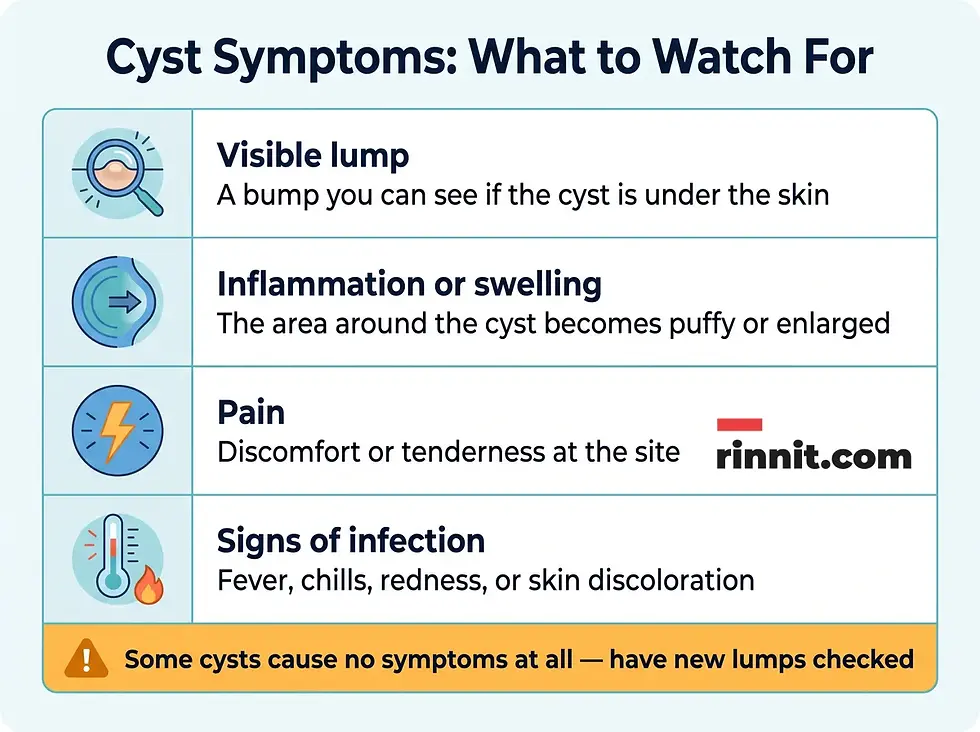
Cyst symptoms: visible lump, swelling, pain, and signs of infection.
What Causes Cysts?
Cysts form for many different reasons, and sometimes they appear randomly without an obvious cause. The known causes are listed below.
Cause | How It Leads to a Cyst |
Blocked ducts | Fluid backs up and collects in a closed sac |
Clogged glands | Gland secretions become trapped |
Infections | The body walls off infected tissue |
Certain parasites | Parasites such as tapeworms can form cysts |
Certain injuries | Especially injuries that damage blood vessels |
Chronic inflammation | Ongoing inflammation promotes sac formation |
Genetic conditions | Inherited conditions can predispose to cysts |
What Are the Potential Complications of Cysts?
Left untreated, cancerous (malignant) cysts can allow cancer cells to spread beyond the lump to other parts of the body.
Noncancerous (benign) cysts can also cause problems. They can grow larger and press on surrounding structures, leading to pain and other complications. Benign cysts can also become infected and turn into an abscess. If an abscess ruptures inside the body, it can lead to a blood infection.
All cysts can lead to complications, even noncancerous ones. That is why it is important to tell your healthcare provider about any new lumps or bumps you notice.
Diagnosis and Tests
How Are Cysts Diagnosed?
A healthcare provider will start with a physical exam. If you have a visible cyst, they will look at it and gently feel the area around it.
In some cases, the provider may order tests to look deeper. The main diagnostic tools are summarized below.
Diagnostic Tool | What It Does |
Physical exam | Looking at and gently feeling the lump and surrounding area |
X-rays | Imaging to see cysts inside the body |
Ultrasounds | Imaging to visualize internal cysts |
CT scans | Detailed cross-sectional imaging of internal cysts |
Fine-needle aspiration (FNA) | A needle and syringe pull fluid out of the cyst for lab testing |
Fine-needle aspiration is a type of biopsy. After the fluid is collected, it is sent to a lab for testing. This can help your provider figure out the type of cyst you have and whether treatment is needed.
Management and Treatment
Do Cysts Go Away on Their Own?
Some cysts go away on their own without treatment. However, you should still tell your healthcare provider right away if you develop a lump, even if it seems harmless. The provider may recommend treatment in some cases, or may want to observe the cyst for a few days or weeks before making any decisions.
How Are Cysts Treated?
Healthcare providers use several treatment methods depending on the type of cyst. The options are compared below.
Treatment | How It Works | Best For |
Antibiotics | Shrink an infected cyst temporarily; usually not a permanent fix | Infected cysts |
Steroid injections | Corticosteroids reduce pain and inflammation around the cyst | Painful, inflamed cysts |
Incision and draining | A small cut is made with a needle or scalpel, and all fluid is drained | Fluid-filled cysts |
Laser removal | Laser energy heats the cyst and its fluid so it shrinks and fades over time | Selected skin cysts |
Surgical removal | Fluid is drained and the sac of tissue around the cyst is removed | Cysts that keep returning |
Surgical removal is the best way to reduce the chances of a cyst coming back. It also keeps the cyst from growing bigger or causing complications.
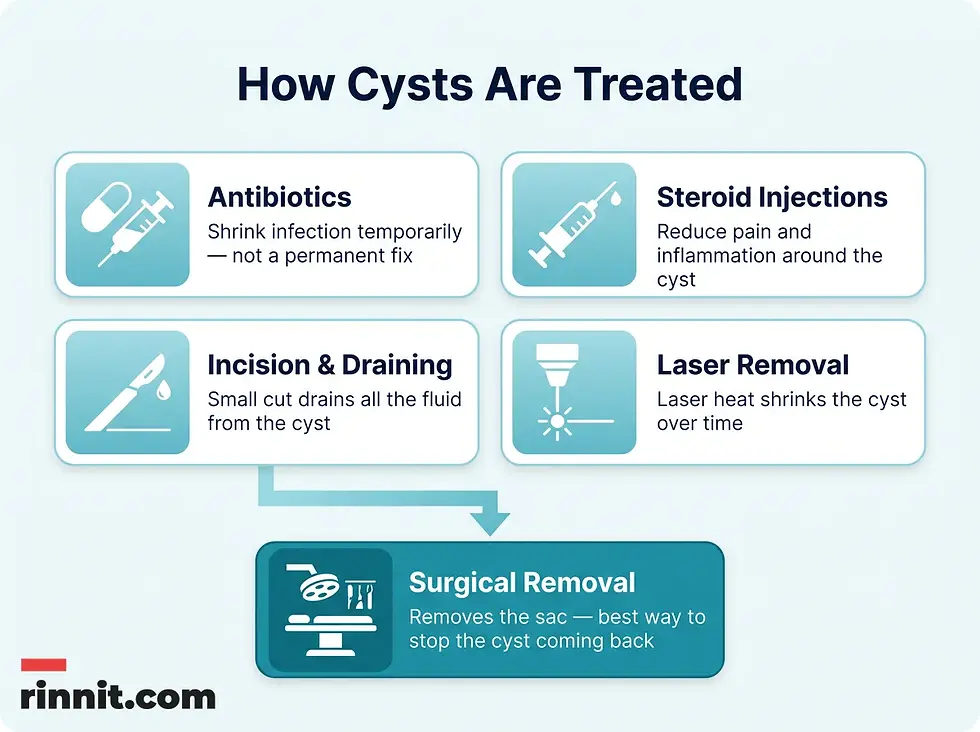
Cyst treatment options, from antibiotics to surgical removal.
What Can You Do for a Cyst at Home?
If you are wondering how to get rid of a cyst, do not try to drain it or remove it yourself. That includes poking it or using something sharp to break it open, which can lead to serious complications such as a skin infection or blood poisoning.
There are, however, safe home-care steps that can ease symptoms.
Home-Care Step | Benefit |
Keep the skin around the cyst clean | Reduces the risk of infection |
Apply heat packs | Helps thin the fluid inside the cyst, draining it into the lymphatic system faster |
Apply ice | Reduces pain and inflammation around the cyst |
When Should You See a Healthcare Provider?
You should tell your healthcare provider any time you notice any of the following.
Warning Sign | Why It Matters |
Any new lump under your skin | Cysts are common, but new lumps should always be checked |
Changes to existing lumps | Growth or change can signal infection or something more serious |
Pain around a cyst | May indicate infection or pressure on surrounding tissue |
Swelling, redness, or skin discoloration | Classic signs of an infected cyst that needs attention |
Outlook / Prognosis
The overall outlook is good if you have a cyst. Cysts are common and rarely cancerous. Even so, a benign cyst might still need treatment, so it is always best to see a healthcare provider.
Conclusion
A cyst is a closed sac of tissue that can form almost anywhere in the body, and most are harmless, fluid-filled lumps that appear on the skin, breasts, ovaries, or kidneys. While most cysts are benign and the outlook is good, some can be precancerous or cancerous, and even benign cysts can become infected, rupture, or press on nearby structures. Because symptoms vary so widely, and because some cysts cause none at all, the safest move is to have any new or changing lump evaluated. A healthcare provider can identify the type of cyst, rule out anything serious, and recommend the right treatment, from simple home care to surgical removal.
If you or a loved one has noticed a new lump, do not wait to see whether it goes away. Talk to a healthcare provider who can examine it, explain what it is, and help you decide on next steps.
Related reading: Pilonidal cyst: symptoms, causes, and treatment.
Frequently Asked Questions
What is a cyst and where do they form?
A cyst is a closed sac of tissue that can form anywhere in the body, usually filled with fluid, pus, air, or other materials. Cysts most commonly develop on the skin, breasts, ovaries, and kidneys. They look like pouches or pockets and are usually not serious.
Are cysts cancerous?
Cysts are usually benign, meaning noncancerous and mostly harmless, though they may cause pain or discomfort. Rarely, cysts can be precancerous or cancerous (malignant). You should always report a new lump, especially one that does not go away after several days or keeps growing, to your healthcare provider.
What do cysts feel and look like?
Cysts typically appear as a visible lump under the skin, and may cause inflammation, swelling, or pain. An infected cyst can become painful and swollen with signs such as fever, chills, redness, or skin discoloration. Some cysts cause no symptoms at all or are visible but painless.
What causes cysts to form?
Cysts form for many reasons: blocked ducts, clogged glands, infections, chronic inflammation, certain parasites (such as tapeworms), injuries that damage blood vessels, and genetic conditions. Sometimes cysts appear randomly with no obvious cause.
What is the difference between a cyst and an abscess?
An abscess is an infected cyst. Benign cysts can become infected and turn into an abscess, which can be painful and swollen. If an abscess ruptures inside the body, it can lead to a blood infection, so infected cysts need medical attention.
Can a cyst go away on its own?
Some cysts go away on their own without treatment. Even so, you should tell your healthcare provider about any new lump, since the provider may recommend treatment or observe the cyst for a few days or weeks before deciding.
Can a cyst rupture?
Yes, cysts can rupture (burst). Whether a rupture causes symptoms depends on the type and location of the cyst. A ruptured skin cyst may cause mild symptoms or none at all, while a ruptured ovarian cyst could cause more severe symptoms like abdominal pain or bleeding.
Are pimples cysts?
No. Pimples differ from cysts because they do not have a sac. Some people develop cystic acne, a condition in which cysts form deep under the skin instead of near the surface like a pimple.
Can I pop or drain a cyst at home?
No. You should never drain or remove a cyst yourself, including poking it or using something sharp to break it open. This can cause serious complications like skin infection or blood poisoning. Safe home care includes keeping the area clean, using heat packs to thin the fluid, and applying ice for pain and inflammation.
How is a cyst removed?
Providers treat cysts with antibiotics (for infections), corticosteroid injections (for pain and inflammation), incision and draining, laser removal, or surgical removal. Surgical removal drains the fluid and removes the sac of tissue, which is the best way to reduce the chance of the cyst coming back.
When should I see a doctor about a lump?
You should tell your healthcare provider any time you notice a new lump under the skin, changes to an existing lump, or pain, swelling, redness, or skin discoloration around a cyst. Even harmless-looking lumps deserve a professional evaluation.
Related Reading
Cyst Removal: Drainage vs. Surgery, What to Expect and Recovery explains how a cyst is drained or surgically removed, what to expect on the day and how recovery goes.
References
Cleveland Clinic. Cyst. Cleveland Clinic. Medically reviewed; last updated November 14, 2025. https://my.clevelandclinic.org/health/diseases/cyst
Balasubramanian K, Kharbat A, Haider A, et al. A systematic review of clinical features of intradiploic epidermoid cysts and strategies for patient management. Neurosurgical Review. 2025;48(1):639. PMID 40938443. https://doi.org/10.1007/s10143-025-03798-2
Paliotta A, Sapienza P, D'Ermo G, et al. Epidermal inclusion cyst of the breast: a literature review. Oncology Letters. 2016;11(1):657-660. PMID 26870262. https://doi.org/10.3892/ol.2015.3968
Medical disclaimer
This article is for general educational purposes only and is not a substitute for professional medical advice, diagnosis or treatment. Always seek the guidance of your healthcare professional with any questions about your or your child's health. In a medical emergency, call 911 or your local emergency number.



Comments