Endoscopy: Types, Preparation, What to Expect and Recovery

Updated: 2 days ago
Written and medically reviewed by Dr. Baraa Alnahhal, MD · Last reviewed: November 2026 · How we review
Quick Answer: What is an endoscopy?
An endoscopy is a procedure that lets a provider look inside the body using an endoscope, a thin tube with a light and camera. The scope goes in through a natural opening, such as the mouth or anus, or a small incision. Providers use it to screen for, diagnose and treat conditions. Most people go home the same day. [1]
What the research says
A careful colonoscopy lowers future colon cancer risk. In 314,872 colonoscopies by 136 gastroenterologists, patients of doctors with the highest adenoma (precancerous polyp) detection rates had about half the risk of later colorectal cancer (hazard ratio 0.52), and each 1% rise in detection rate lowered cancer risk by 3%. (Corley et al., The New England Journal of Medicine, 2014) [2]
Upper endoscopy quality matters too. A meta-analysis of 10 studies with 3,787 people with upper GI cancer found 6.4% had an endoscopy that missed the cancer within the year before diagnosis, and 11.3% within 3 years, highlighting the value of high-quality exams. (Menon and Trudgill, Endoscopy International Open, 2014) [3]
Key takeaways
An endoscope lets providers see organs up close without open surgery. [1]
Each type is named for the organ it examines, such as colonoscopy for the colon. [1]
Many endoscopes have channels for tools to take biopsies, stop bleeding or remove growths. [1]
Preparation may include fasting, a bowel prep and pausing some medicines. [1]
Most side effects, such as a sore throat or bloating, improve within 2 days. [1]
What is an endoscopy?
During an endoscopy, a provider gently places an endoscope inside your body until it reaches the organ or area they need to check. Most endoscopes have a light and a special camera at the end that capture images or video and display them on a screen. Many also have channels inside, so providers can pass instruments through them to remove tissue or perform surgery during the same procedure. [1]
What are the types of endoscopy?
All endoscopies work in the same basic way, but they differ in name, the type of scope (flexible or rigid) and where the scope goes in. The procedure is usually named after the organ being examined. Common types include: [1]

Type | Scope goes through | What it examines |
Colonoscopy | Anus | The entire large intestine (colon) |
Upper endoscopy (EGD) | Mouth | Esophagus, stomach and upper small intestine |
Sigmoidoscopy | Anus | Lower colon (sigmoid) and rectum |
Enteroscopy | Mouth or anus | Small intestine |
Bronchoscopy | Mouth or nostril | Windpipe (trachea) and lungs |
Laryngoscopy | Mouth or nostril | Voice box (larynx) |
Cystoscopy | Urethra | Urethra and bladder |
Ureteroscopy | Urethra | Ureters (tubes from kidneys to bladder) |
Hysteroscopy | Vagina | Uterus |
Laparoscopy | Small incision in the abdomen | Abdominal and reproductive organs |
Arthroscopy | Small incision near a joint | Joint damage or arthritis |
Thoracoscopy | Small incision in the chest | Lungs and the area around them |
Sources: [1]
For step-by-step details on the two most common digestive scopes, see our guides to upper endoscopy (EGD) and lower endoscopy.
Capsule endoscopy
Newer techniques make endoscopy even less invasive. In a capsule endoscopy, you swallow a vitamin-sized capsule with a camera inside. As it travels through your esophagus, stomach and small intestine, it takes pictures that can help find bleeding and tumors. [1]
What does an endoscopy test for?
Endoscopy is used to screen for and diagnose disease. Colonoscopy is the best-known screening endoscopy and is used to detect colon cancer. Endoscopy also lets providers remove abnormal tissue for a biopsy to show whether a growth is cancerous. It can detect conditions affecting your: [1]
Digestive system: gastrointestinal diseases, colon polyps and colon cancer
Head and neck: swallowing disorders and laryngitis
Joints: arthritis, tears and dislocations
Nervous system: brain tumors
Respiratory system: lung disease and infections
Urinary system: urinary tract infections and kidney stones
Reproductive system: abnormal uterine bleeding, endometriosis and fertility problems
Treatments done during endoscopy
With the right instruments, providers can seal wounds, inject medicine, drain fluid, stop internal bleeding, remove damaged tissue or tumors, widen narrowed areas, place stents and perform surgery. For example, a bleeding stomach ulcer that once needed surgery can now often be fixed with endoscopy. Laparoscopic (keyhole) surgery through tiny incisions is now the preferred technique for many conditions. [1]
How do you prepare for an endoscopy?
You will receive instructions for your type of endoscopy. You may be asked to: [1]
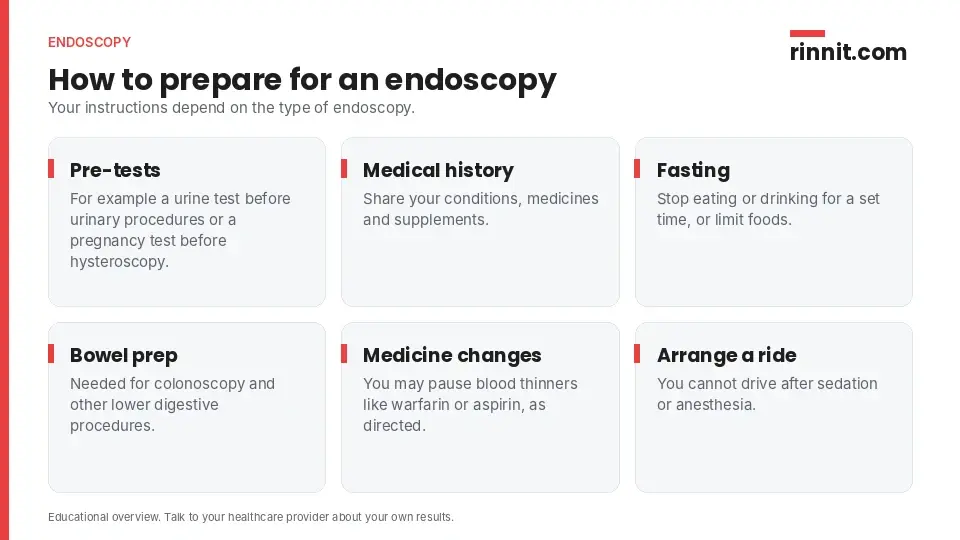
Complete pre-tests, such as a urine test before urinary procedures or a pregnancy test before a hysteroscopy.
Share your medical history, including conditions, medicines and supplements.
Fast, or limit yourself to certain foods and drinks for a set time.
Do a bowel prep before a colonoscopy, enteroscopy or other lower digestive procedure.
Pause certain medicines, such as blood thinners like warfarin and aspirin, only as your provider directs.
Stop smoking and using tobacco before the procedure.
Arrange a ride home, because you cannot drive after sedation or anesthesia.
Sources: [1]
What happens during an endoscopy?
Most endoscopies use moderate sedation so you are asleep and pain-free. A small number need general anesthesia with a breathing tube, and some use local anesthesia plus a sedative so you stay relaxed. Once you are comfortable, the provider gently inserts the scope, adjusts it to view the right area, notes anything irregular, takes tissue or gives treatment if needed and closes any incisions. [1]
Item | What to expect |
Length | About 30 minutes to 2 hours, depending on the type |
Anesthesia | Usually moderate sedation; sometimes general or local anesthesia |
Pain | Prevented by anesthesia or sedation; brief pressure possible |
Going home | Usually the same day; some need an overnight stay |
Sources: [1]
What happens after an endoscopy?
Your care team monitors your vital signs while the anesthesia wears off. You will likely feel groggy, so take it easy for the rest of the day and avoid heavy machinery. Most side effects improve within 2 days and depend on where the scope went: a scope in your throat may leave you hoarse or with a mild sore throat, while a scope in your intestines may cause cramps, bloating or nausea. Your provider will recommend ways to manage discomfort. [1]
Your provider may discuss findings the same day or at a follow-up visit, especially if a biopsy was taken. [1]
When should you call your provider?
Endoscopy is common and considered safe, but complications such as tears and infections can happen. Contact your provider if you notice: [1]

Fever or chills, or redness or swelling at an incision
Black, tarry stool
Extreme pain or bleeding at the incision site
A cough that will not go away, or coughing up blood
Shortness of breath or trouble breathing
Chest pain
Conclusion
Endoscopy gives providers a direct view inside your body, can find problems that other imaging misses and, in many cases, treats them in the same session with faster healing than open surgery. Most procedures are short, and you are usually home the same day. Follow your preparation instructions closely and ask your provider what recovery will look like for your type of endoscopy. [1]
Keep learning: Read our guides to colon polyps, peptic ulcer disease and the CT scan. For more, see the Merck Manual's overview of endoscopy.
FAQ
What is an endoscopy?
An endoscopy is a procedure where a long, thin tube with a light and camera (endoscope) goes inside your body to look at an organ or area up close [1].
What are the most common types of endoscopy?
The most common are colonoscopy, upper endoscopy (EGD) and laparoscopy. Others include bronchoscopy, cystoscopy and hysteroscopy [1].
What can an endoscopy detect?
It can detect problems in the digestive, respiratory, urinary and reproductive systems, joints, head and neck, and nervous system, and it allows biopsies [1].
Do they put you to sleep for an endoscopy?
It depends. Many endoscopies, including those of the digestive tract, use sedation so you sleep; for others you are awake with medicine that blocks pain [1].
Is an endoscopy painful?
Anesthesia and sedatives prevent pain during the procedure. With some, like colonoscopy, you may briefly feel pressure [1].
How long does an endoscopy take?
Typically 30 minutes to 2 hours, depending on the type [1].
How do I prepare for an endoscopy?
You may need pre-tests, fasting, a bowel prep, pausing some medicines and stopping smoking. Arrange a ride home if you get sedation [1].
What are the side effects of an endoscopy?
Most improve within 2 days, such as a mild sore throat after an upper scope or cramps and bloating after a lower scope [1].
Can you go home the same day after an endoscopy?
Most people go home the same day, though some endoscopies need an overnight stay [1].
When should I call my provider after an endoscopy?
Call for fever or chills, black tarry stool, extreme pain or bleeding at an incision, a lasting cough or coughing up blood, trouble breathing or chest pain [1].
Related Reading
Gastrointestinal (GI) Tests: Types, Preparation and What to Expect explains the main types of tests used to check the digestive tract.
Learn more in our guide to Peptic Ulcer Disease: Causes, Symptoms, Diagnosis, and Treatment.
Learn more in our guide to Colon Polyps: Complete Guide to Symptoms, Causes, and Treatment.
Learn more in our guide to Gastrointestinal Bleeding: Where It Comes From, and How Doctors Find and Stop It.
Learn more in our guide to Acid Reflux & GERD: Symptoms, Causes, Diagnosis, and Treatment.
tTG-IgA Test for Celiac Disease: Normal Ranges, What Results Mean and Next Steps explains the main blood test used to diagnose celiac disease.
References
Cleveland Clinic. Endoscopy: Procedure, Types, What To Expect. Cleveland Clinic. Last updated July 12, 2023. https://my.clevelandclinic.org/health/diagnostics/25126-endoscopy
Corley DA, Jensen CD, Marks AR, et al. Adenoma detection rate and risk of colorectal cancer and death. N Engl J Med. 2014;370(14):1298-1306. PMID 24693890. https://doi.org/10.1056/NEJMoa1309086
Menon S, Trudgill N. How commonly is upper gastrointestinal cancer missed at endoscopy? A meta-analysis. Endosc Int Open. 2014;2(2):E46-E50. PMID 26135259. https://doi.org/10.1055/s-0034-1365524
Medical disclaimer
This article is for general education only and does not replace advice from a qualified healthcare professional. Talk to your doctor about your own diagnosis and treatment, and seek emergency care right away for severe or sudden symptoms.



Comments