Peptic Ulcer Disease: Causes, Symptoms, Diagnosis, and Treatment

Updated: 2 days ago
Medically reviewed by Dr. Baraa Alnahhal, MD · Last reviewed: October 2026
A peptic ulcer is an open sore on the inner lining of the stomach (gastric ulcer) or the first part of the small intestine (duodenal ulcer). The two most common causes are Helicobacter pylori infection and long-term use of NSAID pain relievers. The most common symptom is a dull or burning stomach pain. Most ulcers heal with prescription medicines once the cause is addressed, and untreated ulcers can cause bleeding, perforation, or blockage, which is why medical evaluation matters.
Quick Answer
A peptic ulcer is an open sore on the inner lining of the stomach or duodenum, most commonly caused by Helicobacter pylori infection or long-term NSAID use. The most common symptom is dull or burning stomach pain. Treatment combines antibiotics, acid-reducing medicines and lifestyle changes. Most ulcers heal, but untreated ones can bleed or perforate the stomach wall. [1]
What the research says
Proton pump inhibitors sharply cut NSAID-related ulcers. A Cochrane review of 12 trials with 8,760 people taking NSAIDs long term found that PPIs probably lower the chance of a new ulcer by about 70% compared with placebo (risk ratio 0.29, 95% CI 0.23–0.36; 11 studies, 7,022 participants; moderate-certainty evidence) (Garegnani et al., Cochrane Database Syst Rev, 2025).
Breath tests are the most accurate non-invasive way to detect H. pylori. In a Cochrane review of 101 studies and 11,003 participants, urea breath tests had a sensitivity of 92–94% at a fixed specificity of 90%, compared with 84% for serology and 83% for stool antigen tests, though the comparison was indirect (Best et al., Cochrane Database Syst Rev, 2018).
PPIs protect better than H2 blockers in people on daily low-dose aspirin. A meta-analysis of 1,879 patients found that H2 blockers were less effective than PPIs at preventing aspirin-related GI bleeding (odds ratio 2.10, 95% CI 1.01–4.39) and ulcer formation (odds ratio 2.26, 95% CI 1.28–3.99) (Szabó et al., J Gastrointestin Liver Dis, 2017).
Research summaries are based on article abstracts retrieved from PubMed.
What Is a Peptic Ulcer?
A peptic ulcer is an open sore on the inner lining of the stomach and the upper part of the small intestine. The sore forms when digestive acid eats away at the tissue, creating a painful wound that may bleed. [1]
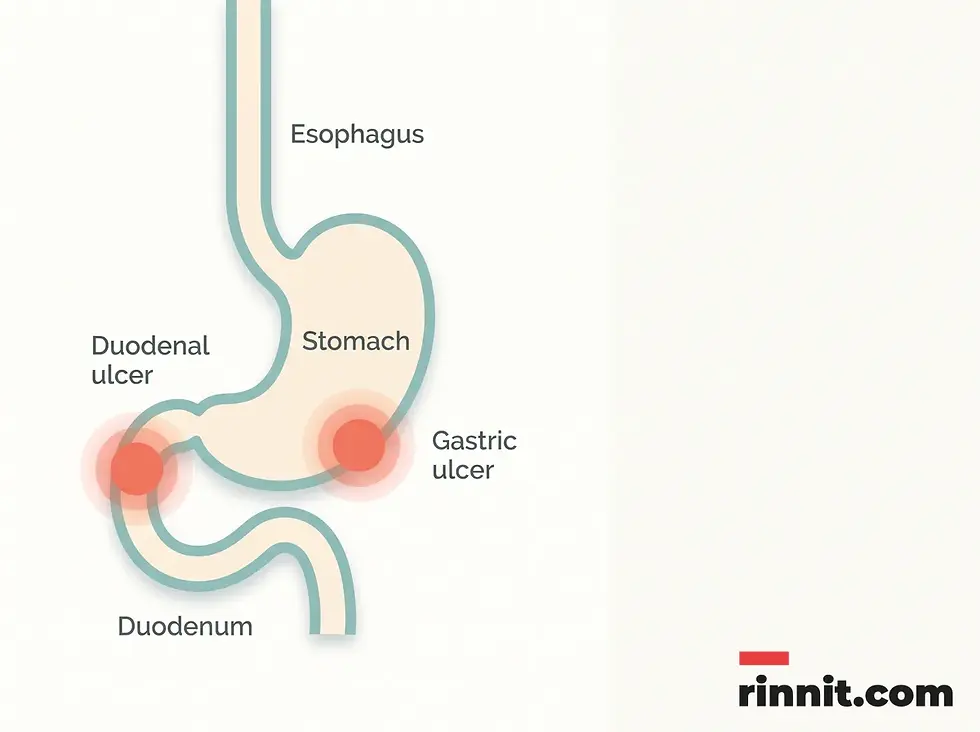
Doctors classify peptic ulcers by location. A gastric ulcer appears on the inside of the stomach. A duodenal ulcer appears on the inside of the duodenum, the first part of the small intestine. Both develop through the same basic process: acid damages the protective lining faster than the body can repair it. [1]
Your digestive tract is normally coated with a mucous layer that protects it against acid. An ulcer develops when the balance tips — either the amount of acid increases or the amount of protective mucus decreases. [1]
Ulcer Type | Location | Notes |
Gastric ulcer | Inside of the stomach | More likely to need a follow-up endoscopy after treatment to confirm healing |
Duodenal ulcer | Inside of the duodenum (first part of the small intestine) | Pain often feels worse between meals and at night |
It is worth knowing what does not cause ulcers. Stress and spicy foods do not cause peptic ulcers. They can make symptoms worse, but they are not the underlying cause. [1]
What are the symptoms of peptic ulcer disease?
Many people with peptic ulcers have no symptoms at all. When symptoms do occur, the most common is stomach pain — typically a dull or burning sensation. [1]
Stomach pain patterns
The pattern of the pain varies from person to person. For some people, the pain is worse between meals and at night, when the stomach is empty. For others, it is worse after eating. This variation in pattern is one reason ulcers can be hard to recognize on your own. [1]
Other common symptoms
Beyond pain, peptic ulcers can produce digestive discomfort. The most frequent accompanying symptoms are a feeling of fullness or bloating, belching, heartburn, and nausea. [1]
Symptom | What It Feels Like |
Stomach pain | Dull or burning; worse between meals and at night for some, worse after eating for others |
Fullness or bloating | Feeling full or swollen in the stomach area |
Belching | Frequent burping |
Heartburn | Burning sensation rising from the stomach toward the chest |
Nausea | Queasy feeling, sometimes with vomiting |
Warning signs of a bleeding ulcer
When an ulcer bleeds, the symptoms become urgent. Vomiting blood can appear red or black. Stools may contain dark blood, or look black and tarry. Feeling dizzy or fainting can signal significant blood loss. These signs need same-day medical attention. [1]
Bleeding Sign | What It Looks Like |
Vomiting blood | Red or black in appearance |
Blood in stools | Dark blood in stool, or stools that are black or tarry |
Blood-loss symptoms | Dizziness or fainting |
When should you see a doctor about a peptic ulcer?
See a healthcare professional right away if you are vomiting blood, having dark blood in your stools, or feeling dizzy. These are possible signs of a bleeding ulcer, which is a medical emergency. [1]
You should also see a healthcare professional if over-the-counter antacids and acid blockers relieve your pain but the pain comes back. Recurring pain means the underlying ulcer is not being addressed, and untreated ulcers can lead to serious complications. [1]
What causes peptic ulcers?
Peptic ulcers happen when acid in the digestive tract eats away at the inner surface of the stomach or small intestine. The acid creates a painful open sore that may bleed. [1]
Two causes account for most ulcers. The first is infection with the germ Helicobacter pylori (H. pylori). This germ lives in the mucous layer that covers and protects the tissues lining the stomach and small intestine. It often causes no problems, but it can cause inflammation — swelling and irritation — of the stomach’s inner layer, which can lead to an ulcer. Read more in our guide to H. pylori infection: symptoms, tests, and treatment. [1]
The second is regular use of certain pain relievers. Taking aspirin or NSAIDs over time can irritate or inflame the lining of the stomach and small intestine. [1]
Cause | How It Creates an Ulcer |
H. pylori infection | The germ inflames the stomach’s inner lining, breaking down its acid protection |
Regular NSAID or aspirin use | The medicines irritate and inflame the stomach and small intestine lining over time |
How H. pylori spreads
It is not clear exactly how H. pylori infection spreads. It may pass from person to person through close contact, such as kissing. People can also contract H. pylori through food and water. [1]
Which pain relievers are the problem
NSAIDs that raise ulcer risk include ibuprofen (Advil, Motrin IB, and others), naproxen sodium (Aleve, Anaprox DS, and others), and ketoprofen, among others. Acetaminophen (Tylenol) is not an NSAID and is not on this list. [1]
What are the risk factors for peptic ulcer disease?
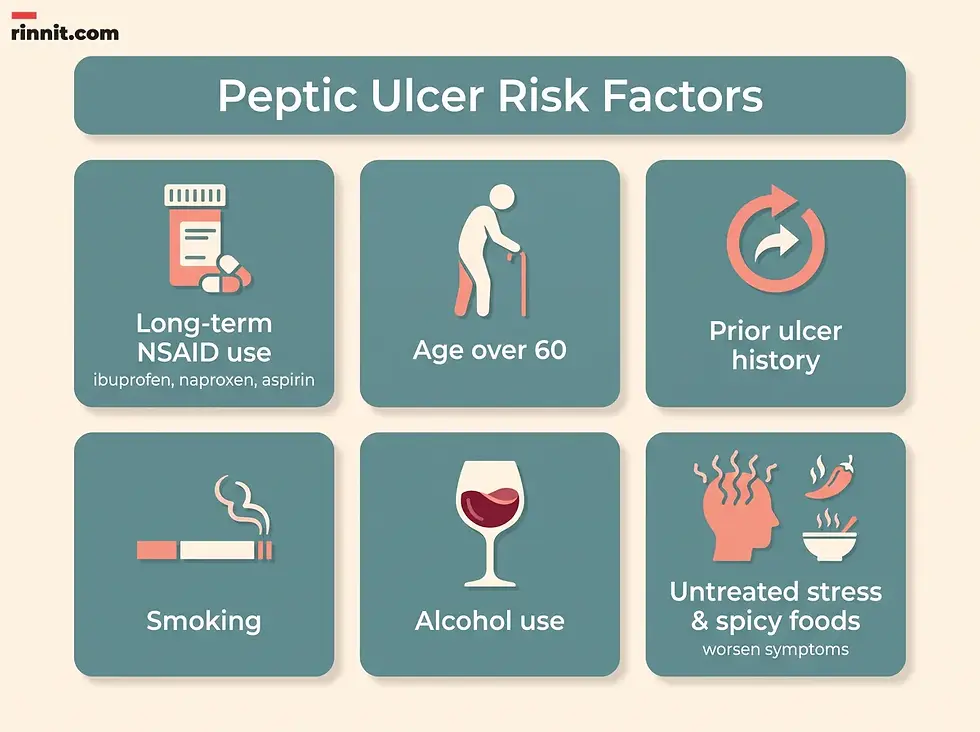
Your risk of peptic ulcers rises mainly if you take NSAIDs. Within that group, certain factors push the risk higher. [1]
Risk Factor | How It Raises Risk |
Age over 60 | Older age increases vulnerability |
Prior peptic ulcer | Having had one before raises the chance of another |
High NSAID doses or multiple NSAIDs | Taking high doses, or two or more NSAIDs, increases risk |
Combining NSAIDs with other medicines | Other pain relievers, steroids, blood thinners, SSRIs (a type of antidepressant), and osteoporosis medicines (such as alendronate and risedronate) add to the risk |
Factors that worsen ulcers without causing them
Four common habits do not cause peptic ulcers, but they can make them worse. Smoking may increase the risk of ulcers in people infected with H. pylori. Alcohol irritates and erodes the mucous lining of the stomach and increases stomach acid. Untreated stress can aggravate symptoms. Spicy foods can also make symptoms worse. [1]
What are the complications of untreated peptic ulcers?
When a peptic ulcer is left untreated, it can lead to four serious complications. [1]
Complication | What Happens | Possible Consequence |
Bleeding | Slow blood loss in the stomach or duodenum | Anemia (too few red blood cells); heavy loss may require hospital care or a blood transfusion |
Perforation | The ulcer eats a hole through the stomach or intestine wall | Peritonitis — a dangerous infection of the abdomen |
Blockage | The ulcer blocks food from passing through the digestive tract | Feeling full easily, vomiting, and weight loss |
Stomach cancer | H. pylori infection is linked to higher stomach cancer risk | Studies show people infected with H. pylori have an increased risk of stomach cancer |
Severe bleeding may show up as black or bloody vomit or black or bloody stools. This is a medical emergency. [1]
How can peptic ulcers be prevented?
You can lower your risk of peptic ulcers with careful pain reliever habits and lifestyle choices. [1]
If you often use NSAIDs, take pain relievers with meals to reduce stomach risk. Work with your healthcare professional to find the lowest dose that still gives you pain relief. Do not drink alcohol with pain relievers — together, they increase your risk of stomach upset. [1]
If you need an NSAID, you may also need protective medicines. These include antacids, proton pump inhibitors, acid blockers, or cytoprotective agents. [1]
Prevention Step | Detail |
Take NSAIDs with meals | Reduces direct stomach irritation |
Use the lowest effective dose | Work with your healthcare professional to find it |
Avoid alcohol with pain relievers | The combination raises stomach upset risk |
Consider protective medicines | Antacids, PPIs, acid blockers, or cytoprotective agents if you need NSAIDs |
COX-2 inhibitors as an option | A class of NSAIDs less likely to cause ulcers, but they may increase heart attack risk |
Quit smoking | Lowering smoking reduces your risk of peptic ulcer |
If you smoke, quitting lowers your peptic ulcer risk. Talk with your healthcare professional for help with quitting. [1]
How are peptic ulcers diagnosed?
To detect an ulcer, a healthcare professional usually starts with a medical history and a physical exam. Several tests can then confirm the diagnosis and find the cause. [2]
H. pylori testing
Blood, stool, or breath tests can show whether H. pylori is in your body. For the breath test, you drink or eat something containing radioactive carbon. H. pylori breaks down the substance in your stomach. You then blow into a bag. If you have H. pylori, your breath sample contains the radioactive carbon in the form of carbon dioxide. [2]
If you take an antacid or an antibiotic, tell your healthcare professional. Both can affect test results, so you may need to stop the medicine temporarily before testing. [2]
Endoscopy
During an endoscopy, a healthcare professional passes a long, flexible tube with a tiny camera (an endoscope) down your throat and into your esophagus, stomach, and small intestine to look for ulcers. If an ulcer is found, a small tissue sample — a biopsy — may be removed for lab study. The biopsy can also show whether H. pylori is in the stomach lining. [2]
You are more likely to have an endoscopy if you are older, have signs of bleeding, or have had recent weight loss or trouble eating and swallowing. If the endoscopy shows a stomach ulcer, a follow-up endoscopy after treatment is likely, to confirm the ulcer has healed. [2]
Upper GI series (barium swallow)
Sometimes doctors order an upper gastrointestinal series, also called a barium swallow. This is a series of X-rays of the upper digestive system that pictures your esophagus, stomach, and small intestine. You swallow a white liquid containing barium, which coats your digestive tract and makes an ulcer easier to see. [2]
Test | How It Works | What It Shows |
H. pylori blood, stool, or breath test | Breath test detects radioactive carbon dioxide after you ingest radioactive carbon | Whether H. pylori is in your body |
Endoscopy | Flexible camera tube down the throat into the stomach and small intestine; biopsy if an ulcer is found | Ulcer presence, and whether H. pylori is in the stomach lining |
Upper GI series (barium swallow) | X-rays after swallowing barium liquid that coats the digestive tract | Ulcers visible on the coated lining |
How are peptic ulcers treated?
Treatment involves three steps: killing the H. pylori germ if it is present, stopping or lowering NSAID use if possible, and taking medicines that help the ulcer heal. [2]
Medicines
Medicine Class | Examples | What It Does |
Antibiotics | Amoxicillin, clarithromycin, metronidazole, tinidazole, tetracycline, levofloxacin | Kills H. pylori — usually given as a combination |
Proton pump inhibitors (PPIs) | Omeprazole, lansoprazole, rabeprazole, esomeprazole, pantoprazole | Reduces stomach acid; given by mouth or, for bleeding ulcers in hospital, through a vein |
Acid blockers (H-2 blockers) | Famotidine, cimetidine, nizatidine | Relieves ulcer pain and helps healing |
Antacids | Various over-the-counter products | Counters stomach acid for quick pain relief; does not heal ulcers |
Cytoprotective agents | Sucralfate (Carafate), misoprostol (Cytotec) | Protects the lining of the stomach and small intestine |
Important cautions
Most people take PPIs in pill form. In the hospital, treatment for a bleeding ulcer may involve a PPI given through a vein in the arm — known as intravenous delivery. [2]
Long-term or high-dose use of proton pump inhibitors may increase your risk of hip, wrist, and spine fracture. Ask your healthcare professional whether a calcium supplement may reduce this risk. [2]
Antacids can relieve pain quickly, but they are not used to heal ulcers. Side effects can include constipation or diarrhea, depending on the antacid’s main ingredients. [2]

What follow-up is needed after peptic ulcer treatment?
Treatment for peptic ulcers often leads to healing. But if your symptoms are severe, or if you still have symptoms even with treatment, your healthcare professional may suggest an endoscopy. This procedure can rule out other possible causes of your symptoms. [2]
If an ulcer is found during endoscopy, you may need another endoscopy after treatment to confirm the ulcer has healed. [2]
Refractory ulcers: when ulcers do not heal
Peptic ulcers that do not heal with treatment are called refractory ulcers. The most common reasons are not taking medicines as prescribed, having a strain of H. pylori that resists antibiotics, or frequent use of NSAIDs. [2]
Reason the Ulcer Doesn’t Heal | How Common |
Not taking medicines as prescribed | Common |
Antibiotic-resistant H. pylori strain | Common |
Frequent NSAID use | Common |
Excess stomach acid (such as Zollinger-Ellison syndrome) | Less common |
Infection other than H. pylori | Less common |
Stomach cancer | Less common |
Other ulcerlike conditions, such as Crohn disease | Less common |
Treatment for refractory ulcers usually involves removing the factors that keep the ulcer from healing and trying other antibiotics. If you smoke, your healthcare professional may suggest quitting, because smoking slows ulcer healing. [2]
When surgery is needed
A serious complication, such as bleeding or a hole in the stomach, may need treatment with endoscopy or surgery. However, because many medicines work well, people with peptic ulcers need surgery far less often than in the past. [2]
Which lifestyle habits and home remedies help peptic ulcers?
You may find relief from ulcer pain with a few everyday changes. [2]
If you use pain relievers regularly, ask your healthcare professional whether acetaminophen (Tylenol) might work for you as a switch. Since acetaminophen is not an NSAID, it does not carry the same ulcer risk. [2]
Controlling stress can help, because stress may make ulcer symptoms worse. Identify what causes your stress and what eases it. Options include exercise, spending time with friends, deep breathing, writing in a journal, or meditating. [2]
Not smoking matters. Smoking may harm the lining of the stomach, raising the chance of an ulcer, and it also increases stomach acid. Limiting or avoiding alcohol helps too — too much alcohol can irritate and eat away the mucous lining in the stomach and intestines, causing inflammation and bleeding. [2]
Home Remedy | Why It Helps |
Switch to acetaminophen | Avoids NSAID irritation of the stomach lining |
Control stress | Stress may make ulcer symptoms worse |
Quit smoking | Smoking harms the stomach lining and increases acid |
Limit or avoid alcohol | Alcohol irritates and erodes the mucous lining |
Can alternative medicine help peptic ulcers?
Products containing bismuth may help with symptoms of a peptic ulcer. There is also some evidence that zinc can help heal ulcers. Talk to your healthcare professional before using any alternative medicine for peptic ulcers. [2]
How should you prepare for a peptic ulcer appointment?
Make an appointment with your main healthcare professional if you have symptoms that worry you. You may be referred to a specialist in the digestive system, called a gastroenterologist. [2]
When you make the appointment, ask if you need to do anything in advance, such as restricting your diet or stopping certain medicines. [2]
Make a list of your symptoms and when they began, noting whether they are worse when your stomach is empty. Include key personal information such as other medical concerns, major stresses, or recent life changes. Also note any family history of peptic ulcers, H. pylori infection, and cancer in the digestive tract. [2]
Write down all medicines, vitamins, and supplements you take, including doses. Be sure to include any pain relievers you use, how much you take, and how often. [2]
Questions to ask your healthcare professional
Your Question | Why It Matters |
What’s the most likely cause of my symptoms? | Identifies H. pylori vs. NSAID cause |
What tests do I need, and how do I prepare? | Prep may include stopping antacids or antibiotics |
Is my condition likely to go away or to last? | Sets expectations for healing time |
What treatment do you suggest? | Guides medicine and lifestyle plan |
Do I need to restrict my diet? | Clarifies eating guidance |
How can I manage my other conditions along with ulcers? | Prevents medicine conflicts |
What your doctor will likely ask
Your healthcare professional might ask whether your symptoms are constant or come and go, how bad they are, whether they are worse when you are hungry, what improves or worsens them, and whether you have nausea or vomiting. They may also ask if you have ever vomited blood or black material, or noticed blood in your stool or black stools. [2]
In the meantime
While you wait for your appointment, avoid tobacco, alcohol, and spicy foods to help ease your discomfort. [2]
Conclusion: Take Ulcer Symptoms Seriously
Peptic ulcers are common, but they are also very treatable when properly diagnosed. The key steps are identifying the cause — usually H. pylori or long-term NSAID use — getting tested, and completing the full treatment plan. Ignoring recurring stomach pain is risky, because untreated ulcers can bleed, create a hole in the stomach wall, or block digestion.
If you have burning or dull stomach pain that returns, even after over-the-counter relief, schedule an appointment with your healthcare professional. Early evaluation protects your digestive health and your peace of mind.
Talk to a healthcare professional today about your stomach pain symptoms. A simple test for H. pylori could be the first step toward lasting relief.
Related Reading
Learn more in our guide to Endoscopy: Types, Preparation, What to Expect and Recovery.
Fecal Occult Blood Test (FOBT): Types, Preparation, Results and Next Steps explains the stool test that checks for hidden bleeding linked to this condition.
H. pylori Tests: Breath, Stool, Blood and Endoscopy Explained explains the breath, stool, blood and endoscopy tests used to find H. pylori infection.
Upper GI Series: What It Is, Why It's Done, How to Prepare and What to Expect explains the barium X-ray test that can show this condition in the esophagus, stomach and duodenum.
Frequently Asked Questions
What is a peptic ulcer?
A peptic ulcer is an open sore on the inner lining of the stomach or the upper part of the small intestine. A sore in the stomach is a gastric ulcer; one in the first part of the small intestine (the duodenum) is a duodenal ulcer. It forms when digestive acid damages the protective lining.
What are the most common causes of peptic ulcers?
The two most common causes are infection with the bacterium Helicobacter pylori and long-term use of nonsteroidal anti-inflammatory drugs (NSAIDs) such as ibuprofen and naproxen. Both irritate or inflame the stomach’s inner lining, letting acid create a sore.
Can stress or spicy food cause peptic ulcers?
No. Stress and spicy foods do not cause peptic ulcers. However, both can make ulcer symptoms worse, so limiting them may ease discomfort.
What does peptic ulcer pain feel like?
Most people describe a dull or burning stomach pain. For some, it is worse between meals and at night. For others, it is worse after eating. Other symptoms include bloating, belching, heartburn, and nausea.
How is H. pylori tested?
Doctors use blood, stool, or breath tests. In the breath test, you ingest radioactive carbon that H. pylori breaks down in your stomach, and a breath sample then shows radioactive carbon dioxide. Antacids and antibiotics can affect results, so tell your doctor about them.
What is an endoscopy for peptic ulcers?
An endoscopy passes a flexible tube with a tiny camera down your throat into your esophagus, stomach, and small intestine to look for ulcers. A small tissue sample (biopsy) may be taken, which can also show whether H. pylori is present.
What medicines treat peptic ulcers?
Treatment may include antibiotics to kill H. pylori (such as amoxicillin and clarithromycin), proton pump inhibitors to reduce acid (such as omeprazole), H-2 blockers (such as famotidine), antacids for quick relief, and cytoprotective agents (such as sucralfate) that protect the stomach lining.
Do antacids heal peptic ulcers?
No. Antacids can relieve ulcer pain quickly by countering stomach acid, but they are not used to heal ulcers. Healing requires treating the cause, usually with antibiotics or acid-blocking prescription medicines.
What are the complications of untreated peptic ulcers?
Untreated ulcers can bleed (causing anemia or emergency blood loss), create a hole in the stomach wall (perforation leading to peritonitis), or block food from passing through the digestive tract. H. pylori infection also raises stomach cancer risk.
What is a refractory ulcer?
A refractory ulcer is one that does not heal with treatment. Common reasons include not taking medicines as prescribed, antibiotic-resistant H. pylori, or frequent NSAID use. Less often, it results from excess stomach acid, another infection, stomach cancer, or Crohn disease.
Can peptic ulcers come back?
Yes. People who have had a peptic ulcer before have a higher risk of having another one. Quitting smoking, limiting alcohol, using the lowest effective NSAID dose with meals, and taking protective medicines can lower your risk of recurrence.
References
Mayo Clinic Staff. Peptic ulcer — Symptoms and causes. Mayo Clinic. August 16, 2024. https://www.mayoclinic.org/diseases-conditions/peptic-ulcer/symptoms-causes/syc-20354223
Mayo Clinic Staff. Peptic ulcer — Diagnosis and treatment. Mayo Clinic. August 16, 2024. https://www.mayoclinic.org/diseases-conditions/peptic-ulcer/diagnosis-treatment/drc-20354229
Garegnani L, Oltra G, Burgos MA, et al. Proton pump inhibitors for the prevention of non-steroidal anti-inflammatory drug-induced ulcers and dyspepsia. Cochrane Database Syst Rev. 2025;5(5):CD014585. PMID: 40337979. DOI: 10.1002/14651858.CD014585.pub2
Best LM, Takwoingi Y, Siddique S, et al. Non-invasive diagnostic tests for Helicobacter pylori infection. Cochrane Database Syst Rev. 2018;3(3):CD012080. PMID: 29543326. DOI: 10.1002/14651858.CD012080.pub2
Szabó IL, Mátics R, Hegyi P, et al. PPIs prevent aspirin-induced gastrointestinal bleeding better than H2RAs. A systematic review and meta-analysis. J Gastrointestin Liver Dis. 2017;26(4):395-402. PMID: 29253055. DOI: 10.15403/jgld.2014.1121.264.hra
Medical disclaimer
This article is for informational purposes only and is not a substitute for professional medical advice, diagnosis, or treatment. Always seek the advice of your physician or other qualified health provider with any questions you may have about a medical condition.



Comments