Fecal Occult Blood Test (FOBT): Types, Preparation, Results and Next Steps

Updated: 2 days ago
Written and medically reviewed by Dr. Baraa Alnahhal, MD · Last reviewed: November 2026 · How we review
Quick Answer: What is a fecal occult blood test?
A fecal occult blood test (FOBT) is a stool test that looks for hidden (occult) blood in your poop. You collect a small sample at home and send it to a lab. It's used to check for bleeding in the digestive tract and to screen for colorectal cancer. A positive result needs follow-up, usually a colonoscopy. [1]
What the research says
FIT finds most colorectal cancers. A meta-analysis of 19 studies found fecal immunochemical tests had a pooled sensitivity of 79% and specificity of 94% for colorectal cancer in average-risk adults. (Lee et al., Annals of Internal Medicine, 2014) [2]
One sample works as well as several. The same review found a single-sample FIT had similar sensitivity and specificity to multiple samples. (Lee et al., Annals of Internal Medicine, 2014) [2]
Screening with FOBT saves lives. Four randomized trials with more than 320,000 people showed FOBT screening reduced colorectal cancer deaths by 16%, and by 25% in people who attended at least one screening. (Hewitson et al., The American Journal of Gastroenterology, 2008) [3]
Key takeaways
An FOBT checks a stool sample for blood you cannot see. [1]
There are three types: guaiac FOBT, FIT and FIT-DNA. [1]
Only the guaiac test needs diet and medicine changes beforehand. [1]
Results usually come back in about a week. [1]
A positive result is not a diagnosis; it leads to more tests, usually a colonoscopy. [1]
Why would you need a fecal occult blood test?
Your provider may order an FOBT if you have symptoms that suggest hidden bleeding in your gastrointestinal (GI) tract, such as unexplained belly or anal pain, or signs of anemia like fatigue and pale skin. [1]
Many conditions can cause hidden bleeding, including colon polyps and hemorrhoids, so the test helps confirm or rule out a diagnosis. [1]
An FOBT is also used for colorectal cancer screening, which is recommended from age 45, or earlier if you have a higher personal or family risk. Colonoscopy remains the gold standard for screening, so discuss the pros and cons of each method with your provider. [1]
What are the types of fecal occult blood test?
There are three types of FOBT, and each finds blood in a different way. [1]

Test | How it works | Best at |
Guaiac FOBT (gFOBT) | Guaiac, a tree resin, changes color when it reacts with heme from red blood cells | May spot bleeding higher in the GI tract |
Fecal immunochemical test (FIT or iFOBT) | Antibodies bind to hemoglobin and trigger a color reaction | More specific for bleeding in the lower GI tract and colorectal cancer screening |
Multitarget stool DNA test with FIT (FIT-DNA) | Combines FIT with a test for DNA changes linked to colon cancer in shed colon cells | An option for people at average risk; repeat every 1 to 3 years |
Sources: [1]
How do you prepare for an FOBT?
FIT and FIT-DNA tests need no preparation. If you have a guaiac FOBT, you need to avoid certain foods and medicines for a few days before the test. [1]
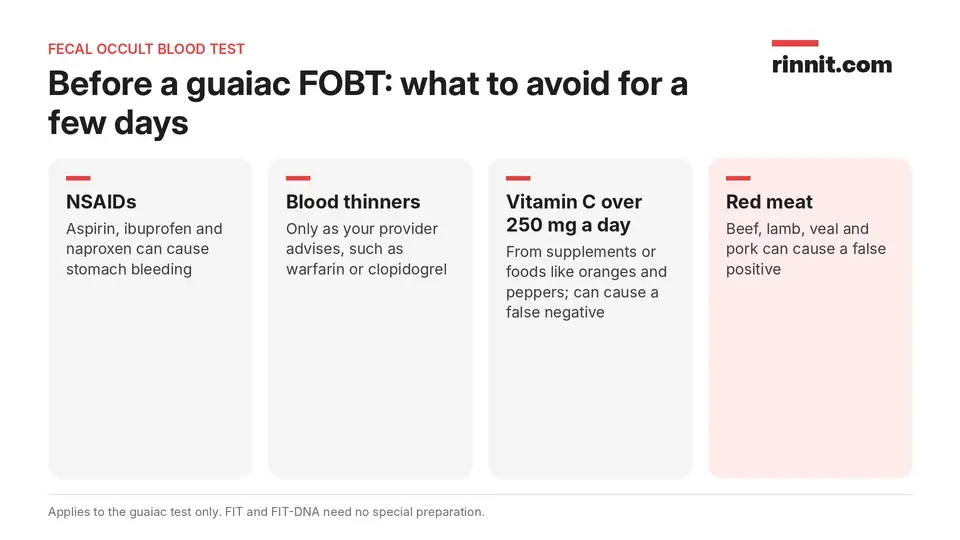
NSAIDs such as aspirin, naproxen and ibuprofen, which can cause temporary stomach bleeding [1]
Blood thinners such as heparin, warfarin or clopidogrel, only as your provider advises [1]
More than 250 mg of vitamin C a day from supplements or foods like oranges, strawberries, broccoli and peppers, which can cause a false negative [1]
Red meat such as beef, lamb, veal and pork, which can cause a false positive [1]
How is the test done?
You may take the test at your provider's office or at home with a prescribed or over-the-counter kit. Always follow the instructions that come with your kit. [1]
Most kits include collection brushes or wooden sticks, test cards or tubes, waste bags and an envelope or box for shipping. You may need one sample or several samples over a few days. Keep them at room temperature and send them back as soon as possible. [1]
The lab usually returns results in about a week. [1]
What does a negative result mean?
A negative result means no bleeding was found. For cancer screening, it means your risk is low. Guidelines recommend repeating a guaiac test or FIT every year, or a FIT-DNA test every 1 to 3 years. [1]
If you have had polyps or have a family history of colorectal cancer or related genetic conditions, colonoscopy is recommended as the only screening method. [1]
What does a positive result mean?
A positive result means blood was detected. It does not mean you have cancer, and false positives can happen, so it must be confirmed. [1]
Bleeding can be a sign of colon polyps, which can turn into cancer and tend to bleed easily. Other causes of hidden bleeding include: [1]
Anal fissures and anal STIs
Diverticulosis or diverticulitis
Esophageal or gastrointestinal varices
Hemorrhoids
Infectious colitis or gastroenteritis
Inflammatory bowel disease
Peptic ulcer disease
In babies and children, other causes include intestinal defects such as malrotation or Hirschsprung's disease, food allergies and food protein-induced enterocolitis syndrome, and necrotizing enterocolitis in preterm infants. [1]
What happens after a positive FOBT?

Your provider will usually follow up with a colonoscopy to look for polyps or other causes of bleeding in the lower intestine. If your symptoms suggest bleeding higher up, you may have an upper GI endoscopy instead. These procedures help confirm, locate and treat the source. [1]
Conclusion
A fecal occult blood test is a simple, painless way to check for hidden blood in your stool. It is a screening tool, not a diagnosis: a positive result means your provider will look for the source, usually with a colonoscopy.
If you are 45 or older, ask your provider whether an FOBT, FIT or colonoscopy is the best screening option for you.
Keep learning: Read our guide to gastrointestinal bleeding or learn about colon cancer screening and treatment. For more background, see MedlinePlus on the fecal occult blood test.
FAQ
What is a fecal occult blood test?
It is a stool test that looks for hidden blood in your poop that you cannot see. [1]
What does an FOBT check for?
It checks for bleeding in the digestive tract and is used to screen for colorectal cancer. [1]
What are the types of FOBT?
The three types are the guaiac FOBT, the fecal immunochemical test (FIT) and FIT-DNA. [1]
Do I need to prepare for an FOBT?
Only for the guaiac test, which requires avoiding NSAIDs, red meat and high-dose vitamin C for a few days. [1]
Can I do an FOBT at home?
Yes. You collect the sample at home with a kit and send it to a lab. [1]
How long do FOBT results take?
Results usually take about a week. [1]
What does a positive FOBT mean?
It means blood was found in your stool. It does not mean cancer, and your provider will look for the cause. [1]
What causes a positive FOBT besides cancer?
Polyps, hemorrhoids, anal fissures, diverticular disease, ulcers, varices, colitis and inflammatory bowel disease can all cause hidden bleeding. [1]
What happens after a positive FOBT?
You usually need a colonoscopy, or an upper endoscopy if bleeding seems to come from higher up. [1]
How often should I have an FOBT?
After a negative screening result, guidelines recommend repeating a guaiac test or FIT every year, or FIT-DNA every 1 to 3 years. [1]
Is an FOBT as good as a colonoscopy?
No. Colonoscopy is the gold standard for colorectal cancer screening, and an FOBT cannot diagnose cancer on its own. [1]
Related Reading
Gastrointestinal Bleeding: Where It Comes From, and How Doctors Find and Stop It explains the bleeding an FOBT is designed to detect.
Colon Cancer: Symptoms, Screening, Diagnosis, Treatment and Support covers the main cancer FOBT screening looks for.
Colon Polyps: Complete Guide to Symptoms, Causes, and Treatment describes growths that can cause a positive result.
Peptic Ulcer Disease: Causes, Symptoms, Diagnosis, and Treatment explains one cause of hidden bleeding higher in the gut.
Diverticulitis: Symptoms, Causes, Treatment & Diet — Complete Guide covers another common cause of a positive FOBT.
References
Cleveland Clinic. Fecal Occult Blood Test (FOBT): Results & What They Mean. Cleveland Clinic. Last updated April 1, 2026. https://my.clevelandclinic.org/health/diagnostics/24227-fecal-occult-blood-test-fobt
Lee JK, Liles EG, Bent S, et al. Accuracy of fecal immunochemical tests for colorectal cancer: systematic review and meta-analysis. Ann Intern Med. 2014;160(3):171-181. PMID 24658694. https://doi.org/10.7326/M13-1484
Hewitson P, Glasziou P, Watson E, et al. Cochrane systematic review of colorectal cancer screening using the fecal occult blood test (hemoccult): an update. Am J Gastroenterol. 2008;103(6):1541-1549. PMID 18479499. https://doi.org/10.1111/j.1572-0241.2008.01875.x
Medical disclaimer
This article is for general education only and does not replace advice from a qualified healthcare professional. Talk to your doctor about your own diagnosis and treatment, and seek emergency care right away for severe or sudden symptoms.



Comments