tTG-IgA Test for Celiac Disease: Normal Ranges, What Results Mean and Next Steps

Updated: 2 days ago
Written and medically reviewed by Dr. Baraa Alnahhal, MD · Last reviewed: November 2026 · How we review
Quick Answer
The tTG-IgA test (tissue transglutaminase IgA) is a blood test that looks for antibodies the immune system makes in celiac disease. It's usually the first test for people with celiac symptoms or at higher risk. You must still be eating gluten for the result to be accurate. A positive test is usually confirmed with a small intestine biopsy.
What the research says
It's a strong first test, especially in children: a meta-analysis of 113 studies and 28,338 people found tTG-IgA had 90.7% sensitivity and 87.4% specificity in adults and 97.7% sensitivity in children, while the endomysial antibody (EMA) test was the most specific (99.6% in adults), supporting tTG to rule out and EMA to rule in celiac disease (Sheppard AL et al., Alimentary Pharmacology & Therapeutics, 2022) [2]
Very high levels may avoid a biopsy in some adults: across 18 studies and 12,103 adults, a tTG-IgA level at least 10 times the upper limit of normal had 100% specificity for celiac disease, though only 51% sensitivity, so selected adults with very high levels and a high pretest probability could be diagnosed without a biopsy (Shiha MG et al., Gastroenterology, 2024) [3]
Key takeaways
Measures IgA antibodies against tissue transglutaminase, an enzyme targeted in celiac disease.
Keep eating gluten before the test; a gluten-free diet can cause a false negative.
Typical ranges: below 4 U/mL negative, 4–10 borderline, above 10 positive.
IgA deficiency can cause a false negative, so total IgA is often checked at the same time.
A positive result is usually confirmed with an upper endoscopy and small intestine biopsy.
What is the tTG-IgA test?
In celiac disease, eating gluten, a protein in wheat, barley and rye, triggers an immune attack on the small intestine. As part of this reaction, the body makes IgA antibodies against tissue transglutaminase (tTG), an enzyme in the gut lining. The tTG-IgA test measures these antibodies in the blood. It's the most widely used screening test for celiac disease and is often combined with other tests to confirm the diagnosis. Sources: [1]
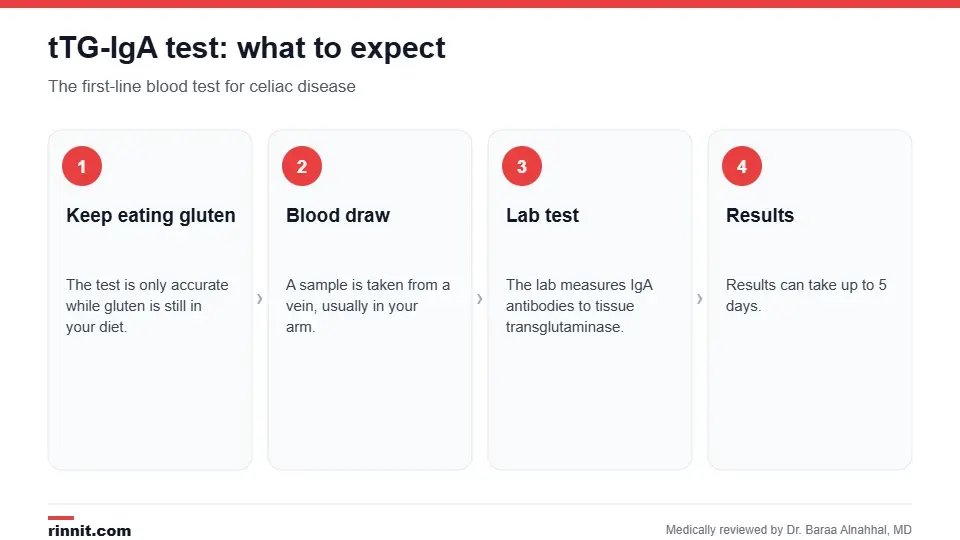
The tTG-IgA test is a simple blood draw.
Why is it done?
Your provider may order it if you or your child has symptoms such as: Sources: [1]
Diarrhea or constipation.
Bloating and abdominal pain.
Poor growth in children (growth faltering).
Malnutrition or weight loss.
Infertility.
Iron deficiency anemia without another explanation.
It's also used to screen people at higher risk, including those with type 1 diabetes, autoimmune thyroid disease or a family history of celiac disease. Sources: [1]
How do I prepare?
No special preparation is needed, but you must keep eating gluten. If you've already cut gluten out, the antibodies fall and the test can miss celiac disease. Talk to your provider before starting a gluten-free diet; if you've already stopped, they may advise eating gluten again for several weeks before testing. Sources: [1]
What happens during the test?
A provider cleans the skin and draws a blood sample, usually from a vein in your arm.
The sample is sent to a lab.
Results can take up to five days. Sources: [1]
The risks are low: brief needle pain or a small bruise. Sources: [1]
Understanding your results

Labs may use different units and cutoffs.
Result (U/mL) | Interpretation | Usual next step |
Less than 4 | Negative | Celiac disease is unlikely if you were eating gluten and have normal IgA |
4–10 | Borderline | Repeat testing or other antibody tests |
Greater than 10 | Positive | Referral for endoscopy and small intestine biopsy |
A high level usually points to celiac disease, but a positive result isn't 100% conclusive, so providers usually confirm it with a biopsy. Ranges can differ between labs. Sources: [1]
What can cause a false result?
A gluten-free diet: antibody levels drop when gluten is removed.
IgA deficiency: people with selective IgA deficiency don't make enough IgA, so the test can be falsely negative; a total IgA level and IgG-based tests help in this case.
Other conditions: some autoimmune and liver diseases can cause low positive results. Sources: [1, 2]
What happens next?
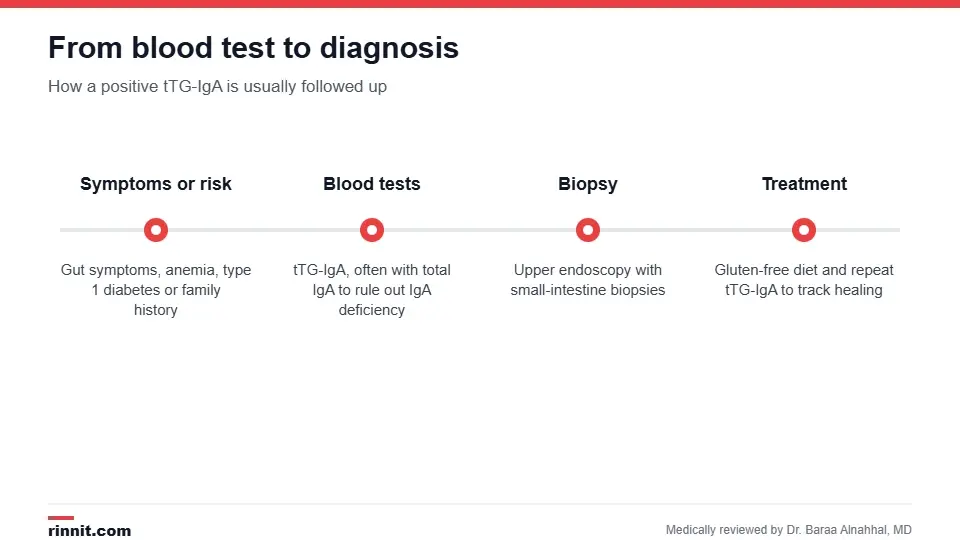
How celiac disease is usually confirmed and treated.
After a positive test, a gastroenterologist usually performs an upper endoscopy and takes small biopsies from the small intestine to look for damage. In some guidelines, children with very high levels and a confirmatory EMA test can be diagnosed without a biopsy, and research suggests this may also work for selected adults. Once diagnosed, a strict gluten-free diet is the treatment, and tTG-IgA is repeated over time to check that levels fall. Sources: [1, 2, 3]
Not everyone with symptoms after eating gluten has celiac disease; gluten intolerance (non-celiac gluten sensitivity) causes similar symptoms with a negative tTG-IgA. Sources: [1]
Conclusion
The tTG-IgA test is the main blood test for celiac disease and is very accurate while you're still eating gluten. Get tested before changing your diet, make sure IgA deficiency is ruled out, and expect a biopsy to confirm a positive result in most cases.
Keep learning: read about celiac disease and selective IgA deficiency.
Frequently asked questions
What does a tTG-IgA test detect?
IgA antibodies against tissue transglutaminase, which are made in celiac disease.
Do I need to eat gluten before the test?
Yes. A gluten-free diet can lower antibody levels and cause a false negative.
What is a normal tTG-IgA level?
Typically below 4 U/mL, though ranges vary by lab.
What does a positive result mean?
It usually points to celiac disease, but it's often confirmed with a small intestine biopsy.
Can the test be wrong?
Yes. IgA deficiency or a gluten-free diet can cause false negatives.
Why is total IgA checked too?
To make sure you make enough IgA for the test to work.
How accurate is tTG-IgA?
Very accurate while eating gluten; about 91% sensitive in adults and 98% in children in one meta-analysis.
Do I always need a biopsy?
Usually yes, though some children, and possibly some adults, with very high levels may be diagnosed without one.
How long do results take?
Up to five days.
Is the test used to monitor celiac disease?
Yes. Levels should fall on a strict gluten-free diet.
Related Reading
Celiac Disease: How Gluten Damages Your Gut, and How a Gluten-Free Diet Can Heal It the condition this test detects.
Gluten Intolerance: What It Is, Why It Happens, and How It's Treated similar symptoms with a negative test.
Selective IgA Deficiency Guide: Symptoms, Causes, Diagnosis, and Treatment a cause of false-negative results.
Iron Deficiency Anemia: Symptoms, Causes, Treatment & Complete Guide a common sign of celiac disease in adults.
Endoscopy: Types, Preparation, What to Expect and Recovery the procedure used to confirm the diagnosis.
References
Cleveland Clinic. Tissue Transglutaminase IgA Test. Cleveland Clinic. Last updated April 28, 2026. https://my.clevelandclinic.org/health/diagnostics/ttg-iga-test
Sheppard AL, Elwenspoek MMC, Scott LJ, et al. Systematic review with meta-analysis: the accuracy of serological tests to support the diagnosis of coeliac disease. Alimentary Pharmacology & Therapeutics. 2022;55(5):514-527. PMID 35043426. https://doi.org/10.1111/apt.16729
Shiha MG, Nandi N, Raju SA, et al. Accuracy of the no-biopsy approach for the diagnosis of celiac disease in adults: a systematic review and meta-analysis. Gastroenterology. 2024;166(4):620-630. PMID 38176661. https://doi.org/10.1053/j.gastro.2023.12.023
Medical disclaimer
This article is for general education only and does not replace advice from a qualified healthcare professional. Talk to your doctor about your own diagnosis and treatment, and seek emergency care right away for severe or sudden symptoms.



Comments