Selective IgA Deficiency Guide: Symptoms, Causes, Diagnosis, and Treatment

Updated: 2 days ago
Medically reviewed by Dr. Baraa Alnahhal, MD · Last reviewed: September 2026
TL;DR
Selective IgA deficiency is the most common primary immunodeficiency: the body produces little or no immunoglobulin A (IgA), the antibody that guards the airways, lungs, and digestive system, while other antibodies usually stay at typical levels. Most people with it never have a single symptom. Those who do tend to get frequent repeat infections of the ears, sinuses, lungs, and gut. There is no treatment for the deficiency itself; care focuses on treating infections with antibiotics, and in some cases with preventive antibiotics. One safety rule stands apart from everything else: because of the risk of reactions to transfused blood, a medical alert bracelet is recommended [1] [2].
Quick Answer
What it is: A condition in which immune cells produce little or no IgA, the antibody found in blood, tears, saliva, breast milk, and the fluids lining the airways, lungs, and digestive tract, while other immunoglobulins usually remain at typical levels [1].
How it's diagnosed: With a blood test that measures immunoglobulin levels; the deficiency can be complete or partial [2].
What causes it: Immune cells fail to produce enough IgA for reasons not fully understood; certain seizure, epilepsy, or rheumatoid arthritis medicines can cause it in some people, and it may persist after the medicine is stopped [1].
What the symptoms look like: Most people have none; some have frequent ear infections (especially young children), colds, sinus infections, lung illnesses, or giardiasis, a parasitic gut infection [1].
Treatment in one line: There is no treatment specifically for the deficiency; antibiotics treat infections as needed, and long-term illness may call for preventive antibiotics (antibiotic prophylaxis) [2].
What This Guide Is Based On
This guide is built entirely from specialist-reviewed clinical guidance updated in May 2024, supported by the Nelson Textbook of Pediatrics (22nd ed., 2025) chapter on primary defects of antibody production, the Immune Deficiency Foundation's selective IgA deficiency resource, Goldman-Cecil Medicine (27th ed., 2024), Henry's Clinical Diagnosis and Management by Laboratory Methods (24th ed., 2022), UpToDate overviews of selective IgA deficiency, and the Merck Manual's transfusion complications reference. These peer-reviewed and institution-backed references are cited inline throughout, with the full list at the end of this guide [1] [2].
What Is Selective IgA Deficiency?
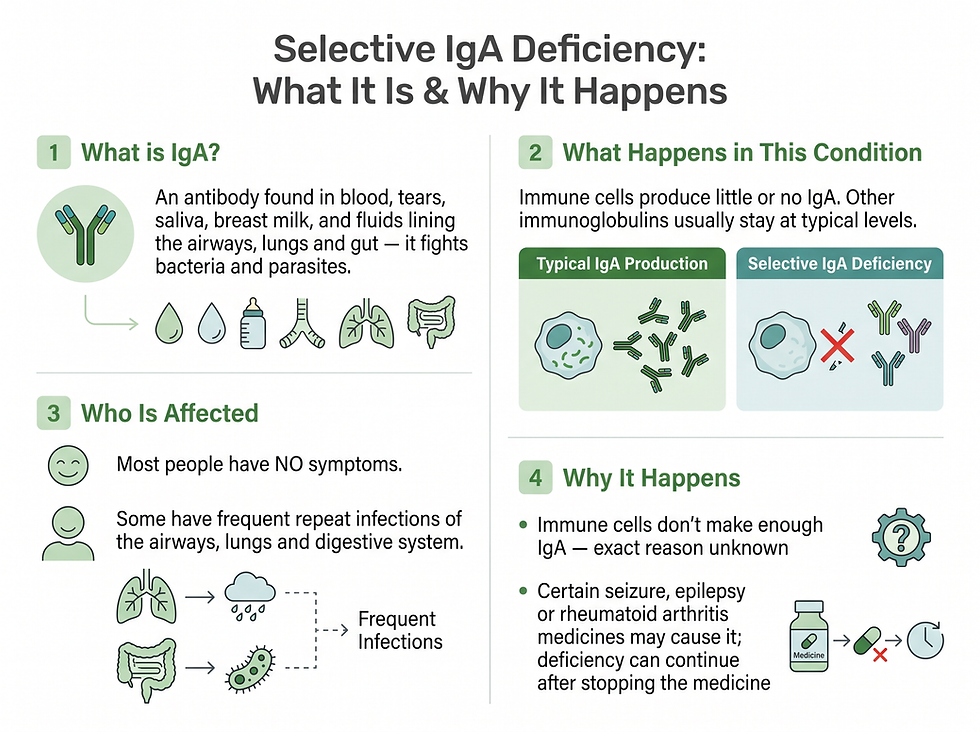
Selective IgA deficiency is the lack of a disease-fighting antibody in the immune system called immunoglobulin A (IgA). People with this condition usually have typical levels of the other immunoglobulins, which is what makes the deficiency “selective” [1].
An immunoglobulin is an antibody produced by immune system cells to fight bacteria, parasites, and other agents that cause illness. IgA antibodies circulate in the blood and are found in tears, saliva, breast milk, and the fluids released from the lining of the airways, lungs, and digestive system, the body's front-line surfaces where most germs enter [1].
Most people with selective IgA deficiency have no symptoms at all. Some people do have frequent illness of the airways, lungs, and digestive system, and the condition may raise the risk of other immune-related conditions such as allergies, asthma, rheumatoid arthritis, and inflammatory bowel disease. There is no treatment specifically for the deficiency itself; treatments focus on the frequent, repeat, or long-lasting conditions that develop alongside it [1].
What Are the Signs and Symptoms?
Most people with selective IgA deficiency have no symptoms. Some people have illnesses more often than is typical, and they may have a particular illness that returns often. It is worth noting that having frequent illnesses does not necessarily mean a person has selective IgA deficiency [1].
When symptoms do occur, they center on repeat episodes of infections at the body's mucosal surfaces, the airways, lungs, and digestive system [1].
Symptom | What it looks like |
Ear infections | Frequent or repeat episodes, particularly in young children [1] |
Colds | Repeated upper respiratory infections [1] |
Sinus infections | Frequent or recurring sinusitis [1] |
Lung illnesses | Bronchitis or pneumonia that comes back [1] |
Giardiasis | A parasitic illness of the digestive system that causes diarrhea [1] |
Children with frequent illnesses may not eat well or may not gain weight typical for their age [1].

What Causes Selective IgA Deficiency?
Selective IgA deficiency happens when immune system cells don't produce any IgA antibodies, or produce very few. The exact reason cells fail to produce these antibodies is not known [1].
There is one known exception with a clearer link: certain medicines used to treat seizures, epilepsy, or rheumatoid arthritis may cause selective IgA deficiency in some people. In those cases, the deficiency may continue even after the medicine is no longer taken [1].
Who Is Most at Risk?
A family history of selective IgA deficiency increases the risk of the condition. Certain variations of genes appear to be linked to it, but no gene is known to directly cause the condition [1].
Risk factor | What it means |
Family history | Having a relative with selective IgA deficiency increases risk [1] |
Gene variations | Certain gene variants appear linked, though no single gene directly causes the condition [1] |
Certain medicines | Drugs for seizures, epilepsy, or rheumatoid arthritis may cause the deficiency in some people; it may persist after stopping the medicine [1] |
What Are the Possible Complications?
People with selective IgA deficiency are at increased risk of other long-term conditions, including allergies and asthma, rheumatoid arthritis, celiac disease, inflammatory bowel disease, and common variable immunodeficiency (CVID), a more serious condition defined as a lack of two or more types of immunoglobulins [1].
Complication | What it means |
Allergies and asthma | Elevated risk of these common immune-related conditions [1] |
Rheumatoid arthritis | Higher risk of this autoimmune joint disease [1] |
Celiac disease | An immune reaction to gluten; risk is elevated [1] |
Inflammatory bowel disease | Higher risk of chronic gut inflammation such as Crohn's disease or ulcerative colitis [1] |
Common variable immunodeficiency | A lack of two or more types of immunoglobulins, a step beyond selective IgA deficiency [1] |
The Blood Transfusion Risk: Why a Medical Bracelet Matters
People with selective IgA deficiency are at risk of reactions to blood transfusions or blood products. Because the body does not make IgA, the immune system may see the IgA in transfused blood as a foreign substance and attack it [1].
A reaction may cause high fever, chills, sweating, and other symptoms. Rarely, the reaction can be a life-threatening allergic reaction called anaphylaxis. Healthcare professionals recommend wearing a medical bracelet that shows you have selective IgA deficiency and should receive modified blood or blood products [1].
How Is Selective IgA Deficiency Diagnosed?
Diagnosis is based on a blood test that measures levels of immunoglobulins in the blood. The IgA deficiency can be complete, essentially no IgA is made, or partial, with low but detectable levels [2].
Your healthcare professional may order an immunoglobulin blood test because you have had frequent or repeat illnesses. The test also may be part of a series of lab tests ordered to diagnose or rule out other conditions [2].

How Is Selective IgA Deficiency Treated?
There is no treatment specifically for selective IgA deficiency. Care focuses on the infections and conditions that develop alongside it [1].
Antibiotic treatments are prescribed as needed to treat bacterial disease. If you have had a long-term illness, such as chronic bronchitis, you may receive antibiotics as a preventive treatment, a therapy called antibiotic prophylaxis [2].
Treatment approach | When it is used |
Antibiotics as needed | Prescribed to treat bacterial infections when they occur [2] |
Antibiotic prophylaxis | Preventive antibiotics for people with long-term illness, such as chronic bronchitis [2] |
Treating associated conditions | Care for the frequent, repeat, or long-lasting conditions that develop with the deficiency; no treatment targets the deficiency itself [1] |
What Self-Care and Safety Measures Help?
The single most important self-care step is a safety precaution rather than a treatment: wear a medical alert bracelet stating that you have selective IgA deficiency and should receive modified blood or blood products. This protects you in emergencies where blood products may be needed before your care team is available [1].
Beyond that, the practical guidance is straightforward: report frequent or repeat infections to your healthcare professional so the pattern can be investigated; complete any antibiotic course as prescribed; and tell every new doctor, dentist, and hospital about the condition before any procedure involving blood products [1] [2].
How Should You Prepare for Your Appointment?
You may start by seeing your primary healthcare professional, who may refer you to a specialist in immune system disorders called an immunologist [2].
When preparing, make a list of your symptoms, including any that do not seem related to the reason for the appointment. Note key personal information such as major stresses, recent life changes, and family medical history. Bring a list of all medicines, vitamins, and supplements you take, with doses and reasons. Take a family member or friend along, if possible, to help remember the information you receive [2].
Useful questions to ask include: what are the possible causes of these frequent illnesses; what tests will I need; what are possible treatment plans; how can I manage my other health conditions together; should I see a specialist; and what printed materials or websites do you recommend [2].
Your healthcare professional is likely to ask about the symptoms you have had, the illnesses you have been diagnosed with in the past, how often you have had them in the past year, the treatments you have received, and whether there is a history of immune system disorders in your family [2].
Conclusion: Common, Often Silent, Manageable
Selective IgA deficiency is a surprisingly common immune condition, yet most people with it never have a single symptom. When it does show itself, it does so through frequent repeat infections of the ears, sinuses, lungs, and gut, particularly in young children, and it can raise the risk of conditions like allergies, asthma, rheumatoid arthritis, and celiac disease. The diagnosis is simple, a blood test measuring immunoglobulin levels, and while there is no treatment for the deficiency itself, antibiotics treat infections as needed and preventive antibiotics protect those with long-term lung illness. The one detail everyone with this condition should act on is the blood transfusion risk: a medical bracelet ensures you receive modified blood products if an emergency ever requires them. If you or your child has a pattern of frequent infections, a medical evaluation is the sensible first step.
If you or a family member has frequent or repeat infections, talk to a healthcare professional.
This guide is for general education only and is not a substitute for professional medical advice, diagnosis, or treatment. Always seek the advice of a qualified healthcare provider with any questions about a medical condition.
Frequently Asked Questions
What is selective IgA deficiency, in simple terms?
It is a condition in which the immune system produces little or no immunoglobulin A (IgA), the antibody found in blood, tears, saliva, breast milk, and the fluids lining the airways, lungs, and digestive tract, while the other antibodies usually stay at typical levels [1].
How common is it, and do most people notice it?
Most people with selective IgA deficiency have no symptoms and never notice it. Some people have illnesses more often than typical, particularly infections of the airways, lungs, and digestive system [1].
What symptoms should I look for?
Frequent or repeat ear infections (especially in young children), colds, sinus infections, lung illnesses such as bronchitis or pneumonia, and giardiasis, a parasitic gut infection that causes diarrhea. But frequent illness alone does not necessarily mean selective IgA deficiency [1].
Is it inherited?
A family history of selective IgA deficiency increases the risk, and certain gene variations appear linked, but no gene is known to directly cause the condition [1].
What other conditions does it raise the risk of?
Allergies and asthma, rheumatoid arthritis, celiac disease, inflammatory bowel disease, and common variable immunodeficiency, a more serious condition defined as a lack of two or more types of immunoglobulins [1].
How is it diagnosed?
With a blood test that measures immunoglobulin levels in the blood. The deficiency can be complete or partial, and the test may be ordered after frequent or repeat illnesses, or as part of a series of lab tests to diagnose or rule out other conditions [2].
Is there a cure or treatment for the deficiency itself?
No. There is no treatment specifically for selective IgA deficiency. Treatment focuses on the infections and conditions that develop alongside it, antibiotics as needed, and preventive antibiotics (prophylaxis) for long-term illness such as chronic bronchitis [1] [2].
Why is a medical bracelet recommended?
Because the body makes no IgA, the immune system can treat the IgA in transfused blood as a foreign substance, causing reactions with fever, chills, and sweating, and rarely anaphylaxis, a life-threatening allergic reaction. A medical bracelet shows you need modified blood or blood products [1].
References
Additional references consulted:
Kliegman RM, et al. Primary defects of antibody production. In: Nelson Textbook of Pediatrics. 22nd ed. Elsevier; 2025.
Immune Deficiency Foundation: Selective immunoglobulin deficiency: IgA and IgM
McPherson RA, et al., eds. Laboratory evaluation of immunoglobulin function and humoral immunity. In: Henry's Clinical Diagnosis and Management by Laboratory Methods. 24th ed. Elsevier; 2022.
Goldman L, et al., eds. Primary immunodeficiency diseases. In: Goldman-Cecil Medicine. 27th ed. Elsevier; 2024.
Hostoffer RW. Selective IgA deficiency: Management and prognosis. UpToDate.
Hostoffer RW. Selective IgA deficiency: Clinical manifestations, pathophysiology, and diagnosis. UpToDate.
Merck Manual Professional Version: Complications of transfusions
Source references:
Selective IgA deficiency — Symptoms & causes (updated May 24, 2024)
Selective IgA deficiency — Diagnosis & treatment (updated May 24, 2024)
Comments