Gluten Intolerance: What It Is, Why It Happens, and How It's Treated

Updated: 3 days ago
Medically reviewed by Dr. Baraa Alnahhal, MD · Last reviewed: October 2026
Quick Answer
Gluten intolerance is a condition in which eating gluten causes illness without the autoimmune response seen in celiac disease. Symptoms include bloating, gas, stomach pain, brain fog and fatigue. The exact cause is unknown. Diagnosis involves ruling out other conditions, then an elimination and reintroduction diet, and treatment is a gluten-free or limited-gluten diet. [1]
What the research says
How common it is. A systematic review and meta-analysis of 25 studies (49,476 participants from 16 countries) found a pooled prevalence of self-reported non-celiac gluten or wheat sensitivity of 10.3% (95% CI 7.0% to 14.0%). It was more common in women than in men (odds ratio 2.29; 95% CI 1.80 to 2.90) and was linked with irritable bowel syndrome (odds ratio 4.78; 95% CI 3.48 to 6.57). These are self-reported cases, not confirmed diagnoses [2].
Is gluten always the trigger? In a double-blind crossover trial of 37 people with self-reported gluten sensitivity and irritable bowel syndrome, symptoms improved on a low-FODMAP diet (fermentable carbohydrates) and then worsened to a similar degree when the diet contained gluten or whey protein. Gluten-specific effects were seen in only 8% of participants [3].
Why testing matters. A meta-analysis of 11 gluten re-challenge studies found that about 30% of patients with a diagnosis of gluten sensitivity relapsed after a gluten challenge (range 7% to 77%), and the percentage who relapsed after gluten or after placebo was similar [4]. This is why a careful, supervised elimination and reintroduction process is recommended instead of self-diagnosis.
What Is Gluten Intolerance?
Gluten intolerance occurs when an individual experiences illness after consuming gluten, a specific protein found in wheat, barley, rye, and other grains. Medically referred to as non-celiac gluten/wheat sensitivity (NCGWS), it is a distinct condition that should not be confused with celiac disease or a wheat allergy [5]. While the symptoms can be remarkably similar, the underlying mechanisms differ significantly. In the United States, it is estimated that up to 1 in 20 people live with this sensitivity, while the global prevalence may be about 1 in 10 [1].
Unlike celiac disease, which is an autoimmune disorder where the body attacks its own intestinal lining, gluten intolerance does not involve an autoimmune response [1]. It is also not an allergy, which would involve an immediate immune system overreaction. Instead, it is a functional sensitivity that results in uncomfortable and often disruptive symptoms that can last for hours or even days after exposure.
Condition | Cause | Main Impact |
Gluten Intolerance | Functional sensitivity to gluten or certain carbohydrates. | Uncomfortable symptoms without intestinal damage. |
Celiac Disease | Autoimmune response to gluten. | Inflammation and long-term damage to the small intestine. |
Wheat Allergy | Immune system overreaction to wheat proteins. | Immediate reactions like hives, itching, or breathing trouble. |

What Are the Symptoms of Gluten Intolerance?
The symptoms of gluten intolerance are broad and can affect multiple systems in the body. Because these symptoms often overlap with other digestive issues, they can be difficult to pinpoint without careful tracking. These issues may appear several hours after eating gluten or can be delayed by several days [1].
Digestive and Physical Symptoms
Most people with gluten intolerance experience significant gastrointestinal distress. Common digestive signs include:
Persistent bloating or excessive gas.
Frequent diarrhea or constipation.
Nausea and occasional vomiting.
General stomach pain or cramping.
Beyond the digestive system, many individuals report "brain fog," which is characterized by a general difficulty in concentrating. Other systemic symptoms include chronic fatigue, frequent headaches, joint pain, and even skin rashes. In some cases, the persistent discomfort can contribute to feelings of anxiety or depression.

What Causes Gluten Intolerance?
The exact medical cause of gluten intolerance remains unknown. While gluten is the primary trigger, some researchers believe the problem may actually stem from certain carbohydrates found in many gluten-containing foods. When the body fails to absorb these carbohydrates properly, they begin to ferment in the gut, which triggers the characteristic bloating and gas [1].
Risk Factors and Development
Anyone can develop gluten intolerance at any point in their lives. While some individuals are born with the sensitivity, others may find it develops as they age. Statistics show that the condition is more common in women. Additionally, individuals who already manage other digestive conditions, such as Irritable Bowel Syndrome (IBS) or other food sensitivities, are at a higher risk for developing an intolerance to gluten [1].
How Is Gluten Intolerance Diagnosed and Treated?
Diagnosing gluten intolerance is a process of elimination because there is no single blood test that can confirm the condition [7]. A healthcare provider will typically begin by reviewing your medical history and current symptoms.
The Diagnostic Process
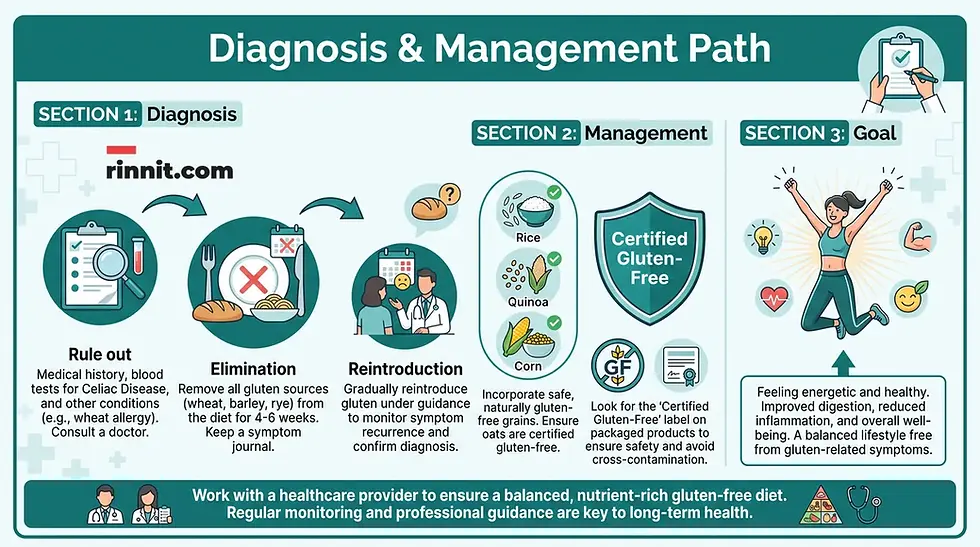
The diagnosis usually follows a structured three-step approach [1]:
Rule Out Other Conditions: For approximately eight weeks, you must continue eating gluten while a doctor performs blood and skin tests to rule out celiac disease and wheat allergies. These tests are only accurate if gluten is present in your system.
Elimination Phase: If other conditions are ruled out, you will be asked to remove all gluten from your diet for at least six weeks while keeping a detailed record of your symptoms.
Reintroduction: You will slowly begin eating gluten again. If the symptoms return, a diagnosis of gluten intolerance is likely.
Treatment and Management
There is no cure for gluten intolerance, but it can be effectively managed. The primary treatment is a gluten-free or limited-gluten diet. Because every individual's tolerance level is different, some people may need to eliminate gluten entirely, while others can handle small amounts without significant distress.
It is important to note that cutting out gluten can sometimes lead to nutritional deficiencies in fiber, iron, or vitamin B [1]. Therefore, it is highly recommended to work with a dietitian to ensure your new diet remains balanced and healthy [6].
Ready to manage your digestive health? Visit Rinnit.com for comprehensive guides on living gluten-free, understanding food sensitivities, and maintaining a balanced diet for long-term wellness.
Frequently Asked Questions
Is gluten intolerance the same as a wheat allergy?
No. An intolerance causes uncomfortable symptoms but is not an immune system overreaction. An allergy involves the immune system and can cause life-threatening reactions like shortness of breath.
Can I develop gluten intolerance later in life?
Yes. While some people are born with it, others develop the sensitivity as they get older.
Does gluten intolerance cause permanent damage to my body?
Unlike celiac disease, gluten intolerance is not an autoimmune condition and is not known to cause long-term damage to your intestines.
How long do symptoms last after eating gluten?
Symptoms can appear hours or days after consumption and may persist for several days depending on the individual.
Can I eat small amounts of gluten if I am intolerant?
Some people find they can tolerate small amounts of gluten without getting sick, but this varies from person to person and often requires trial and error.
What are the best gluten-free grains?
Rice, corn, quinoa, and buckwheat are popular naturally gluten-free alternatives to wheat, barley, and rye.
Is brain fog a real symptom of gluten intolerance?
Yes, many people with gluten sensitivity report difficulty concentrating or a "cloudy" feeling in their head after consuming gluten.
Should I see a doctor before going gluten-free?
Yes. It is important to be tested for celiac disease and wheat allergies first, as these tests are not accurate if you have already removed gluten from your diet.
Are there hidden sources of gluten?
Yes. Gluten can be found in unexpected places like soy sauce, certain salad dressings, and even some medications or lip balms.
Does gluten intolerance run in families?
While the exact genetics are unclear, having family members with food sensitivities or digestive issues may increase your risk.
Can gluten intolerance cause skin problems?
Yes, skin rashes are a reported symptom for some individuals with gluten sensitivity.
Will a gluten-free diet help me lose weight?
Not necessarily. A gluten-free diet is a medical treatment for intolerance, not a weight-loss plan. Many gluten-free processed foods can be high in calories and sugar.
How do I know if a product is truly gluten-free?
Always read labels carefully and look for certified "Gluten-Free" labels, which indicate the product meets specific safety standards.
Can children have gluten intolerance?
Yes, children can develop gluten intolerance, often showing symptoms through irritability, stomach pain, or behavioral changes.
Is there a pill I can take to eat gluten?
Currently, there is no medication that allows people with gluten intolerance to eat gluten without symptoms. The only effective treatment is dietary management.
Related Reading
tTG-IgA Test for Celiac Disease: Normal Ranges, What Results Mean and Next Steps explains the main blood test used to diagnose celiac disease.
References
Cleveland Clinic. Gluten Intolerance. Cleveland Clinic. Last updated May 20, 2026. https://my.clevelandclinic.org/health/diseases/21622-gluten-intolerance
Shiha MG, Manza F, Figueroa-Salcido OG, et al. Global prevalence of self-reported non-coeliac gluten and wheat sensitivity: a systematic review and meta-analysis. Gut. Published online October 28, 2025. PMID 41151790. https://doi.org/10.1136/gutjnl-2025-336304
Biesiekierski JR, Peters SL, Newnham ED, et al. No effects of gluten in patients with self-reported non-celiac gluten sensitivity after dietary reduction of fermentable, poorly absorbed, short-chain carbohydrates. Gastroenterology. 2013;145(2):320-328.e1-3. PMID 23648697. https://doi.org/10.1053/j.gastro.2013.04.051
Lionetti E, Pulvirenti A, Vallorani M, et al. Re-challenge studies in non-celiac gluten sensitivity: a systematic review and meta-analysis. Front Physiol. 2017;8:621. PMID 28928668. https://doi.org/10.3389/fphys.2017.00621
American Academy of Allergy, Asthma & Immunology. Celiac Disease, Non-Celiac Gluten Sensitivity and Food Allergy: How are they different? AAAAI. Page dated May 12, 2026. https://www.aaaai.org/tools-for-the-public/conditions-library/allergies/celiac-disease
Office on Women's Health, U.S. Department of Health and Human Services. Celiac disease and gluten intolerance. womenshealth.gov. Last updated February 3, 2025. https://womenshealth.gov/healthy-eating/food-allergies-and-sensitivities/celiac-disease-and-gluten-intolerance
Igbinedion SO, Ansari J, Vasikaran A, et al. Non-celiac gluten sensitivity: all wheat attack is not celiac. World J Gastroenterol. 2017;23(40):7201-7210. PMID 29142467. https://doi.org/10.3748/wjg.v23.i40.7201
Medical disclaimer
This article is for general educational purposes only and is not a substitute for professional medical advice, diagnosis, or treatment. Always seek the advice of your physician or other qualified healthcare provider with any questions you may have about a medical condition. Never disregard professional medical advice or delay seeking care because of something you have read here. If you think you may have a medical emergency, call your doctor or emergency services immediately.



Comments