Understanding Pancreatic Pseudocysts: Causes, Symptoms, and Management

Updated: 2 days ago
Medically reviewed by Dr. Baraa Alnahhal, MD · Last reviewed: October 2026
A pancreatic pseudocyst is a benign, fluid-filled pocket that usually develops after an episode of pancreatitis or a pancreatic injury. Unlike true cysts, a pseudocyst is walled off by fibrous scar tissue and holds pancreatic juices. Many resolve on their own within about six weeks, while larger or symptomatic ones may need drainage to prevent infection or blockage [1].
Quick Answer: What is a pancreatic pseudocyst?
A pancreatic pseudocyst is a pocket of fluid that forms outside the pancreas, usually after pancreatitis, most often related to alcohol or gallstones. It is not a tumor and has no cancerous potential. Large ones can cause pain, nausea and bloating. About one-third resolve on their own, and those lasting beyond six weeks or causing problems are usually drained. [1]
What the research says
Endoscopic drainage works as well as surgery, with a shorter stay. A systematic review and meta-analysis comparing surgical and endoscopic drainage of pancreatic pseudocysts found no significant difference in treatment success, adverse events, or recurrence, while hospital stay and cost were lower with the endoscopic approach (Farias et al., Medicine, 2019).
What Is a Pancreatic Pseudocyst?
A pancreatic pseudocyst is a collection of fluid that develops in the abdomen after the pancreas has been injured or inflamed. The pancreas makes digestive enzymes and sends them to the small intestine through the pancreatic duct. When the duct is damaged, most often by severe pancreatitis, pancreatic juices leak out and irritate nearby tissue [1].
In response, the body builds a protective wall around the leak. That wall is fibrous, scar-like granulation tissue. It is called a "pseudocyst" because it lacks the epithelial cell lining of a true pancreatic cyst. In essence, a pseudocyst is an inflammatory wound, not a separate growth or tumor.
How is a pancreatic pseudocyst different from a pancreatic cyst?
The difference between a true pancreatic cyst and a pseudocyst matters, because the risks and care differ a great deal [1].
Feature | Pancreatic pseudocyst | True pancreatic cyst |
Wall | Fibrous scar tissue (granulation tissue) | Lined with epithelial cells |
Nature | An inflammatory wound or leak pocket | A growth or tumor in the pancreas |
Cancer risk | Benign; no cancerous potential | Some types can become cancerous |
Common cause | Pancreatitis or abdominal trauma | Often unknown; can be hereditary |

A leaking pancreatic duct lets fluid collect outside the pancreas, where a fibrous capsule forms around it.
What causes pancreatic pseudocysts and how common are they?
Pseudocysts are the most common type of pancreatic cystic mass, making up about 75% of cases. They are most often seen in adults with chronic pancreatitis (35%) or acute pancreatitis (10%) [1].
Primary Triggers
Alcohol use: long-term heavy drinking is the leading cause of pancreatitis that leads to pseudocysts, behind about 70% of adult cases [1].
Gallstones: the second most common cause of pancreatitis-related pseudocysts.
Abdominal trauma: the most common cause in children, when injury damages the pancreatic duct.
What are the symptoms and complications of pancreatic pseudocysts?
Small pseudocysts often cause no symptoms and are found on imaging done for other reasons. Larger ones can cause real discomfort and risks [1].
Common Symptoms
Symptoms usually develop several weeks after an acute flare of pancreatitis. You may have abdominal pain, visible swelling of the belly, loss of appetite, and ongoing nausea or vomiting [1].
Potential Complications
Most pseudocysts resolve without trouble, but complications can occur if one grows too large or becomes infected [1]:
Infection: dead tissue inside the cyst can attract bacteria, and the infection can turn septic if the cyst ruptures.
Vessel compression: a large cyst can press on nearby blood vessels or bile ducts and cause jaundice.
Bleeding: the cyst can erode the wall of a nearby blood vessel and cause internal bleeding.
Digestive blockage: pressure on the stomach or small intestine can stop food passing through.

Common symptoms of a large pseudocyst, and the warning complications to watch for.
How are pancreatic pseudocysts diagnosed?
Providers usually identify pseudocysts with high-quality imaging. On a contrast CT or MRI they look like smooth, round structures with well-defined walls [1].
When the mass must be told apart from a true cyst or tumor, special procedures are used [1]:
Endoscopic ultrasound (EUS): a long, thin tube with a camera and ultrasound wand goes down the throat for a detailed view of the pancreas.
Fine needle aspiration (FNA): during EUS, a hollow needle takes fluid and tissue for lab analysis to rule out cancer.
How are pancreatic pseudocysts managed and treated?
Care depends on the pseudocyst’s size, how long it has been there, and whether it causes symptoms [1].
Surveillance and supportive care:
About one-third of pseudocysts resolve without any procedure [1]. During the first six weeks, providers usually offer supportive care: pain relief, IV fluids, and nutrition support if you cannot eat normally.
Drainage procedures:
If a pseudocyst lasts longer than six weeks or causes complications, treatment is needed. The most common procedure is a cystogastrostomy, which creates a connection between the pseudocyst and the stomach (or small intestine) so the fluid can drain safely. After drainage, the fibrous capsule usually dissolves. Endoscopic drainage is preferred because it is less invasive than traditional surgery [1].
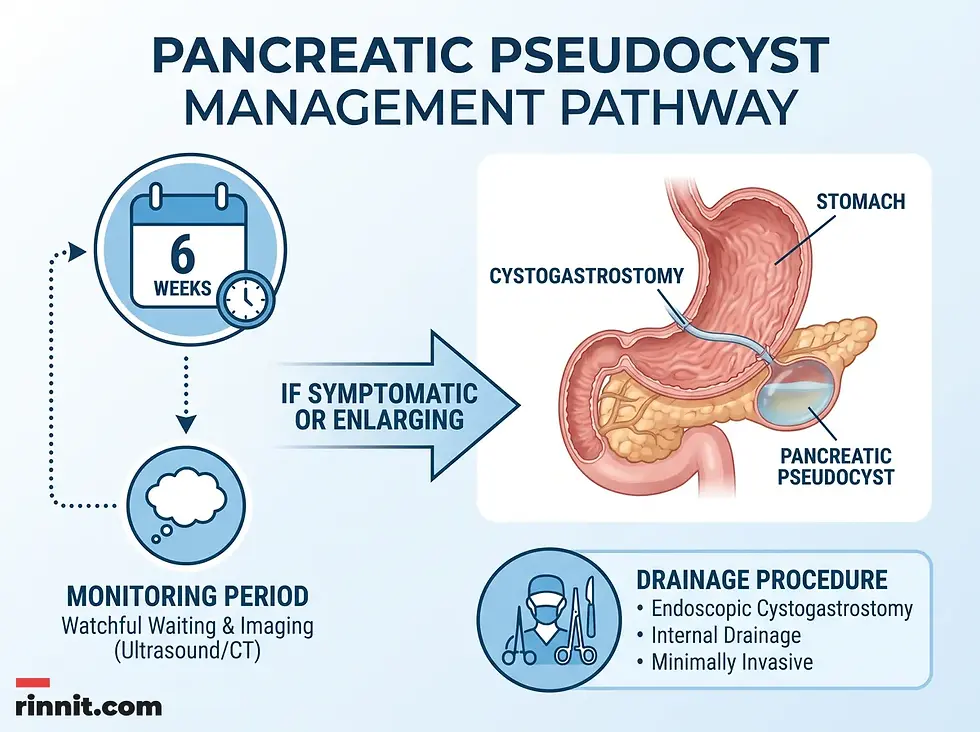
The management path: six weeks of monitoring, then drainage if the pseudocyst is symptomatic or enlarging.
What is the outlook and recovery for pancreatic pseudocysts?
The outlook is generally excellent, especially when the underlying cause, such as alcohol use or gallstones, is dealt with. Most pseudocysts that need drainage are resolved with a single procedure, and the chance of recurrence is low once the pancreatic duct has healed.
What is the bottom line on pancreatic pseudocysts?
Pseudocysts are a common result of pancreatic inflammation: the body’s way of containing a digestive enzyme leak. Large ones can cause significant discomfort, but modern imaging and drainage make them very treatable. If you are recovering from pancreatitis and notice new abdominal swelling, contact your healthcare provider about imaging and a monitoring plan.
Frequently Asked Questions
Is a pancreatic pseudocyst a tumor?
No. It is an inflammatory pocket of fluid, not a true growth or tumor, and it has no cancerous potential.
Can a pseudocyst go away without surgery?
Yes. About one-third of pancreatic pseudocysts resolve on their own, usually within about six weeks, with monitoring and supportive care.
What is the main cause of pseudocysts?
The most common cause is pancreatitis, often triggered by chronic alcohol use or gallstones.
Is drainage painful?
Drainage procedures such as cystogastrostomy are done under sedation or anesthesia, and endoscopic methods are minimally invasive.
Can children get pancreatic pseudocysts?
Rarely, yes. In children they usually follow abdominal trauma rather than chronic illness.
How large can a pseudocyst get?
Sizes vary widely, from about 2 centimeters to as large as 30 centimeters across.
What happens if a pseudocyst ruptures?
A rupture can let pancreatic enzymes and possible infection spread into the abdominal cavity. This is serious and needs immediate medical attention.
Where do pseudocysts usually form?
About two-thirds form at the tail of the pancreas, and the rest at the head.
How is a pseudocyst different from a cyst?
A true cyst is lined with epithelial cells and can be precancerous, while a pseudocyst is lined with scar tissue and is benign.
Can I eat normally with a pseudocyst?
Large pseudocysts can cause nausea or loss of appetite. Sometimes providers recommend temporary tube feeding or IV nutrition.
Related Resources
Related reading on Rinnit:
References
Cleveland Clinic. Pancreatic pseudocysts. Cleveland Clinic Health Library. Medically reviewed; last updated October 11, 2023. https://my.clevelandclinic.org/health/diseases/pancreatic-pseudocysts
Farias GFA, Bernardo WM, De Moura DTH, et al. Endoscopic versus surgical treatment for pancreatic pseudocysts: systematic review and meta-analysis. Medicine (Baltimore). 2019;98(8):e14255. PMID: 30813129. DOI: 10.1097/MD.0000000000014255
Medical disclaimer
This article is for informational purposes only and is not a substitute for professional medical advice, diagnosis, or treatment. Always seek the advice of your physician or other qualified health provider with any questions you may have about a medical condition.



Comments