Brachytherapy: What Internal Radiation Is, How It Works and What to Expect

Updated: 6 days ago
Written and medically reviewed by Dr. Baraa Alnahhal, MD · Last reviewed: October 2026 · How we review
Quick Answer: What is brachytherapy?
Brachytherapy is a cancer treatment that places tiny radioactive implants, about the size of a grain of rice, inside or right next to a tumor. The radiation shrinks or destroys the tumor while sparing nearby healthy tissue, and it works best for cancers that haven't spread. Anesthesia is given first, so the procedure shouldn't hurt. [1]
What the research says
A brachytherapy boost kept more prostate cancers in check than extra external radiation. In a randomized trial of 398 men with intermediate- or high-risk prostate cancer, 83% of those given a low-dose-rate brachytherapy boost were free of PSA-based cancer progression at 9 years, compared with 62% of those given an external-beam boost. Overall survival did not differ between the groups. (Morris et al., Int J Radiat Oncol Biol Phys, 2017)
For early breast cancer, brachytherapy to part of the breast worked as well as whole-breast radiation. In a randomized trial of 1,184 women treated with breast-conserving surgery, the 5-year rate of cancer returning in the same breast was 1.44% after brachytherapy versus 0.92% after whole-breast radiation, a difference too small to matter statistically. (Strnad et al., Lancet, 2016)
MRI-guided brachytherapy controlled cervical cancer in 9 out of 10 patients. In a study of 1,341 people with locally advanced cervical cancer treated with chemoradiotherapy plus MRI-guided brachytherapy, 92% had the tumor controlled at the treated site after 5 years. Severe long-term bowel or bladder problems affected 8.5% and 6.8% of patients. (Pötter et al., Lancet Oncol, 2021)
Key takeaways
Brachytherapy is internal radiation: the radiation source goes inside your body, in or near the tumor.
It's used for breast, eye, gynecological, head and neck, and prostate cancers, and soft tissue sarcomas.
LDR treats over hours or days. HDR treats in 10- to 20-minute sessions.
Common side effects include fatigue, nausea, vomiting and diarrhea.
Most people feel better within a few days to a week.
With permanent implants, you may need to limit close contact with babies, young children and pregnant women for a while.
What is brachytherapy?
Brachytherapy, also called internal radiation therapy, is a treatment for cancerous tumors that haven't spread.

Your care team places implants carrying tiny amounts of radioactive material inside the tumor or right beside it. The implants release radiation that shrinks or destroys the tumor without hurting the healthy tissue around it.
You may have brachytherapy:
After surgery to remove a tumor
Together with external beam radiation therapy (radiation from a machine outside your body)
On its own, depending on your cancer
It's normal to feel uneasy about having radiation inside your body. Your radiation oncologist (a doctor who specializes in treating cancer with radiation) will explain exactly how it works and what to expect.
Which cancers can brachytherapy treat?
Brachytherapy can treat breast, eye, gynecological, head and neck, and prostate cancers, as well as soft tissue sarcomas.
Cancer type | Examples |
Used after breast-conserving treatment in some cases | |
Eye cancer | Such as eye melanoma |
Gynecological cancers | |
Head and neck cancer | Can be an option when other treatments haven't worked |
Prostate cancer | Often with permanent seed implants (see our prostate brachytherapy guide) |
Soft tissue sarcomas | Cancers of the body's connective tissues |
What are the types of brachytherapy?
Brachytherapy is grouped in two ways: by dose rate (low or high) and by whether the implant is temporary or permanent.
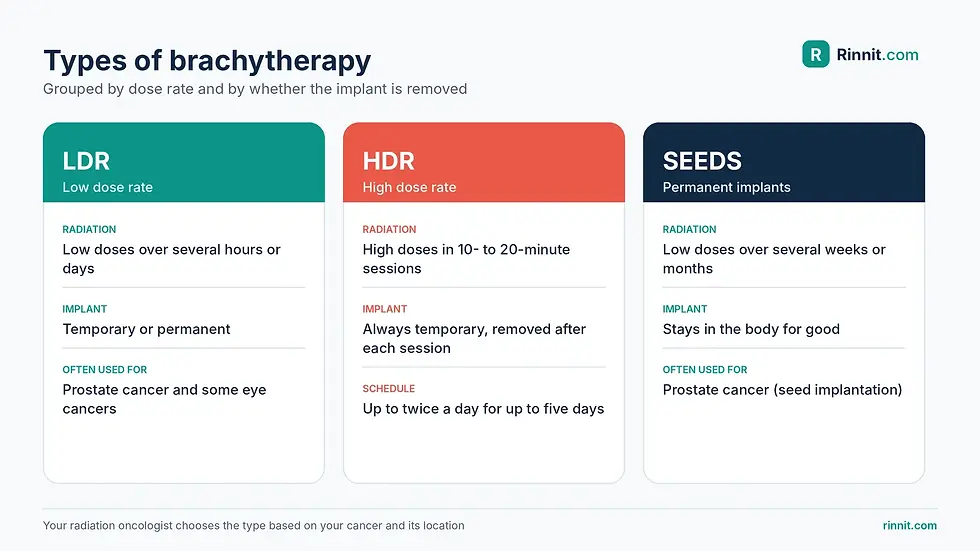
How do low-dose-rate and high-dose-rate brachytherapy differ?
Feature | Low dose rate (LDR) | High dose rate (HDR) |
How radiation is given | Low doses over several hours or days | High doses in short sessions |
Session length | Hours to days | 10 to 20 minutes |
Implant stays in? | Can be temporary or permanent | Always temporary, removed after each session |
Typical schedule | Varies by cancer | Up to twice a day for up to five days |
Common uses | Prostate cancer and some eye cancers | Depends on the cancer and its location |
What is the difference between temporary and permanent implants?
Permanent implants stay in your body for good. They release low doses of radiation over several weeks or months, then stop. This approach is common for prostate cancer and is also called seed implantation.
Temporary implants are removed after your treatment session. They can deliver either low or high doses of radiation.
Where is the brachytherapy implant placed?
The brachytherapy implant can go directly inside the tumor, near a tumor that sits inside a body cavity, or on the eye, depending on where the tumor is.
Method | Where the implant goes |
Interstitial brachytherapy | Directly inside the tumor |
Intracavity brachytherapy | Near a tumor that sits inside a body cavity |
Episcleral brachytherapy | On the eye, to treat eye cancer |
Is brachytherapy painful?
Brachytherapy itself shouldn't hurt because you'll have anesthesia before treatment.
General anesthesia puts you to sleep during the procedure.
Local anesthesia numbs only the area where the implant goes.
You may also get pain medicine before or after treatment. Some side effects can still be uncomfortable, and your team will explain how to manage them.
How do you prepare for brachytherapy?
Preparing for brachytherapy means arranging a ride, planning for a possible hospital stay and writing down your questions.
Arrange a ride. If you have anesthesia or pain medicine, someone needs to drive you to and from treatment.
Plan for a possible hospital stay. If treatment runs over several days, you may stay in the hospital.
Write down your questions. Ask about your specific side effects, schedule and safety steps at home.
What happens during brachytherapy?
During brachytherapy, your radiation oncologist inserts a thin tube or applicator, guides a rice-grain-sized implant through it to the tumor, and removes the implant afterward if it is temporary. The exact steps depend on your cancer, the type of brachytherapy and where the implant goes.

Interstitial and intracavity treatments follow the same basic steps. After anesthesia, your radiation oncologist will:
Insert a delivery device. This is a thin tube (catheter) or an applicator designed for that part of your body.
Send the implant through it. The implant is about the size of a grain of rice.
Position the implant in or near the tumor. It then releases its radiation.
Remove the implant if your treatment uses a temporary one.
What are the benefits of brachytherapy?
The main benefit of brachytherapy is targeted treatment, because radiation goes straight to the tumor and limits harm to nearby healthy tissue.
Targeted treatment. Radiation goes straight to the tumor, limiting harm to nearby healthy tissue.
Effective for tumors that haven't spread. In most cases, it can get rid of prostate cancer and keep it from coming back.
Flexible. It can follow surgery, pair with external radiation or, in some cases, be used on its own.
What are the risks and side effects of brachytherapy?
Brachytherapy side effects depend on which part of the body is treated, and common ones include fatigue, nausea, vomiting and diarrhea. Some start during treatment and stop soon after you finish.
Common side effects | Possible complications |
Fatigue | Bleeding |
Nausea and vomiting | Trouble peeing or leaking pee (urinary incontinence) |
Diarrhea | |
Vaginal scarring | |
Your radiation oncologist will go over the side effects and complications that apply to you, and how each one can be managed or treated.
How long does recovery from brachytherapy take?
Most people feel better within a few days to a week after brachytherapy, depending on the procedure. You may need to limit activity and rest more for a while. Follow your care team's advice on when to return to your usual routine.
How can you manage radiation fatigue?
You can't push through radiation fatigue, but you can manage it:
Rest when you need to, not only when you get the chance.
Plan activities for the times of day when you have the most energy.
How can you manage nausea, vomiting and diarrhea?
Eat several smaller meals instead of three large ones.
Plan your meals ahead to make digestive problems less likely.
Is it safe to be around others after brachytherapy?
With permanent brachytherapy implants, there's a very small chance of exposing other people to radiation until the implant has released all its radioactive material, which can take a few weeks or months.
Your care team will explain how to interact safely with others. They'll likely advise you to limit close contact with:
Babies
Young children
Pregnant women
Ask as many questions as you need to feel comfortable spending time with family and friends.
When should you call your doctor after brachytherapy?
Contact your healthcare provider after brachytherapy if you have trouble breathing or swallowing, severe stomach upset, vomiting or diarrhea, or trouble controlling your bladder or bowels.
Warning sign | Why it matters |
Trouble breathing or swallowing | Needs prompt medical review |
Severe stomach upset, vomiting or diarrhea | Can lead to dehydration |
Trouble peeing or leaking pee | Possible urinary complication |
Trouble controlling bowel movements | Possible bowel complication |
Conclusion
Brachytherapy treats cancer from the inside by placing tiny radioactive implants in or near a tumor. It's a successful treatment for tumors that haven't spread, and it's used for many cancers, from prostate and breast to cervical and eye cancers.
Treatment shouldn't hurt, most people recover within days to a week, and side effects can be managed. If you have permanent implants, a few simple precautions help keep the people around you safe.
Your next step: Bring this guide to your next appointment and ask your radiation oncologist which type of brachytherapy fits your cancer, what side effects to expect and what precautions apply at home. For more plain-language, doctor-reviewed guidance, read the Rinnit.com overview of cancer symptoms, diagnosis and treatment.
Frequently asked questions
What is brachytherapy in simple terms?
It's radiation therapy given from inside your body. Tiny radioactive implants are placed in or right next to a tumor to shrink or destroy it.
Is brachytherapy painful?
No, the procedure shouldn't hurt. You'll receive general or local anesthesia first, and pain medicine may be given before or after treatment.
How big are brachytherapy seeds?
Each implant is about the size of a grain of rice.
What's the difference between LDR and HDR brachytherapy?
LDR gives low doses of radiation over several hours or days. HDR gives high doses in 10- to 20-minute sessions, and the implant is removed after each session.
How long do permanent brachytherapy seeds stay radioactive?
They release low doses of radiation over several weeks or months, until all the radioactive material is used up.
Can I be around my family after brachytherapy?
Yes, with care. If you have permanent implants, your team will likely advise limiting close contact with babies, young children and pregnant women for a while.
How long does it take to recover from brachytherapy?
Most people feel better within a few days to a week, depending on the procedure.
Will I need to stay in the hospital?
Possibly. If your treatment runs over several days, you may need to stay in the hospital.
Is brachytherapy successful?
It's a successful treatment for tumors that haven't spread. Your radiation oncologist can explain what results to expect for your specific cancer.
Can brachytherapy be used with other cancer treatments?
Yes. Brachytherapy can be given after surgery, together with external beam radiation, or on its own, depending on your cancer.
Related Reading
Coronary Brachytherapy: Procedure, Benefits and Risks explains coronary brachytherapy.
Radiation Therapy: Types, How It Works and Side Effects explains how radiation therapy treats cancer.
References
Cleveland Clinic. Brachytherapy for Cancer. Cleveland Clinic. Last updated August 18, 2026. https://my.clevelandclinic.org/health/treatments/16500-brachytherapy
National Cancer Institute. Brachytherapy for Cancer. Cancer.gov. Updated May 14, 2025. https://www.cancer.gov/about-cancer/treatment/types/radiation-therapy/brachytherapy
Mayer C, Gasalberti DP, Kumar A. Brachytherapy. In: StatPearls [Internet]. Treasure Island (FL): StatPearls Publishing; updated June 15, 2023. PMID: 32965861. https://pubmed.ncbi.nlm.nih.gov/32965861/
Merck Manual. Radiation Therapy for Cancer. Merck Manual Consumer Version. Updated July 2024. https://www.merckmanuals.com/home/cancer/prevention-and-treatment-of-cancer/radiation-therapy-for-cancer
Morris WJ, Tyldesley S, Rodda S, et al. Androgen Suppression Combined with Elective Nodal and Dose Escalated Radiation Therapy (the ASCENDE-RT Trial): an analysis of survival endpoints for a randomized trial comparing a low-dose-rate brachytherapy boost to a dose-escalated external beam boost for high- and intermediate-risk prostate cancer. International Journal of Radiation Oncology, Biology, Physics. 2017;98(2):275-285. PMID: 28262473. https://doi.org/10.1016/j.ijrobp.2016.11.026
Strnad V, Ott OJ, Hildebrandt G, et al. 5-year results of accelerated partial breast irradiation using sole interstitial multicatheter brachytherapy versus whole-breast irradiation with boost after breast-conserving surgery for low-risk invasive and in-situ carcinoma of the female breast: a randomised, phase 3, non-inferiority trial. Lancet. 2016;387(10015):229-238. PMID: 26494415. https://doi.org/10.1016/S0140-6736(15)00471-7
Pötter R, Tanderup K, Schmid MP, et al. MRI-guided adaptive brachytherapy in locally advanced cervical cancer (EMBRACE-I): a multicentre prospective cohort study. Lancet Oncology. 2021;22(4):538-547. PMID: 33794207. https://doi.org/10.1016/S1470-2045(20)30753-1
Medical disclaimer
This article is for general educational purposes and is not a substitute for professional medical advice, diagnosis or treatment. Always talk with your radiation oncologist or cancer care team about whether brachytherapy is right for you and what precautions apply to your treatment.



Comments