Breast Cancer: Symptoms, Causes, and Treatment

Updated: 3 days ago
Medically reviewed by Dr. Baraa Alnahhal, MD · Last reviewed: October 2026

Quick answer
Breast cancer is cancer that starts when DNA changes make breast cells multiply quickly and form a tumor that can spread; it can affect anyone, including men. Signs include a new lump, nipple or skin changes and orange-peel dimpling, so get any new change checked. Diagnosis uses imaging and biopsy, and treatment combines surgery with radiation, chemotherapy or other therapies. [1] [2]
What the research says
According to PubMed:
Screening mammography is linked to fewer breast cancer deaths. A meta-analysis of randomized controlled trials found a relative risk of breast cancer death of 0.75 (95% CI 0.67–0.83) with mammographic screening alone in women aged 40–74, with greater benefit in women aged 50 and over than in those aged 40–49. (Hamashima et al., DOI).
Every extra daily drink adds to the risk. A dose-response meta-analysis of 22 cohort studies and 45,350 breast cancer cases found that each additional 10 g of alcohol per day raised breast cancer risk by 10.5% (RR 1.10, 95% CI 1.08–1.13), and by 11.1% in postmenopausal women. (Sun et al., DOI).
Family history and inherited gene changes shape lifetime risk. In 67,692 US women (33,841 diagnosed with breast cancer), estimated cumulative risk by age 80 ranged from 11.1% in women without an inherited variant or family history to 70.5% in PALB2 variant carriers with a family history (among women not diagnosed by age 50). (O'Brien et al., DOI).
Study details are from PubMed abstracts.
What is breast cancer and how does it develop?
Each breast contains 15 to 20 lobes of glandular tissue arranged like the petals of a daisy. These lobes divide into smaller lobules that produce milk, and ducts carry milk to a reservoir beneath the nipple. Breast cancer begins as an abnormal growth of cells within this tissue [1].
In healthy tissue, cells grow and multiply at a set rate and die at a set time. In breast cancer, changes inside the DNA of breast cells cause them to keep multiplying quickly and to keep living when normal cells would die. The result is too many cells, which can pile up into a mass that invades and destroys surrounding tissue [1].
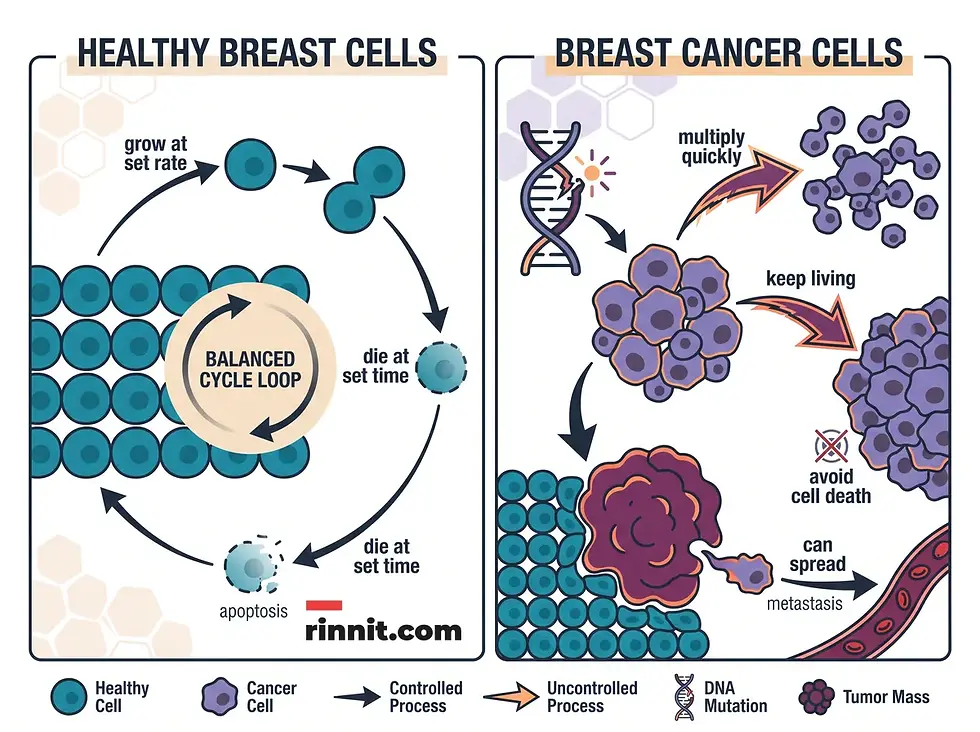
Cancer cells can also break away from the original tumor and travel to other parts of the body, where they form new tumors. Once this happens, the disease is called metastatic breast cancer [1].
After skin cancer, breast cancer is the most common cancer diagnosed in women in the United States. It is not only a women's disease — everyone is born with breast tissue, so anyone can develop it, including men. The encouraging news is that survival rates keep climbing. Deaths are steadily going down thanks to awareness, research, and earlier screening, and cancer caught earlier is much more likely to be curable. Even when it cannot be cured, today's treatments can extend life for many years [1].
What are the warning signs and symptoms of breast cancer?
Breast cancer often first shows up as a change you can see or feel, such as a lump, a thickened area of skin, an inverted nipple or dimpled breast skin. Breast cancer signs and symptoms may include [1]:
A breast lump or a thickened area of skin that feels different from the surrounding tissue
A nipple that has flattened or turned inward
Skin color changes, such as pink or red on lighter skin, or skin that looks darker than the surrounding chest or red or purple on brown and Black skin
A change in the size, shape, or appearance of a breast
Dimpling of the skin that looks like the surface of an orange peel
Peeling, scaling, crusting, or flaking of skin on the breast
Symptom | What you might notice | Why it matters |
New lump | A firm area or mass that feels different from the rest of the breast | The most common early sign of breast cancer |
Skin dimpling | Skin that puckers or looks like an orange peel | Can signal a tumor pulling on skin from inside |
Nipple change | A nipple that flattens or turns inward | A change from your breast's normal shape |
Color change | Pink, red, purple, or darker patches | Appears differently on lighter and darker skin |
Peeling skin | Flaking, scaling, or crusting on the breast | Mimics a skin rash but does not heal like one |
When to see a doctor
Do not wait for your next scheduled mammogram. If you notice any of these changes — or anything new in how your breast looks or feels — contact your healthcare professional right away, even if a recent mammogram came back normal [1].
What causes breast cancer?
The exact cause of most breast cancers is not known. Researchers believe the risk involves a mix of hormones, lifestyle choices, and environmental factors [1].
What is known is how it starts: a change in the DNA inside a breast cell. That change tells the cell to divide quickly and to keep living past its normal time, producing more and more abnormal cells. Over time these cells can form a tumor that invades healthy tissue and can break away to spread [1].
Most breast cancers start in the cells lining the milk ducts — this is called invasive ductal carcinoma, the most common type. Cancers can also begin in the milk-producing glands (lobules) as invasive lobular carcinoma, or, more rarely, in other cells [1].
What are the risk factors for breast cancer?
Having a risk factor does not mean you will develop breast cancer, and many people diagnosed have few or none of the known risks. The table below covers the main factors identified by health researchers [1].
Risk factor | How it raises risk |
Female sex | Women are far more likely to develop breast cancer, but anyone with breast tissue can |
Increasing age | Risk rises as you get older |
Family history | A parent, sibling, or child with breast cancer raises risk, especially with early diagnoses or multiple relatives |
Personal history of breast cancer | Raises the risk of cancer in the other breast |
Personal history of certain breast conditions | Lobular carcinoma in situ and atypical hyperplasia found on biopsy raise risk |
Early first period | Menstrual periods beginning before age 12 |
Later menopause | Menopause beginning after age 55 |
Dense breast tissue | More glandular and fibrous tissue than fat; increases risk and makes tumors harder to see on mammograms |
Alcohol use | Drinking alcohol increases risk |
No pregnancies or first birth after 30 | Having at least one pregnancy lowers risk; a first child after 30 may increase it |
Menopausal hormone therapy | Estrogen combined with progesterone raises risk; risk falls after stopping |
Obesity | Higher body weight raises risk |
Chest radiation as a child | Radiation to the chest area during childhood or young adulthood |
Inherited DNA changes | BRCA1 and BRCA2 gene changes greatly raise the risk of breast and other cancers, though not everyone with these changes develops cancer |
One fact stands out clearly: most people diagnosed with breast cancer have no family history of the disease. Family history matters, but it is only one piece of the picture.
How is breast cancer diagnosed?
Diagnosis begins with a physical exam and a discussion of your symptoms. If something looks or feels concerning, imaging tests and a tissue sample follow [2].
Your healthcare team may perform a clinical breast exam, looking at both breasts for skin and nipple changes and feeling for lumps in the breasts, along the collarbones, and in the armpits. Imaging tests are the next step [2].
Test | What it does |
Mammogram | An X-ray of the breast used for screening; if it finds something concerning, a diagnostic mammogram examines both breasts closely |
Breast ultrasound | Sound waves show whether a lump is a solid mass or a fluid-filled cyst and guide the next tests |
Breast MRI | Magnetic fields and radio waves create detailed pictures to look for additional cancer areas, usually with injected dye |
Biopsy | A needle guided by imaging draws a tissue sample; a tiny metal marker marks the spot for monitoring |
Lab testing of tissue | Confirms cancer, identifies the type and growth rate, and checks for hormone receptors to guide treatment |
If cancer is found, your team stages it to learn how far it has spread. This can include blood tests, a bone scan, CT, MRI, or PET scan. Stages run from 0 to 4, and a lower number means less advanced disease that is more likely to be curable. Stage 0 means the cancer is contained within a breast duct, while stage 4 means it has spread to other parts of the body. Complete staging information may not be available until after surgery [2].
What are the treatment options for breast cancer?
Treatment most often starts with surgery, and most people then go on to radiation, chemotherapy, hormone therapy, or a combination. Some people receive chemotherapy or hormone therapy before surgery to shrink the tumor first. Your plan depends on the cancer's stage, growth rate, hormone sensitivity, your overall health, and your preferences. Getting a second opinion from a breast cancer specialist is a common and encouraged step [2].

Surgery
Procedure | What happens |
Lumpectomy | Removes the cancer and some surrounding healthy tissue while keeping the rest of the breast; also called breast-conserving surgery; most people also receive radiation afterward |
Mastectomy | Removes all breast tissue; total (simple) mastectomy removes the breast including lobules, ducts, fat, and some skin; skin-sparing and nipple-sparing versions are newer options with a better look afterward |
Sentinel node biopsy | Finds the first few lymph nodes the tumor drains into so they can be tested for cancer |
Axillary lymph node dissection | Removes many lymph nodes from the armpit if imaging shows spread or cancer is found in the sentinel biopsy |
Breast reconstruction | Optional surgery to restore breast shape using an implant or your own tissue, at the time of mastectomy or later |
Radiation therapy
Radiation uses high-powered energy beams, such as X-rays or protons, delivered by a machine that moves around the body to aim precisely at the breast. It is most often used after surgery to kill any leftover cancer cells and lower the chance the cancer returns. Less commonly, radiation can be placed inside the body, called brachytherapy. Side effects include fatigue, a sunburn-like rash where the beams were aimed, and swelling or firmness of the breast tissue. Rarely, radiation can damage the heart or lungs, and very rarely a new cancer can form in the treated area [2].
Chemotherapy
Chemotherapy uses medicines that kill fast-growing cells, and cancer cells divide quickly. It can be given after surgery to lower the risk of the cancer returning, before surgery to shrink the tumor and make removal easier, or when the cancer has spread to control it and relieve symptoms such as pain. Side effects can include hair loss, nausea, vomiting, fatigue, and a higher risk of infection. Rare side effects include premature menopause, nerve damage, and, very rarely, a blood cell cancer [2].
Hormone therapy
Hormone therapy blocks the hormones that some breast cancers use as fuel. Cancers that test positive for estrogen or progesterone receptors (ER-positive and PR-positive) grow in response to these hormones, and blocking them can make cancer cells shrink or die. This treatment is often used after surgery to lower the risk of the cancer coming back, and it can help control cancer that has spread [2].
Options include medicines called selective estrogen receptor modulators, which block hormones from attaching to cancer cells; aromatase inhibitors, which stop the body from making estrogen after menopause; and surgery or medicines to stop the ovaries from making hormones. Side effects include hot flashes, night sweats, and vaginal dryness, with more serious risks of bone thinning and blood clots [2].
Targeted therapy and immunotherapy
Targeted therapy medicines attack specific chemicals inside cancer cells. The most common target is the HER2 protein, which some breast cancer cells make in extra amounts to help themselves grow and survive. Targeted medicines attack the HER2-producing cells while sparing healthy cells, and cancer cells can be tested to see whether targeted therapy would help. These medicines may be used before surgery, after surgery, or when the cancer has spread [2].
Immunotherapy helps your own immune system find and kill cancer cells, which normally hide from immune defenses. It is an option for triple-negative breast cancer, the type whose cells lack estrogen, progesterone, and HER2 receptors [2].
How can you live with breast cancer treatment and its side effects?
No alternative medicine treatment has been found to cure breast cancer, but complementary approaches can help you cope with side effects. Cancer-related fatigue can last for years, and several strategies can ease it: expressing your feelings through journaling, support groups, or counseling; gentle exercise such as walking, swimming, yoga, or tai chi with your team's approval; and stress reduction through muscle relaxation, visualization, and time with friends and family [2].
Palliative care is another supportive option. Specialists work alongside your treatment team to help you feel better, and this extra layer of support can run at the same time as strong, active treatment [2].
How can you prevent breast cancer or lower your risk?
No strategy guarantees prevention, but several evidence-based steps reduce risk and improve the odds of catching cancer early [1].
Step | What to do |
Get screened | Talk to your healthcare professional about when to start breast cancer screening and which tests fit your risk |
Know your breasts | Practice breast awareness — feel for changes in a wedge pattern, like pieces of a pie, moving fingers toward the nipple, and report anything new right away |
Limit alcohol | Drink no more than one drink a day, and note that no amount of alcohol is considered safe for breast cancer prevention |
Stay active | Aim for at least 30 minutes of exercise on most days, starting slowly if you are inactive |
Keep a healthy weight | Eat fewer calories and build up exercise gradually; ask a healthcare professional about healthy weight-loss plans |
Limit hormone therapy | If you use menopausal hormone therapy, take the lowest dose for the shortest time and weigh the benefits against the risks |
Consider high-risk options | For people at very high risk, estrogen-blocking medicines or surgery can lower risk; these carry side effects, so discuss benefits and risks with your team |
Conclusion: early action changes everything
Breast cancer is more treatable than ever before. The disease starts with changes inside breast cells that most often begin in the milk ducts, and it shows itself through lumps, skin changes, and nipple changes that anyone can learn to recognize. Diagnosis moves from a simple exam through mammograms, ultrasound, MRI, and biopsy, with lab tests that reveal the cancer's type, speed, and hormone sensitivity so your team can match the treatment to the tumor. Surgery, radiation, chemotherapy, hormone therapy, targeted therapy, and immunotherapy are the main tools, and many people receive several together for the best protection against the cancer returning.
If you notice anything new in how your breast looks or feels, do not wait for your next mammogram. Report the change right away — early diagnosis makes breast cancer far more likely to be curable.
Next steps: Talk to your healthcare professional about when to start screening and which tests fit your risk, and report any new lump, nipple change, or skin change right away — even after a normal mammogram.
Frequently asked questions
What is the first sign of breast cancer?
The most common first sign is a new lump or a thickened area of breast skin that feels different from the surrounding tissue. Other early signs include a flattened or inward nipple, skin dimpling like an orange peel, and color changes in the skin [1].
What are the early warning signs of breast cancer?
Early warning signs include a breast lump, changes in the size, shape, or appearance of a breast, skin dimpling, peeling or flaking skin on the breast, and skin that turns pink or red on lighter skin or darker, red, or purple on brown and Black skin. Any of these changes should be checked right away, even after a normal mammogram [1].
What causes breast cancer?
Breast cancer starts when changes in the DNA of breast cells make them multiply quickly and keep living when normal cells would die, forming a mass of abnormal cells. The exact cause of most cases is unknown, but risk factors include hormones, lifestyle choices such as alcohol use and obesity, and inherited DNA changes like BRCA1 and BRCA2 [1].
How is breast cancer diagnosed?
Diagnosis starts with a physical exam and a discussion of symptoms, followed by imaging tests such as a mammogram, breast ultrasound, or breast MRI. A biopsy takes a tissue sample that confirms cancer and reveals its type, growth rate, and hormone receptor status. Staging tests such as CT, MRI, PET, or bone scans show how far the cancer has spread, with stages from 0 (contained) to 4 (spread to other body parts) [2].
What is the best treatment for breast cancer?
The best treatment depends on the cancer's stage, growth rate, hormone sensitivity, and your health and preferences. Treatment most often starts with surgery — lumpectomy or mastectomy — followed by radiation, chemotherapy, hormone therapy, targeted therapy, or a combination. Some people receive medicine before surgery to shrink the tumor, and getting a second opinion from a breast specialist is a common step [2].
This article is for general education and is not a substitute for professional medical advice, diagnosis, or treatment. Always consult a qualified healthcare professional about your individual situation.
Related Reading
Chemotherapy for Breast Cancer: Types, Timing and Side Effects explains chemotherapy for breast cancer.
Mastectomy: Types, Surgery, Recovery and Reconstruction explains the main types of mastectomy, what happens during surgery, recovery with drains and reconstruction options.
Clinical Breast Exam (CBE): What to Expect, How Often and What Results Mean explains the hands-on breast check that can find lumps and other changes.
Learn more in our guide to Mammogram: Types, How to Prepare, What Happens and Your Results.
Breast Cancer Risk Assessment: Tools, Risk Factors and What Your Score Means explains the tools doctors use to estimate breast cancer risk.
Breast Self-Exam: How to Do It Step by Step and What to Look For shows how to check your breasts at home and which changes to report.
BRCA Testing: Who Should Get It, How It Works and What Results Mean explains who should consider genetic testing for inherited BRCA changes linked to this cancer.
Breast MRI: Why It's Done, What to Expect and How It Compares to a Mammogram explains how this imaging test checks breast tissue, implants and known cancer.
Learn more in our guide to Breast Ultrasound: Why It's Done, What to Expect and Results.
Breast Cancer Screening: When to Start, How Often and Which Tests Are Used explains when to start screening and which tests find breast cancer early.
Breast Biopsy: Types, What to Expect, Recovery and Results explains the procedure used to confirm or rule out breast cancer.
Genetic Testing for Cancer Risk: Who Needs It, How It Works and What Results Mean explains how inherited gene changes that raise cancer risk are tested.
Biomarker Testing for Cancer: What It Is, How It Works and What Results Mean explains how testing a tumor for gene changes and proteins helps match people with cancer to the treatments most likely to work.
Stereotactic Breast Biopsy: Why It's Done, What to Expect, Recovery and Results explains the mammogram-guided biopsy used for calcifications that can't be felt.
Sentinel Node Biopsy: How It Works, Recovery, Risks and Results explains the biopsy that checks whether cancer has reached the first lymph nodes.
References
Mayo Clinic Staff. Breast cancer - Symptoms and causes. Mayo Clinic. September 1, 2026. https://www.mayoclinic.org/diseases-conditions/breast-cancer/symptoms-causes/syc-20352470
Mayo Clinic Staff. Breast cancer - Diagnosis and treatment. Mayo Clinic. September 1, 2026. https://www.mayoclinic.org/diseases-conditions/breast-cancer/diagnosis-treatment/drc-20352475
American Cancer Society. 2023 Cancer Facts & Figures. American Cancer Society. Accessed October 14, 2026. https://www.cancer.org/research/cancer-facts-statistics/all-cancer-facts-figures/2023-cancer-facts-figures.html
National Cancer Institute. Breast Cancer. National Cancer Institute. Accessed October 15, 2026. https://www.cancer.gov/types/breast
American Cancer Society. Breast Cancer. American Cancer Society. Last Revised June 24, 2026. https://www.cancer.org/cancer/types/breast-cancer.html
National Cancer Institute. Breast Cancer Prevention. National Cancer Institute. Updated December 2, 2025. https://www.cancer.gov/types/breast/causes-risk-factors/prevention
National Comprehensive Cancer Network. NCCN Guidelines for Patients: Invasive Breast Cancer. National Comprehensive Cancer Network. 2025. https://www.nccn.org/patients/guidelines/content/PDF/breast-invasive-patient.pdf
Hamashima C, et al. A meta-analysis of mammographic screening with and without clinical breast examination. Cancer Sci. 2015;106(7):812-8. PMID 25959787. https://doi.org/10.1111/cas.12693
Sun Q, et al. Alcohol Consumption by Beverage Type and Risk of Breast Cancer: A Dose-Response Meta-Analysis of Prospective Cohort Studies. Alcohol Alcohol. 2020;55(3):246-253. PMID 32090238. https://doi.org/10.1093/alcalc/agaa012
O'Brien KM, et al. Pathogenic Variants, Family History, and Cumulative Risk of Breast Cancer in US Women. JAMA Oncol. 2025;11(12):1458-1469. PMID 41066089. https://doi.org/10.1001/jamaoncol.2025.3875



Comments