Breast Cancer Surgery: Types, Recovery and Risks Explained

Updated: 7 days ago
Written and medically reviewed by Dr. Baraa Alnahhal, MD · Last reviewed: October 2026 · How we review
Quick Answer
Breast cancer surgery is the first step in treatment for most types of breast cancer. A lumpectomy removes the tumor with a small rim of healthy tissue, a mastectomy removes all breast tissue, and lymph node surgery checks for spread. Reconstruction can rebuild the breast. Recovery ranges from days to several weeks. [1] [2]
What the research says
Keeping the breast can be as safe as removing it. In a 20-year trial of 1,851 women with invasive breast cancer, lumpectomy plus breast radiation gave the same overall survival as total mastectomy (hazard ratio for death 0.97). Radiation cut cancer returning in the same breast from 39.2% to 14.3%. (Fisher et al., N Engl J Med, 2002)
Fewer lymph nodes may be enough for some women. In a randomized trial of 891 women with 1–2 cancer-positive sentinel nodes treated with lumpectomy and radiation, 10-year survival was 86.3% with sentinel node removal alone versus 83.6% with full underarm node removal — no survival disadvantage. (Giuliano et al., JAMA, 2017)
Robotic nipple-sparing mastectomy shows early promise. A meta-analysis of 8 studies (1,743 patients) found robotic surgery took about 48 minutes longer but lowered major complications by 55% and nipple-areola tissue loss by 45% compared with open surgery. Long-term cancer outcomes still need study. (Elghazaly et al., Clin Breast Cancer, 2026)
Key takeaways
Surgery is one of the most common breast cancer treatments and is often the first step.
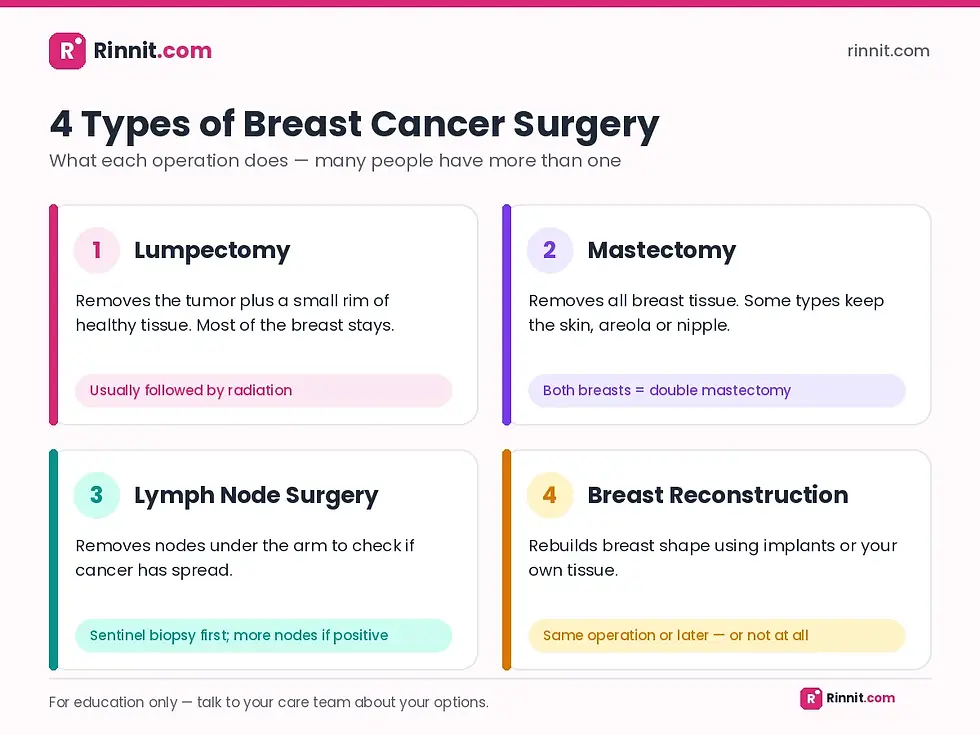
The four main types are lumpectomy, mastectomy, lymph node surgery and breast reconstruction.
The right choice depends on tumor size and location, breast size, spread, overall health and personal preference.
Lumpectomy recovery is often a few days to two weeks; mastectomy and reconstruction take longer.
Fever, spreading redness, pus, heavy bleeding or arm swelling after surgery need a call to your care team.
What is breast cancer surgery?
Breast cancer surgery is an operation that removes cancer from the breast, checks whether it has spread to nearby lymph nodes, or rebuilds the breast afterward. For many people with breast cancer, it is the first step in treatment. [1]
You may need surgery to:
Remove a cancerous tumor from the breast
Remove all of the breast tissue
Check whether cancer has reached the lymph nodes under the arm
Reconstruct the breast
Some people with a high risk of breast cancer choose surgery to lower that risk. Surgery may be the only treatment, or one part of a larger plan that includes radiation, chemotherapy or other therapies. [1] [3]
When is breast cancer surgery an option?
Breast cancer surgery is used for cancers that are still contained in or near the breast. It can treat: [1]
Type of breast cancer | What it means |
Ductal carcinoma in situ (DCIS) | Noninvasive cancer that has not grown into surrounding tissue |
Early-stage breast cancer | Small cancer that has not spread outside the breast |
Locally advanced cancer that may involve the breast skin or nearby muscles | |
Cancer that has come back after the first treatment |
Surgery is usually not the main treatment if the cancer has already spread beyond the breast to distant parts of the body. [1]
What are the types of breast cancer surgery?
The four types of breast cancer surgery are lumpectomy, mastectomy, lymph node surgery and breast reconstruction. Many people have more than one of these during the same operation. [1] [2]
Lumpectomy (breast-conserving surgery)
A lumpectomy removes only the cancer and a small amount of healthy tissue around it, so most of the breast stays. It is also called a partial mastectomy. [1]
Most people who have a lumpectomy then receive radiation therapy to the breast. [1] [2]
Mastectomy
A mastectomy removes all of the breast tissue. Some types keep the skin, the areola or the nipple. [1]
If you have certain risk factors, you and your surgeon may decide to remove both breasts. This is called a double mastectomy. Some people still need radiation or chemotherapy after a mastectomy. [1] [2]
Lymph node surgery
Lymph node surgery removes one or more lymph nodes from under the arm to see whether cancer has spread. There are two main approaches: [1]
Sentinel lymph node biopsy: The surgeon removes the first few nodes that cancer would most likely reach, then sends them to a lab for testing.
Axillary lymph node dissection: If the sentinel nodes contain cancer, the surgeon may remove more nodes.
Breast reconstruction
Breast reconstruction rebuilds the shape and look of the breast after a mastectomy. It can use implants or your own tissue taken from another part of your body. [1] [4]
Reconstruction can often happen during the same operation as the mastectomy, or later as a separate procedure. Some people choose not to have reconstruction at all. [1]
Lumpectomy vs mastectomy: how do they compare?
A lumpectomy keeps most of the breast and is usually followed by radiation, while a mastectomy removes all breast tissue and often has a longer recovery. [1]

Feature | Lumpectomy | Mastectomy |
What is removed | Tumor plus a small rim of healthy tissue | All breast tissue (skin, areola or nipple may be kept) |
Other name | Partial mastectomy / breast-conserving surgery | Total mastectomy; double mastectomy if both breasts |
Usual follow-up | Radiation therapy in most cases | Radiation or chemotherapy in some cases |
Reconstruction | Usually not needed | Optional — same day or later |
Typical recovery | A few days to two weeks | Longer; several weeks or more with reconstruction |
How do doctors choose the right breast cancer surgery?
Doctors choose breast cancer surgery based on the cancer's size and location, the size of the breast, whether cancer has spread, your overall health and your personal preferences. [1]
Before surgery, you will meet your care team to discuss options. Depending on your situation, the team may include a breast surgeon, a surgical oncologist and a plastic surgeon. [1]
Helpful steps when deciding:
Ask your surgeon to explain the benefits and risks of each option.
Write your questions down before each appointment.
Meet a plastic surgeon before surgery if reconstruction is an option.
Bring a family member or friend to help you remember details.
What are the benefits and risks of breast cancer surgery?
Breast cancer surgery removes cancer from the breast, can cure many early-stage cancers and lowers the chance of the cancer coming back. In some people with advanced disease, it also relieves symptoms. [1]
Possible risk | What it may look like |
Bleeding | Blood loss during or after surgery |
Infection | Redness, warmth, pus or fever |
Scarring | Visible marks where incisions heal |
Fluid buildup | A soft swelling near the surgical area |
Numbness | Reduced feeling in the breast or changed nipple sensation |
Arm swelling | Swelling in the arm after lymph node removal |
How successful is breast cancer surgery?
Breast cancer surgery is very successful at removing cancer, and for many people with early-stage breast cancer it is the main treatment and may cure the disease. [1]
Your own results depend on the type and stage of the cancer, whether it has spread, the type of surgery and whether you need other treatments. Your doctor can explain what to expect for your diagnosis. [1]
How long is recovery after breast cancer surgery?
Recovery after breast cancer surgery depends on the operation: many people recover from a lumpectomy within a few days to two weeks, a mastectomy takes longer, and reconstruction can add several weeks or more. [1]

Your surgeon will tell you when it is safe to return to work, drive and lift heavy objects. [1]
To help your recovery, your care team may advise you to:
Care for your incisions exactly as directed
Take medicines as prescribed
Wear a surgical bra
Do gentle arm and shoulder exercises
Return to normal activities slowly
Emotional recovery matters too. Many people feel anxious, sad or worried about how their body will look and feel. Leaning on family, friends, support groups or your care team can help. [1]
Will breast cancer surgery change how the breast looks or feels?
Breast cancer surgery can change how the breast looks and feels, depending on the type of operation. [1]
You may notice scars, numbness or changes in breast or nipple sensation. The breast may look different, especially if a large amount of tissue is removed. Your care team can show you what changes to expect before surgery. [1]
When should you call a doctor after breast cancer surgery?
You should call your doctor after breast cancer surgery if you notice any of these signs: [1]
Fever
Redness, warmth or swelling around an incision that is getting worse
Drainage or pus from an incision
Heavy bleeding
Severe or worsening pain
Swelling in your arm or hand
An incision that opens
Emergency: Call your local emergency number or go to the nearest emergency department right away if you have chest pain or trouble breathing.
Conclusion
Breast cancer surgery is often the first and most important step in treating breast cancer. A lumpectomy keeps most of the breast, a mastectomy removes all of it, lymph node surgery checks for spread, and reconstruction can restore the breast's shape. The best option depends on the cancer, your body and your own goals. Learning the choices ahead of time helps you ask better questions and feel more confident in the plan you make with your care team.
Next step: Save or share this guide and bring it to your next surgeon appointment. For more clear, research-backed health guides, explore our health library.
Frequently asked questions
What is the most common surgery for breast cancer?
The two main surgeries are lumpectomy, which removes only the tumor and a small rim of tissue, and mastectomy, which removes all breast tissue. Many people also have lymph node surgery at the same time. [1] [2]
Is a lumpectomy as safe as a mastectomy?
For many women with invasive breast cancer, lumpectomy followed by radiation gives the same long-term survival as mastectomy, as long as the removed tissue has cancer-free edges. [5]
Do I always need radiation after a lumpectomy?
Most people who have a lumpectomy receive radiation therapy afterward, because it greatly lowers the chance of cancer returning in the same breast. Your care team decides based on your situation. [1] [5]
What is a sentinel lymph node biopsy?
It is a procedure that removes the first lymph nodes cancer would likely reach and tests them in a lab. If they contain cancer, more nodes may be removed. [1]
How long does it take to recover from breast cancer surgery?
Many people recover from a lumpectomy in a few days to two weeks. Mastectomy recovery takes longer, and reconstruction can add several weeks or more. [1]
Can breast reconstruction be done at the same time as a mastectomy?
Yes. Reconstruction can often be done during the same operation, or later as a separate procedure. Some people choose no reconstruction. [1] [4]
Will I lose feeling in my breast after surgery?
You may notice numbness or changes in breast or nipple sensation after surgery. How much depends on the type of operation. [1]
When is surgery not used for breast cancer?
Surgery is usually not the main treatment when cancer has already spread beyond the breast to distant parts of the body. [1]
How do I prepare for breast cancer surgery?
Before surgery you meet your care team, which may include a breast surgeon, a plastic surgeon and a surgical oncologist. [1] If you are considering reconstruction, discuss it with your breast and plastic surgeons before surgery. If a wire is used to mark the tumor, it is placed on the day of surgery shortly before the operation, while reflector-type markers can be placed days or even weeks before. [2]
When should I call my doctor after breast cancer surgery?
Call your doctor if you have a fever, increasing redness, warmth or swelling around an incision, drainage or pus, heavy bleeding, severe or worsening pain, swelling in your arm or hand, or an incision that opens. [1] Call 911 or go to the emergency room if you have chest pain or trouble breathing. [1]
Does breast cancer surgery hurt, and what anesthesia is used?
For a mastectomy, you are given general anesthesia, so you are asleep and pain-free during surgery. [8] Afterward, pain around the cut is worst in the first few days and goes away over several weeks, and you receive pain medicine during your hospital stay. [8]
Related Reading
Breast Surgery Options: Cancer, Cosmetic and Reconstructive compares the types of breast surgery.
References
Cleveland Clinic. Breast Cancer Surgery: Types. Cleveland Clinic. Last updated August 17, 2026. https://my.clevelandclinic.org/health/treatments/8338-breast-cancer-surgery
American Cancer Society. Surgery and Other Procedures for Breast Cancer. Cancer.org. Last revised July 1, 2026. https://www.cancer.org/cancer/types/breast-cancer/treatment/surgery-for-breast-cancer.html
National Cancer Institute. Breast Cancer Surgery. Cancer.gov. Accessed October 30, 2026. https://www.cancer.gov/types/breast/treatment/surgery
Czajka ML, Pfeifer C. Breast Cancer Surgery. In: StatPearls [Internet]. Treasure Island (FL): StatPearls Publishing; updated February 8, 2023. PMID: 31971717. https://pubmed.ncbi.nlm.nih.gov/31971717/
Fisher B, Anderson S, Bryant J, et al. Twenty-year follow-up of a randomized trial comparing total mastectomy, lumpectomy, and lumpectomy plus irradiation for the treatment of invasive breast cancer. N Engl J Med. 2002;347(16):1233-1241. PMID: 12393820. https://doi.org/10.1056/NEJMoa022152
Giuliano AE, Ballman KV, McCall L, et al. Effect of axillary dissection vs no axillary dissection on 10-year overall survival among women with invasive breast cancer and sentinel node metastasis: the ACOSOG Z0011 (Alliance) randomized clinical trial. JAMA. 2017;318(10):918-926. PMID: 28898379. https://doi.org/10.1001/jama.2017.11470
Elghazaly S, Fakeh S, Elbarbary S, et al. Robot-assisted versus open surgery in early-stage breast cancer: a systematic review and meta-analysis. Clin Breast Cancer. 2026;26(2):181-190. PMID: 40962684. https://doi.org/10.1016/j.clbc.2025.08.019
MedlinePlus. Mastectomy. MedlinePlus. Last reviewed February 17, 2025. https://medlineplus.gov/ency/article/002919.htm
Medical disclaimer
This article is for general education and does not replace advice from your doctor. Always discuss treatment decisions with your own healthcare team.



Comments