Breast Surgery Options: Cancer, Cosmetic and Reconstructive

Updated: 2 days ago
Written and medically reviewed by Dr. Baraa Alnahhal, MD · Last reviewed: November 2026 · How we review
Quick Answer
Breast surgery is any surgery on the breasts. Cancer surgeries include breast biopsy, lumpectomy and mastectomy. Cosmetic and reconstructive surgeries include breast augmentation, reconstruction, reduction and lift. Most are done under general anesthesia. Recovery ranges from a few weeks to several months after mastectomy. Men may need breast surgery for breast cancer or gynecomastia.
What the research says
Lumpectomy with radiation matched mastectomy for survival: in the NSABP B-06 trial of 1,851 women followed for 20 years, survival was the same after lumpectomy as after mastectomy, and adding radiation to lumpectomy cut same-breast cancer return from 39.2% to 14.3% (Fisher B et al., New England Journal of Medicine, 2002) [2]
Breast-conserving surgery was confirmed in another 20-year trial: in 701 women with tumors up to 2 cm, death from any cause was 41.7% after breast-conserving surgery plus radiation versus 41.2% after radical mastectomy over 20 years (Veronesi U et al., New England Journal of Medicine, 2002) [3]
Key takeaways
Breast surgery includes cancer, cosmetic and reconstructive procedures.
Lumpectomy and mastectomy are the most common cancer surgeries.
Breast augmentation is the most common cosmetic surgery.
Most procedures use general anesthesia.
Recovery ranges from a few weeks to several months.
What is breast surgery?
Breast surgery may be done to diagnose or treat breast cancer, remove a noncancerous lump, lower cancer risk in people with a strong family history or BRCA1 or BRCA2 gene changes, ease pain from large breasts, or change how the breasts look. Sources: [1]
Breast cancer surgery options
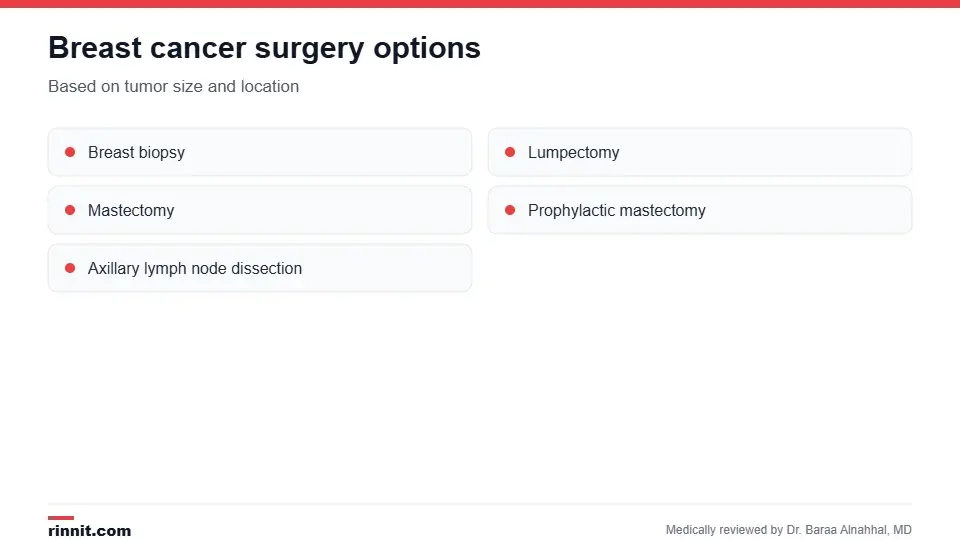
Your surgeon recommends options based on tumor size and location.
Surgery | What it involves |
Removes a tissue sample to check for cancer | |
Removes the tumor and a margin of healthy tissue, keeping the breast | |
Removes the whole breast | |
Prophylactic mastectomy | Removes one or both healthy breasts to lower cancer risk; see double mastectomy |
Axillary lymph node dissection | Removes lymph nodes under the arm to check for cancer spread |
Learn more about breast cancer surgery. Sources: [1]
Cosmetic and reconstructive options

Breast augmentation is the most common cosmetic surgery.
Surgery | What it involves |
Enlarges the breasts with implants or fat | |
Breast reconstruction | Rebuilds the breast after mastectomy |
Removes tissue to ease pain from large breasts | |
Raises and reshapes sagging breasts | |
Reduces enlarged breast tissue in men |
Sources: [1]
How to prepare
For cancer surgery, your surgeon reviews your history and the tumor's size and location, explains your options, recovery and side effects, and discusses reconstruction.
For cosmetic surgery, your surgeon confirms you're healthy enough and talks through your goals and expected results.
Your breasts may be measured and photographed.
Ask how your breasts may look and feel over time and whether you'll be able to breastfeed. Sources: [1]
What happens during surgery

Drains are common after mastectomy, reconstruction and reduction.
You get general anesthesia, or local anesthesia for needle biopsies.
The surgeon makes incisions to take samples, remove tissue or place implants.
A pathologist examines any tissue removed.
The incisions are closed with stitches.
Drains are usually placed after mastectomy, reconstruction or reduction. Sources: [1]
Risks
Anesthesia complications.
Excessive bleeding.
More pain than expected.
Scars.
Wound infection. Sources: [1]
Recovery
Surgery | Typical recovery |
Many breast surgeries | Take it easy and arrange rides for a few weeks |
Breast reconstruction | About a month |
Mastectomy | Several months |
Your team will explain bra or bandage use, incision care and how to empty drains. Emotional support can help after breast cancer surgery. Sources: [1]
When to call your provider
Bleeding from the wound that's more than expected.
Stitches that break or an incision that opens.
A fever of 101°F (38.3°C) or higher.
Pain that medicine doesn't relieve.
Redness, tenderness or swelling at the incision.
Swelling in your arm, hand or armpit. Sources: [1]
Conclusion
Breast surgery covers a wide range of procedures, from cancer treatment to reconstruction and cosmetic changes. Your surgeon can help you understand each option and choose the one that fits your health and goals.
Keep learning: read about lumpectomy and mastectomy.
Frequently asked questions
What are the types of breast surgery?
Cancer surgeries, cosmetic surgeries and reconstructive surgeries.
What is the most common breast cancer surgery?
Lumpectomy and mastectomy.
What's the difference between lumpectomy and mastectomy?
Lumpectomy removes the tumor; mastectomy removes the whole breast.
Is lumpectomy as effective as mastectomy?
For many early cancers, lumpectomy with radiation has similar survival.
What is a prophylactic mastectomy?
Removing healthy breasts to lower cancer risk.
What is the most common cosmetic breast surgery?
Breast augmentation.
Do men have breast surgery?
Yes, for breast cancer or gynecomastia.
Will I need drains?
Often after mastectomy, reconstruction or reduction.
How long is recovery?
From a few weeks to several months, depending on the surgery.
When should I call my provider?
For fever, heavy bleeding, an opened incision or arm swelling.
Related Reading
Breast Reconstruction: Implant and Flap Options, Surgery and Recovery explains implant and flap breast reconstruction.
Mastectomy: Types, Surgery, Recovery and Reconstruction surgery to remove the whole breast.
Lumpectomy: Purpose, Procedure, Recovery and Risks surgery that keeps most of the breast.
Breast Cancer Surgery: Types, Recovery and Risks Explained an overview of breast cancer surgery.
Breast Augmentation: Types, Surgery, Recovery and Risks Explained the most common cosmetic breast surgery.
Breast Biopsy: Types, What to Expect, Recovery and Results a test to check breast tissue for cancer.
References
Cleveland Clinic. Types of Breast Surgery for Cancer, Cosmetic & Preventive. Cleveland Clinic. Last updated February 20, 2025. https://my.clevelandclinic.org/health/treatments/9097-breast-surgery-options
Fisher B, Anderson S, Bryant J, et al. Twenty-year follow-up of a randomized trial comparing total mastectomy, lumpectomy, and lumpectomy plus irradiation for the treatment of invasive breast cancer. New England Journal of Medicine. 2002;347(16):1233-1241. PMID 12393820. https://doi.org/10.1056/NEJMoa022152
Veronesi U, Cascinelli N, Mariani L, et al. Twenty-year follow-up of a randomized study comparing breast-conserving surgery with radical mastectomy for early breast cancer. New England Journal of Medicine. 2002;347(16):1227-1232. PMID 12393819. https://doi.org/10.1056/NEJMoa020989
Medical disclaimer
This article is for general education only and does not replace advice from a qualified healthcare professional. Talk to your doctor about your own diagnosis and treatment, and seek emergency care right away for severe or sudden symptoms.



Comments