Breast Biopsy: Types, What to Expect, Recovery and Results

Updated: 2 days ago
Written and medically reviewed by Dr. Baraa Alnahhal, MD · Last reviewed: November 2026 · How we review
Quick Answer: What is a breast biopsy?
A breast biopsy is a procedure where a provider removes a sample of breast tissue, with a needle or surgery, to check it for cancer. It's the only way to rule breast cancer in or out after a lump or an abnormal imaging result. Most biopsies don't find cancer: 80% of people who have one don't have breast cancer. [1]
What the research says
Needle biopsies are nearly as accurate as surgery, with fewer complications. A systematic review found that image-guided core-needle biopsies were almost as accurate as open surgical biopsy, with severe complications in under 1% versus 2% to 10% after surgery, and people diagnosed by needle biopsy were far more likely to need only one operation. (Bruening et al., Annals of Internal Medicine, 2010) [2]
Vacuum-assisted biopsy is highly accurate. Across 21 studies, vacuum-assisted breast biopsy diagnosed breast cancer with a pooled sensitivity of 98.1% and specificity of 99.9%. (Yu et al., Breast Cancer Research and Treatment, 2010) [3]
Key takeaways
A breast biopsy is the only way to confirm or rule out breast cancer. [1]
About 80% of people who have a breast biopsy don't have cancer. [1]
The four main types are fine-needle aspiration, core needle, excisional and incisional biopsy. [1]
Most needle biopsies take under an hour, with a short recovery. [1]
Results usually take one to two weeks. [1]
What is a breast biopsy?
A breast biopsy is when a healthcare provider takes a sample of your breast tissue to look at under a microscope. You may have one if your provider thinks changes in your breast could be breast cancer. [1]
It's normal to feel anxious, but having a biopsy doesn't mean you have cancer. In fact, 80% of females who have a breast biopsy don't have cancer. [1]
Why would you need a breast biopsy?

A biopsy is the only way to rule out breast cancer.
Providers usually order a breast biopsy after an exam or imaging test shows a possible sign of cancer, such as: [1]
A lump or thickening that you or your provider feels, for example during a breast self-exam
A mammogram showing an abnormal area
A breast ultrasound showing an area that could be cancer
Unusual changes in your nipple or areola, such as crusting, dimpling skin or unusual discharge
What are the types of breast biopsy?
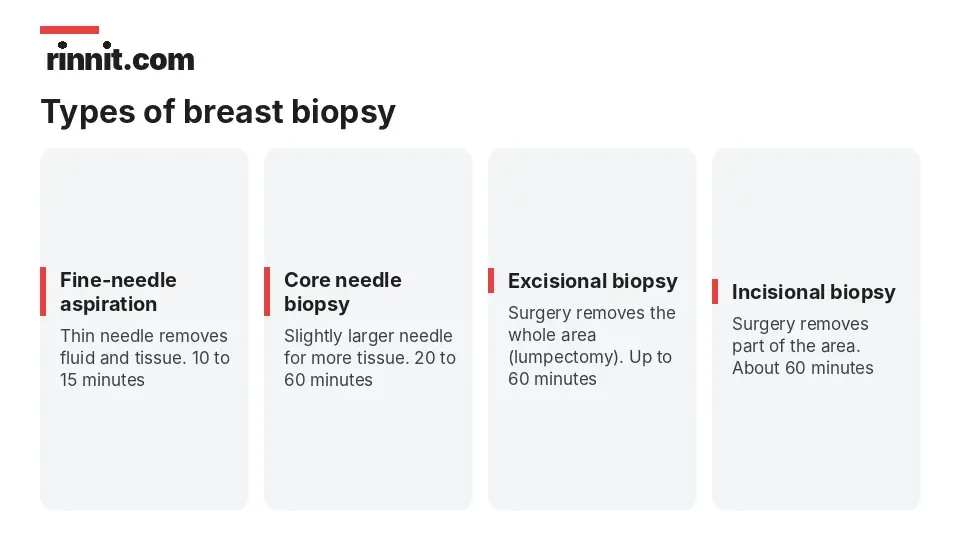
Your provider chooses the type based on the changes in your breast.
Your provider recommends the type that fits the changes in your breast. [1]
Type | How it's done | How long it takes |
Fine-needle aspiration (FNA) | A radiologist uses a syringe with a thin needle to remove fluid and tissue | 10 to 15 minutes |
Core needle biopsy | A radiologist uses a slightly larger needle to remove more tissue | 20 to 60 minutes |
Excisional biopsy (lumpectomy) | A surgeon removes all the abnormal area, sometimes with some normal tissue around it | Up to 60 minutes |
Incisional biopsy | A surgeon removes only part of the abnormal area | About 60 minutes |
Sources: [1]
How do you prepare for a breast biopsy?
Tell your provider, surgeon or radiologist if you: [1]
Are pregnant or might be pregnant
Take blood thinners (anticoagulants), which may need adjusting to prevent bleeding or bruising
Take aspirin or herbal supplements
Have any health conditions or recently had surgery
Have allergies, especially to anesthesia
Your care team will also tell you whether you can wear deodorant that day and whether you'll need someone to drive you home. [1]
What happens before the biopsy?
Your provider may first pinpoint the exact area to sample. [1]
Image-guided procedures
Imaging machines guide the needle during the biopsy. Types include: [1]
Stereotactic breast biopsy using mammogram images
Ultrasound-guided biopsy
Breast MRI-guided biopsy
Wire or wire-free localization
Before a surgical biopsy, your surgeon may place a thin wire in your breast to guide them: [1]
Your anesthesiologist numbs the area with a tiny needle.
Using ultrasound or MRI, the surgeon places a thin, hollow needle into the biopsy area.
A thin wire with a small hook is passed through the needle to hold it in place.
The needle is removed, leaving the wire, with one end outside your breast.
The wire is removed after the biopsy.
Instead of a wire, your surgeon may place tiny radioactive pellets, magnetic pellets or radiofrequency reflectors in the area and use a handheld detector to find it. [1]
What happens during a breast biopsy?
Fine-needle aspiration: You get local anesthesia, then the needle collects fluid and tissue. [1]
Core needle biopsy: You get local anesthesia, and your radiologist may make a tiny cut to insert the needle. They place small markers at the site in case more tissue is needed later. [1]
Surgical biopsy: You get general anesthesia. Your surgeon removes tissue through a cut, then closes it with stitches and a sterile bandage. [1]
A breast biopsy shouldn't hurt, but you may feel a slight poke when you get anesthesia and some pressure during a needle biopsy. [1]
What is recovery like?
Biopsy type | Typical recovery |
Fine-needle aspiration | The area may be sore; take it easy for the rest of the day and return to normal activities the next day |
Core needle biopsy | Avoid strenuous activity for at least two days |
Surgical biopsy | Pain may last a few days; normal activities usually resume within a couple of days to a week |
Sources: [1]
What are the risks?
Common side effects include bruising, bleeding, swelling, pain or soreness and wound infection. Serious complications are very rare and include a breast hematoma (collected blood), infection, a collapsed lung (pneumothorax), or blood collecting between the chest wall and lungs (hemothorax or hemopneumothorax). [1]
Call your surgeon if you have a fever above 101°F (38.3°C), red or darker skin around the site, pain when you touch it, or bruising that keeps spreading. [1]
What do breast biopsy results mean?
After a fine-needle aspiration, a pathologist does cytology tests. Results range from no abnormal cells to precancerous or cancerous cells. [1]
After a core needle, excisional or incisional biopsy, the pathologist decides whether you have a noncancerous (benign) breast condition, whether some tissue is cancerous or whether a removed lump is a cancerous tumor. [1]
It usually takes one to two weeks to get results. Keeping your routine and talking with others can help while you wait. [1]
Conditions that can look like breast cancer
Several benign breast conditions can look or feel like cancer: [1]
Fibroadenoma, the most common noncancerous breast tumor
Breast calcifications, small clusters of calcium deposits
Breast cysts, fluid-filled sacs that can be painful and usually move under the skin
Fibrosis, firm, thickened breast tissue often caused by hormone changes
What happens if the biopsy finds cancer?
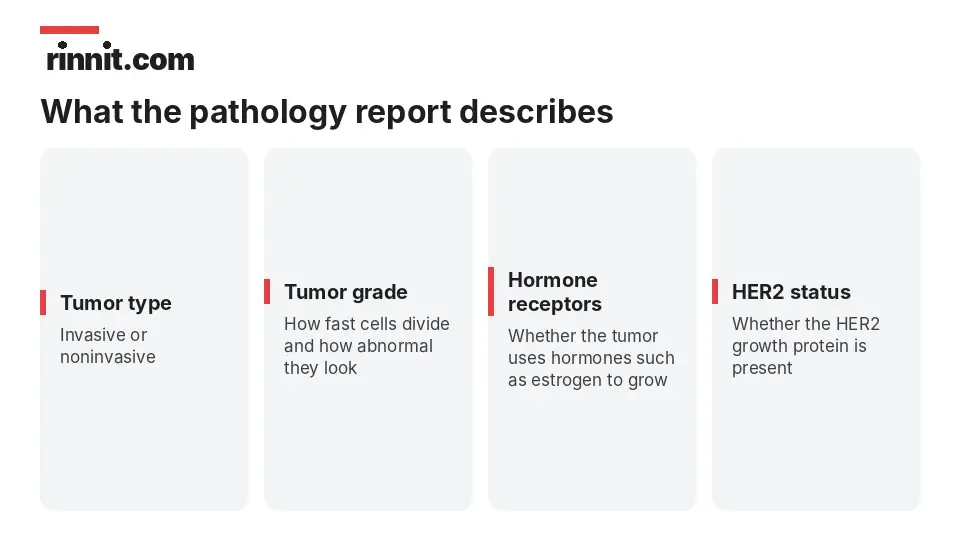
Results usually take one to two weeks.
The pathologist's report describes: [1]
Detail | What it tells your provider |
Tumor type | Whether it's invasive (likely to spread) or noninvasive |
Tumor grade | How quickly cancer cells divide and how different they look from normal cells |
Hormone receptor status | Whether the tumor uses hormones to grow, such as estrogen receptor-positive (ER+) cancer |
HER2 status | Whether the cancer has HER2, a protein that helps cancer cells grow and spread |
Sources: [1]
Your provider will explain the results and discuss treatment options with you. [1]
Conclusion
A breast biopsy is the only way to know for sure whether a change in your breast is cancer, and most biopsies don't find cancer. Needle biopsies are quick, and even surgical biopsies usually need only a short recovery. [1]
Waiting for results can be stressful. Share your concerns and ask your care team anything you'd like to know. [1]
Keep learning: Read our guide to breast cancer screening or our breast cancer guide. For more background, see the American Cancer Society page on breast biopsy.
FAQ
What is a breast biopsy?
A procedure that removes a small sample of breast tissue to check it for cancer under a microscope.
Does needing a breast biopsy mean I have cancer?
No. About 80% of people who have a breast biopsy don't have cancer.
What are the types of breast biopsy?
Fine-needle aspiration, core needle biopsy, excisional biopsy and incisional biopsy.
Is a breast biopsy painful?
It shouldn't be. You may feel a slight poke from the anesthesia and some pressure.
How long does a breast biopsy take?
From 10 to 15 minutes for fine-needle aspiration up to about 60 minutes for a surgical biopsy.
How long are breast biopsy results?
Usually one to two weeks.
What is the recovery after a core needle biopsy?
Avoid strenuous activity for at least two days.
What are the risks of a breast biopsy?
Bruising, bleeding, swelling, soreness or infection; serious complications are very rare.
When should I call my doctor after a breast biopsy?
For a fever above 101°F (38.3°C), redness, pain to the touch or spreading bruising.
What does the pathology report show if it's cancer?
Tumor type, grade, hormone receptor status and HER2 status.
Related Reading
Breast Surgery Options: Cancer, Cosmetic and Reconstructive compares the types of breast surgery.
Molecular Breast Imaging (MBI): Finding Cancer in Dense Breasts explains the tracer-based breast test for women with dense breasts.
Digital Breast Tomosynthesis (3D Mammogram): Benefits, Prep and Results explains 3D mammography and how it compares with a standard mammogram.
Breast Cancer: Symptoms, Causes, and Treatment explains the condition a breast biopsy is used to confirm or rule out.
Invasive Ductal Carcinoma: Symptoms, Causes, and Treatment covers the most common type of breast cancer found on biopsy.
Lobular Carcinoma in Situ (LCIS) explains a breast change often found on biopsy.
Estrogen Receptor-Positive (ER+) Breast Cancer explains the hormone receptor status in a biopsy report.
Mammogram and Breast MRI explain imaging tests that often come before a biopsy.
Stereotactic Breast Biopsy: Why It's Done, What to Expect, Recovery and Results explains the mammogram-guided biopsy used for calcifications that can't be felt.
Immunohistochemistry (IHC): What It Is, How It Works and What Results Mean explains the antibody staining test that identifies cancer type and treatment targets.
Core Needle Breast Biopsy: Procedure, Recovery and Results explains the needle biopsy used to check breast changes for cancer.
References
Cleveland Clinic. Breast Biopsy: Types, Procedure, Recovery & Results. Cleveland Clinic. Last updated January 13, 2025. https://my.clevelandclinic.org/health/diagnostics/24204-breast-biopsy-overview
Bruening W, Fontanarosa J, Tipton K, et al. Systematic review: comparative effectiveness of core-needle and open surgical biopsy to diagnose breast lesions. Ann Intern Med. 2010;152(4):238-246. PMID 20008742. https://doi.org/10.7326/0003-4819-152-1-201001050-00190
Yu YH, Liang C, Yuan XZ. Diagnostic value of vacuum-assisted breast biopsy for breast carcinoma: a meta-analysis and systematic review. Breast Cancer Res Treat. 2010;120(2):469-479. PMID 20130983. https://doi.org/10.1007/s10549-010-0750-1
Medical disclaimer
This article is for general education only and does not replace advice from a qualified healthcare professional. Talk to your doctor about your own diagnosis and treatment, and seek emergency care right away for severe or sudden symptoms.



Comments