Digital Breast Tomosynthesis (3D Mammogram): Benefits, Prep and Results

Updated: 3 days ago
Written and medically reviewed by Dr. Baraa Alnahhal, MD · Last reviewed: November 2026 · How we review
Quick Answer
Digital breast tomosynthesis (DBT), often called 3D mammography, is an advanced mammogram that takes many low-dose X-ray pictures of the breast from different angles and combines them into a 3D image. It helps find cancers hidden by overlapping tissue and reduces false alarms. It's especially helpful for dense breasts. The appointment takes about 30 minutes.
What the research says
3D mammography finds more invasive cancers: in a population-based screening program in Oslo, adding tomosynthesis to digital mammography detected 25 more invasive cancers, about a 40% increase, compared with mammography alone (Skaane P et al., Radiology, 2013) [2]
It also means fewer callbacks: in 454,850 screening exams at 13 U.S. breast centers, adding tomosynthesis lowered the recall rate from 107 to 91 per 1,000 screens and raised the cancer detection rate from 4.2 to 5.4 per 1,000, with more invasive cancers found (Friedewald SM et al., JAMA, 2014) [3]
Key takeaways
DBT builds a 3D picture of the breast from many low-dose X-rays.
It finds more cancers and leads to fewer callbacks than 2D mammography alone.
It's especially useful for dense breast tissue.
The appointment takes about 30 minutes and feels like a regular mammogram.
The radiation dose is low.
What is digital breast tomosynthesis?
In a standard 2D mammogram, breast tissue overlaps in a single flat image, which can hide a small cancer or make normal tissue look suspicious. In tomosynthesis, the X-ray tube moves in an arc over the breast, taking several images that a computer turns into thin slices. The FDA approved DBT in 2011. It can be used for breast cancer screening and for checking symptoms such as a lump, pain or skin changes. Sources: [1]
3D vs. 2D mammography
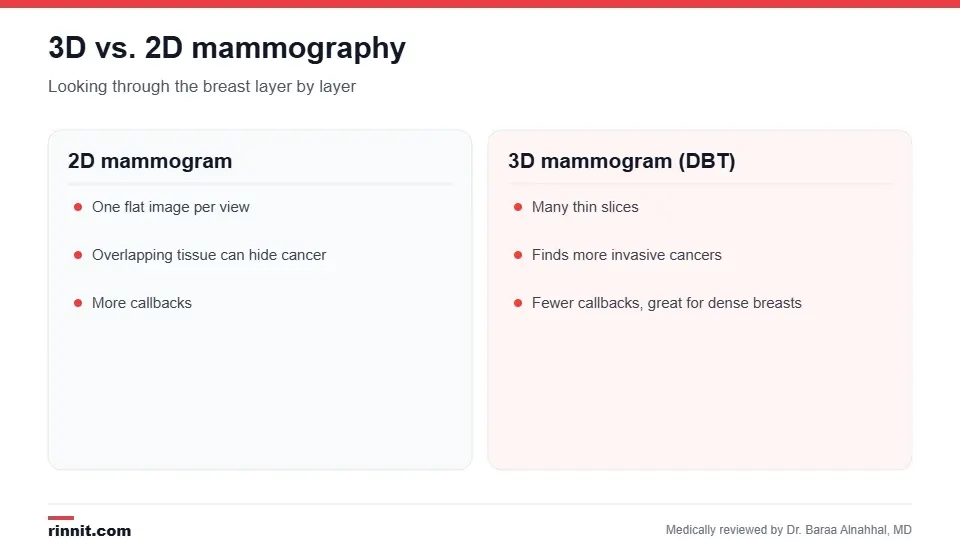
3D mammography looks through the breast layer by layer.
Feature | 2D mammogram | 3D mammogram (DBT) |
Image | One flat picture per view | Many thin slices |
Cancer detection | Standard | Finds more invasive cancers |
Callbacks | More false alarms | Fewer callbacks |
Dense breasts | Tissue can hide cancer | Especially helpful |
Radiation | Low | Low; slightly more, depending on technique |
Sources: [1, 2, 3]
How to prepare

Simple steps help get clear images.
Schedule the test when your breasts are least tender, often 1 to 2 weeks after your period.
Don't wear deodorant, powder or lotion, which can show up as white spots.
Wear a two-piece outfit; you'll change into a gown from the waist up.
Have earlier mammogram images sent for comparison, and tell staff about breast symptoms, implants, pregnancy or breastfeeding. Sources: [1]
What happens during the test

The appointment takes about 30 minutes.
A technologist positions one breast on a platform and gently compresses it with a plastic plate.
The X-ray tube moves in an arc, taking several low-dose images in a few seconds while you hold still.
The process is repeated for the other breast.
A computer combines the images into thin slices for the radiologist to review. Sources: [1]
Compression can be uncomfortable for a few seconds; tell the technologist if it hurts. Sources: [1]
Radiation and results
The total dose of DBT combined with a standard mammogram is just under three times that of a standard mammogram alone, which is still low. Newer systems that create 2D images from the 3D data bring the dose close to a standard mammogram. Results usually come within a few days. If something looks suspicious, you may need more images, an ultrasound, a breast MRI or a breast biopsy, which is the only way to confirm cancer. Sources: [1]
Conclusion
3D mammography gives a clearer view of breast tissue than a standard mammogram, finding more cancers while reducing false alarms. Ask your provider whether it's a good option for your screening, especially if you have dense breasts.
Keep learning: read about the mammogram and breast cancer screening.
Frequently asked questions
What is 3D mammography?
Another name for digital breast tomosynthesis, which builds a 3D image of the breast.
Is 3D mammography better than 2D?
It finds more cancers and leads to fewer callbacks.
Who benefits most?
People with dense breast tissue.
Does it hurt?
It feels like a regular mammogram, with brief compression.
How long does it take?
About 30 minutes for the appointment.
Is the radiation safe?
Yes. The dose is low.
Can I wear deodorant?
No. It can show up on the images.
When is the best time to schedule it?
When your breasts are least tender, often 1 to 2 weeks after your period.
When will I get results?
Usually within a few days.
What happens if something looks abnormal?
More imaging or a biopsy may be needed.
Related Reading
Molecular Breast Imaging (MBI): Finding Cancer in Dense Breasts explains the tracer-based breast test for women with dense breasts.
Mammogram: Types, How to Prepare, What Happens and Your Results the standard breast X-ray.
Breast Cancer Screening: When to Start, How Often and Which Tests Are Used who should be screened and when.
Breast MRI: Why It's Done, What to Expect and How It Compares to a Mammogram an imaging test used for high-risk screening.
Breast Biopsy: Types, What to Expect, Recovery and Results the test that confirms a diagnosis.
Core Needle Breast Biopsy: Procedure, Recovery and Results the most common type of breast biopsy.
References
Cleveland Clinic. Breast Tomosynthesis. Cleveland Clinic. Last updated October 4, 2022. https://my.clevelandclinic.org/health/diagnostics/15939-digital-breast-tomosynthesis-and-breast-cancer-screening
Skaane P, Bandos AI, Gullien R, et al. Comparison of digital mammography alone and digital mammography plus tomosynthesis in a population-based screening program. Radiology. 2013;267(1):47-56. PMID 23297332. https://doi.org/10.1148/radiol.12121373
Friedewald SM, Rafferty EA, Rose SL, et al. Breast cancer screening using tomosynthesis in combination with digital mammography. JAMA. 2014;311(24):2499-2507. PMID 25058084. https://doi.org/10.1001/jama.2014.6095
Medical disclaimer
This article is for general education only and does not replace advice from a qualified healthcare professional. Talk to your doctor about your own diagnosis and treatment, and seek emergency care right away for severe or sudden symptoms.



Comments