Breast MRI: Why It's Done, What to Expect and How It Compares to a Mammogram

Updated: 4 days ago
Written and medically reviewed by Dr. Baraa Alnahhal, MD · Last reviewed: November 2026 · How we review
Quick Answer: What is a breast MRI?
A breast MRI is an imaging test that uses a strong magnet, radio waves and a computer to make very detailed pictures of breast tissue. Providers mainly use it to evaluate known breast cancer, and alongside mammograms and ultrasound to screen people at high risk or with dense breasts. The scan itself takes about 20 minutes and uses no X-rays. [1]
What the research says
MRI cuts missed cancers in dense breasts. In a randomized trial of 40,373 women with extremely dense breasts and normal mammograms, the interval-cancer rate was 2.5 per 1,000 screenings in the group invited to MRI versus 5.0 per 1,000 with mammography alone. (Bakker et al., The New England Journal of Medicine, 2019) [2]
False positives are common. The same trial reported a false-positive rate of 79.8 per 1,000 MRI screenings. (Bakker et al., The New England Journal of Medicine, 2019) [2]
MRI plus mammography rules out cancer better in high-risk women. A review of 11 prospective studies found that, at a 2% pre-test risk, the chance of a suspicious lesion after negative results was 1.4% with mammography alone and 0.3% with MRI plus mammography. (Warner et al., Annals of Internal Medicine, 2008) [3]
Key takeaways
A breast MRI makes detailed images of breast tissue without X-rays or compression. [1]
It is used for high-risk screening, dense breasts, implant checks and evaluating known cancer. [1]
Most breast MRIs use gadolinium contrast through an IV. [1]
You lie face down for about 20 minutes, with up to 60 minutes allowed in total. [1]
Results are reported with the BI-RADS system and usually arrive within a few business days. [1]
Why is a breast MRI done?
Your provider may use a breast MRI with a mammogram to screen for breast cancer, to biopsy breast tissue, or to see how far cancer has spread. Common reasons include: [1]

Screening if you are at high risk for breast cancer or have dense breast tissue
Checking breast implants for rupture or cancer
Measuring how far cancer has spread into the nipple, skin or chest wall muscle
Looking for other cancers or abnormal tissue in the breast
Checking for enlarged lymph nodes in the armpit
Monitoring breast cancer treatment progress or recurrence
Depending on the reason, the test may need an injection of contrast dye called gadolinium through an IV, which helps the radiologist see breast structures more clearly. [1]
How do you prepare for a breast MRI?
Before the scan, tell your radiologist or technologist if you: [1]
Are pregnant or breastfeeding
Cannot lie on your stomach for 30 to 60 minutes
Have had an allergic reaction to contrast dye
Have claustrophobia
Have medical devices or metal objects in your body
Are wearing a medication patch, such as a birth control or nicotine patch
If you have a medical device, ask the provider who manages it what they recommend for your MRI. [1]
What happens during a breast MRI?
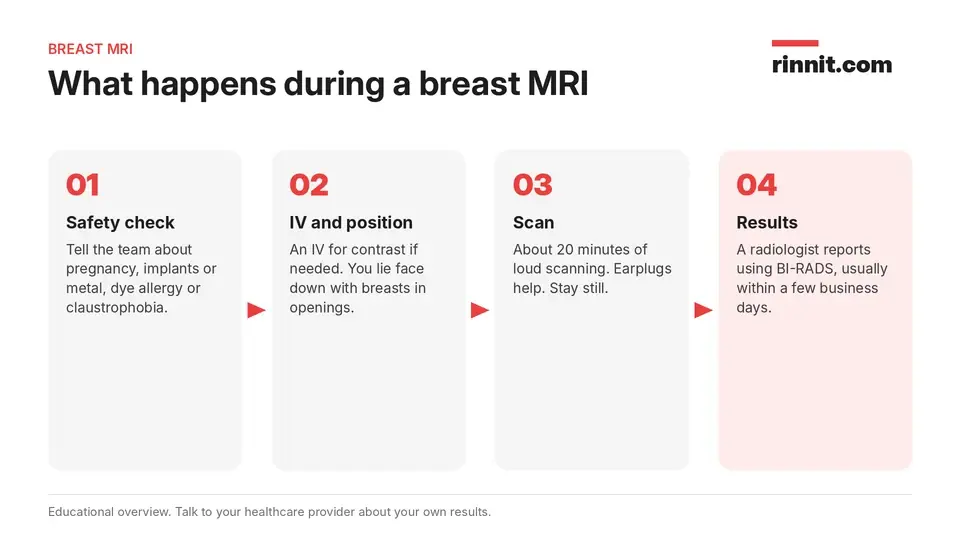
You change into a gown and lie face down on a table with openings for your breasts.
If you need contrast, a technologist or nurse places an IV in your arm.
The table slides into the MRI machine. It is noisy, so you get earplugs.
You stay very still while the technologist runs the scan from another room and talks with you through an intercom.
When the images are done, the IV is removed and you can go home.
Sources: [1]
How long does it take? The scan takes about 20 minutes, but facilities plan up to 60 minutes for IV placement and positioning. [1]
What are the risks?
There is very little risk if you and your technologist follow safety guidelines. Possible risks are: [1]
Allergic reaction to contrast dye: rare, usually mild and quickly treated
False positives: MRI is very sensitive and may flag normal tissue as abnormal, leading to more tests
Breast MRI vs mammogram
Mammograms are usually the first choice for screening and diagnosing breast cancer. The two tests work very differently. [1]
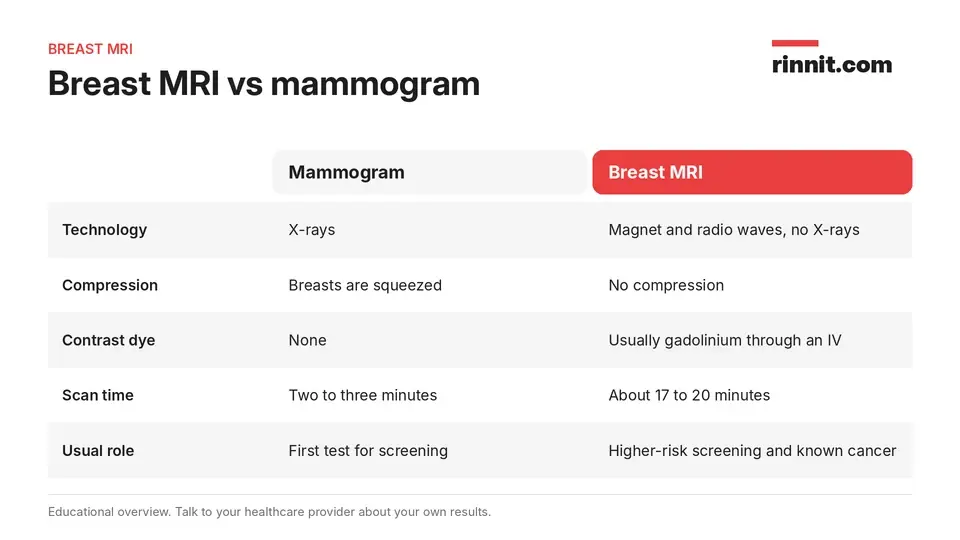
Feature | Mammogram | Breast MRI |
Technology | X-rays | Magnets and radio waves, no X-rays |
Compression | Squeezes the breasts | No compression |
Contrast dye | None, no IV | Usually contrast dye through an IV |
Scan time | Two to three minutes | 17 to 20 minutes |
Sources: [1]
What happens after a breast MRI?
You can go back to your usual activities. If you had an MRI-guided breast biopsy, follow the home care instructions you were given. If you took a sedative, someone else needs to drive you home. [1]
What do breast MRI results mean?
Results usually appear in your electronic medical record within a few business days, and the provider who ordered the test will discuss them with you. [1]
Radiologists describe breast imaging results using the Breast Imaging Reporting and Data System (BI-RADS), which sorts findings on a scale of 0 to 6. If your results are abnormal, your provider will recommend more imaging or a breast biopsy. [1]
Conclusion
A breast MRI gives a highly detailed view of breast tissue and is an important extra tool for people at high risk, those with dense breasts and those with known breast cancer. It is very sensitive, which helps find cancer but can also lead to extra tests.
If you are anxious about your scan or results, share your concerns with your care team so they can explain each step.
Keep learning: Read our guide to breast cancer symptoms, causes and treatment or learn about BRCA testing. For more background, see the American Cancer Society on breast MRI.
FAQ
What is a breast MRI?
It is an imaging test that uses a strong magnet, radio waves and a computer to make detailed pictures of breast tissue. [1]
Why would a doctor order a breast MRI?
To screen high-risk or dense breasts, check implants, see how far cancer has spread, or follow treatment and recurrence. [1]
How long does a breast MRI take?
The scan takes about 20 minutes, with up to 60 minutes allowed for preparation. [1]
Does a breast MRI use contrast dye?
Many do. Gadolinium contrast is given through an IV to show breast structures more clearly. [1]
Does a breast MRI hurt?
It does not compress the breasts; you lie face down and may feel only the IV placement. [1]
Is a breast MRI better than a mammogram?
Mammograms are usually the first test; MRI is added for higher-risk or complex cases. [1]
What are the risks of a breast MRI?
Risks include a rare allergic reaction to contrast dye and false positives that lead to more tests. [1]
What should I tell the technologist before a breast MRI?
Tell them about pregnancy, breastfeeding, dye allergy, claustrophobia, metal or devices in your body, and medicine patches. [1]
When will I get breast MRI results?
Results usually appear in your medical record within a few business days. [1]
What does BI-RADS mean on a breast MRI report?
It is a standard 0-to-6 system radiologists use to describe breast imaging findings. [1]
Related Reading
Molecular Breast Imaging (MBI): Finding Cancer in Dense Breasts explains the tracer-based breast test for women with dense breasts.
Digital Breast Tomosynthesis (3D Mammogram): Benefits, Prep and Results explains 3D mammography and how it compares with a standard mammogram.
Breast Cancer: Symptoms, Causes, and Treatment explains the cancer a breast MRI helps find and assess.
What Is Recurrent Breast Cancer? A Plain-Language Guide to When Cancer Comes Back covers the recurrence a breast MRI can monitor for.
Breast Implant-Associated Anaplastic Large Cell Lymphoma (BIA-ALCL): Symptoms, Causes, Diagnosis and Treatment describes an implant-related cancer that breast imaging can help evaluate.
Gadolinium Contrast for MRI: How It Works, Side Effects and Kidney Safety explains the MRI contrast dye, its side effects and kidney safety.
Core Needle Breast Biopsy: Procedure, Recovery and Results explains the needle biopsy used to check breast changes for cancer.
References
Cleveland Clinic. Breast MRI: Why It's Done & Results. Cleveland Clinic. Last updated September 3, 2025. https://my.clevelandclinic.org/health/diagnostics/8332-breast-mri
Bakker MF, de Lange SV, Pijnappel RM, et al. Supplemental MRI Screening for Women with Extremely Dense Breast Tissue. N Engl J Med. 2019;381(22):2091-2102. PMID 31774954. https://doi.org/10.1056/NEJMoa1903986
Warner E, Messersmith H, Causer P, et al. Systematic review: using magnetic resonance imaging to screen women at high risk for breast cancer. Ann Intern Med. 2008;148(9):671-679. PMID 18458280. https://doi.org/10.7326/0003-4819-148-9-200805060-00007
Medical disclaimer
This article is for general education only and does not replace advice from a qualified healthcare professional. Talk to your doctor about your own diagnosis and treatment, and seek emergency care right away for severe or sudden symptoms.



Comments