BRCA Testing: Who Should Get It, How It Works and What Results Mean

Updated: 4 days ago
Written and medically reviewed by Dr. Baraa Alnahhal, MD · Last reviewed: November 2026 · How we review
Quick Answer: What is a BRCA test?
A BRCA test is a blood or saliva test that looks for inherited changes (mutations) in two genes, BRCA1 and BRCA2. These changes raise the risk of breast, ovarian, prostate and pancreatic cancer. A positive result does not mean you will get cancer, but it helps you and your care team plan screening and prevention. [1]
What the research says
Lifetime breast cancer risk is high for carriers. In a prospective study of 6,036 BRCA1 and 3,820 BRCA2 carriers, the cumulative breast cancer risk to age 80 was 72% for BRCA1 and 69% for BRCA2 carriers. (Kuchenbaecker et al., JAMA, 2017) [2]
Ovarian cancer risk differs between the two genes. The same study found a cumulative ovarian cancer risk to age 80 of 44% for BRCA1 and 17% for BRCA2 carriers. (Kuchenbaecker et al., JAMA, 2017) [2]
Preventive surgery lowers risk sharply. Among 5,783 BRCA carriers, removing the ovaries was linked to an 80% lower risk of ovarian, fallopian tube or peritoneal cancer and a 77% reduction in all-cause mortality. (Finch et al., Journal of Clinical Oncology, 2014) [3]
Key takeaways
BRCA tests check the BRCA1 and BRCA2 genes using a blood or saliva sample. [1]
BRCA changes are rare: between 1 in 400 and 1 in 800 people in the U.S. have them. [1]
Testing starts with genetic counseling, and results take a few days to a week. [1]
A positive result means higher risk, not a cancer diagnosis. [1]
Your parents, siblings and children have a 1 in 2 chance of carrying the same change. [1]
What are the BRCA1 and BRCA2 genes?
BRCA1 and BRCA2 are genes that help protect your body from cancer. They manage how fast cells grow and repair DNA damage that can turn normal cells into cancer cells. [1]
When one of these genes has a harmful change, that protection weakens. Researchers first linked BRCA changes to breast cancer, and later learned they also raise the risk of ovarian, prostate and pancreatic cancer. [1]
Having a BRCA change does not mean you or your relatives will get cancer. It means the risk is higher, and there are ways to lower it. [1]
Who should get a BRCA test?
BRCA changes are rare, so testing is usually offered to people with a personal or family history that suggests an inherited risk. [1]

Your provider may suggest a BRCA test if you or a close family member has: [1]
Breast cancer. BRCA changes raise breast cancer risk in women and men. Men with a BRCA2 change have a 1 in 10 chance of male breast cancer. [1]
Ovarian cancer. About 3 to 7 out of 10 women with a BRCA1 change, and 1 to 3 out of 10 with a BRCA2 change, will develop ovarian cancer. The risk of fallopian tube and peritoneal cancer also rises. [1]
Prostate cancer. One study found 6% of men with metastatic prostate cancer had BRCA changes. [1]
Pancreatic cancer. People with these changes are four to seven times more likely to develop pancreatic cancer. [1]
Testing may also be recommended if: [1]
You have triple-negative breast cancer, cancer in both breasts, or breast cancer before age 50
A parent, sibling or child has a known BRCA change
You have Ashkenazi Jewish ancestry
Your family has an inherited condition that raises cancer risk, such as Cowden syndrome, Fanconi anemia or Li-Fraumeni syndrome
How does a BRCA test work?
A BRCA test is simple for your body, but it starts with a conversation. [1]
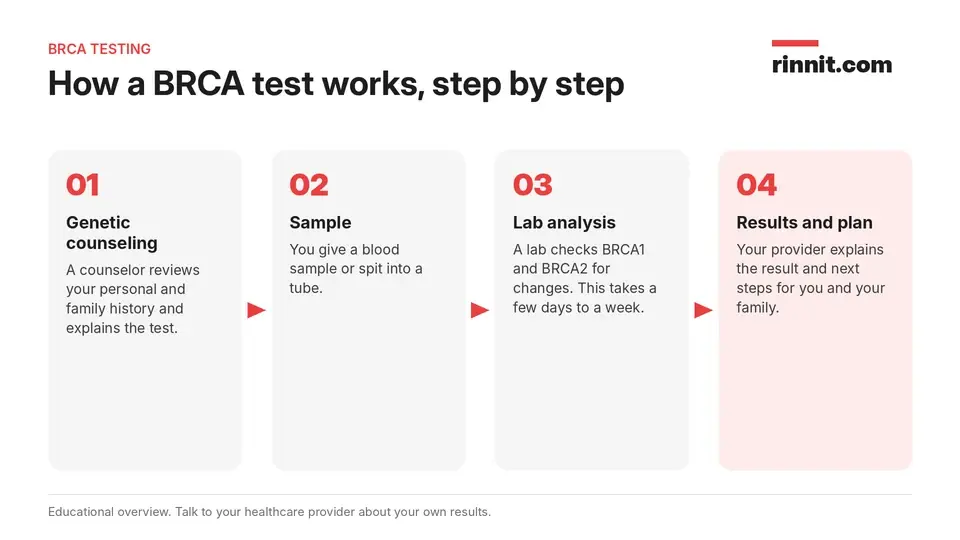
Genetic counseling. A genetic counselor reviews your medical and family history, explains the test and answers your questions. It is normal to feel stressed, so share your concerns. [1]
Sample collection. You either spit into a tube or have a small blood sample taken. [1]
Lab analysis. A lab checks your BRCA genes for changes. This can take a few days to a week. [1]
Results. The lab sends the results to your provider, who explains what they mean. [1]
Many labs also offer broader genetic panels that check several genes besides BRCA1 and BRCA2. Your genetic counselor can help you choose the right test. [1]
Benefits and risks of BRCA testing
Benefits | Risks |
Helps you understand your own cancer risk | Very little physical risk from a blood or saliva sample |
Gives your family information that affects their health | Results can cause worry, anxiety or sadness |
Guides screening and prevention choices | An inconclusive result can leave questions open |
Sources: [1]
What do BRCA test results mean?
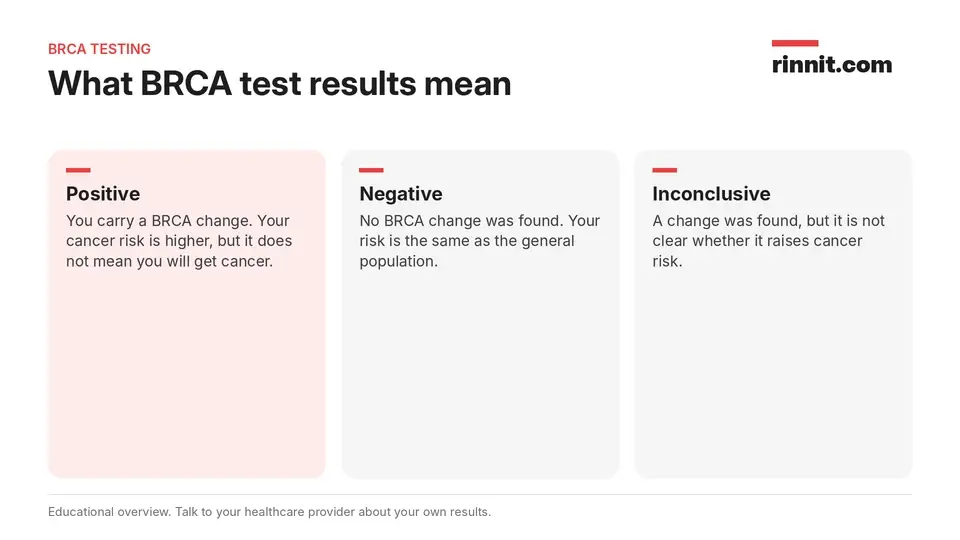
Your BRCA result will be positive, negative or inconclusive. [1]
Result | What it means |
Positive | You have a BRCA change. Your cancer risk is higher than average, but it does not mean you will get cancer. |
Negative | No BRCA change was found. If a known family BRCA change was ruled out, your risk is usually close to average; otherwise, a strong family history may still raise your risk. |
Inconclusive | A change was found, but it is not clear whether it raises cancer risk. |
Sources: [1]
What happens after a positive BRCA result?
A positive result can feel overwhelming. Your genetic counselor and provider will help you understand your options. [1]
Steps you can take on your own include eating well with lean protein and high-fiber foods, quitting tobacco, cutting back on alcohol and protecting your skin. [1]
Your care team may also recommend extra screening or preventive treatment: [1]
Breast cancer: Women may start mammograms earlier and have them more often, along with breast MRI. Men may have yearly mammograms. [1]
Ovarian cancer: There is no approved screening test. Birth control pills may lower risk, and surgery to remove the ovaries or fallopian tubes may prevent the disease. [1]
Prostate cancer: Men may start prostate cancer screening earlier than usual. [1]
Pancreatic cancer: Ultrasounds and other imaging tests may be used to check the pancreas. [1]
Your counselor will also talk about testing for family members, since your parents, siblings and children each have a 1 in 2 chance of carrying the same change. [1]
Conclusion
A BRCA test is a simple blood or saliva test with a big role: it shows whether you carry an inherited change that raises the risk of breast, ovarian, prostate and pancreatic cancer. Knowing your result lets you and your family plan earlier screening and prevention.
If cancer runs in your family, ask your provider whether genetic counseling and BRCA testing are right for you.
Keep learning: Read our guide to breast cancer symptoms, causes and treatment or learn about PARP inhibitors for BRCA-related cancers. For more background, see the National Cancer Institute's BRCA fact sheet.
FAQ
What is a BRCA test?
A BRCA test is a blood or saliva test that checks the BRCA1 and BRCA2 genes for inherited changes that raise cancer risk. [1]
Which cancers are linked to BRCA gene changes?
BRCA changes raise the risk of breast, ovarian, prostate and pancreatic cancer, plus fallopian tube and peritoneal cancer. [1]
Who should get BRCA testing?
People with a personal or close family history of these cancers, a known family BRCA change, or Ashkenazi Jewish ancestry may be offered testing. [1]
How common are BRCA gene changes?
They are rare. Between 1 in 400 and 1 in 800 people in the U.S. have them. [1]
How is a BRCA test done?
After genetic counseling, you give a blood sample or spit into a tube, and a lab checks the genes for changes. [1]
How long do BRCA test results take?
The lab usually needs a few days to a week to complete the analysis. [1]
Does a positive BRCA result mean I will get cancer?
No. It means your risk is higher than average, and there are ways to lower it. [1]
What does an inconclusive BRCA result mean?
A gene change was found, but it is not yet clear whether it increases cancer risk. [1]
Can men have BRCA gene changes?
Yes. Men with a BRCA2 change have a 1 in 10 chance of male breast cancer and may have a higher prostate cancer risk. [1]
Should my family get tested if I am positive?
Your parents, siblings and children each have a 1 in 2 chance of having the same change, so your counselor may suggest testing. [1]
Are there risks to BRCA testing?
There is very little physical risk, but results can be emotionally stressful, so counseling is part of the process. [1]
Related Reading
Prophylactic Mastectomy: Who It's For, Types and Recovery explains prophylactic mastectomy.
Breast Cancer: Symptoms, Causes, and Treatment explains the cancer most closely linked to BRCA changes.
Ovarian Cancer: Symptoms, Causes, and Treatment — A Clear Guide to Understanding and Managing Ovarian Cancer covers the second major BRCA-related cancer.
Male Breast Cancer: Symptoms, Causes, and Treatment describes breast cancer in men, a known BRCA2 risk.
Pancreatic Cancer: Symptoms, Causes, and Treatment — A Clear Guide for Patients and Families explains a cancer that is more likely in BRCA carriers.
What Is Metastatic Prostate Cancer? A Plain-Language Guide to Stage 4 Prostate Cancer covers the prostate cancer type where BRCA changes are often found.
References
Cleveland Clinic. What Is BRCA Testing? Cleveland Clinic. Last updated January 28, 2026. https://my.clevelandclinic.org/health/diagnostics/22728-brca-testing
Kuchenbaecker KB, Hopper JL, Barnes DR, et al. Risks of Breast, Ovarian, and Contralateral Breast Cancer for BRCA1 and BRCA2 Mutation Carriers. JAMA. 2017;317(23):2402-2416. PMID 28632866. https://doi.org/10.1001/jama.2017.7112
Finch AP, Lubinski J, Møller P, et al. Impact of oophorectomy on cancer incidence and mortality in women with a BRCA1 or BRCA2 mutation. J Clin Oncol. 2014;32(15):1547-1553. PMID 24567435. https://doi.org/10.1200/JCO.2013.53.2820
Medical disclaimer
This article is for general education only and does not replace advice from a qualified healthcare professional. Talk to your doctor about your own diagnosis and treatment, and seek emergency care right away for severe or sudden symptoms.



Comments