Prophylactic Mastectomy: Who It's For, Types and Recovery

Updated: 2 days ago
Written and medically reviewed by Dr. Baraa Alnahhal, MD · Last reviewed: November 2026 · How we review
Quick Answer
A prophylactic mastectomy, also called a preventive or risk-reducing mastectomy, is surgery to remove one or both healthy breasts to lower breast cancer risk. It's for people at high risk, such as those with a BRCA1 or BRCA2 gene change or a strong family history. It can't remove all risk because some breast tissue always remains.
What the research says
Removing both breasts cut risk about 90% in BRCA carriers: in the PROSE study of 483 women with BRCA1 or BRCA2 changes followed for about 6.4 years, breast cancer occurred in 1.9% of women who had a bilateral prophylactic mastectomy versus 48.7% of those who didn't, about a 90% reduction (about 95% if the ovaries were also removed) (Rebbeck TR et al., Journal of Clinical Oncology, 2004) [2]
Surgery also protected women with a family history: in a Mayo Clinic study of 639 women with a family history of breast cancer followed for a median of 14 years, bilateral prophylactic mastectomy cut breast cancer risk by about 90% in both moderate- and high-risk women (Hartmann LC et al., New England Journal of Medicine, 1999) [3]
Key takeaways
A prophylactic mastectomy removes healthy breasts to lower cancer risk.
It's for people at high risk, such as BRCA carriers.
It lowers risk by up to 90% to 95%, but not to zero.
Reconstruction can be done at the same time or later.
It's not usually advised for average risk.
What is a prophylactic mastectomy?
It's a type of mastectomy done before cancer develops. Removing both breasts is a double mastectomy. Genetic counseling and BRCA testing often come first. Sources: [1]
Who it's for

It's usually not recommended for average risk.
A BRCA1 or BRCA2 gene change.
A strong family history or a close relative diagnosed young.
Chest radiation before age 30.
Certain types of LCIS with a strong family history.
Cancer in one breast and high risk in the other. Sources: [1]
For average or slightly higher risk, alternatives include earlier or more frequent screening, breast MRI with mammograms and risk-lowering medicine. Sources: [1]
Types and techniques

Not everyone qualifies for skin- or nipple-sparing surgery.
Type | What it means |
Bilateral | Both breasts removed |
Contralateral | Healthy breast removed when treating cancer in the other |
Total (simple) | Breast tissue, nipple and areola removed |
Most of the breast skin kept | |
Nipple and skin kept |
Breast reconstruction can be done right away or later. Sources: [1]
What happens during surgery
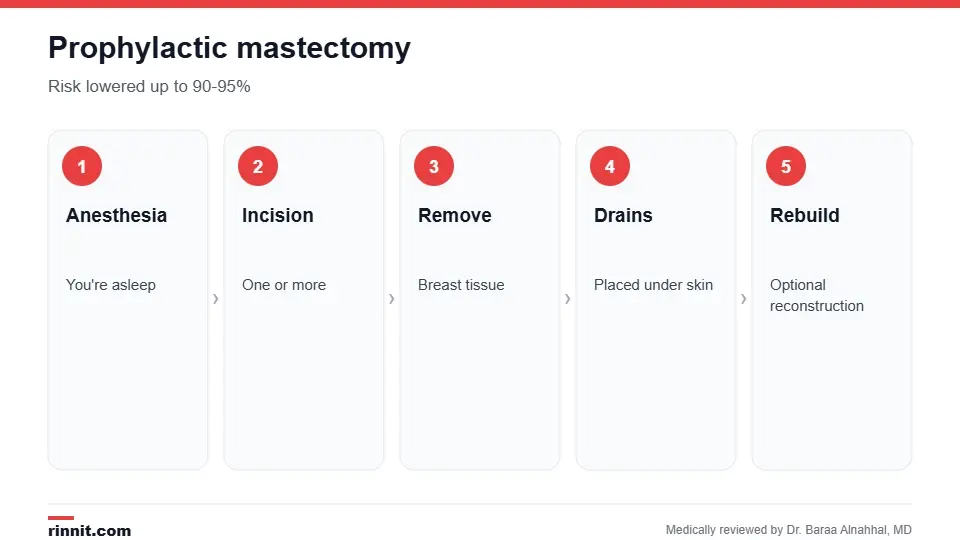
The length depends on the technique and reconstruction.
You're asleep under anesthesia.
The surgeon makes one or more incisions.
As much breast tissue as possible is removed.
Thin drains are placed under the skin.
A plastic surgeon may start reconstruction in the same operation. Sources: [1]
Risks
Bleeding, infection or fluid buildup.
Slow healing, pain or scarring.
Loss of breast or nipple feeling.
Problems with reconstruction.
Inability to breastfeed.
Effects on body image, sex life or mood. Sources: [1]
Recovery
You'll learn how to care for your incisions and drains.
Pain, swelling, bruising, numbness and chest tightness are common.
Recovery often takes several weeks, or a few months with reconstruction.
Gentle arm and shoulder exercises help; physical therapy may be needed.
The removed tissue is tested and occasionally finds a hidden cancer. Sources: [1]
After both breasts are removed, regular mammograms usually aren't needed, but watch for changes in your chest, skin or scars. Counseling or support groups may help. Sources: [1]
Outlook
Removing both breasts lowers risk by about 90% to 95% with a harmful BRCA change and by up to 90% with a strong family history. Risk isn't zero, and surgery may not lengthen life for everyone. Sources: [1, 2, 3]
When to call your provider
Fever or worsening pain.
New or spreading redness, warmth or swelling.
Pus, foul-smelling drainage or heavy bleeding.
A wound that opens or drain problems.
New arm swelling or weakness. Sources: [1]
Get emergency care for chest pain or trouble breathing. Sources: [1]
Conclusion
A prophylactic mastectomy can dramatically lower breast cancer risk for people at high risk. Genetic counseling and a full talk about alternatives and reconstruction help you make the right choice.
Keep learning: read about BRCA testing and breast reconstruction.
Frequently asked questions
What is a prophylactic mastectomy?
Surgery to remove healthy breasts to lower cancer risk.
Who should consider it?
People at high risk, such as BRCA1 or BRCA2 carriers.
How much does it lower risk?
By up to 90% to 95% when both breasts are removed.
Does it remove all risk?
No. Some breast tissue always remains.
Can I keep my nipples?
Sometimes, with a nipple-sparing mastectomy.
Can I have reconstruction?
Yes, at the same time or later.
How long is recovery?
Several weeks, or a few months with reconstruction.
Will I need mammograms afterward?
Usually not after both breasts are removed.
Can I breastfeed afterward?
No.
Are there alternatives?
Yes, closer screening, breast MRI and risk-lowering medicine.
Related Reading
Double Mastectomy: Types, Surgery, Recovery and Risks removing both breasts.
Mastectomy: Types, Surgery, Recovery and Reconstruction an overview of mastectomy.
BRCA Testing: Who Should Get It, How It Works and What Results Mean genetic testing for breast cancer risk.
Breast Reconstruction: Implant and Flap Options, Surgery and Recovery rebuilding the breast.
Breast Cancer Risk Assessment: Tools, Risk Factors and What Your Score Means estimating your risk.
References
Cleveland Clinic. Prophylactic (Preventive) Mastectomy. Cleveland Clinic. Last updated October 5, 2026. https://my.clevelandclinic.org/health/treatments/24025-prophylactic-mastectomy
Rebbeck TR, Friebel T, Lynch HT, et al. Bilateral prophylactic mastectomy reduces breast cancer risk in BRCA1 and BRCA2 mutation carriers: the PROSE Study Group. Journal of Clinical Oncology. 2004;22(6):1055-1062. PMID 14981104. https://doi.org/10.1200/JCO.2004.04.188
Hartmann LC, Schaid DJ, Woods JE, et al. Efficacy of bilateral prophylactic mastectomy in women with a family history of breast cancer. New England Journal of Medicine. 1999;340(2):77-84. PMID 9887158. https://doi.org/10.1056/NEJM199901143400201
Medical disclaimer
This article is for general education only and does not replace advice from a qualified healthcare professional. Talk to your doctor about your own diagnosis and treatment, and seek emergency care right away for severe or sudden symptoms.



Comments