Breast Cancer Risk Assessment: Tools, Risk Factors and What Your Score Means

Updated: 2 days ago
Written and medically reviewed by Dr. Baraa Alnahhal, MD · Last reviewed: November 2026 · How we review
Quick Answer: What is a breast cancer risk assessment?
A breast cancer risk assessment is a questionnaire-based tool that estimates your chance of developing breast cancer over a set time or your lifetime. It weighs risk factors such as age, family history, gene mutations and breast density. Your score helps decide how often you need screening. It can't tell you whether you will get cancer. [1]
What the research says
Common tools predict risk moderately well. In 35,921 women aged 40 to 84 followed for 6 years after mammography, the Gail, BRCAPRO, Tyrer-Cuzick and BCSC models had similar, moderate accuracy (AUC 0.61 to 0.64) and good calibration overall. (McCarthy et al., Journal of the National Cancer Institute, 2020) [2]
Accuracy can differ between groups. Among 90,967 postmenopausal women followed for a median of 18.9 years, the IBIS/Tyrer-Cuzick model was well calibrated overall (observed-to-expected ratio 0.95) but overestimated risk for Hispanic women (ratio 0.75). (Kurian et al., Cancer, 2021) [3]
Key takeaways
About 1 in 8 US females (around 12%) will develop breast cancer during their lifetime. [1]
Risk assessments estimate probability; they can't predict who will get cancer. [1]
At least 24 tools exist, and most take 10 minutes or less to complete. [1]
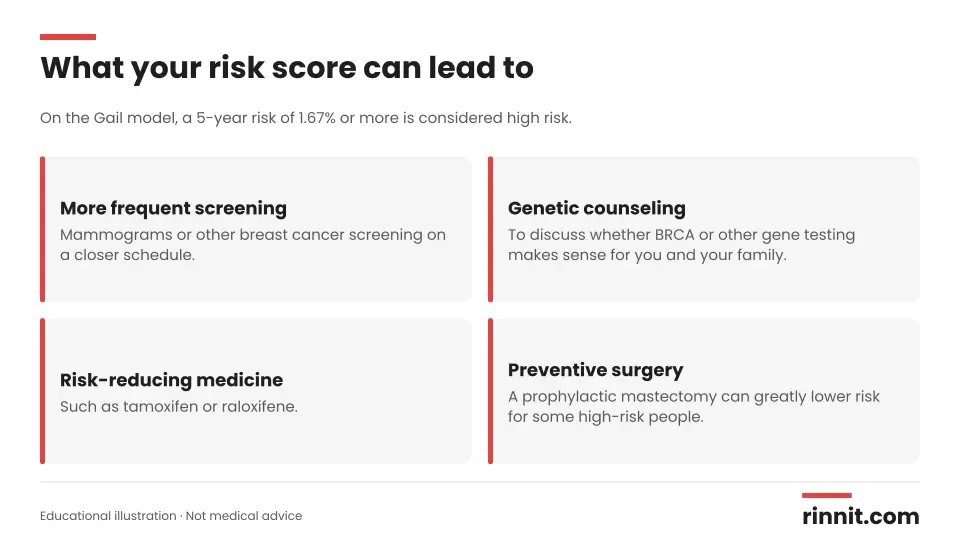
A 5-year Gail score of 1.67% or more is considered high risk. [1]
Results can lead to closer screening, genetic counseling, risk-lowering medicine or preventive surgery. [1]
How does a breast cancer risk assessment work?
You answer questions about your health and family history, and the tool calculates a score based on your risk factors. Most tools can be completed online in 10 minutes or less. The score compares your risk with people of a similar age and background. Current tools are designed for females and don't score male breast cancer risk. [1]
What risk factors do the tools look at?
A risk factor raises the odds of a condition. Breast cancer risk factors include: [1]
Age: Risk increases as you get older.
Family history: Especially a first-degree relative or several relatives with breast cancer.
Gene mutations: Carrying a BRCA1 or BRCA2 mutation.
Race and ethnicity: For example, people of Ashkenazi Jewish descent are more likely to inherit BRCA mutations.
Breast density: Dense breast tissue carries a higher risk than mostly fatty tissue.
Previous breast biopsies: Especially results showing atypical hyperplasia.
Hormone exposure: Long-term exposure to high estrogen or progesterone, including some hormonal birth control and hormone replacement therapy.
Age at first period and at menopause: An earlier first period or later menopause means longer hormone exposure.
Childbirth history: Not having given birth raises risk; giving birth, especially before 35, lowers it, and each additional birth lowers it further.
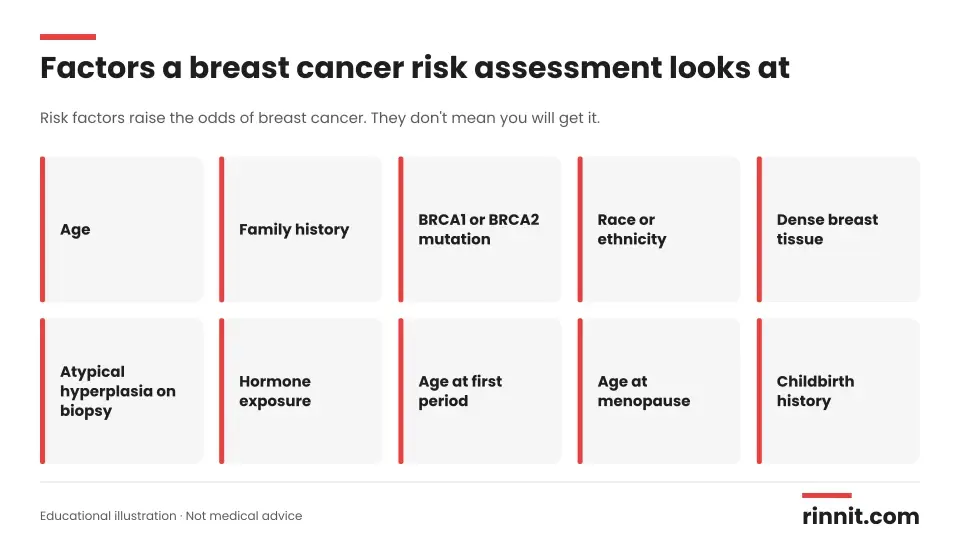
Not all risk factors carry the same weight. Risk rises somewhat with age, but a BRCA1 mutation alone raises the chance of breast cancer to 60%, which makes a person high risk on its own. [1]
Common breast cancer risk assessment tools
Each tool weighs risk factors differently. These are some of the most widely used: [1]
Tool | What it estimates | Key inputs |
Gail model (BCRAT) | Invasive breast cancer risk over 5 years and up to age 90 | Age, race/ethnicity, childbirth, biopsies, first period, family history |
IBIS (Tyrer-Cuzick) | Risk within 10 years or over your lifetime | Adds breast density, BMI, menopause age, HRT use, ovarian cancer history, BRCA status |
BCSC Risk Calculator | Invasive cancer in 5 years and advanced cancer in 6 years | Includes breast density and prior breast cancer history |
BRCAPRO | Chance you carry a BRCA1 or BRCA2 mutation | Family history of breast and ovarian cancer |
BOADICEA (CanRisk) | Breast and ovarian cancer risk | Mainly family history and genetic information |
BWHS calculator | 5-year invasive breast cancer risk for Black women | Age, BMI, childbirth, biopsies, birth control use, family history |
Sources: [1]
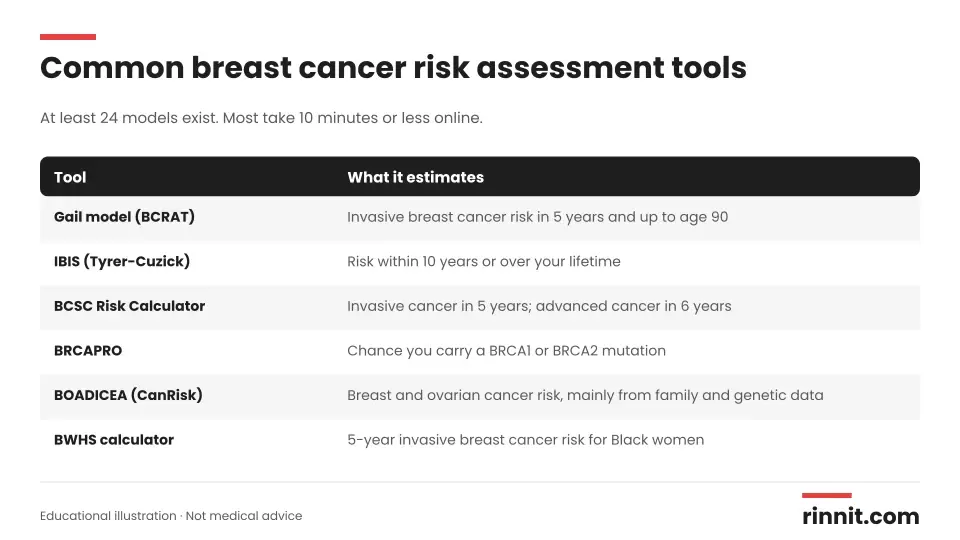
The Gail model, from the US National Cancer Institute, is the most popular. It takes as little as five minutes. It isn't reliable if you've had breast cancer before or carry a gene mutation that raises your risk. The IBIS model also can't predict risk after a past breast cancer diagnosis. [1]
What happens after you get your score?
Your score is something to discuss with your provider, not a diagnosis. Depending on the result, your provider may: [1]
Recommend more frequent breast cancer screening
Refer you to genetic counseling to discuss gene testing, or to understand what a known mutation means for you and your family
Prescribe medicines that lower breast cancer risk, such as tamoxifen or raloxifene
Discuss preventive surgery (prophylactic mastectomy), which can greatly lower risk
How reliable are the results?
Results are only as reliable as the population data behind each tool. Population data can't predict any one person's health with 100% accuracy. Known limits include: [1]
Differences in racial and ethnic data: Much historical data came from non-Hispanic white people, so some tools fit other groups less well.
Limited scope: Most tools predict invasive or advanced cancer in people never diagnosed, and some cancer types are predicted better than others.
Incomplete risk factors: No single tool covers every risk factor, so your provider may use more than one.
Even so, these tools estimate risk well enough that providers continue to use them, and researchers are working to improve them. [1]
Conclusion
A breast cancer risk assessment can't tell you whether you'll get cancer, but it can flag risk factors that call for closer attention. It may lead to BRCA testing, more frequent screening or preventive options, all aimed at catching cancer early, when it's most treatable. [1]
Breast cancer screening matters for everyone. If you have a strong family history, a known gene mutation or a past abnormal biopsy, ask your provider which risk tool fits you and what your score means.
Keep learning: Read our guide to breast cancer or learn about atypical hyperplasia of the breast. For more background, see the cancer risk factors overview from the National Cancer Institute.
FAQ
What is a breast cancer risk assessment?
It is a tool that estimates your chance of developing breast cancer over a set time or your lifetime, based on your risk factors. [1]
What is the Gail model?
It is the US National Cancer Institute's Breast Cancer Risk Assessment Tool (BCRAT), which estimates invasive breast cancer risk over 5 years and up to age 90. [1]
What Gail score is considered high risk?
A 5-year risk of 1.67% or more is considered high risk. [1]
What is the Tyrer-Cuzick (IBIS) model?
It estimates breast cancer risk within 10 years or over your lifetime, using factors such as breast density and BRCA status. [1]
What factors raise breast cancer risk?
Age, family history, BRCA1 or BRCA2 mutations, dense breasts, atypical hyperplasia, long hormone exposure and not having given birth. [1]
Can a risk assessment tell me if I will get breast cancer?
No. It estimates probability compared with similar people; it can't predict any one person's outcome. [1]
Can men use breast cancer risk calculators?
Current tools are designed for females and don't score male breast cancer risk. [1]
What happens if my risk is high?
Your provider may recommend more frequent screening, genetic counseling, risk-lowering medicine or preventive surgery. [1]
How long does a breast cancer risk assessment take?
Most tools take 10 minutes or less, and the Gail model can take as little as five minutes. [1]
How accurate are breast cancer risk assessment tools?
They are accurate enough for clinical use but limited by the population data behind them, so providers sometimes combine tools. [1]
Related Reading
Prophylactic Mastectomy: Who It's For, Types and Recovery explains prophylactic mastectomy.
Breast Cancer: Symptoms, Causes, and Treatment explains the cancer these risk tools estimate.
Atypical Hyperplasia of the Breast: Symptoms, Causes, Risk & Treatment — Complete Guide covers a biopsy finding that raises breast cancer risk scores.
Breast Cancer in Young Women: Early-Onset Diagnosis, Risk Factors, and What to Do Next discusses risk factors and early-onset breast cancer.
Breast Self-Exam: How to Do It Step by Step and What to Look For shows how to check your breasts at home and which changes to report.
References
Cleveland Clinic. Breast Cancer Risk Assessment: Models & How It's Calculated. Cleveland Clinic. Last updated January 30, 2024. https://my.clevelandclinic.org/health/diagnostics/breast-cancer-risk-assessment
McCarthy AM, Guan Z, Welch M, et al. Performance of Breast Cancer Risk-Assessment Models in a Large Mammography Cohort. J Natl Cancer Inst. 2020;112(5):489-497. PMID 31556450. https://doi.org/10.1093/jnci/djz177
Kurian AW, Hughes E, Simmons T, et al. Performance of the IBIS/Tyrer-Cuzick model of breast cancer risk by race and ethnicity in the Women's Health Initiative. Cancer. 2021;127(20):3742-3750. PMID 34228814. https://doi.org/10.1002/cncr.33767
Medical disclaimer
This article is for general education only and does not replace advice from a qualified healthcare professional. Talk to your doctor about your own diagnosis and treatment, and seek emergency care right away for severe or sudden symptoms.



Comments