Breast Self-Exam: How to Do It Step by Step and What to Look For

Updated: 2 days ago
Written and medically reviewed by Dr. Baraa Alnahhal, MD · Last reviewed: November 2026 · How we review
Quick Answer: What is a breast self-exam?
A breast self-exam (BSE) is a step-by-step way to look at and feel your own breasts so you learn what is normal for you and notice changes early. It takes a few minutes and is usually done once a month, right after your period ends. It does not replace mammograms or exams by a healthcare provider. [1]
What the research says
Self-exams alone have not lowered breast cancer deaths. A Cochrane review of two large trials with 388,535 women in Russia and Shanghai found no difference in breast cancer deaths with self-exam screening (relative risk 1.05), but almost twice as many biopsies with benign results (3,406 vs 1,856). (Kösters et al., Cochrane Database of Systematic Reviews, 2003) [2]
Intensive training didn't change the outcome. In the Shanghai trial of 266,064 women followed for 10 to 11 years, breast cancer deaths were 0.10% in both the self-exam instruction group and the control group, while more benign breast lesions were found with training. (Thomas et al., Journal of the National Cancer Institute, 2002) [3]
Key takeaways
The goal of a self-exam is to know what is normal for your breasts, so changes stand out. [1]
Check both by looking in a mirror and by feeling with the pads of your fingers. [1]
Breast tissue extends to the armpit, collarbone and top of the belly. [1]
Most lumps aren't cancer, but report any change to a provider. [1]
Self-exams don't replace mammograms or clinical breast exams. [1]
Why do a breast self-exam?
Knowing how your breasts usually look and feel makes it easier to spot something new. Many people with breast cancer say that finding a lump at home was the first sign something was different. [1]
A self-exam isn't a reliable way to detect breast cancer on its own, and there are better screening methods. That is why it's no longer recommended as a screening test. Even so, it is the most helpful thing you can do at home to stay familiar with your breasts and tell your provider when something changes. Keep seeing your primary care provider or gynecologist for regular screening. [1]
When should you do a breast self-exam?
Some providers suggest a monthly self-exam, though groups such as the American Cancer Society no longer recommend a set schedule and instead advise knowing how your breasts normally look and feel. If you still get periods, do it right after your period ends. [1]
How to do a breast self-exam
Examine your breasts with your eyes and with your fingers. Remember that breast tissue isn't only the cleavage and nipples; it reaches up to your collarbone, out to your armpit and down to the top of your belly. [1]
Step 1: The visual check
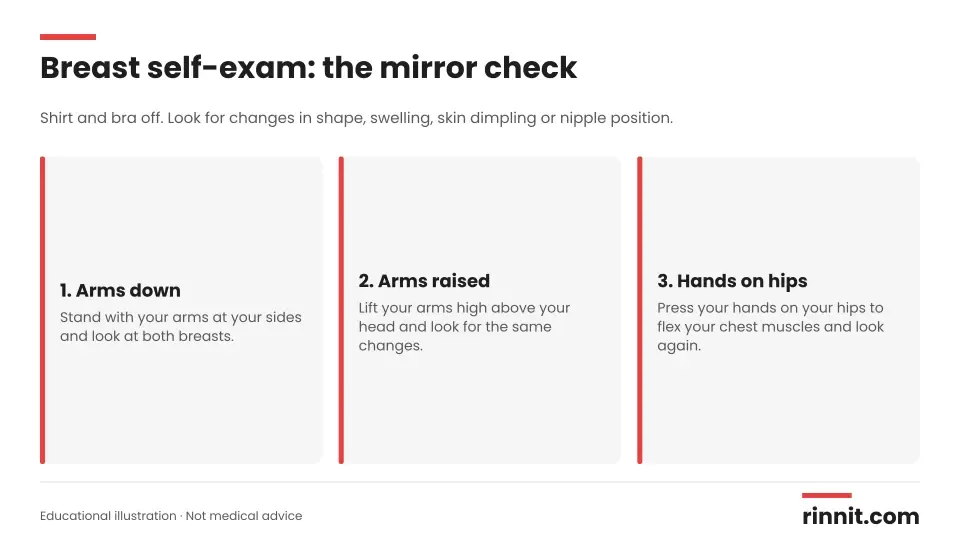
With your shirt and bra off, stand in front of a mirror and look for changes in breast shape, swelling, dimpling of the skin or the position of your nipples. [1]
Look with your arms down at your sides.
Raise your arms high above your head and look again.
Put your hands on your hips and press to flex your chest muscles, then look again.
Sources: [1]
Step 2: The physical check
There are two ways to feel your breasts. Many people do the standing exam in the shower. [1]
Standing: [1]
Use your right hand to check your left breast, then switch.
With the pads of your three middle fingers, press every part of the breast using light, then medium, then firm pressure. Feel for lumps, thick spots or other changes.
Move in a circular pattern to cover the whole breast.
Press the tissue near your armpit, check under the areola and gently squeeze the nipple to check for discharge.
Repeat on the other side.
Lying down: This spreads the breast tissue evenly, which makes changes easier to feel, especially in larger breasts. [1]
Lie down with a pillow under your right shoulder and your right arm behind your head.
Use the pads of your left middle fingers to check all of your right breast with light, medium and firm pressure.
Check under the armpit and around the areola, and gently squeeze the nipple for discharge.
Switch sides.

The 7 Ps of breast self-examination
The 7 Ps are an easy way to remember a thorough self-exam: [1]
P | What it means |
Position | Check in the mirror and lying down |
Perimeter | Include breast tissue up to your armpit |
Palpation | Use three fingers in gentle circles |
Pressure | Use light, medium and firm pressure |
Pattern | Follow a pattern so you cover the whole breast |
Practice | Do it regularly |
Planning | Know what to look for and what to do if something seems unusual |
Sources: [1]
Are lumps normal?
Lumps in breast tissue are common and not a reason to panic. Some people have naturally lumpier breasts. Learning what is normal for you helps you notice when something isn't. [1]
Downsides of breast self-exams
Self-exams have some drawbacks: [1]
Skipping professional care: Some people wrongly think self-exams mean they don't need clinical exams or mammograms.
Worry: Most lumps aren't cancer, but finding one can cause anxiety.
When should you call your provider?
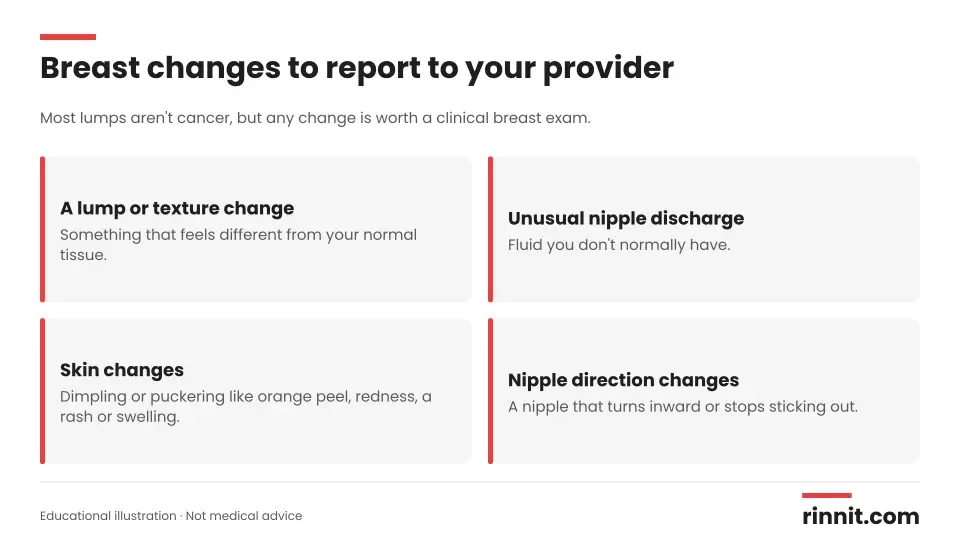
Contact a healthcare provider if you notice: [1]
A lump or a change in how your breast tissue feels
Unusual nipple discharge
Dimpling, puckering like orange peel, redness, a rash or swelling of the skin
A change in nipple direction, such as a nipple turning inward
Your provider can do a clinical breast exam and decide whether you need a breast ultrasound or mammogram. Only a trained provider can tell whether a lump might be harmful. [1]
Conclusion
A monthly breast self-exam is a simple habit that helps you stay familiar with your body, so a real change doesn't go unnoticed. It works best alongside, not instead of, regular screening and clinical exams. [1]
Try fitting it into your routine, such as in the shower or before bed. If something feels or looks different, book a visit with your provider rather than waiting to see if it goes away.
Keep learning: Read our guide to breast cancer symptoms and treatment or learn about fibrocystic breasts. For more background, see the American Cancer Society's breast cancer early detection recommendations.
FAQ
What is a breast self-exam?
It is a step-by-step way to look at and feel your breasts so you know what's normal and can spot changes. [1]
How often should I do a breast self-exam?
Some providers suggest once a month, but many experts now advise simply knowing what is normal for you rather than following a set schedule. [1]
When is the best time to do a breast self-exam?
If you still get periods, do it right after your period ends. [1]
How do I do a breast self-exam?
Look at your breasts in a mirror in three positions, then feel every part with three fingers using light, medium and firm pressure. [1]
Should I do a breast self-exam standing or lying down?
Either works. Many people check in the shower, and lying down spreads tissue evenly, which helps with larger breasts. [1]
What am I feeling for during a breast self-exam?
Lumps, thick spots or any change from how your breast tissue normally feels. [1]
Is it normal to feel lumps in my breasts?
Yes. Some breasts are naturally lumpy, and most lumps aren't cancer, but tell a provider about any change. [1]
Why are breast self-exams no longer recommended for screening?
They aren't a reliable way to detect breast cancer, and better screening methods exist, but they still help you know your body. [1]
Does a breast self-exam replace a mammogram?
No. Keep up with clinical breast exams and mammograms as your provider recommends. [1]
When should I see a doctor about a breast change?
See a provider for a lump, unusual nipple discharge, skin dimpling or redness, or a nipple that turns inward. [1]
Related Reading
Testicular Self-Exam: How to Check Your Testicles and What's Normal explains how to check your testicles monthly and which changes need a doctor.
Breast Cancer: Symptoms, Causes, and Treatment explains the warning signs a self-exam can help you notice.
Fibrocystic Breasts: Why They Happen, What the Lumps Mean, and What Actually Helps explains why some breasts feel naturally lumpy.
Breast Cancer Risk Assessment: Tools, Risk Factors and What Your Score Means explains how doctors estimate breast cancer risk and plan screening.
References
Cleveland Clinic. Breast Self-Exam: Purpose, Steps & How To. Cleveland Clinic. Last updated August 25, 2025. https://my.clevelandclinic.org/health/diagnostics/3990-breast-self-exam
Kösters JP, Gøtzsche PC. Regular self-examination or clinical examination for early detection of breast cancer. Cochrane Database Syst Rev. 2003;2003(2):CD003373. PMID 12804462. https://doi.org/10.1002/14651858.CD003373
Thomas DB, Gao DL, Ray RM, et al. Randomized trial of breast self-examination in Shanghai: final results. J Natl Cancer Inst. 2002;94(19):1445-1457. PMID 12359854. https://doi.org/10.1093/jnci/94.19.1445
Medical disclaimer
This article is for general education only and does not replace advice from a qualified healthcare professional. Talk to your doctor about your own diagnosis and treatment, and seek emergency care right away for severe or sudden symptoms.



Comments