Testicular Self-Exam: How to Check Your Testicles and What's Normal

Updated: 2 days ago
Written and medically reviewed by Dr. Baraa Alnahhal, MD · Last reviewed: November 2026 · How we review
Quick Answer
A testicular self-exam (TSE) is a check you do yourself to learn how your testicles normally look and feel, so you can notice changes early. It takes a few minutes and is easiest in or after a warm shower. Most lumps are not cancer, but any new lump, swelling or heaviness should be checked by a provider promptly.
What the research says
Routine screening isn't proven to save lives: an evidence review for the U.S. Preventive Services Task Force found no studies that met its criteria on the benefits or harms of screening for testicular cancer, so no new evidence changed the Task Force's earlier recommendation against routine screening (Lin K et al., Ann Intern Med, 2010) [2]
Many young men don't know how to check: a systematic review of 25 studies found clear gaps in men's knowledge of testicular cancer and self-exams; men who didn't do self-exams were often simply uninformed, and most welcomed education on the topic (Saab MM et al., Oncol Nurs Forum, 2016) [3]
Key takeaways
A TSE helps you learn what's normal for you so you notice changes.
Testicular cancer is the most common cancer in males aged 15 to 35.
Do it in or after a warm shower, when the scrotum is relaxed.
One testicle being slightly larger or hanging lower is normal.
See a provider promptly for any new lump, swelling, heaviness or pain.
What is a testicular self-exam?
A testicular self-exam is a hands-on check of your scrotum and testicles. The goal isn't to diagnose anything yourself. It's to become familiar with your own anatomy so that a new lump or change stands out. Testicular cancer is the most common cancer in males aged 15 to 35, and it's highly treatable when found early. Your provider should also examine your testicles at your yearly checkup. Sources: [1]
Expert groups don't agree on routine self-exams for everyone, because studies haven't shown they lower deaths. Many providers still encourage them, especially if you have risk factors such as an undescended testicle or a family history. Sources: [1, 2]
How to do a testicular self-exam
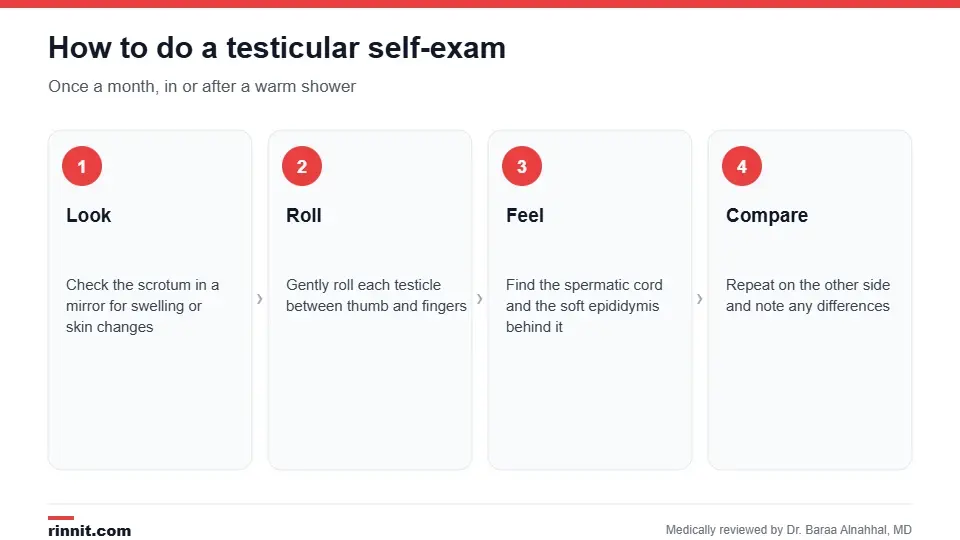
A self-exam takes just a few minutes once a month.
Look: stand in front of a mirror and check the scrotum for swelling or changes in skin.
Hold: grip the top of your scrotum with one hand so the testicles stay in place.
Feel the cord: find the spermatic cord, a firm tube running up from the back of each testicle.
Roll each testicle: gently roll it between your thumb and fingers, feeling for hard lumps, smooth bumps or changes in size or firmness.
Check the epididymis: feel the soft, coiled tube at the back of each testicle.
Compare sides: repeat on the other testicle and note any differences. Sources: [1]
It's easiest in or after a warm shower or bath, when the skin of the scrotum is relaxed. Sources: [1]
What's normal and what's not

Knowing what's normal makes changes easier to spot.
Usually normal | See a provider |
One testicle slightly larger than the other | A new lump or hard area on a testicle |
One testicle hanging lower | Swelling or a change in size or shape |
The epididymis feeling soft or a little tender | A feeling of heaviness in the scrotum |
Smooth, firm, egg-shaped testicles | A dull ache in the groin or lower belly |
Most lumps aren't cancer. They're often fluid-filled cysts, a varicocele or other scrotal masses. Only a provider can tell the difference. Sources: [1]
When to get help
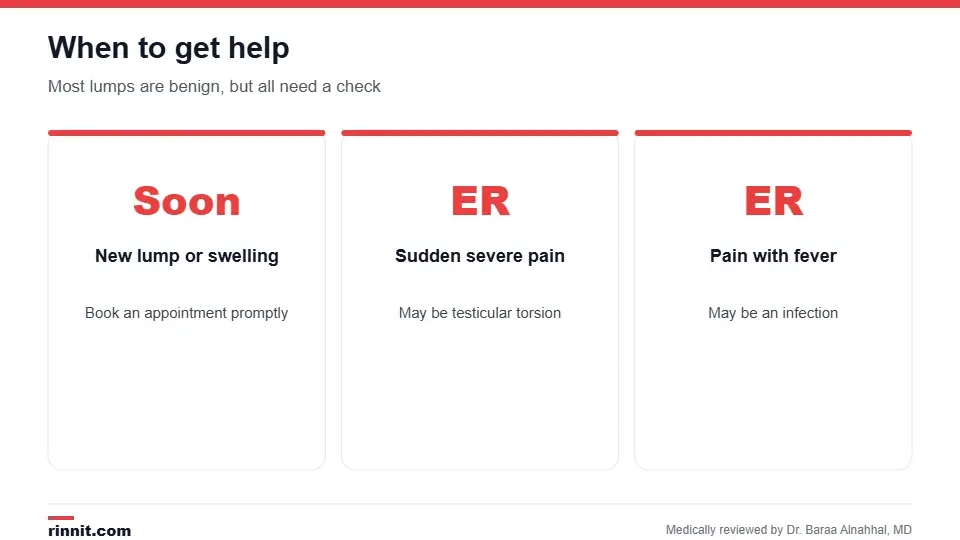
Sudden pain is an emergency; a painless lump still needs prompt review.
Make an appointment soon if you find a lump, swelling or any change. Go to the emergency room for sudden, severe testicle pain, which can mean testicular torsion, or for pain with fever or redness, which can mean infection. Sources: [1]
At the visit, your provider examines you and may shine a light through the scrotum (transillumination). Light passes through a fluid-filled cyst but not through a solid lump. A scrotal ultrasound is often the next step. Sources: [1]
Conclusion
A monthly testicular self-exam takes only minutes and helps you notice changes early. Most findings are harmless, but don't wait if something feels new or different.
Keep learning: read about testicular cancer and the breast self-exam.
Frequently asked questions
At what age should I start testicular self-exams?
Many providers suggest starting around age 15.
How often should I do a testicular self-exam?
Once a month is a common recommendation.
When is the best time to do it?
In or right after a warm shower or bath.
Is it normal for one testicle to be bigger?
Yes. Slight differences in size and position are normal.
What does the epididymis feel like?
A soft, coiled tube at the back of each testicle that may feel slightly tender.
Does a lump mean I have cancer?
No. Most lumps are benign, but all should be checked.
When is testicle pain an emergency?
Sudden, severe pain needs emergency care right away.
What will my provider do if I find a lump?
Examine you, possibly shine a light through the scrotum, and often order an ultrasound.
Is routine screening recommended?
Experts disagree; studies haven't shown routine screening lowers deaths.
Should my doctor check my testicles too?
Yes, a provider can examine them at your yearly checkup.
Related Reading
Testicular Ultrasound: Checking Lumps, Pain and Swelling explains the ultrasound used to check scrotal lumps, pain and swelling.
Retroperitoneal Lymph Node Dissection (RPLND): Surgery, Risks and Recovery explains the lymph node surgery used to stage and treat testicular cancer.
Testicular Cancer: The Young Man's Cancer That's Highly Curable — Symptoms, Self-Exam Guidance, and Treatment Explained the cancer a self-exam helps you notice early.
Testicular Torsion: Symptoms, Causes, Diagnosis and Treatment — What You Need to Know the emergency behind sudden testicle pain.
Scrotal Masses Guide: Symptoms, Causes, Diagnosis, and Treatment the many causes of a scrotal lump.
Testicles: Anatomy, Essential Functions, and Care how the testicles are built and what they do.
Breast Self-Exam: How to Do It Step by Step and What to Look For another self-check for early changes.
References
Cleveland Clinic. Testicular Self-Exam: Purpose, Age & How To. Cleveland Clinic. Last updated December 13, 2024. https://my.clevelandclinic.org/health/diagnostics/testicular-self-exam
Lin K, Sharangpani R. Screening for testicular cancer: an evidence review for the U.S. Preventive Services Task Force. Ann Intern Med. 2010;153(6):396-399. PMID 20855803. https://doi.org/10.7326/0003-4819-153-6-201009210-00007
Saab MM, Landers M, Hegarty J. Testicular cancer awareness and screening practices: a systematic review. Oncol Nurs Forum. 2016;43(1):E8-E23. PMID 26679456. https://doi.org/10.1188/16.ONF.E8-E23
Medical disclaimer
This article is for general education only and does not replace advice from a qualified healthcare professional. Talk to your doctor about your own diagnosis and treatment, and seek emergency care right away for severe or sudden symptoms.



Comments