Retroperitoneal Lymph Node Dissection (RPLND): Surgery, Risks and Recovery

Updated: 3 days ago
Written and medically reviewed by Dr. Baraa Alnahhal, MD · Last reviewed: November 2026 · How we review
Quick Answer
Retroperitoneal lymph node dissection (RPLND) is surgery to remove lymph nodes from the retroperitoneum, the space behind the belly organs near the large blood vessels. It's used mainly for testicular cancer, to find out how far cancer has spread, remove cancer and lower the chance it comes back. It usually means a 4- to 7-day hospital stay.
What the research says
Nerve-sparing surgery can protect ejaculation: in men who had nerve-sparing RPLND after chemotherapy for nonseminomatous germ cell tumors, 57.8% regained antegrade (normal) ejaculation after a mean of 6.8 months, and 5-year disease-free survival was 98% (Raja A et al., Indian Journal of Surgical Oncology, 2021) [2]
Robotic RPLND is feasible: a small series of nerve-sparing robot-assisted RPLND for testicular cancer removed a median of 19 lymph nodes with no surgical complications, hospital stays of 3 to 4 days and no recurrences during short-term follow-up (Afferi L et al., European Urology Open Science, 2021) [3]
Key takeaways
RPLND removes lymph nodes from behind the belly organs.
It's used mainly to stage and treat testicular cancer.
It can be open, laparoscopic or robotic.
Surgery takes 3 to 10 hours, with a 4- to 7-day hospital stay.
Ejaculation problems are a key risk; nerve-sparing techniques help.
What is RPLND?
Lymph nodes filter fluid and can trap cancer cells. Testicular cancer often spreads first to lymph nodes in the retroperitoneum, near the aorta and vena cava. In RPLND, a surgeon removes these nodes and sends them to a pathologist. The procedure is also called retroperitoneal lymphadenectomy. Sources: [1]
Why it's done

RPLND can both stage and treat cancer.
Stage cancer by checking whether it has reached the lymph nodes.
Remove cancer and lower the chance of spread or recurrence.
Treat cancer that has come back.
Remove enlarged nodes seen on CT, MRI or PET scans. Sources: [1]
Besides testicular cancer, RPLND may be used for some kidney, reproductive organ cancers and sarcomas. Enlarged retroperitoneal nodes are generally 10 mm (about half an inch) or larger and can cause back pain, belly pain or bloating. Sources: [1]
What happens during surgery
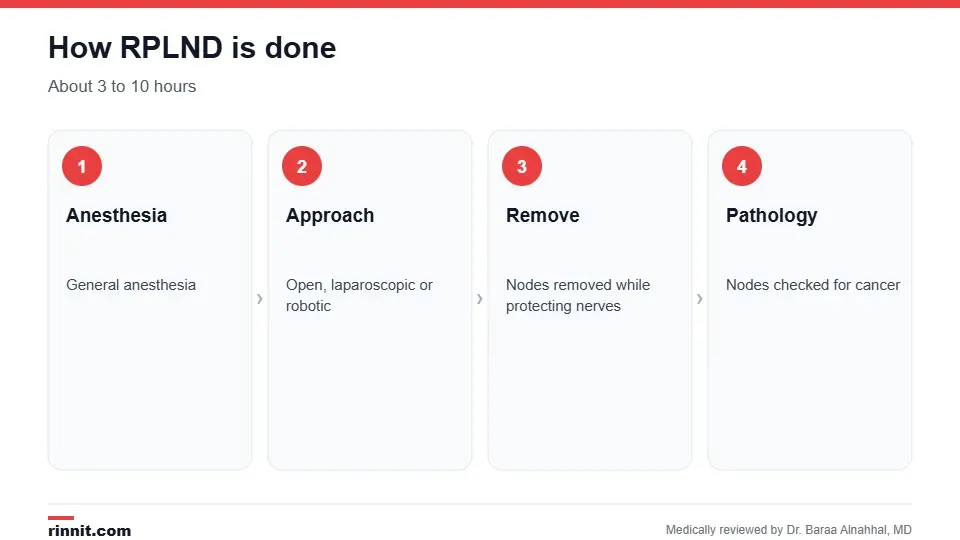
Surgery takes about 3 to 10 hours.
You receive general anesthesia.
The surgeon reaches the retroperitoneum through an open incision or small keyhole cuts for laparoscopic or robotic surgery.
Lymph nodes near the cancer are removed, sometimes along with more nodes or other masses.
Where possible, the surgeon protects the nerves that control ejaculation.
The nodes go to a pathologist for examination. Sources: [1, 3]
Recovery
Most people stay in the hospital for about 4 to 7 days, often less after robotic surgery. Pain is managed with medicine. Call your doctor right away for an incision that won't heal or shows signs of infection, pus, vomiting that stops you from keeping fluids down, being unable to pass gas or stool, or severe pain. Sources: [1, 3]
Risks

Your surgeon will discuss your personal risks.
Ejaculation problems, including being unable to ejaculate semen (anejaculation), because the nerves run through this area.
Bleeding from large blood vessels.
A lymphocele, a fluid collection that may need draining.
Infection, breathing problems, organ injury, belly pain and constipation. Sources: [1, 2]
If you hope to have children, ask your care team about sperm banking before surgery.
Results
The pathologist reports whether the nodes contain cancer, how many nodes were positive out of the total removed, and sometimes the cancer type and grade. Results usually take 1 to 2 weeks. Next steps may include surveillance, chemotherapy or radiation therapy. Sources: [1]
Conclusion
RPLND is a major surgery that can both stage and cure testicular cancer that has spread to the lymph nodes. Modern nerve-sparing and robotic techniques aim to keep side effects, especially ejaculation problems, to a minimum.
Keep learning: read about testicular cancer and the testicular self-exam.
Frequently asked questions
What is RPLND?
Surgery to remove lymph nodes from behind the belly organs.
Why is RPLND done for testicular cancer?
To stage the cancer, remove it and lower the chance it returns.
How long does the surgery take?
About 3 to 10 hours.
How long will I be in the hospital?
Usually 4 to 7 days.
Can it be done robotically?
Yes, in some cases.
Will it affect ejaculation?
It can; nerve-sparing techniques lower the risk.
Should I bank sperm first?
Ask your provider, especially if you want children.
What is a lymphocele?
A fluid collection that can form after lymph node removal.
When will I get results?
Usually within 1 to 2 weeks.
What happens after RPLND?
Surveillance, chemotherapy or radiation, depending on results.
Related Reading
Testicular Ultrasound: Checking Lumps, Pain and Swelling explains the ultrasound used to check scrotal lumps, pain and swelling.
Testicular Cancer: The Young Man's Cancer That's Highly Curable — Symptoms, Self-Exam Guidance, and Treatment Explained the main cancer treated with RPLND.
Lymphadenectomy: What Lymph Node Removal Involves, Recovery and Risks an overview of lymph node removal surgery.
Anejaculation: What It Is, Why It Happens, and How Biological Fatherhood Is Still Possible a possible side effect and fertility options.
Testicular Self-Exam: How to Check Your Testicles and What's Normal how to check your testicles monthly.
Sentinel Node Biopsy: How It Works, Recovery, Risks and Results another way to check lymph nodes for cancer.
References
Cleveland Clinic. Retroperitoneal Lymph Node Dissection (RPLND): Surgery & Results. Cleveland Clinic. Last updated January 14, 2025. https://my.clevelandclinic.org/health/diagnostics/17803-retroperitoneal-lymph-node-dissection
Raja A, Malik K, Kathiresan N, et al. Nerve-sparing postchemotherapy retroperitoneal lymph node dissection (PC RPLND) for nonseminomatous germ cell tumour: experience from a tertiary cancer centre. Indian Journal of Surgical Oncology. 2021;12(2):374-377. PMID 34295081. https://doi.org/10.1007/s13193-021-01313-9
Afferi L, Baumeister P, Fankhauser C, et al. Nerve-sparing robot-assisted retroperitoneal lymph node dissection: the monoblock technique. European Urology Open Science. 2021;32:1-7. PMID 34667953. https://doi.org/10.1016/j.euros.2021.07.004
Medical disclaimer
This article is for general education only and does not replace advice from a qualified healthcare professional. Talk to your doctor about your own diagnosis and treatment, and seek emergency care right away for severe or sudden symptoms.



Comments