Testicular Cancer: The Young Man's Cancer That's Highly Curable — Symptoms, Self-Exam Guidance, and Treatment Explained

Updated: 2 days ago
Medically reviewed by Dr. Baraa Alnahhal, MD · Last reviewed: September 2026
Editorial note: This article is for educational purposes only and does not replace professional medical advice, diagnosis, or treatment. All clinical content is drawn from Mayo Clinic's patient-facing testicular cancer pages (updated October 10, 2024), with population statistics from the National Cancer Institute's SEER program and the American Cancer Society. Always consult a qualified health care provider for decisions about your health.
TL;DR
Testicular cancer is an uncommon but highly treatable cancer that most often affects men aged 15 to 45. The first sign is usually a lump or swelling in one testicle, and you should have any symptom that lasts more than two weeks checked by a doctor. Diagnosis involves an ultrasound, tumor-marker blood tests, and usually surgical removal of the testicle. The overall five-year survival rate is about 95%, and even advanced cases are frequently curable — but treatment can affect fertility, so sperm banking before treatment is a key question to ask.
Quick Answer
What is testicular cancer and how curable is it? Testicular cancer starts in the testicles (testes), the glands inside the scrotum that make sperm and testosterone. It most often strikes men between 15 and 45 and usually begins as a lump or swelling in one testicle. It is one of the most curable cancers: about 9,810 new cases are expected in the U.S. in 2026, and the five-year relative survival rate is roughly 95% — including about 99% for cancer confined to the testicle. Treatment typically starts with surgery to remove the affected testicle, sometimes followed by chemotherapy or radiation. Ask about sperm preservation before treatment begins.
What exactly is testicular cancer?
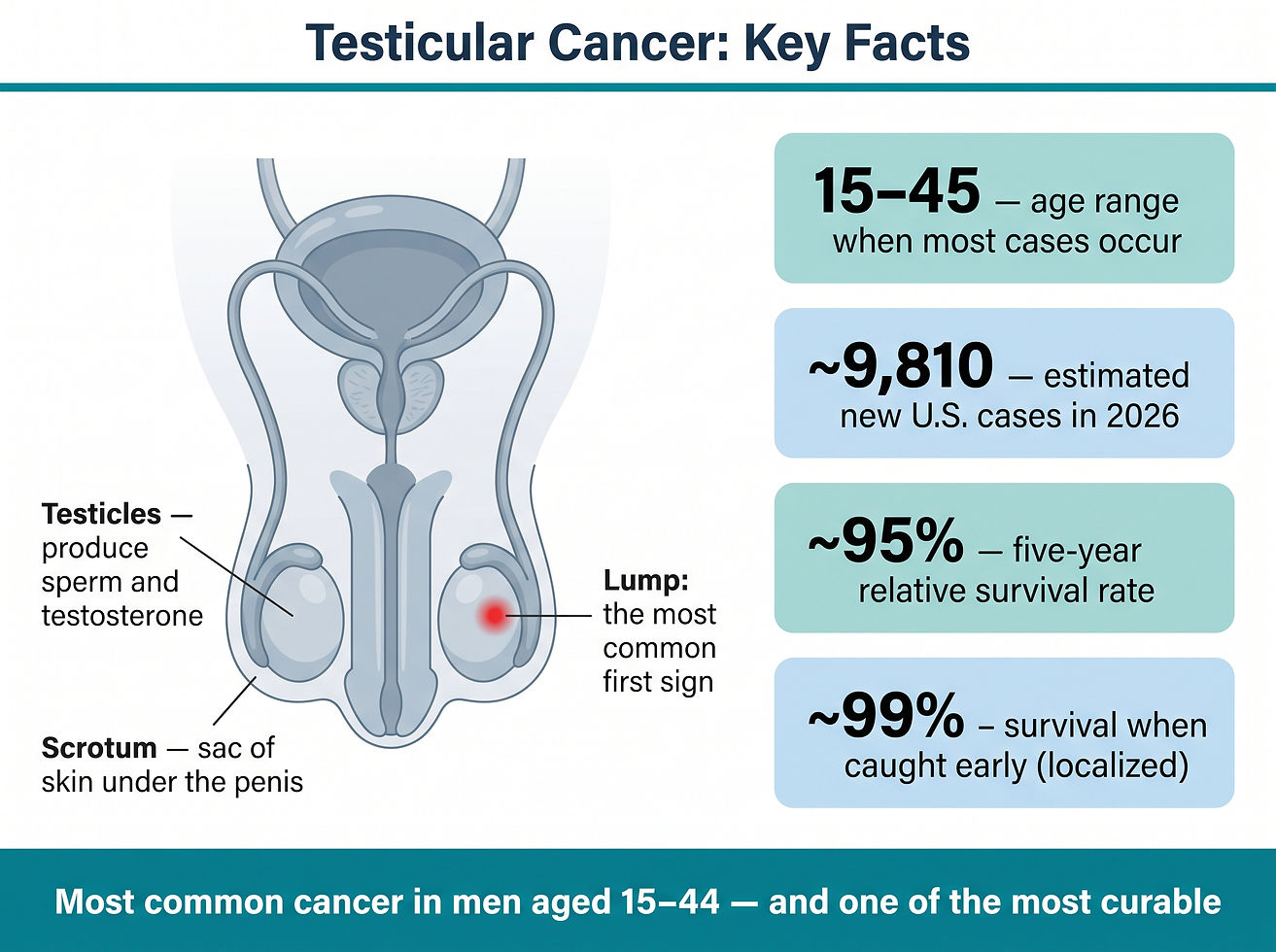
Testicular cancer is a growth of abnormal cells that starts in the testicles — the two egg-shaped glands inside the scrotum, the loose bag of skin underneath the penis. The testicles produce sperm and the hormone testosterone.
Cancer cells can grow quickly and often spread outside the testicle to other parts of the body. The good news is that this cancer is highly treatable, even after it spreads.
Testicular cancer isn't a common type of cancer. It can happen at any age, but it happens most often between the ages of 15 and 45. The first sign of testicular cancer often is a bump or lump on a testicle.
How rare is it? Testicular cancer accounts for a small share of male cancers, with an estimated 9,810 new cases and about 630 deaths projected in the United States in 2026. Within its age group, however, it is the most common cancer in men aged 15 to 44.
| Quick fact | Detail | |------------|--------| | Where it starts | Germ cells of the testicle (the cells that make sperm) | | Peak age | 15–45 years; most common cancer in men 15–44 | | 2026 U.S. estimate | ~9,810 new cases; ~630 deaths | | Most common first sign | Lump or swelling in one testicle | | Overall 5-year survival | ~95% (localized: 99%; regional: 96%; distant: 72%) | | Primary treatments | Surgery (orchiectomy), chemotherapy, radiation |
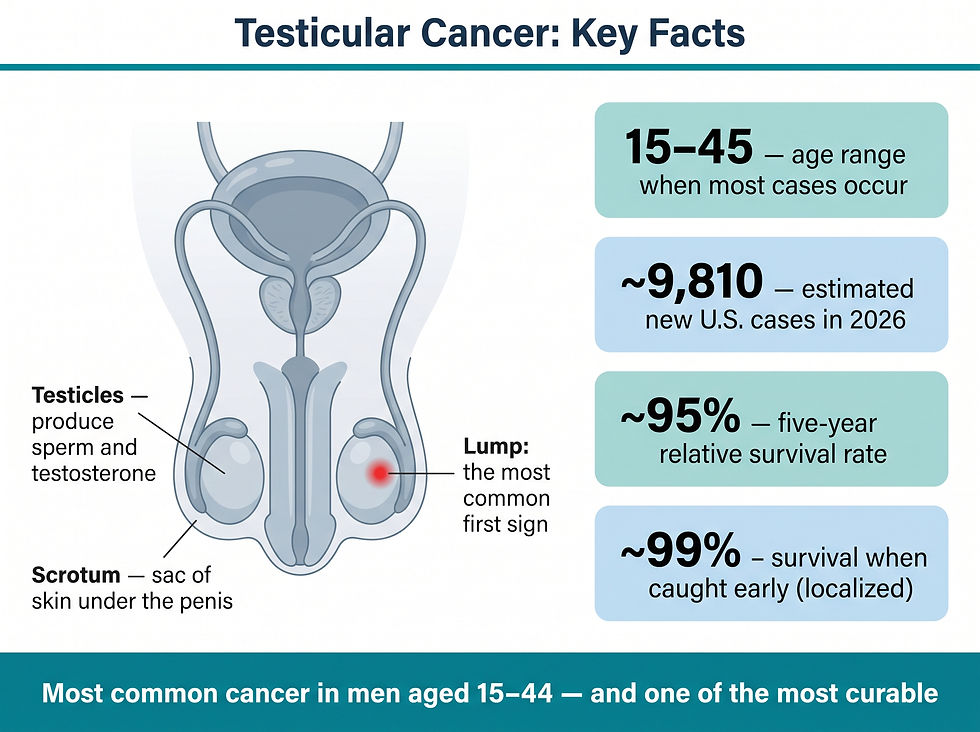
Testicular cancer key facts: peak age, 2026 case estimates, and five-year survival rates.
What are the symptoms of testicular cancer?
The first sign is usually a lump or swelling in one testicle. Usually the cancer develops in only one testicle.
| Sign or symptom | What you may notice | |-----------------|---------------------| | Lump or swelling | A lump or swelling in either testicle | | Heaviness | A feeling of heaviness in the scrotum | | Dull ache | A dull ache in the lower belly or groin | | Sudden swelling | Sudden swelling in the scrotum | | Pain or discomfort | Pain or discomfort in a testicle or the scrotum | | Breast changes | Enlargement or tenderness of breast tissue | | Back pain | Persistent back pain |
When to see a doctor. Have any symptom that lasts longer than two weeks checked by a health care provider — especially pain, swelling, or lumps in your testicles or groin area.

Testicular cancer warning signs — get any symptom lasting more than two weeks checked.
A lump is not automatically cancer. Cysts, fluid collections, infections, and other benign conditions cause most scrotal lumps. But because testicular cancer grows quickly, the two-week rule matters: do not wait for a lump to go away on its own.
Why does it happen? (And what increases your risk)
The cause of most testicular cancers is not clear. It starts when DNA changes in testicle cells cause them to grow and multiply quickly, forming a tumor. Nearly all testicular cancers begin in the germ cells — the cells that make sperm — and it is not known what causes those DNA changes.
Over time, the tumor can grow beyond the testicle. When cells break away and spread, the cancer is called metastatic testicular cancer. It most often spreads to the lymph nodes, liver, and lungs.
| Risk factor | How it relates | |-------------|----------------| | Undescended testicle (cryptorchidism) | The strongest known risk factor; risk stays elevated even after surgery to move the testicle into the scrotum | | Family history | Having a close relative with testicular cancer raises your risk | | Age 15–45 | Most common in teens and young adults; risk falls after that | | Being white | Testicular cancer is most common in white men |
Can you prevent it? No. There is no way to prevent testicular cancer, and if you get it, there is nothing you could have done differently. The focus is on finding it early — not avoiding it.
Does self-exam actually help? The honest answer
Some health care providers recommend regular testicular self-exams, where you feel your testicles for lumps or other changes. Others do not, and the evidence is worth understanding clearly:
Not all health care providers agree with this recommendation. There's no research to show that self-exams can lower the risk of dying of testicular cancer. Even when it is found at a late stage, testicular cancer is likely to be cured.
So why bother at all? Knowing the usual feel of your testicles can help you spot changes early — and early detection keeps treatment simpler and less intensive. If you notice any change that lasts longer than two weeks, make an appointment.
A practical routine (often suggested after a warm shower, when the scrotum is relaxed): look and feel each testicle, comparing sides; roll each one gently between your fingers; feel for any hard lump, rough spot, or change in size. The small cord-like structure at the back of each testicle (the epididymis) is normal — do not mistake it for a lump.
The two-week rule: don't wait out a lump or ache — see a doctor.
How is testicular cancer diagnosed?
You may find a lump yourself, or a provider may detect one during an exam. Several tests then confirm what is causing your symptoms.
| Test | What it shows | |------|---------------| | Ultrasound | Sound-wave pictures of the scrotum and testicles; shows whether a lump is inside the testicle (more likely cancer) or outside it | | Tumor-marker blood tests | Levels of beta-hCG, alpha-fetoprotein, and LDH — elevated levels are a clue, not proof of cancer | | Surgery to remove the testicle (orchiectomy) | The removed testicle is tested in a lab to confirm whether it is cancerous |
Seminoma vs. nonseminoma: why the type matters
Testing on the cancer cells reveals the cancer's type, which guides treatment.
| Type | Typical pattern | |------|-----------------| | Seminoma | Tends to occur at an older age; grows and spreads more slowly | | Nonseminoma | Tends to occur earlier in life; grows and spreads quickly | | Nonseminoma subtypes | Choriocarcinoma, embryonal carcinoma, teratoma, and yolk sac tumor |
How is the cancer staged?
Staging shows whether the cancer has spread beyond the testicle, which shapes prognosis and treatment.
| Stage | What it means | |-------|---------------| | Stage 0–1 | Cancer affects only the testicle and the area around it; no spread to lymph nodes | | Stage 2 | Cancer has spread to the lymph nodes | | Stage 3 | Cancer has spread to other parts of the body — or sits in the lymph nodes with very high tumor-marker levels |
Staging relies on CT scans of the belly, chest, and pelvis, and on repeat tumor-marker blood tests after the testicle is removed. Those repeat tests help the team decide whether additional treatment is needed and monitor your condition afterward.
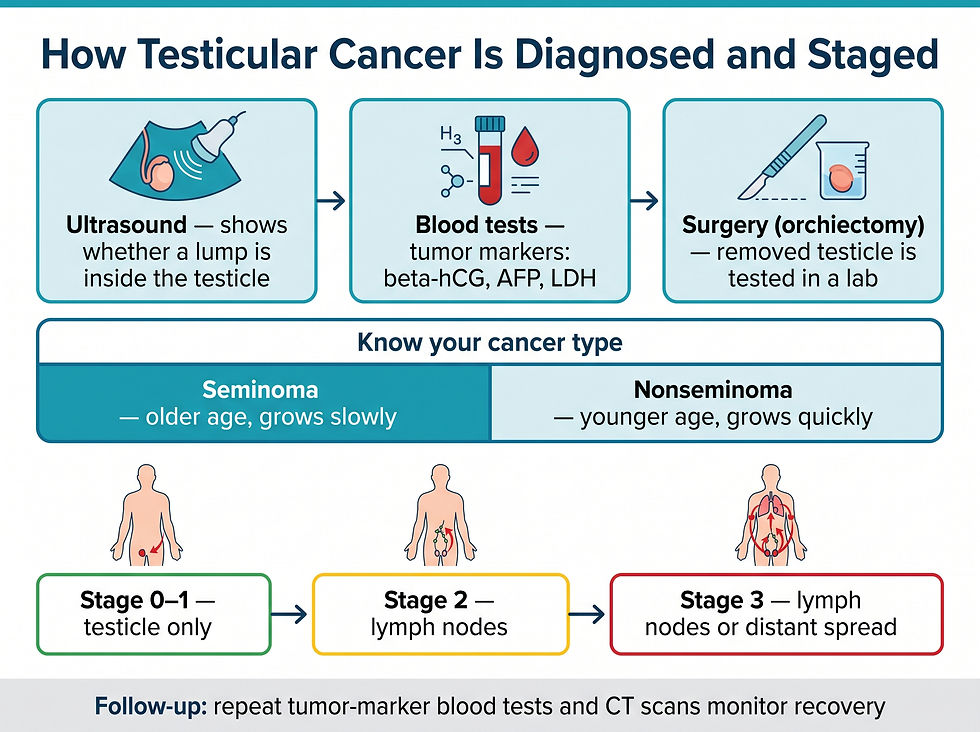
How testicular cancer is diagnosed, typed (seminoma vs. nonseminoma), and staged.
What are the treatment options for testicular cancer?
Treatment depends on the cancer's type and stage, your overall health, and your preferences. Surgery and chemotherapy are the workhorses.
| Approach | How it works | Key notes | |----------|--------------|-----------| | Surgery to remove the testicle (radical inguinal orchiectomy) | Incision in the groin; the entire testicle is removed. A gel-filled prosthetic can be inserted if you choose | The first treatment for most testicular cancers; may be the only treatment needed if the cancer has not spread beyond the testicle | | Surgery to remove nearby lymph nodes | Incision in the belly; nodes are tested in a lab; often used for nonseminoma | Carries risks of bleeding, infection, and possible nerve damage affecting ejaculation — not erections | | Chemotherapy | Strong medicines that travel through the whole body to kill cancer cells; often used after surgery, or before surgery if the cancer is very advanced | Side effects include fatigue, hearing loss, and higher infection risk; may temporarily or permanently stop sperm production | | Radiation therapy | High-energy beams (X-rays, protons) aimed at the cancer; sometimes used after orchiectomy for seminoma | Typically not used for nonseminoma; may cause nausea, fatigue, and temporarily lower sperm counts | | Immunotherapy | Medicines that help your immune system find and kill cancer cells | Sometimes used for advanced cancer that does not respond to other treatments |
Why sperm banking matters before treatment
Chemotherapy, radiation, and lymph node surgery can all affect fertility — temporarily or permanently. Sperm production often restarts after chemotherapy, but sometimes the loss is permanent.
Before any treatment starts, ask your health care provider about options for preserving your sperm. Banking sperm before chemotherapy or radiation, and before surgery, protects your future fertility options.
What is life like after treatment?
Most men live fully and normally after losing one testicle. One healthy testicle typically provides enough testosterone and sperm production for normal hormone function and fertility. A prosthetic testicle is an option for appearance, if you want one.
What should I expect after treatment? Follow-up and recovery
Follow-up matters because testicular cancer can return — and recurrence sometimes has few symptoms, which is why scheduled monitoring is part of the treatment plan.
| Aspect | What to expect | |--------|-----------------| | Tumor-marker monitoring | Repeat blood tests during and after treatment to check that marker levels stay down | | Imaging follow-up | Periodic CT scans to confirm the cancer has not returned | | Fertility check | Sperm production often restarts; testing can confirm recovery | | Hormone levels | Rarely needed, but low testosterone can be treated if it occurs | | Emotional support | Survivor support groups and counseling are widely available |
How do I prepare for an appointment about a testicular lump?
If you notice symptoms that worry you, start with your usual health care provider. If testicular cancer is suspected, you may be referred to a urologist (specialist in the urinary tract and male reproductive system) or an oncologist (cancer specialist).
What to bring: a written symptom list (when each started, whether it is constant or comes and goes), your key personal and medical information, a full medication/supplement list, and a family member or friend to help remember details.
Questions worth asking:
| Question | Why ask it | |----------|------------| | Do I have testicular cancer, and what type? | Type (seminoma vs. nonseminoma) drives treatment | | Can you explain my pathology report? May I have a copy? | Your right to understand your own records | | What is the stage? | Stage determines how far treatment must go | | What are the side effects and risks of each option? | Fertility, ejaculation, and hormone effects differ by treatment | | What can I do before treatment to plan for possible infertility? | Sperm banking should happen before treatment starts | | Would you recommend a second opinion? | A specialist's confirmation is common and appropriate |
Conclusion: A curable cancer — the two-week rule is your best tool
Testicular cancer is the most common cancer in young men, but it is also one of the most curable. Roughly 9,810 American men will be diagnosed in 2026, and about 95% of them will be alive five years later. The first sign is usually a lump, and the single most important habit is simple: notice changes, and act on any symptom that lasts more than two weeks.
Your next steps: get any persistent lump, swelling, or ache checked promptly — diagnosis is quick, starting with an ultrasound. If cancer is confirmed, ask about your type and stage, your treatment options, and sperm preservation before treatment begins. And remember: one healthy testicle is enough for a normal life, including fatherhood.
This article is for educational purposes only and does not replace professional medical advice, diagnosis, or treatment. Always consult a qualified health care provider for decisions about your health.
Frequently Asked Questions
1. Is testicular cancer curable? Yes. It is one of the most curable cancers. The overall five-year relative survival rate is about 95%, and it remains highly treatable even after it has spread to other parts of the body.
2. What does testicular cancer feel like? Most often a lump or swelling in one testicle, sometimes with a feeling of heaviness, a dull ache in the lower belly or groin, or pain in the testicle or scrotum. Any symptom lasting longer than two weeks should be checked.
3. Is a lump in my testicle always cancer? No. Most scrotal lumps are caused by benign conditions such as cysts or infections. But because testicular cancer can grow quickly, a lump that lasts more than two weeks needs evaluation — usually starting with an ultrasound.
4. Can testicular cancer spread, and where? Yes. When it spreads (metastatic testicular cancer), it most often goes to the lymph nodes, liver, and lungs. Even then, it is frequently curable.
5. What age is most at risk? Men aged 15 to 45, with testicular cancer the most common cancer in men aged 15 to 44. It can happen at any age, including after 45.
6. Can I still have children after testicular cancer? Often, yes. One healthy testicle usually produces enough sperm and testosterone. Because treatment can affect fertility, ask about sperm banking before treatment starts — sperm production may restart afterward, but sometimes the loss is permanent.
7. Can I prevent testicular cancer? No. There is no known way to prevent it, and having it is not the result of anything you did or didn't do. Research has not shown that self-exams reduce the risk of dying from it, though knowing your normal anatomy helps you catch changes early.
8. What happens if my testicle is removed? You can live a normal life with one testicle, including normal hormone levels and fatherhood. A gel-filled prosthetic is available if you want one, and your care team will monitor tumor markers and imaging afterward.
References
Testicular cancer — Symptoms & causes — Mayo Clinic (updated October 10, 2024)
Testicular cancer — Diagnosis & treatment — Mayo Clinic (updated October 10, 2024)
Cancer Stat Facts: Testicular Cancer — SEER, National Cancer Institute
Survival Rates for Testicular Cancer — American Cancer Society
Testicular Cancer: Symptoms, Causes & Treatment — Cleveland Clinic (updated June 16, 2026)
Testicular Cancer Treatment (PDQ) Patient Version — National Cancer Institute
Health information, not medical advice. This article is for general education and is not a substitute for professional diagnosis or treatment. Always consult a qualified healthcare provider about your own health, and seek emergency care for urgent symptoms.
Comments