Sentinel Node Biopsy: How It Works, Recovery, Risks and Results

Updated: 2 days ago
Written and medically reviewed by Dr. Baraa Alnahhal, MD · Last reviewed: November 2026 · How we review
Quick Answer
A sentinel node biopsy (SLNB) is a surgical test that checks whether cancer has spread from a tumor to the nearby lymph nodes. The sentinel nodes are the first lymph nodes that fluid from the tumor drains into. It's used for breast cancer and melanoma. If the sentinel nodes are clear, cancer is unlikely to have spread further.
What the research says
A negative sentinel node is reliable: in the NSABP B-32 trial of 5,611 women with breast cancer, those with cancer-free sentinel nodes who had no further lymph node surgery had the same overall survival as women who also had all armpit nodes removed (8-year survival 90.3% vs 91.8%, a nonsignificant difference) (Krag DN et al., The Lancet Oncology, 2010) [2]
Guidelines define who benefits in melanoma: an ASCO and Society of Surgical Oncology guideline recommends sentinel node biopsy for intermediate-thickness melanomas (1.0–4.0 mm), suggests it be considered for some thinner and thicker melanomas, and does not recommend it for thin T1a melanomas (Wong SL et al., Journal of Clinical Oncology, 2018) [3]
Key takeaways
Tests the first lymph nodes a tumor drains to, to see whether cancer has spread.
Mainly used for breast cancer and melanoma; also for some endometrial, penile and vulvar cancers.
A tracer and/or dye guides the surgeon to the right nodes; usually 1–5 nodes are removed.
Many people go home the same day; blue-green urine or stool from the dye is normal.
A negative result usually means no further node surgery is needed.
What is a sentinel lymph node?
Lymph nodes are small filters along the lymphatic vessels that carry fluid away from tissues. Fluid from a tumor drains first to one or a small group of nodes, the sentinel nodes. If cancer cells break away, they usually lodge there first. Checking only these nodes gives staging information with far less surgery than removing a whole group of nodes. Sources: [1]
Why is it done?
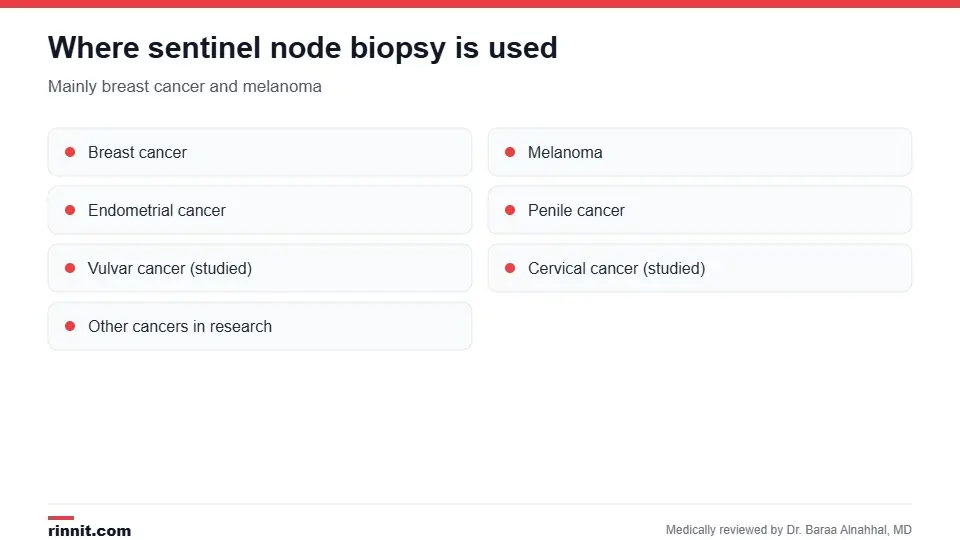
Sentinel node biopsy is mainly used for breast cancer and melanoma.
To stage breast cancer when the armpit nodes don't feel enlarged.
To stage melanoma of a certain thickness.
To stage endometrial cancer and penile cancer.
It's also used to stage vulvar cancer, and researchers are studying it for cervical, colorectal, esophageal, lung and thyroid cancers. Sources: [1]
Results help with cancer staging and treatment decisions. It's usually done during surgery to remove the tumor, sometimes before or after. Sources: [1]
How do I prepare?
Follow instructions about fasting before anesthesia.
Ask which medicines, vitamins, herbs and supplements to stop, especially blood thinners.
Arrange for someone to drive you home. Sources: [1]
What happens during the procedure?
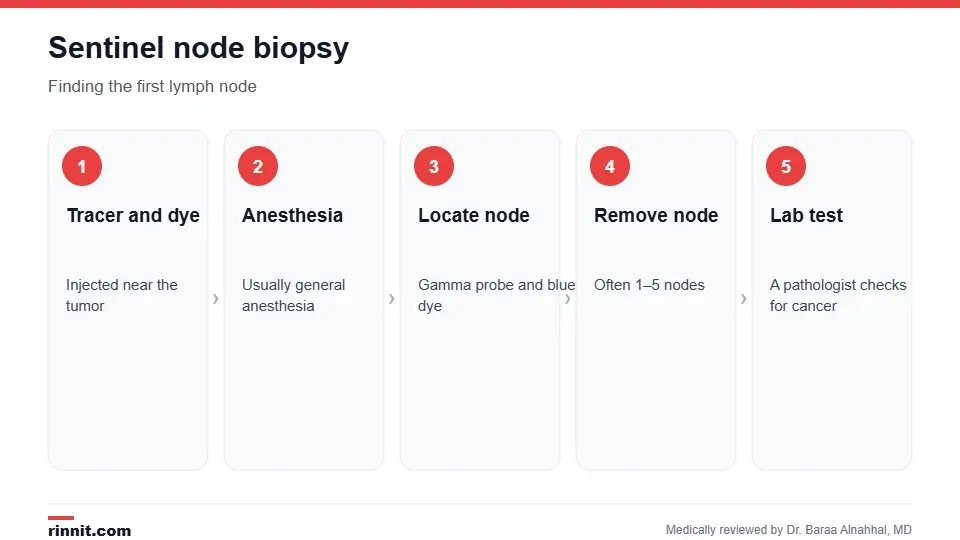
The tracer and dye follow the same path as cancer cells would.
A radioactive tracer is injected near the tumor hours or a day before surgery; this mapping is called lymphoscintigraphy. A blue or fluorescent dye may be injected at surgery. Many providers use both.
You receive general anesthesia, usually.
The surgeon uses a handheld gamma probe and looks for dye-stained nodes to find the sentinel nodes.
A small cut is made, and one or more sentinel nodes are removed; most people have more than one, often 1–5.
The cut is closed with stitches.
A pathologist examines the nodes for cancer cells. Sources: [1]
If the main tumor is removed at the same time, such as during breast cancer surgery, both are done in one operation. Sources: [1]
Recovery
Many people go home the same day; some stay overnight.
Soreness, tingling or numbness near the cut is common.
Blue or green urine or stool for a day or two, and bluish skin near the cut, come from the dye and are harmless.
A firm area may form as scar tissue develops.
If armpit nodes were removed, the arm may feel stiff.
Most people wait several weeks before running, exercising hard or lifting heavy things. Sources: [1]
Risks
Bleeding, bruising, swelling, pain or infection at the cut.
A rare allergic reaction to the blue dye.
Lymphedema (swelling from fluid buildup), which is rare after sentinel node biopsy and much more likely when many nodes are removed.
Axillary web syndrome ("cording"), tight cords under the skin of the arm, which is rare. Sources: [1, 2]
Call your provider for fever, redness, warmth or swelling at the cut, bleeding or pain that medicine doesn't control. Sources: [1]
Understanding your results

Results guide the next step in treatment.
Results may be ready the same day or take a few weeks. A negative result means no cancer was found in the sentinel nodes, so spread to other nodes is unlikely and further node surgery is usually not needed. A positive result means cancer cells were found. Your team may recommend removing more nodes, such as an axillary lymph node dissection, radiation or other treatment; in some cases careful monitoring is an option. If results come back during surgery, more nodes may be removed right away. Sources: [1, 2, 3]
Conclusion
A sentinel node biopsy gives important staging information with much less surgery than removing a whole group of lymph nodes. A negative result is reassuring and often means you can avoid further node surgery and its higher risk of lymphedema.
Keep learning: read about breast cancer and melanoma.
Frequently asked questions
What is a sentinel lymph node?
The first lymph node, or group of nodes, that fluid from a tumor drains into.
Why is a sentinel node biopsy done?
To find out whether cancer has spread to the lymph nodes.
Which cancers use sentinel node biopsy?
Mainly breast cancer and melanoma; also some endometrial, penile and vulvar cancers.
How many lymph nodes are removed?
Usually more than one, often between 1 and 5.
Is it painful?
You're under anesthesia; afterward, soreness is usually managed with over-the-counter medicine.
Why is my urine blue after surgery?
It's from the blue dye and is harmless.
How long is recovery?
Most people go home the same day and avoid heavy exercise for several weeks.
What if the sentinel node is negative?
Cancer is unlikely to have spread to other nodes, and more node surgery usually isn't needed.
What if it's positive?
You may need more nodes removed or other treatment.
Does sentinel node biopsy cause lymphedema?
Rarely; the risk is much lower than with a full lymph node dissection.
Related Reading
Retroperitoneal Lymph Node Dissection (RPLND): Surgery, Risks and Recovery explains the lymph node surgery used to stage and treat testicular cancer.
Lymphoscintigraphy (Lymph Node Mapping): Uses, Procedure and Results the imaging test that maps sentinel nodes.
Breast Cancer: Symptoms, Causes, and Treatment the most common cancer staged with this biopsy.
Melanoma: A Comprehensive Guide to Early Detection and Treatment a skin cancer staged with sentinel node biopsy.
Axillary Lymph Node Dissection: Understanding the Procedure, Risks, and Recovery the larger surgery a negative result can spare.
Understanding Lymph Nodes: Your Body's Essential Filtration System how lymph nodes filter fluid.
Pathology Report: How to Read Margins, Grade, Stage and More explains how to read the sections and key terms of a pathology report.
References
Cleveland Clinic. Sentinel Node Biopsy (SLNB): Procedure and Recovery. Cleveland Clinic. Last updated September 8, 2023. https://my.clevelandclinic.org/health/diagnostics/9192-sentinel-node-biopsy
Krag DN, Anderson SJ, Julian TB, et al. Sentinel-lymph-node resection compared with conventional axillary-lymph-node dissection in clinically node-negative patients with breast cancer: overall survival findings from the NSABP B-32 randomised phase 3 trial. Lancet Oncol. 2010;11(10):927-933. PMID 20863759. https://doi.org/10.1016/S1470-2045(10)70207-2
Wong SL, Faries MB, Kennedy EB, et al. Sentinel lymph node biopsy and management of regional lymph nodes in melanoma: American Society of Clinical Oncology and Society of Surgical Oncology clinical practice guideline update. J Clin Oncol. 2018;36(4):399-413. PMID 29232171. https://doi.org/10.1200/JCO.2017.75.7724
Medical disclaimer
This article is for general education only and does not replace advice from a qualified healthcare professional. Talk to your doctor about your own diagnosis and treatment, and seek emergency care right away for severe or sudden symptoms.



Comments