Axillary Lymph Node Dissection: Understanding the Procedure, Risks, and Recovery

Updated: 3 days ago
Medically reviewed by Dr. Baraa Alnahhal, MD · Last reviewed: October 2026
Quick Answer
Axillary lymph node dissection (ALND) is a surgical procedure in which a surgical oncologist removes lymph nodes from the armpit to find out whether breast cancer has spread. [1] Each armpit contains between 20 and 40 lymph nodes. It is usually done during breast cancer surgery, such as a lumpectomy or mastectomy, and results guide staging and further treatment. [1]
What the research says
ALND carries roughly four times the arm lymphedema risk of sentinel node biopsy. A systematic review and meta-analysis of 72 studies found a pooled arm lymphedema incidence of 16.6% after breast cancer treatment. Incidence was 19.9% after axillary lymph node dissection versus 5.6% after sentinel node biopsy (PubMed: DiSipio et al., Lancet Oncol, 2013 [2]).
In early breast cancer with a positive sentinel node, sentinel biopsy alone did not worsen survival. A meta-analysis of 12 studies (130,575 patients) found no significant difference in overall survival (HR 0.95, 95% CI 0.85–1.06), disease-free survival or locoregional recurrence, while ALND was linked to more lymphedema and paresthesia. This is why the decision is individualized (PubMed: Li et al., Eur J Surg Oncol, 2015 [3]).
Cording (axillary web syndrome) is common after axillary surgery but usually settles. A systematic review of 37 studies reported cording in up to 85.4% of patients, most often within 8 weeks of surgery, with symptoms usually resolving within 3 months though sometimes persisting (PubMed: Yeung et al., J Cancer Surviv, 2015 [4]).
What are the axillary lymph nodes?
Axillary lymph nodes are small, bean-shaped structures in the underarm that form part of the immune system. They sit in several groups, and each armpit contains between 20 and 40 of them. [1] These nodes act as a checkpoint for lymph draining from the arms, breasts and chest wall. When breast cancer is present, the armpit nodes are generally the first place it spreads. [1]
Axillary lymph node dissection (ALND) is surgery to remove the lymph nodes in your armpit. Surgical oncologists do this surgery to see if cancer from your breast is in these nodes.
Why is axillary lymph node dissection done?
A surgical oncologist may recommend an axillary lymph node dissection based on several clinical factors. The decision is guided by physical examination, imaging results and the outcome of preliminary biopsies.
Indication Category | Clinical Finding |
Physical Exam | Swollen lymph nodes felt in the underarm or collarbone area. [1] |
Imaging Tests | Signs of swollen axillary lymph nodes on ultrasound, CT scan or PET scan. [1] |
Preliminary Biopsy | A sentinel node biopsy showing cancer cells in three or more nodes. [1] |
Treatment Response | Presurgical chemotherapy that does not eliminate cancer in the target axillary nodes. [1] |
What happens during an axillary lymph node dissection?
Before surgery, your surgical oncologist will explain what to do beforehand, such as whether you should stop eating and drinking (fasting). The operation is typically done under general anesthesia, so you are asleep and comfortable throughout. [1]

Steps of the Procedure
During the operation, the surgeon follows a structured series of steps to remove the target tissue safely:
Incision: A cut is made in the armpit to reach the lymph nodes that tests show may contain cancer cells.
Removal: The tissue containing the lymph nodes is removed from a particular area of the armpit.
Drainage: A surgical drain is placed at the surgery site to prevent fluid build-up.
Closure: The incision is closed.
Pathology: The removed tissue is sent to a pathologist for microscopic examination. [1]
How do axillary lymph nodes affect cancer staging (N category)?
The number of cancerous lymph nodes is a primary factor in the “N” category of breast cancer staging. In general, a higher number of cancerous axillary nodes leads to a higher overall cancer stage.
Node Category | Description of Findings |
N1 | Cancer in one to three axillary lymph nodes, or abnormal internal lymph nodes in the chest. [1] |
N2 | Cancer detected in four to nine underarm lymph nodes, or abnormal internal lymph nodes in the chest. [1] |
N3 | Cancer in 10 or more axillary lymph nodes, or spread to lymph nodes under the collarbone. [1] |
The lymph node count is only one factor. Your surgical oncologist also considers tumor size and location, whether the tumor is spreading to nearby tissues, and tumor receptor status, such as estrogen and progesterone receptors. [1]
What are the benefits and risks of axillary lymph node dissection?
The main benefit of axillary lymph node dissection is that it shows whether cancer has reached the axillary nodes, which is essential for building an effective treatment plan. Because the surgery affects the lymphatic system, it also carries specific risks that are important to understand.
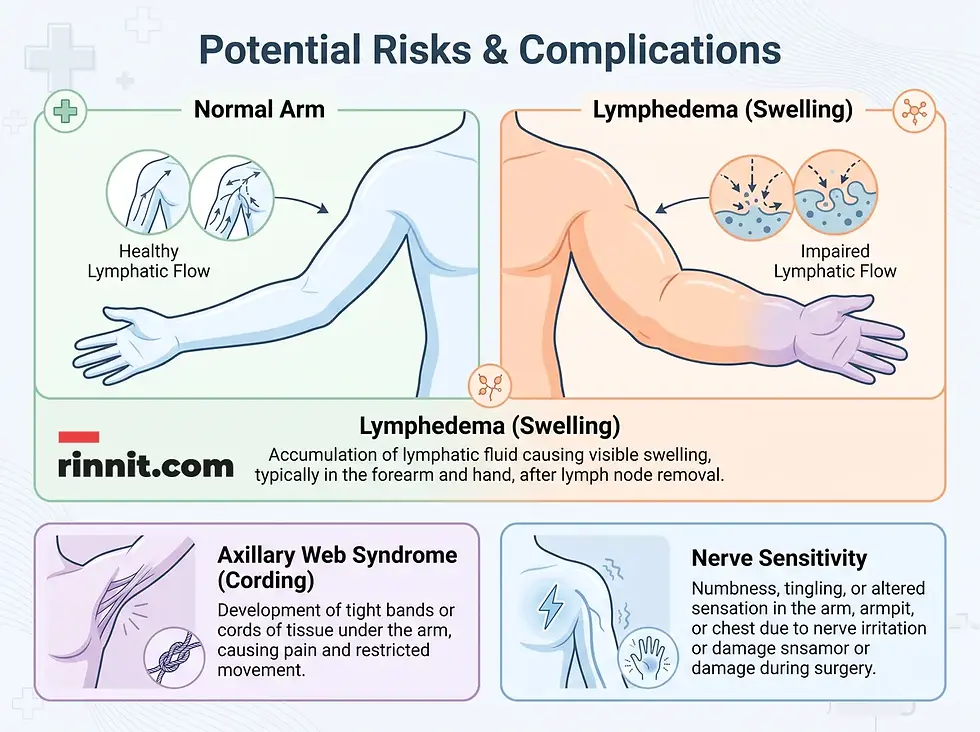
Potential Complications
Lymphedema: Swelling in the arm caused by disrupted lymph drainage, which can lead to skin problems such as wounds and infections. [1]
Axillary Web Syndrome (AWS): Scar tissue in the lymph vessels that causes pain and can limit shoulder movement. [1]
Nerve Damage: Numbness, tingling or altered sensation in the arm, armpit or chest wall.
Bleeding: Bleeding at the surgery site.
Infection: Redness, warmth or discharge at the surgical site.
Your surgical oncologist may refer you to a lymphedema specialist who can watch for early signs and recommend ways to prevent swelling. [1]
What is recovery like after axillary lymph node dissection?

Keep the incision clean and dry, empty the surgical drain as instructed, and follow your care team’s guidance on gentle shoulder movement. Call your oncologist if you notice:
Conclusion
Axillary lymph node dissection remains an important part of breast cancer management because it shows whether cancer has spread to the armpit and helps your care team plan treatment precisely. Recovery needs attention, particularly to protect lymphatic health, so work closely with your surgical and oncology teams to manage risks and support a smooth recovery.
Frequently Asked Questions
1. Why do I need this surgery if I already had a sentinel node biopsy?
A sentinel node biopsy only checks the first few nodes. If three or more of those nodes contain cancer cells, a full dissection may be recommended to remove more of the affected nodes and give more accurate staging.
2. How many lymph nodes are removed during the procedure?
Each armpit contains between 20 and 40 lymph nodes, and the surgery removes some of them. The exact number varies with how much of the armpit needs to be cleared, so your surgical oncologist can explain what to expect in your case.
3. Will I have a permanent drain after surgery?
No. A surgical drain is placed during the operation and is temporary. It is usually removed once the fluid output drops to a safe level, often within one to two weeks, though timing varies.
4. What is lymphedema, and can it be prevented?
Lymphedema is swelling in the arm caused by a build-up of lymph fluid when lymph drainage is disrupted. It cannot always be prevented, but a lymphedema specialist can monitor you for early signs and recommend ways to lower the risk.
5. When can I return to normal activities?
Recovery varies from person to person. Most people return to light activities within a few weeks, while strenuous exercise and heavy lifting are usually restricted for several weeks. Follow your surgeon’s specific instructions.
6. Is the surgery painful?
General anesthesia is used during the procedure, so you are asleep. Pain afterward is managed with medication as directed by your surgeon. Call your oncologist if you have more pain than expected or your pain medicine is not helping.
7. What are the signs of an infection at the incision site?
Redness, warmth, swelling or discharge at the surgery site can be signs of infection, sometimes with a fever. Contact your oncologist promptly if you notice these changes.
8. How does this surgery affect my cancer stage?
The number of cancerous lymph nodes is a key part of the N category in breast cancer staging. More affected nodes generally means a higher N category (N1, N2 or N3), but tumor size, spread and receptor status also count.
9. Will I need chemotherapy after this procedure?
It depends on the lymph node results, the tumor’s characteristics and your overall health. Your oncologist will discuss treatment options with you once the pathology results are available.
10. What is “cording” or axillary web syndrome?
Cording, or axillary web syndrome, is scar tissue in the lymph vessels that forms tight, rope-like bands under the skin of the armpit. It can be painful and limit shoulder movement, and it often improves with physical therapy.
11. How do I prepare for axillary lymph node dissection?
Your surgeon explains the specific steps to take before surgery, including whether and when to stop eating and drinking [1]. You typically receive general anesthesia, so you are asleep during the operation, and a surgical drain is placed to collect fluid from the armpit area afterward [1]. Your surgeon may also refer you to a lymphedema specialist to watch for and help prevent arm swelling [1].
12. When should I call my doctor after axillary lymph node dissection?
Call your provider for redness or discharge at the surgery site, which may signal infection, or for pain that is worse than expected or not relieved by your prescription pain medication [1]. Also call for swelling in the arm or hand on the surgery side, which may be a sign of lymphedema [1].
Related Reading
Lymphoscintigraphy (Lymph Node Mapping): Uses, Procedure and Results explains the scan that maps lymph flow and finds sentinel lymph nodes.
Sentinel Node Biopsy: How It Works, Recovery, Risks and Results explains the biopsy that checks whether cancer has reached the first lymph nodes.
References
Cleveland Clinic. Axillary Lymph Node Dissection. Cleveland Clinic. Oct. 27, 2024. https://my.clevelandclinic.org/health/procedures/axillary-lymph-node
DiSipio T, Rye S, Newman B, et al. Incidence of unilateral arm lymphoedema after breast cancer: a systematic review and meta-analysis. Lancet Oncol. 2013;14(6):500-515. PMID 23540561. https://doi.org/10.1016/S1470-2045(13)70076-7
Li CZ, Zhang P, Li RW, et al. Axillary lymph node dissection versus sentinel lymph node biopsy alone for early breast cancer with sentinel node metastasis: a meta-analysis. Eur J Surg Oncol. 2015;41(8):958-966. PMID 26054706. https://doi.org/10.1016/j.ejso.2015.05.007
Yeung WM, McPhail SM, Kuys SS. A systematic review of axillary web syndrome (AWS). J Cancer Surviv. 2015;9(4):576-598. PMID 25682072. https://doi.org/10.1007/s11764-015-0435-1
Medical Disclaimer
This article is for informational purposes only and does not constitute medical advice. Always seek the advice of your physician or other qualified health provider with any questions you may have regarding a medical condition. Never disregard professional medical advice or delay in seeking it because of something you have read here.



Comments