Melanoma: A Comprehensive Guide to Early Detection and Treatment

Updated: 3 days ago
Medically reviewed by Dr. Baraa Alnahhal, MD · Last reviewed: October 2026
Melanoma is the most dangerous and invasive form of skin cancer. It starts in melanocytes, the pigment-producing cells of the skin, and it can spread quickly to other organs. It is also highly curable when it is caught in its earliest stages[1].
Quick Answer: What is melanoma?
Melanoma is an aggressive skin cancer that develops in melanocytes. It makes up only about 1% of skin cancers but causes most skin cancer deaths. Warning signs include changes in a mole's symmetry, border, color, diameter or evolution. It has a 99% cure rate when caught earliest. Surgery is the main treatment, with immunotherapy or targeted therapy for advanced cases. [1]
What the research says
Indoor tanning raises melanoma risk, and starting young raises it more. A systematic review and meta-analysis of 36 studies with 14,583 melanoma cases found that indoor tanning was linked to a 27% higher risk of melanoma (RR 1.27, 95% CI 1.16–1.39). First use at age 20 or younger carried a relative risk of 1.47 (95% CI 1.16–1.85) (An et al., Cancers, 2021 [2]).
Daily sunscreen may lower the risk of invasive melanoma. In a randomized trial of 1,621 adults in Nambour, Australia, followed for 10 years after the trial ended, 11 new primary melanomas occurred in the daily sunscreen group versus 22 in the discretionary group (HR 0.50, 95% CI 0.24–1.02, a borderline result). For invasive melanomas, the counts were 3 versus 11 (HR 0.27, 95% CI 0.08–0.97) (Green et al., J Clin Oncol, 2011 [3]).
Immunotherapy has changed survival in advanced melanoma. In the phase III CheckMate 067 trial of 945 patients with previously untreated, unresectable stage III or IV melanoma, median overall survival after at least 6.5 years of follow-up was 72.1 months with nivolumab plus ipilimumab, 36.9 months with nivolumab alone, and 19.9 months with ipilimumab alone (Wolchok et al., J Clin Oncol, 2022 [4]).
What is melanoma skin cancer?
Melanoma, which means "black tumor," is the most dangerous type of skin cancer. It begins in the melanocytes, the cells that make melanin, the pigment that gives skin its color. Most melanomas are dark brown or black, but some are pink, red, purple, or the same color as the surrounding skin[1].
Melanoma accounts for only about 1% of all skin cancers, but it causes most skin cancer deaths. It is also one of the most common cancers in people under 30, especially young women. It can appear anywhere on the body, even in the eyes and internal organs, and in people with darker skin it most often appears on the palms, soles, and nails[1].
What are the warning signs of melanoma under the ABCDE rule?
Melanoma warning signs are checked with the ABCDE rule, and an unusual bump, a sore that will not heal or an "ugly duckling" mole also deserves a doctor's attention. Dermatologists use the ABCDE memory device to check any new or existing spot on the skin[1]:
Indicator | What to look for | Warning sign |
Asymmetry | The shape of the spot. | One half does not match the other half. |
Border | The edges of the mole. | Edges are ragged, blurred, or irregular. |
Color | The pigmentation. | Uneven shades of brown, black, gray, red, or white. |
Diameter | The size of the spot. | Larger than a pencil eraser (6.0 mm). |
Evolving | Changes over time. | Any change in size, shape, color, or elevation. |
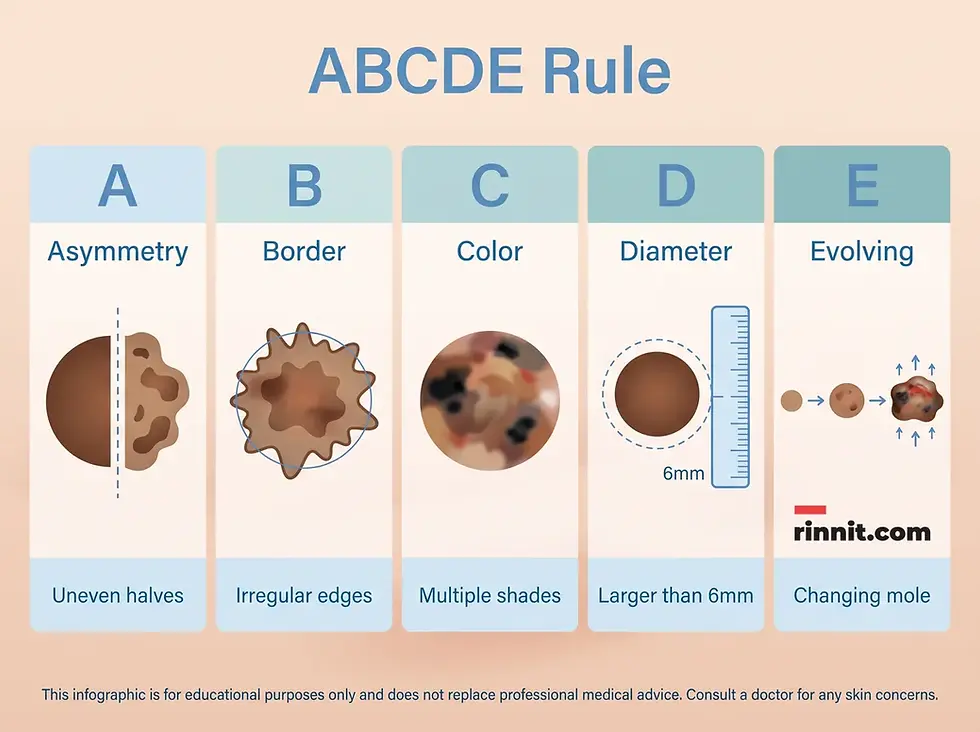
The ABCDE rule helps you spot suspicious skin changes.
Some melanomas do not fit the ABCDE rule, so tell your doctor about any sore that will not heal, unusual bump, rash, or skin change. Another clue is the "ugly duckling" sign: a mole that looks very different from all the others on your body[1].
What causes melanoma, and who is at risk?
About 86% of melanomas are caused by solar ultraviolet (UV) radiation. UV rays damage the DNA in skin cells, causing genetic changes that make cells grow and divide out of control. UV radiation from tanning beds also raises the risk, and it has been designated a carcinogen by the World Health Organization[1][2].
Who Is at Higher Risk?
Anyone can develop melanoma, but certain factors raise the risk[1]:
Fair skin, freckles, blond or red hair, and blue eyes.
A personal or family history of melanoma.
Excess sun exposure, including blistering sunburns, and living near the equator or at high elevations.
A history of tanning bed use.
Many moles, especially atypical moles.
A weakened immune system.

UV exposure, tanning beds, physical traits, and family history all contribute to melanoma risk.
Lowering Your Risk
Seek shade, especially between 10 a.m. and 4 p.m.
Skip tanning beds. Use a cosmetic spray tan instead.
Cover up with a brimmed hat, sunglasses, long sleeves, and pants whenever possible.
Use sunscreen: a broad-spectrum sunscreen with an SPF of 30 or higher, reapplied about every 1.5 hours, or more often if you are swimming or sweating.
How is melanoma diagnosed and staged?
If a spot looks suspicious, your provider may remove it and examine it under a microscope (a biopsy) to see whether it contains cancer cells. Once melanoma is confirmed, it is staged by the thickness of the tumor, which is the most important factor in predicting outcomes, and by whether it has spread to lymph nodes or distant organs. Staging guides the treatment plan[1].
A sentinel lymph node biopsy checks whether cancer has spread to the first lymph nodes near the tumor. It may be needed for melanomas deeper than 0.8 mm, those with ulceration, or those with other concerning features[1].
Stage | Description | Primary treatment |
Stage 0 | Melanoma in situ (top layer of skin only). | Surgical excision. |
Stage I and II | Localized growth with no evidence of spread. | Surgical removal with margins. |
Stage III | Spread to nearby lymph nodes or nearby skin. | Surgery, with possible immunotherapy. |
Stage IV | Spread to distant lymph nodes, skin, or internal organs. | Immunotherapy, targeted therapy, radiation, or clinical trials. |
What are the modern treatment options for melanoma?
Melanoma treatment usually starts with surgery for early-stage disease, while advanced melanoma may also need lymph node removal, immunotherapy, targeted therapy, radiation therapy or clinical trials. The surgeon removes the tumor along with a margin of healthy surrounding skin, often under local anesthesia in the office. More advanced melanoma may need other treatments in addition to or instead of surgery[1]:
Lymphadenectomy: removal of nearby lymph nodes when the melanoma has spread, which can help prevent further spread.
Immunotherapy: treatment that stimulates your own immune system to fight the cancer[4].
Targeted therapy: drugs that attack specific cancer cells while leaving healthy cells untouched.
Radiation therapy: high-energy rays that attack cancer cells and shrink tumors.
Clinical trials: research programs that test new treatments, which some patients may join.

Treatment depends on the stage of the melanoma and your general health.
What is the bottom line on melanoma?
The high cure rate for early-stage melanoma shows why vigilance and regular skin checks matter. By protecting your skin from excessive UV exposure and watching for evolving spots, you can significantly reduce your risk of serious complications. Tell your doctor about any new or changing mole, sore, or skin discoloration, and ask about routine full-body skin exams[1].
Frequently Asked Questions
What is the most common sign of melanoma?
The most common sign is a new spot on the skin or a change in the size, shape, or color of an existing mole.
Is melanoma always black or brown?
No. Most melanomas are dark, but some are pink, red, purple, or skin-colored.
How common is melanoma in young people?
Melanoma is one of the most common cancers in people under 30, particularly among young women.
Can melanoma occur in areas not exposed to the sun?
Yes. It can form anywhere on the body, including the eyes and internal organs. In people with darker skin it most often appears on the palms, soles, and nails.
What is the "ugly duckling" sign?
The "ugly duckling" sign refers to a mole that looks very different from all the other moles on your body. Any mole like this should be checked by a dermatologist.
How effective is early treatment?
Melanoma has a 99% cure rate if it is detected and treated in its earliest stages.
Are tanning beds safer than natural sunlight?
No. UV radiation from tanning beds also increases melanoma risk, and the World Health Organization designates it a carcinogen.
What determines the stage of melanoma?
Staging is based mainly on the thickness of the tumor and on whether it has spread to lymph nodes or other organs.
What is a sentinel lymph node biopsy?
A sentinel lymph node biopsy is a procedure that checks whether melanoma has spread to the first lymph nodes near the tumor.
Can melanoma be inherited?
A family history of melanoma raises your risk. If close relatives have had melanoma, ask your doctor how often you should have skin exams.
Related Reading
Learn more in our guide to Skin Biopsy: Types, What to Expect, Results and Aftercare.
Skin Self-Exam: How to Check Your Skin and the ABCDEs of Melanoma explains how to check your own skin monthly using the ABCDEs of melanoma.
Lymphoscintigraphy (Lymph Node Mapping): Uses, Procedure and Results explains the scan that maps lymph flow and finds sentinel lymph nodes.
Sentinel Node Biopsy: How It Works, Recovery, Risks and Results explains the biopsy that checks whether cancer has reached the first lymph nodes.
LDH (Lactate Dehydrogenase) Test: Normal Range and What High LDH Means explains the enzyme blood test that signals tissue damage.
References
Cleveland Clinic. Melanoma. Cleveland Clinic. June 21, 2021. https://my.clevelandclinic.org/health/diseases/14391-melanoma
An S, Kim K, Moon S, et al. Indoor tanning and the risk of overall and early-onset melanoma and non-melanoma skin cancer: systematic review and meta-analysis. Cancers (Basel). 2021;13(23):5940. PMID 34885049. https://doi.org/10.3390/cancers13235940
Green AC, Williams GM, Logan V, Strutton GM. Reduced melanoma after regular sunscreen use: randomized trial follow-up. J Clin Oncol. 2011;29(3):257-263. PMID 21135266. https://doi.org/10.1200/JCO.2010.28.7078
Wolchok JD, Chiarion-Sileni V, Gonzalez R, et al. Long-term outcomes with nivolumab plus ipilimumab or nivolumab alone versus ipilimumab in patients with advanced melanoma. J Clin Oncol. 2022;40(2):127-137. PMID 34818112. https://doi.org/10.1200/JCO.21.02229
Medical disclaimer
This article is for informational purposes only and is not a substitute for professional medical advice, diagnosis, or treatment. The clinical information in this guide reflects source material last reviewed in June 2021.



Comments