Skin Biopsy: Types, What to Expect, Results and Aftercare

Updated: 2 days ago
Written and medically reviewed by Dr. Baraa Alnahhal, MD · Last reviewed: November 2026 · How we review
Quick Answer: What is a skin biopsy?
A skin biopsy is a quick, in-office test that removes a small sample of skin so it can be examined under a microscope. It helps find the cause of a new or changing mole, a rash, a scaly patch or a sore that won't heal, including skin cancer. The procedure takes about 15 minutes, and the risks are slight. [1]
What the research says
Full removal gives the most complete picture of a suspected melanoma. In a study of 2,304 melanomas, the assessment of tumor thickness changed after later surgery in fewer than 1% of excisional biopsies, compared with 6% of shave biopsies and 15% of punch biopsies. Most partial biopsies still gave enough information to plan surgery. (Doolan et al., Australasian Journal of Dermatology, 2019) [2]
Biopsy type and clinical notes affect how accurate the diagnosis is. In a review of misdiagnosed melanoma cases, partial shave biopsies had about 5 times higher odds of a missed melanoma than a full excisional biopsy. Telling the pathologist the suspected diagnosis cut the odds of a missed melanoma that later progressed by 3.8-fold. (Kok et al., Australasian Journal of Dermatology, 2021) [3]
Shave biopsies are now the most common first biopsy for melanoma. Among 323 people with melanoma, 76% were first diagnosed by shave biopsy. Treatment recommendations changed after full removal in only 6% of shave and 9% of punch biopsy patients, supporting the use of partial biopsies to guide care. (Jones et al., Journal of Surgical Research, 2023) [4]
Key takeaways
A skin biopsy removes a small piece of skin to find the cause of a skin problem under a microscope. [1]
It can help diagnose skin infections, conditions such as eczema and psoriasis, and skin cancer. [1]
The three main types are punch, shave and excisional biopsy. [1]
The area is numbed first, and the whole procedure takes about 15 minutes. [1]
The risks are slight and include bleeding, infection and scarring. [1]
For a suspected melanoma, removing the whole spot gives the most complete assessment. [2] [3]
What is a skin biopsy?
A skin biopsy is a procedure that removes a small sample of skin. The sample is then examined under a microscope to help work out what is causing a skin condition. [1]
It is a quick procedure done in your provider's office. The type of biopsy you have depends on the size and location of the area of skin being tested. [1]
Why is a skin biopsy done?
Your provider may recommend a skin biopsy if you have a skin change that needs a clear diagnosis, such as: [1]
A new mole or a mole that is changing
A rash
An area of scaly or rough skin
An open sore that won't heal
What can a skin biopsy diagnose?
Looking at the skin under a microscope can help confirm several types of conditions. [1]
Group | Examples |
Infections | Bacterial or fungal skin infections |
Skin conditions | Eczema, psoriasis |
Skin cancer | Basal cell carcinoma, squamous cell carcinoma, melanoma |
Sources: [1]
What are the types of skin biopsy?
There are three main types of skin biopsy. Your provider chooses the one that best fits the size and location of the area being tested. [1]

Type | Tool used | What is removed | Stitches |
Punch biopsy | A biopsy punch | A small, circular sample of skin | May be closed with a few stitches |
Shave biopsy | A razor blade | A thin, superficial layer of skin | Usually not needed |
Excisional biopsy | A scalpel | A sample of skin cut out with a scalpel | May be closed with a few stitches |
Sources: [1]
How do you prepare for a skin biopsy?
A skin biopsy is a quick procedure done in your provider's office, so you usually don't need much preparation. Before the sample is taken, your provider cleans the area with alcohol or another disinfectant and then injects a local anesthetic to numb it. [1]
It can help to ask your provider ahead of time which type of biopsy you will have, whether you will need stitches and when to expect results. [1]
What happens during a skin biopsy?
The procedure follows a few simple steps: [1]

Your provider cleans the skin with alcohol or another disinfectant.
A local anesthetic is injected to numb the area.
Your provider removes the sample with a punch, a razor blade or a scalpel.
For a shave biopsy, only a superficial layer is removed. There may be some bleeding, but stitches usually aren't needed.
For a punch or excisional biopsy, the site may be closed with a few stitches.
The area is bandaged, and the sample is examined under a microscope.
Sources: [1]
Skin biopsy at a glance
Item | Typical detail |
Setting | Your provider's office |
Numbing | An injected local anesthetic |
Tools | A biopsy punch, razor blade or scalpel |
How long it takes | About 15 minutes |
Stitches | Not usually needed for a shave biopsy; may be used for punch or excisional biopsy |
Results | Your care team tells you when to expect them |
Sources: [1]
What happens after a skin biopsy?
After the sample is taken, your provider bandages the area and gives you instructions on caring for the wound. [1]
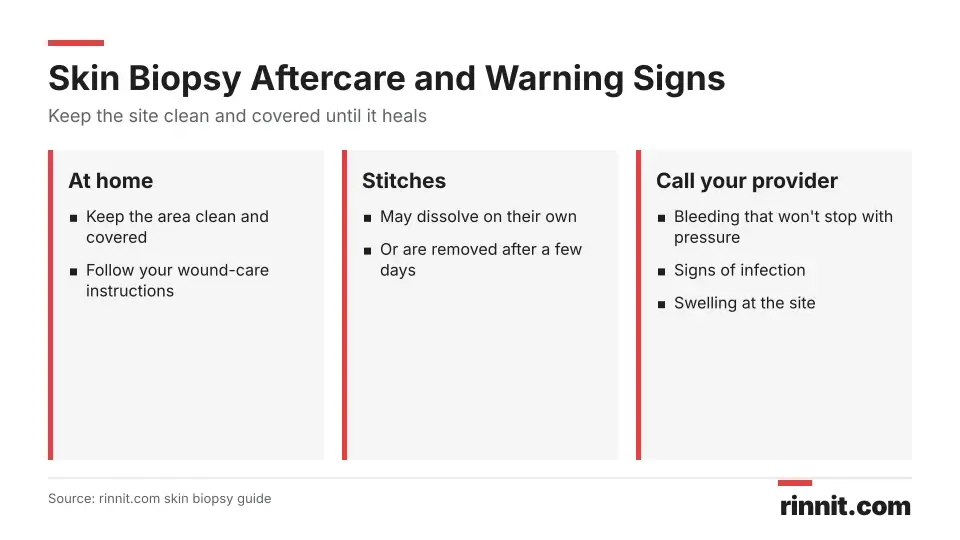
Keep it clean and covered. Keep the area clean and covered until it heals.
Follow wound-care instructions. Your provider will explain how to look after the site at home.
Stitches. If you have stitches, they may dissolve on their own or be removed after a few days.
Follow-up. Your provider will tell you when to expect results and whether you need a follow-up visit.
Sources: [1]
What do skin biopsy results mean?
Ask your care team when to expect your results. The results show what is causing the skin change, which guides your next steps. [1]
Result | What may happen next |
Infection or skin condition | The diagnosis, such as a bacterial or fungal infection, eczema or psoriasis, helps guide treatment |
Basal cell or squamous cell cancer | Your provider reviews options to make sure the entire cancerous area is removed |
Melanoma | Further tests may check whether it has spread, and more surgery or other treatment may be recommended |
Sources: [1]
Melanoma is a more invasive type of skin cancer. If a biopsy shows cancer, your care team will explain the stage and what it means for your treatment. [1]
What are the risks of a skin biopsy?
A skin biopsy is a very safe procedure. There is only a slight risk of problems at the biopsy site. [1]
Risk | What it means |
Bleeding | Some bleeding at the site, which usually stops with pressure |
Infection | Germs entering the wound before it heals |
Scarring | A small scar where the sample was taken |
Sources: [1]
When should you call your provider after a skin biopsy?
Contact your care team if you notice any of these signs: [1]
Bleeding that doesn't stop within a few hours or with direct pressure
Signs of infection at the biopsy site
Swelling at the biopsy site
Questions to ask your provider
Why do I need a skin biopsy?
Which type of biopsy will I have, and why?
Will I need stitches, and when will they come out?
How should I care for the site while it heals?
When should I expect my results, and will I need a follow-up visit?
Conclusion
A skin biopsy removes a small piece of skin so it can be examined under a microscope. It is a quick, in-office procedure that helps find the cause of moles, rashes, rough patches and sores that won't heal, from infections and eczema to skin cancer. [1]
The area is numbed first, the procedure takes about 15 minutes, and the risks of bleeding, infection and scarring are slight. Keeping the site clean and covered, and knowing which warning signs to watch for, helps it heal well. For a spot that may be melanoma, research shows that the biopsy method and the details shared with the lab both affect how complete the diagnosis is. [1] [2] [3]
Keep learning: Read our guides to melanoma, basal cell carcinoma and atypical moles. For more on this test, see the MedlinePlus guide to skin lesion biopsy.
FAQ
What is a skin biopsy?
A skin biopsy removes a small sample of skin so it can be examined under a microscope to find the cause of a skin problem.
Why would I need a skin biopsy?
Your provider may suggest one for a new or changing mole, a rash, a scaly or rough patch, or an open sore that won't heal.
What can a skin biopsy diagnose?
It can help diagnose bacterial or fungal skin infections, skin conditions such as eczema or psoriasis, and skin cancers such as basal cell carcinoma, squamous cell carcinoma and melanoma.
What are the types of skin biopsy?
The three main types are a punch biopsy, a shave biopsy and an excisional biopsy. Your provider chooses based on the size and location of the area.
Does a skin biopsy hurt?
Your provider injects a local anesthetic to numb the area before taking the sample, which helps keep the procedure comfortable.
How long does a skin biopsy take?
The whole procedure usually takes about 15 minutes and is done in your provider's office.
Will I need stitches after a skin biopsy?
A shave biopsy usually doesn't need stitches. A punch or excisional biopsy may be closed with a few stitches that dissolve or are removed after a few days.
How do I care for a skin biopsy site?
Keep the area clean and covered until it heals, and follow the wound-care instructions your provider gives you.
What are the risks of a skin biopsy?
A skin biopsy is very safe. There is a slight risk of bleeding, infection and scarring.
When will I get my skin biopsy results?
Ask your care team when to expect results and whether you need a follow-up visit to discuss them.
When should I call my provider after a skin biopsy?
Call if bleeding doesn't stop within a few hours or with direct pressure, or if you notice swelling or signs of infection at the site.
Related Reading
Muscle Biopsy: Diagnosing Muscle Diseases, Procedure and Recovery explains the procedure that takes a small muscle sample to diagnose muscle diseases.
Wood's Lamp Examination: What the Blacklight Skin Test Shows explains the blacklight skin test and what its colors mean.
Learn more in our guide to Melanoma: A Comprehensive Guide to Early Detection and Treatment.
Learn more in our guide to What Is Basal Cell Carcinoma? Symptoms, Causes, and Treatment.
Learn more in our guide to Squamous Cell Carcinoma of the Skin: Symptoms, Causes, and Treatment Explained.
Learn more in our guide to Actinic Keratosis: Symptoms, Causes, Diagnosis, and Treatment Options.
Learn more in our guide to Dysplastic Nevus (Atypical Moles): What They Look Like, Your Melanoma Risk and What to Do Next.
Learn more in our guide to Nonmelanoma Skin Cancer: Symptoms, Causes, and Treatment Explained.
Skin Self-Exam: How to Check Your Skin and the ABCDEs of Melanoma explains how to check your own skin monthly using the ABCDEs of melanoma.
References
Cleveland Clinic. Skin Biopsy: Skin Cancer Test, Punch Biopsy, Shave Biopsy. Cleveland Clinic. Last updated September 30, 2021. https://my.clevelandclinic.org/health/diagnostics/21857-skin-biopsy
Doolan BJ, Robinson AJ, Wolfe R, et al. Accuracy of partial biopsies in the management of cutaneous melanoma. Australas J Dermatol. 2019;60(3):209-213. PMID 30773625. https://doi.org/10.1111/ajd.13004
Kok Y, Scott K, Pham A, et al. The impact of incomplete clinical information and initial biopsy technique on the histopathological diagnosis of cutaneous melanoma. Australas J Dermatol. 2021;62(4):e524-e531. PMID 34426977. https://doi.org/10.1111/ajd.13697
Jones S, Henry V, Strong E, et al. Clinical Impact and Accuracy of Shave Biopsy for Initial Diagnosis of Cutaneous Melanoma. J Surg Res. 2023;286:35-40. PMID 36739830. https://doi.org/10.1016/j.jss.2022.12.042
Medical disclaimer
This article is for general education only and does not replace advice from a qualified healthcare professional. Talk to your doctor about your own diagnosis and treatment, and seek emergency care right away for severe or sudden symptoms.



Comments