Actinic Keratosis: Symptoms, Causes, Diagnosis, and Treatment Options

Updated: 3 days ago
Medically reviewed by Dr. Baraa Alnahhal, MD · Last reviewed: October 2026
Quick Answer: What is actinic keratosis?
Actinic keratosis, also called solar keratosis, is a rough, scaly skin patch that develops from years of UV exposure, usually first appearing after 40 on the face, lips, ears, forearms, scalp or hands [1]. Because about 5% to 10% of untreated patches become squamous cell carcinoma, doctors usually remove them with cryotherapy, medicated creams, scraping, laser or photodynamic therapy [1] [2].
What the research says
The yearly risk for any single lesion is low, and some patches regress on their own, but treatment is still common. A published viewpoint summarizing the evidence reports progression to cutaneous squamous cell carcinoma of 0% to 0.5% per lesion-year and spontaneous regression of 15% to 63% of actinic keratoses. Because an actinic keratosis is a potential precursor of invasive squamous cell carcinoma, it is commonly treated to reduce the risk of malignant progression (PubMed: Navarrete-Dechent et al., J Dermatolog Treat, 2021) [3].
Several treatments clear lesions about equally well. A systematic review of 80 randomized trials (6,748 patients) found that photodynamic therapy, cryotherapy, imiquimod, ingenol mebutate, 5-fluorouracil, trichloroacetic acid, and ablative fractional laser were non-inferior to one another for percent clearance, with the lowest clearance seen with diclofenac sodium. On the head and neck, 5-fluorouracil, combination photodynamic therapy, and 5-fluorouracil with calcipotriol were most beneficial but often caused the most initial side effects (PubMed: Worley et al., Arch Dermatol Res, 2023) [4].
Among photodynamic therapy regimens, laser-assisted treatment ranked highest. A network meta-analysis of 26 trials (2,285 patients, 14 treatments) of complete response 3 months after the first treatment found a high probability that ablative fractional laser-assisted methyl aminolevulinate LED photodynamic therapy was the most effective option, followed by calcipotriol-assisted treatment and ALA-LED photodynamic therapy. The authors noted that more randomized trials are needed to verify the results (PubMed: Wan et al., J Cutan Med Surg, 2024) [5].
What Is Actinic Keratosis?
An actinic keratosis (pronounced ak-TIN-ik ker-uh-TOE-sis) is a rough, scaly patch on the skin that develops from years of sun exposure. It is also known as a solar keratosis [1]. These keratoses are scaly spots or patches that form on the top layer of skin. Over time, they may become hard with a wartlike surface [1].
Actinic keratosis grows slowly and usually first appears in people over 40 [1]. You can reduce your risk of this skin condition by minimizing sun exposure and protecting your skin from ultraviolet (UV) rays. The condition is most often found on the sun-exposed areas of the body [1]. The table below shows where these patches typically appear.
Body Area | Why It Is at Risk |
Face | Direct sun exposure over many years |
Lips | Constant UV exposure, hard to protect |
Ears | Often forgotten during sun protection |
Scalp | Exposed, especially with thinning hair |
Neck | Continuous sun exposure |
Forearms | Commonly uncovered in daily life |
Back of the hands | Repeated daily sun exposure |
Left untreated, the risk of actinic keratoses turning into a type of skin cancer called squamous cell carcinoma is about 5% to 10% [1].
What does actinic keratosis look like?

What are the symptoms of actinic keratosis?
Actinic keratoses vary in appearance. The patch is usually rough, dry, or scaly, and typically less than 1 inch (2.5 centimeters) in diameter [1]. It appears as a flat to slightly raised patch or bump on the top layer of skin. In some cases, it develops a hard, wartlike surface [1].
The color varies from person to person. Patches may be pink, red, or brown [1]. Some people also notice itching, burning, bleeding, or crusting in the affected area [1]. New patches or bumps typically show up on sun-exposed areas of the head, neck, hands, and forearms [1].
Symptom | What You Notice | What It Looks Like |
Rough, dry, or scaly patch | Sandpaper-like texture | Usually less than 1 inch (2.5 cm) across |
Flat or slightly raised bump | Bump on the top layer of skin | Subtle elevation on the surface |
Hard, wartlike surface | Firm texture in some cases | Thickened, wartlike crust |
Color variation | Pink, red, or brown tones | Varies with skin tone and sun damage |
Itching, burning, bleeding, or crusting | Discomfort on the patch | May crust over or bleed |
New patches on sun-exposed skin | Head, neck, hands, forearms | Multiple spots in UV-exposed areas |
When should you see a doctor about actinic keratosis?
Actinic keratosis spots can be difficult to tell apart from cancerous skin spots [1]. Because of this, it is best to have new skin changes evaluated by a health care provider. This is especially important if a scaly spot or patch persists, grows, or bleeds [1]. Early evaluation protects you from a condition that could otherwise become cancerous.
What Causes Actinic Keratosis?
An actinic keratosis is caused by frequent or intense exposure to ultraviolet (UV) rays from the sun or tanning beds [1]. The damage accumulates over years. That is why the condition usually first appears in people over 40 who have had long-term sun exposure.
What are the risk factors for actinic keratosis?
Anyone can develop actinic keratoses. But you are at increased risk if you match any of the following descriptions.
Risk Factor | Why It Increases Risk |
Red or blond hair with blue or light-colored eyes | Fair skin burns more easily |
History of heavy sun exposure or sunburn | More accumulated UV damage |
Tendency to freckle or burn in sunlight | Skin is more UV-sensitive |
Older than 40 | Years of accumulated sun exposure |
Living in a sunny place | Higher year-round UV exposure |
Working outdoors | Regular prolonged sun exposure |
Weakened immune system | Reduced ability to repair skin damage |
If you work outdoors or live in a sunny climate, sun protection becomes even more important.
What complications can actinic keratosis cause?
If treated early, actinic keratosis can be cleared up or removed [1]. If left untreated, some of these spots might progress to squamous cell carcinoma [1]. Squamous cell carcinoma is a type of skin cancer that usually is not life-threatening if detected and treated early [1]. This is one more reason why early treatment of actinic keratosis matters.
Outcome | If Treated Early | If Left Untreated |
Patch | Cleared up or removed | May persist and grow |
Cancer risk | Removed before it progresses | 5% to 10% may become squamous cell carcinoma [1] |
How is actinic keratosis diagnosed?
Your health care provider will likely be able to determine whether you have an actinic keratosis simply by looking at your skin [2]. If there is any doubt, your health care provider may do other tests, such as a skin biopsy [2]. During a skin biopsy, a small sample of skin is taken for analysis in a lab. A biopsy can usually be done in a clinic after a numbing injection [2]. Even after treatment for actinic keratosis, your health care provider might suggest that you have your skin checked at least once a year for signs of skin cancer [2].
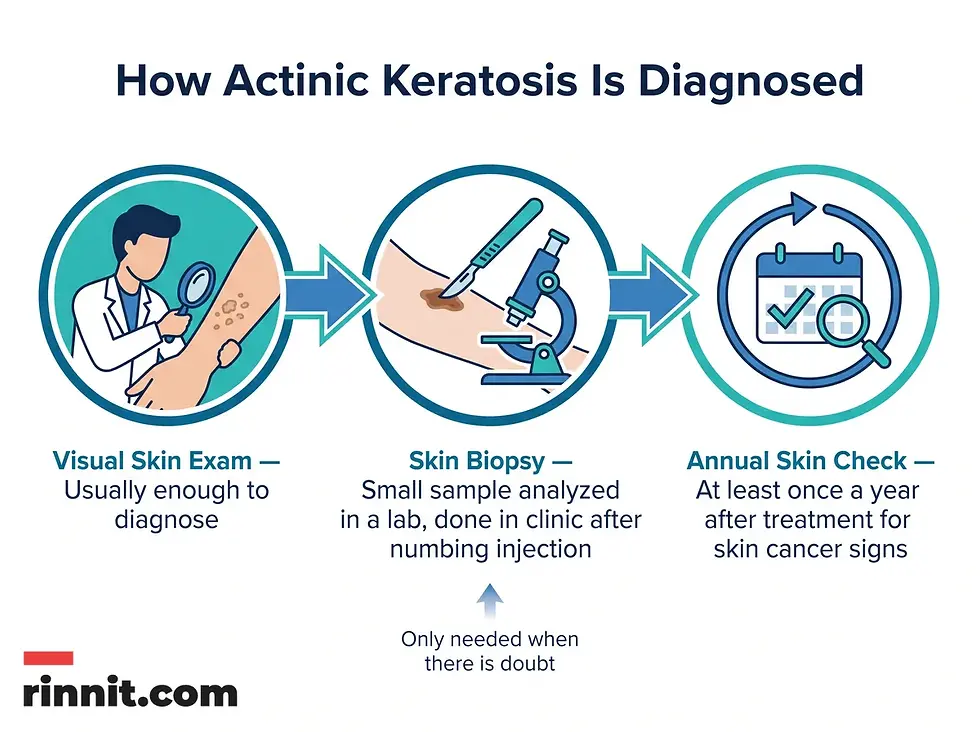
Diagnostic Step | What Happens | When It Is Used |
Visual skin exam | Provider looks at the patch | Usually enough to diagnose |
Skin biopsy | Small skin sample sent to a lab | When there is any doubt |
Annual skin check | Full skin exam each year | After treatment, to watch for skin cancer |
How is actinic keratosis treated?
An actinic keratosis sometimes disappears on its own but might return after more sun exposure [2]. It is hard to tell which actinic keratoses will develop into skin cancer, so they are usually removed as a precaution [2].
Medicines
If you have several actinic keratoses, your health care provider might prescribe a medicated cream or gel to remove them. Options include fluorouracil (Carac, Efudex, and others), imiquimod (Aldara, Zyclara), or diclofenac [2]. These products might cause inflamed skin, scaling, or a burning sensation for a few weeks [2]. This reaction is part of how the medicine works on the damaged cells.
Surgical and Other Procedures
Many methods are used to remove actinic keratosis. The table below compares the main procedures.
Procedure | How It Works | Where It Is Done | Common Side Effects |
Freezing (cryotherapy) | Liquid nitrogen freezes the patch; skin blisters or peels, damaged cells slough off | Provider's office, takes only a few minutes | Blisters, scarring, texture changes, infection, skin color changes |
Scraping (curettage) | Curet device scrapes off damaged cells; may be followed by electrosurgery with local anesthesia | Clinic | Infection, scarring, skin color changes |
Laser therapy | Ablative laser destroys the patch; new skin appears | Clinic | Scarring, discoloration |
Photodynamic therapy | Light-sensitive chemical solution applied, then exposed to special light | Clinic | Inflamed skin, swelling, burning during therapy |
Freezing (cryotherapy) is the most common treatment [2]. Your health care provider applies liquid nitrogen to the affected skin, which causes blistering or peeling. As your skin heals, the damaged cells slough off, allowing new skin to appear. The procedure takes only a few minutes and can be done in your health care provider's office [2].
Scraping (curettage) uses a device called a curet to scrape off damaged cells. Scraping may be followed by electrosurgery, in which a pencil-shaped instrument is used to cut and destroy the affected tissue with an electric current. This procedure requires local anesthesia [2].
Laser therapy is increasingly used to treat actinic keratosis [2]. Your health care provider uses an ablative laser device to destroy the patch, allowing new skin to appear [2].
Photodynamic therapy involves applying a light-sensitive chemical solution to the affected skin and then exposing it to a special light that will destroy the actinic keratosis [2].

How can you prevent actinic keratosis?
Sun safety helps prevent actinic keratoses [1]. The following steps protect your skin from the sun.
Limit your time in the sun. Especially avoid time in the sun between 10 a.m. and 2 p.m. And avoid staying in the sun so long that you get a sunburn or a suntan [1].
Use sunscreen. Before spending time outdoors, apply a broad-spectrum water-resistant sunscreen with a sun protection factor (SPF) of at least 30 [1]. Do this even on cloudy days. Use sunscreen on all exposed skin, and use lip balm with sunscreen on your lips [1]. Apply sunscreen at least 15 minutes before going outside and reapply it every two hours, or more often if you are swimming or sweating [1]. Sunscreen is not recommended for babies under 6 months [1]. Instead, keep them out of the sun if possible, or protect them with shade, hats, and clothing that covers the arms and legs [1].
Cover up. For extra protection from the sun, wear tightly woven clothing that covers your arms and legs. Also wear a broad-brimmed hat. This provides more protection than a baseball cap or golf visor [1].
Avoid tanning beds. The ultraviolet (UV) exposure from a tanning bed can cause just as much skin damage as a tan from the sun [1].
Check your skin regularly and report changes to your health care provider. Examine your skin regularly, looking for the development of new skin growths or changes in existing moles, freckles, bumps, and birthmarks [1]. With the help of mirrors, check your face, neck, ears, and scalp. Examine the tops and undersides of your arms and hands.
Prevention Step | Specific Guidance |
Limit sun time | Avoid 10 a.m. to 2 p.m.; avoid sunburn or suntan |
Sunscreen | Broad-spectrum, water-resistant, SPF 30+; reapply every 2 hours |
Lip protection | Lip balm with sunscreen |
Clothing | Tightly woven fabrics, broad-brimmed hat |
Tanning beds | Avoid completely |
Skin self-checks | Regular exams of face, neck, ears, scalp, arms, hands |
How can you cope with actinic keratosis and prepare for your appointment?
You are likely to start by seeing your primary care provider. In some cases when you call to set up an appointment, you may be referred directly to a specialist in skin diseases (dermatologist) [2].
What You Can Do
Your time with your health care provider is limited, so preparing a list of questions will help you make the most of your appointment. For actinic keratoses, some basic questions to ask include:
Are tests needed to confirm the diagnosis?
What are my treatment options and the pros and cons of each?
What will the treatments cost? Does medical insurance cover these costs?
What suspicious changes in my skin should I look for?
What kind of follow-up should I expect?
What to Expect From Your Doctor
Your health care provider may ask you questions such as:
When did you first notice the patches or spots?
Have you noticed more than one patch or spot?
Have you noticed more changes in the affected skin?
Is the condition bothersome?
Have you had many sunburns or very bad sunburns?
How often are you exposed to sun or ultraviolet (UV) radiation?
Do you protect your skin from UV radiation when you go outdoors?
Appointment Preparation Item | Details to Prepare |
Symptom timeline | When patches or spots first appeared |
Skin changes | Number of patches, any changes in them |
Sun history | Sunburns, UV exposure frequency, sun protection habits |
Questions list | Tests, treatments, costs, follow-up |
Conclusion
Actinic keratosis is a rough, scaly skin patch that forms from years of ultraviolet exposure, usually appearing after age 40 on the face, ears, scalp, neck, forearms, or hands [1]. While it grows slowly and is not cancer itself, about 5% to 10% of untreated patches can turn into squamous cell carcinoma [1].
The good news is that it is easy to spot, easy to diagnose, and highly treatable. Freezing, medicated creams, scraping, laser therapy, and photodynamic therapy all clear the patches effectively. And daily sun protection stops new ones from forming.
The most important step you can take is not ignoring that rough spot on your skin. If a scaly patch persists, grows, or bleeds, have it evaluated by a health care provider [1]. Early action keeps your skin healthy for years to come.
Ready to take the next step? If you have a rough, scaly patch on sun-exposed skin, schedule an appointment with your health care provider or a dermatologist. While you wait, practice the prevention steps above, take note of all your spots, and bring your sun exposure history to the appointment.
Frequently Asked Questions
1. What is actinic keratosis?
Actinic keratosis, also known as a solar keratosis, is a rough, scaly patch on the skin that develops from years of sun exposure. It grows slowly, usually first appears in people over 40, and is most often found on the face, lips, ears, forearms, scalp, neck, or back of the hands.
2. Is actinic keratosis cancer?
No, actinic keratosis itself is not cancer. However, if left untreated, about 5% to 10% of these patches can turn into squamous cell carcinoma, a type of skin cancer that usually is not life-threatening if detected and treated early. Because it is hard to tell which patches will become cancerous, they are usually removed as a precaution.
3. What does actinic keratosis look like?
Actinic keratosis appears as a rough, dry, or scaly patch of skin, usually less than 1 inch (2.5 centimeters) in diameter. It is flat to slightly raised, may develop a hard wartlike surface, and varies in color from pink to red or brown. It may itch, burn, bleed, or crust.
4. What causes actinic keratosis?
An actinic keratosis is caused by frequent or intense exposure to ultraviolet (UV) rays from the sun or tanning beds. The damage accumulates over years, which is why the condition usually first appears in people over 40.
5. Who is at risk of actinic keratosis?
Anyone can develop actinic keratoses. Risk is higher for people with red or blond hair and blue or light-colored eyes, a history of heavy sun exposure or sunburn, a tendency to freckle or burn, those over 40, people who live in sunny places or work outdoors, and people with a weakened immune system.
6. How is actinic keratosis treated?
Treatment options include medicated creams or gels such as fluorouracil, imiquimod, or diclofenac, and procedures such as freezing (cryotherapy, the most common treatment), scraping (curettage), laser therapy, and photodynamic therapy. They are usually removed as a precaution because it is hard to tell which patches will become skin cancer.
7. Does actinic keratosis go away on its own?
An actinic keratosis sometimes disappears on its own, but it might return after more sun exposure. Because it is hard to tell which patches will develop into skin cancer, they are usually removed as a precaution rather than left alone.
8. Is cryotherapy painful for actinic keratosis?
Cryotherapy takes only a few minutes and can be done in your health care provider's office. The freezing causes blistering or peeling as the damaged cells slough off. Side effects may include blisters, scarring, changes to skin texture, infection, and changes in skin color of the affected area.
9. How can I prevent actinic keratosis?
Limit sun exposure, especially between 10 a.m. and 2 p.m. Use a broad-spectrum water-resistant sunscreen with SPF of at least 30, applied 15 minutes before going outside and reapplied every two hours. Wear tightly woven clothing and a broad-brimmed hat, avoid tanning beds, and check your skin regularly for new growths or changes.
10. How often should I have my skin checked after treatment?
Even after treatment for actinic keratosis, your health care provider might suggest that you have your skin checked at least once a year for signs of skin cancer. Regular self-checks of your skin are also recommended.
Trusted External Resources
Related Reading
Cryotherapy: Uses, Procedure, Risks and Recovery explains how freezing treatments remove abnormal tissue.
Photodynamic Therapy (PDT): Uses, Procedure, Recovery and Risks explains how a light-activated drug treats precancer and some skin cancers, with recovery and light-safety tips.
Learn more in our guide to Skin Biopsy: Types, What to Expect, Results and Aftercare.
References
Mayo Clinic Staff. Actinic keratosis - Symptoms and causes. Mayo Clinic. Dec. 17, 2022. https://www.mayoclinic.org/diseases-conditions/actinic-keratosis/symptoms-causes/syc-20354969
Mayo Clinic Staff. Actinic keratosis - Diagnosis and treatment. Mayo Clinic. Dec. 17, 2022. https://www.mayoclinic.org/diseases-conditions/actinic-keratosis/diagnosis-treatment/drc-20354975
Navarrete-Dechent C, Marghoob AA, Marchetti MA. Contemporary management of actinic keratosis. J Dermatolog Treat. 2021;32(5):572-574. PMID 31621454. https://doi.org/10.1080/09546634.2019.1682504
Worley B, Harikumar V, Reynolds K, et al. Treatment of actinic keratosis: a systematic review. Arch Dermatol Res. 2023;315(5):1099-1108. PMID 36454335. https://doi.org/10.1007/s00403-022-02490-5
Wan Y, Zeng Q, Jiang L, et al. Efficacy of photodynamic therapy in the treatment of actinic keratosis: a network meta-analysis. J Cutan Med Surg. 2024;28(6):536-542. PMID 39101280. https://doi.org/10.1177/12034754241266177
Medical Disclaimer
This article is for informational purposes only and does not constitute medical advice. Always seek the advice of your physician or other qualified health provider with any questions you may have regarding a medical condition. Never disregard professional medical advice or delay in seeking it because of something you have read here.



Comments