Cryotherapy: Uses, Procedure, Risks and Recovery

Updated: 2 days ago
Written and medically reviewed by Dr. Baraa Alnahhal, MD · Last reviewed: November 2026 · How we review
Quick Answer
Cryotherapy is a treatment that uses extreme cold, usually liquid nitrogen or argon gas, to freeze and destroy abnormal tissue. It treats skin problems such as warts, skin tags and precancerous patches, some early skin cancers and precancerous cervical cells. It usually causes less pain and bleeding than surgery. Treated skin heals in one to three weeks.
What the research says
For warts, stronger freezing works better: a review of 85 trials with 8,815 people found aggressive freezing cleared more warts than gentle freezing, and freezing plus salicylic acid beat salicylic acid alone (Kwok CS et al., Cochrane Database Syst Rev, 2012) [2]
Cervical cryotherapy is gentler on pregnancy: across 71 studies of 19,240 women, cryotherapy for cervical precancer failed more often than loop excision; a separate analysis of 29 studies found it probably doesn't raise the risk of preterm birth (Athanasiou A et al., Lancet Oncol, 2022) [3]
Key takeaways
Cryotherapy freezes and destroys abnormal tissue.
It treats warts, skin tags, precancerous skin and cervical cells, and some cancers.
It usually causes less pain and bleeding than surgery.
Treated skin heals in about one to three weeks.
More than one treatment may be needed.
What is cryotherapy?
Cryotherapy, also called cryosurgery or cryoablation, destroys cells by freezing them. Liquid nitrogen, liquid nitrous oxide or argon gas creates the cold. On the skin, the frozen area blisters and peels so healthy skin can grow back. Inside the body, your immune system clears away the dead tissue. Sources: [1]
What it treats
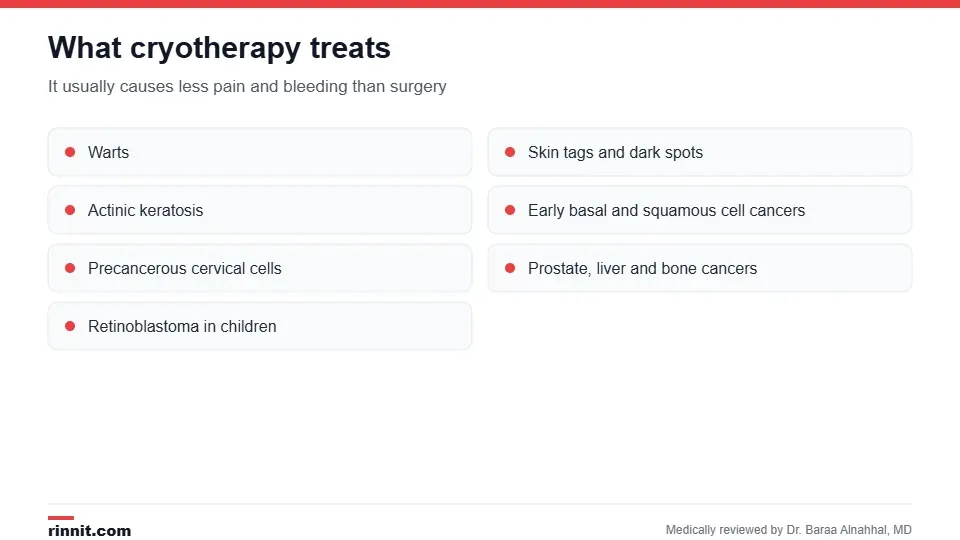
Cryotherapy usually causes less pain and bleeding than surgery.
Warts, including plantar warts.
Skin tags and dark spots.
Precancerous skin patches such as actinic keratosis.
Early basal cell and squamous cell skin cancers.
Precancerous cervical cells (cervical dysplasia).
Prostate, liver, bone and cervical cancers.
Retinoblastoma, an eye cancer in children. Sources: [1]
Types of cryotherapy
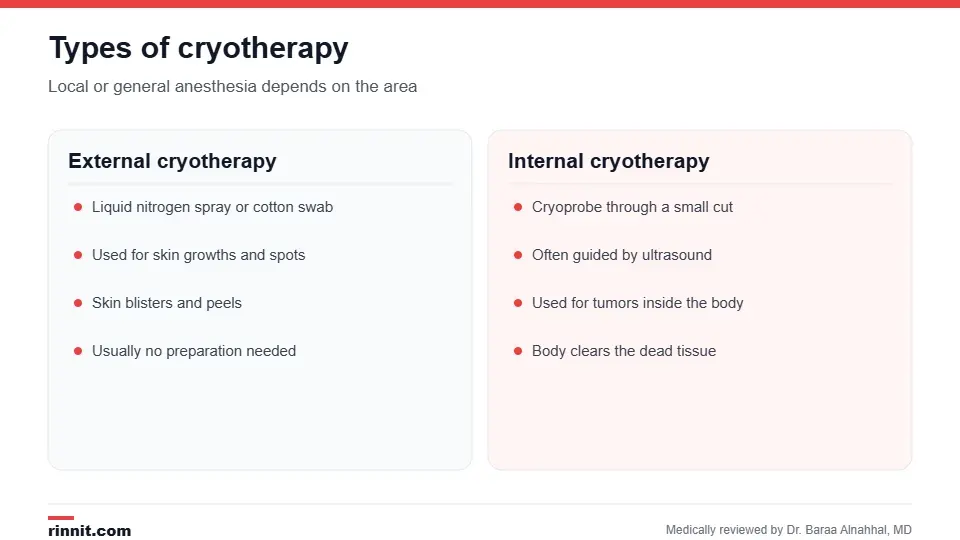
Local or general anesthesia depends on the area treated.
Type | How it works | Used for |
External | Liquid nitrogen is sprayed or applied with a cotton swab | Skin growths and spots |
Internal | A thin cryoprobe is placed through a small cut, often guided by ultrasound | Tumors and precancerous cells inside the body |
Sources: [1]
How to prepare
Skin treatments usually need no special preparation.
For internal treatment, you may need to stop aspirin or blood thinners a few days before.
You may need to limit eating and drinking beforehand.
Arrange a ride home after internal treatment. Sources: [1]
What happens during cryotherapy
You get local anesthesia to numb the area, or general anesthesia so you're asleep, depending on where the abnormal cells are.
For skin, your provider sprays or swabs the cold agent onto the growth.
For internal treatment, your provider guides a cryoprobe to the abnormal tissue and freezes it.
The frozen tissue dies and is shed or cleared by your body over the next weeks. Sources: [1]
Risks
Risk | Notes |
Swelling, blistering, scarring | Most common with skin treatment |
Skin infection | Watch for redness, pus or fever |
Bleeding, cramping or pain | Possible after cervical treatment |
Nerve damage or numbness | Rare |
Bone fractures | Rare, after bone treatment |
Overall risks are small, and there's a lower chance of damaging nearby healthy tissue than with surgery. Sources: [1]
Recovery

More than one treatment may be needed.
Treatment | What to expect |
Skin | Redness and possible blister; mild pain for about three days; scab heals in one to three weeks |
Internal | Mild pain or soreness for up to three days; some people limit activity for a few days |
Cervix | Watery discharge for a few days to a few weeks |
Sources: [1]
When to call your provider
Signs of infection, such as redness, pus or an unexplained fever.
A skin problem that's still there after the area heals. Sources: [1]
Conclusion
Cryotherapy is a quick, low-risk way to remove many skin growths and treat some precancerous and cancerous tissue. Ask your provider whether freezing is the best option for your condition and how many treatments you may need.
Keep learning: read about LEEP and fat freezing (cryolipolysis).
Frequently asked questions
What is cryotherapy?
A treatment that uses extreme cold to freeze and destroy abnormal tissue.
What does cryotherapy treat?
Warts, skin tags, precancerous skin and cervical cells, and some cancers.
What is used to freeze the tissue?
Usually liquid nitrogen or argon gas.
Does cryotherapy hurt?
It can sting, but local anesthesia is often used, and pain is mild afterward.
How long does healing take?
Skin usually heals in one to three weeks.
Will I need more than one treatment?
Sometimes, especially for warts.
What are the risks?
Blistering, swelling, scarring and, rarely, infection or nerve damage.
Is cryotherapy better than surgery?
It usually causes less pain and bleeding, but surgery may work better for some conditions.
Does cervical cryotherapy affect pregnancy?
Studies suggest it probably doesn't raise the risk of preterm birth.
When should I call my provider?
For redness, pus, fever or a skin problem that doesn't go away.
Related Reading
Cryoablation: Uses, Procedure, Benefits and Risks explains cryoablation for tumors.
Warts: Symptoms, Types, and Treatment Options common skin growths often frozen off.
Actinic Keratosis: Symptoms, Causes, Diagnosis, and Treatment Options precancerous patches treated with cryotherapy.
Skin Tags (Acrochordons): Understanding Common Skin Growths harmless growths removed by freezing.
What Is Cervical Dysplasia (Cervical Intraepithelial Neoplasia)? precancerous cervical cells.
Plantar Warts: Symptoms, Causes, Prevention, and Treatment Explained warts on the soles of the feet.
References
Cleveland Clinic. Cryotherapy: Uses, Procedure, Risks & Benefits. Cleveland Clinic. Last updated May 29, 2020. https://my.clevelandclinic.org/health/treatments/21099-cryotherapy
Kwok CS, Gibbs S, Bennett C, et al. Topical treatments for cutaneous warts. Cochrane Database Syst Rev. 2012;2012(9):CD001781. PMID 22972052. https://doi.org/10.1002/14651858.CD001781.pub3
Athanasiou A, Veroniki AA, Efthimiou O, et al. Comparative effectiveness and risk of preterm birth of local treatments for cervical intraepithelial neoplasia and stage IA1 cervical cancer: a systematic review and network meta-analysis. Lancet Oncol. 2022;23(8):1097-1108. PMID 35835138. https://doi.org/10.1016/S1470-2045(22)00334-5
Medical disclaimer
This article is for general education only and does not replace advice from a qualified healthcare professional. Talk to your doctor about your own diagnosis and treatment, and seek emergency care right away for severe or sudden symptoms.



Comments