Warts: Symptoms, Types, and Treatment Options

Updated: 3 days ago
Medically reviewed by Dr. Baraa Alnahhal, MD · Last reviewed: October 2026
Quick Answer
Warts are benign skin lesions caused by HPV [4] entering through small cuts or breaks in the skin, affecting approximately 10% of people worldwide, especially children and those with weakened immunity. They are contagious through direct or indirect contact but rarely pose serious health risks. Treatment ranges from at-home salicylic acid to clinical cryotherapy or laser treatment.
What the research says
Salicylic acid beats placebo for clearing warts, but the effect is modest. In a Cochrane review of 85 randomized trials with 8,815 participants, salicylic acid raised the chance of clearance versus placebo (risk ratio 1.56, 95% CI 1.20–2.03), while two trials of clear duct tape (193 participants) showed no advantage over placebo (risk ratio 1.43, 95% CI 0.51–4.05) (Kwok et al., Cochrane Database of Systematic Reviews, 2012) [1].
For plantar warts, freezing was no better than daily salicylic acid. In a randomized trial of 240 patients aged 12 and older, complete clearance at 12 weeks was 14.3% with 50% salicylic acid versus 13.6% with cryotherapy (p = 0.89) (Cockayne et al., Health Technology Assessment, 2011) [2].
Even with treatment, only about half of patients with common warts are cured within 13 weeks. In 188 primary-care patients with common warts, all warts were cured at 13 weeks in 54% of those treated with liquid nitrogen cryotherapy every 2 weeks and in 43% of those treated with office-applied monochloroacetic acid (risk difference −10%, 95% CI −25 to 4.0; P = 0.16) (Bruggink et al., Journal of Investigative Dermatology, 2015) [3].
When to See a Doctor
Consult a healthcare professional regarding skin growths if you experience:
A growth that is painful, bleeding, or changing in appearance.
Warts that do not respond to over-the-counter treatments.
Growths on the face or genitals (which require specialized care).
Signs of infection, such as redness, pus, or warmth around the site.
What Are Warts?
Warts are benign (noncancerous) growths that develop on the skin and mucosa (such as the inside of the mouth). They are caused by the human papillomavirus (HPV) [4], a virus with over 100 different strains. Only a specific subset of these strains leads to the development of warts on different parts of the body.
Warts are extremely common, affecting about 10% of people worldwide. This rate doubles to 20% in school-aged children. While they are generally harmless, they can cause physical discomfort or emotional distress regarding self-esteem.
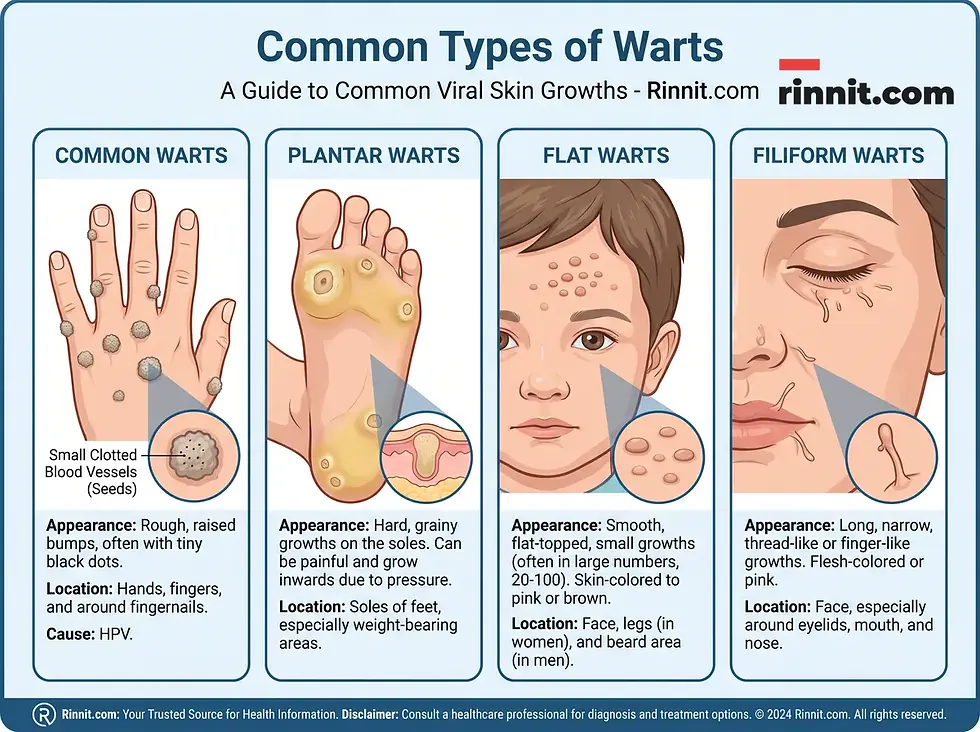
Types of Warts and Their Characteristics
Healthcare providers classify warts based on their appearance, the specific HPV strain involved, and the location on the body.
Type | Medical Name | Typical Location | Key Features |
|---|---|---|---|
Common Warts | Verruca vulgaris | Hands and fingers | Rough bumps, often with black "seed" dots (dead capillaries). |
Plantar Warts | N/A | Soles of feet | Flat or inward-growing; can be painful when walking. [4] |
Flat Warts | N/A | Anywhere on body | Smaller, smoother; often grow in large clusters (20–100). |
Filiform Warts | N/A | Face (mouth, nose) | Long, thread-like growths sticking out from the skin. |
Genital Warts | N/A | Genitals and rectum | Small nodules; a sexually transmitted infection (STI). |
Mosaic Warts | N/A | Balls of feet/toes | Clusters of pinhead-sized white warts; flatter than plantar warts. |
Causes and Transmission
Warts are caused by HPV strains that trigger extra cell growth in the skin's outer layer, causing it to thicken and harden. The virus enters the body through tiny cuts or abrasions.
Warts are highly contagious through:
Direct Contact: Touching someone else's wart or skin-to-skin contact.
Indirect Contact: Sharing personal items like towels, razors, or walking barefoot in communal areas like locker rooms.

Treatment and Management Options
While about 65% of warts resolve on their own within two years in healthy individuals, many people seek treatment to prevent spreading or to alleviate pain.
At-Home and Conservative Treatments
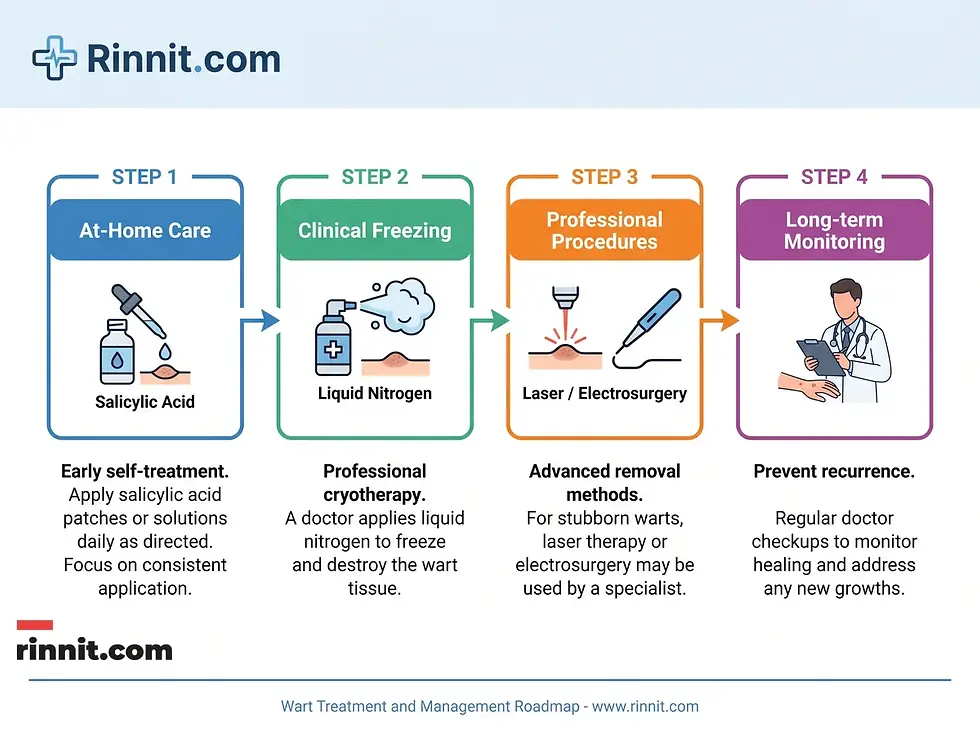
Salicylic Acid: Over-the-counter (OTC) products like Compound W® dissolve the wart layer by layer. This process can take several months.
Cryotherapy: A healthcare provider uses liquid nitrogen to freeze the wart, causing it to eventually peel off.
Professional Medical Procedures
For stubborn or invasive warts, providers may recommend:
Cantharidin: A chemical applied to the wart that forms a blister underneath, cutting off its blood supply.
Immunotherapy: Using chemicals like diphencyprone (DCP) to trigger an immune response against the virus.
Laser Treatment: Using light to destroy the tiny blood vessels inside the wart.
Electrosurgery: Burning the wart tissue with a heated needle.
Complications and Outlook
Most warts heal without significant issues, but complications can occur. Plantar warts can become painful enough to interfere with walking [4], and picking at warts can lead to bacterial infections requiring antibiotics.
The long-term outlook is generally positive, though there is no way to guarantee a wart will not return. Because the virus can remain in the body, new warts may appear in the same or different locations even after successful removal.
If you are immunocompromised, warts are less likely to resolve on their own [4] and require professional medical monitoring.
Frequently Asked Questions
1. Are the black dots in warts actually seeds?
No. The black dots often seen in common or plantar warts are smothered and dead capillaries (tiny blood vessels).
2. Can I cut off a wart at home?
Never attempt to cut or rip a wart yourself. This can lead to severe infection, scarring, and further spreading of the virus.
3. How long does it take for a wart to go away without treatment?
In healthy individuals, about 65% of warts disappear on their own within two years.
4. Is the HPV that causes warts the same as the one that causes cancer?
No. The specific strains of HPV that cause skin warts are generally not the same as the high-risk strains that can lead to cancers like cervical cancer.
5. Why are warts more common in children?
Children often have more frequent skin-to-skin contact and their immune systems are still developing a defense against the various strains of HPV.
6. What are "butcher's warts"?
Butcher's warts are warts that develop on the hands of people who handle raw meat or work in cold, moist environments.
7. Can warts spread to other parts of my body?
Yes. Touching a wart and then touching another area of your skin can spread the virus, a process known as autoinoculation.
8. Are plantar warts different from calluses?
Yes. Plantar warts are caused by a virus and often have black dots, whereas calluses are thickened skin caused by friction or pressure.
9. Does duct tape really work for warts?
Some at-home remedies involve covering the wart with duct tape to irritate the skin and trigger an immune response, but OTC medications are generally more reliable.
10. Can genital warts be prevented?
Genital warts are an STI and can be prevented through safe sex practices and the HPV vaccine.
11. What is cryotherapy?
Cryotherapy is a medical procedure where a doctor uses liquid nitrogen to freeze and destroy the wart tissue.
12. Are flat warts different from other types?
Flat warts are smoother and smaller than common warts and tend to grow in large numbers (up to 100 at a time).
13. What is Heck's disease?
Also known as focal epithelial hyperplasia, it is a rare condition where warts develop inside the mouth.
14. Will a wart leave a scar?
Professional treatments like surgical removal or electrosurgery may leave a scar, while salicylic acid and cryotherapy are less likely to do so.
15. Can I get warts from a swimming pool?
The virus thrives in moist environments. Walking barefoot on pool decks or in communal showers increases the risk of indirect transmission.
Trusted External Resources
American Academy of Dermatology: Warts: FAQs — expert answers on wart identification, contagiousness, and treatment.
Centers for Disease Control and Prevention: About HPV — information on HPV and how it spreads.
Related Reading
Electrosurgery: Types, Uses and Risks explains electrosurgery.
Cryotherapy: Uses, Procedure, Risks and Recovery explains how freezing treatments remove abnormal tissue.
References
Kwok CS, Gibbs S, Bennett C, et al. Topical treatments for cutaneous warts. Cochrane Database Syst Rev. 2012;(9):CD001781. PMID 22972052. https://doi.org/10.1002/14651858.CD001781.pub3
Cockayne S, Curran M, Denby G, et al. EVerT: cryotherapy versus salicylic acid for the treatment of verrucae—a randomised controlled trial. Health Technol Assess. 2011;15(32):1-170. PMID 21899812. https://doi.org/10.3310/hta15320
Bruggink SC, Gussekloo J, Egberts PF, et al. Monochloroacetic acid application is an effective alternative to cryotherapy for common and plantar warts in primary care: a randomized controlled trial. J Invest Dermatol. 2015;135(5):1261-1267. PMID 25584800. https://doi.org/10.1038/jid.2015.1
American Academy of Dermatology Association. Warts: FAQs. American Academy of Dermatology. Last updated May 8, 2025. https://www.aad.org/public/diseases/a-z/warts-overview
Centers for Disease Control and Prevention. About HPV. CDC. Last reviewed July 3, 2024. https://www.cdc.gov/hpv/about/index.html
Medical Disclaimer
This content is for informational purposes only and does not constitute medical advice. Always seek the advice of a physician or other qualified health provider with any questions regarding a medical condition.



Comments