Electrosurgery: Types, Uses and Risks

Updated: 2 days ago
Written and medically reviewed by Dr. Baraa Alnahhal, MD · Last reviewed: November 2026 · How we review
Quick Answer
Electrosurgery uses electricity to cut tissue, destroy growths or stop bleeding by sending current through an electrode, where heat damages the tissue and seals blood vessels. Dermatologists use it to remove skin tags and warts and to treat some skin cancers. You get numbing medicine first. Surface wounds heal in about a week; deeper ones take longer.
What the research says
Electrosurgical cutting reduced blood loss: a review of 14 trials with 2,541 people found cutting with diathermy caused less blood loss and was 36 seconds faster than a scalpel for skin incisions, with no difference in wound complications (Ly J et al., British Journal of Surgery, 2012) [2]
It lowered blood-collection risk in hernia surgery: a review of 9 studies with 830 hernia repair patients found diathermy didn't raise wound infection but lowered blood-collection (hematoma) risk and shortened incision time compared with a scalpel (Hajibandeh S et al., International Journal of Surgery, 2020) [3]
Key takeaways
Electrosurgery uses electricity to cut, destroy or seal tissue.
It removes skin tags, warts and some skin cancers.
There are five main types.
It causes little scarring and stops bleeding fast.
Surface wounds heal in about a week.
What is electrosurgery?
It's used alone or with other treatments. Learn about related techniques like electrocauterization and fulguration. Sources: [1]
What it treats

It's used in many medical specialties.
Basal cell carcinoma and squamous cell carcinoma, using electrodessication and curettage (ED&C).
Cutting and sealing tissue during surgery.
Removing abnormal tissue during endoscopy. Sources: [1]
Types of electrosurgery
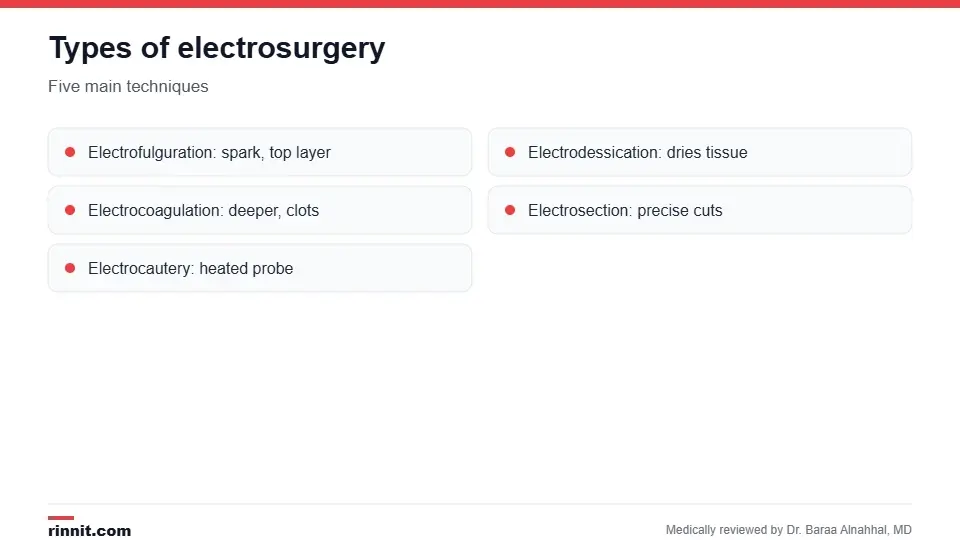
Monopolar and bipolar setups direct the current.
Type | How it works |
Electrofulguration | A spark from just above the skin treats the top layer |
Electrodessication | The electrode touches and dries out tissue |
Electrocoagulation | Reaches deeper layers and promotes clotting |
Electrosection | Makes precise cuts |
Electrocautery | Direct current heats a probe tip |
Monopolar systems use one active electrode and a grounding pad. Bipolar systems use two tips, often on forceps. Sources: [1]
How it works

Providers use the lowest power that works.
You get numbing medicine or anesthesia.
The unit sends current to the active electrode.
Current passes through the tissue, heating it.
It returns through a grounding pad or second tip to the unit. Sources: [1]
Risks
Burns.
Electric shock if not grounded correctly.
Infection.
Bleeding.
Lighter skin at the treated spot.
Interference with pacemakers and defibrillators. Sources: [1]
Tell your provider if you have a pacemaker or defibrillator. Sources: [1]
Benefits
Removes tissue with little damage around it.
Causes little scarring.
Works quickly.
Stops bleeding fast. Sources: [1, 2, 3]
Recovery
Surface skin wounds heal in about one week.
Deeper wounds may take two to four weeks or longer.
Recovery after endoscopy varies. Sources: [1]
When to call your provider
Bleeding that doesn't stop after 20 minutes of direct pressure.
A wound that isn't healing as expected. Sources: [1]
Conclusion
Electrosurgery is a fast, precise way to remove growths and control bleeding with minimal scarring. An experienced provider makes it especially safe.
Keep learning: read about electrocauterization and basal cell carcinoma.
Frequently asked questions
What is electrosurgery?
Using electricity to cut, destroy or seal tissue.
What does it treat?
Skin tags, warts, some skin cancers and bleeding during surgery.
Does it hurt?
No. You get numbing medicine first.
What is ED&C?
Scraping a skin cancer, then destroying remaining cells with electricity.
How well does it treat skin cancer?
ED&C cures basal and squamous cell carcinomas 90% to 95% of the time.
What's the difference between monopolar and bipolar?
Monopolar uses a grounding pad; bipolar uses two tips.
Is electrocautery the same thing?
It's one type, using a heated probe.
Can I have it with a pacemaker?
Tell your provider; it can interfere with devices.
How long does healing take?
About a week for surface wounds.
Will it leave a scar?
Usually little scarring.
Related Reading
Electrocauterization: Uses, Procedure, Risks, and Recovery a related technique.
Fulguration: A Precision Guide to Electrosurgical Tissue Removal spark-based tissue removal.
What Is Basal Cell Carcinoma? Symptoms, Causes, and Treatment a skin cancer it treats.
Skin Tags (Acrochordons): Understanding Common Skin Growths growths it removes.
Warts: Symptoms, Types, and Treatment Options another growth it removes.
References
Cleveland Clinic. Electrosurgery: What Is It, Types & Uses. Cleveland Clinic. Last updated January 10, 2025. https://my.clevelandclinic.org/health/treatments/electrosurgery
Ly J, Mittal A, Windsor J. Systematic review and meta-analysis of cutting diathermy versus scalpel for skin incision. British Journal of Surgery. 2012;99(5):613-620. PMID 22367850. https://doi.org/10.1002/bjs.8708
Hajibandeh S, Hajibandeh S, Maw A. Diathermy versus scalpel for skin incision in patients undergoing open inguinal hernia repair: a systematic review and meta-analysis. International Journal of Surgery. 2020;75:35-43. PMID 31978649. https://doi.org/10.1016/j.ijsu.2020.01.020
Medical disclaimer
This article is for general education only and does not replace advice from a qualified healthcare professional. Talk to your doctor about your own diagnosis and treatment, and seek emergency care right away for severe or sudden symptoms.



Comments