Understanding Fat Freezing: A Non-Surgical Path to Body Contouring

Updated: 2 days ago
Medically reviewed by Dr. Baraa Alnahhal, MD · Last reviewed: October 2026
Source currency note: This guide reflects medical information reviewed in January 2019. Always confirm current guidance with your healthcare professional.
Quick Answer: What is fat freezing, or cryolipolysis?
Fat freezing, or cryolipolysis, is a nonsurgical technique that uses controlled cooling to destroy fat cells in a targeted area, which the immune system then clears over months. Average fat reduction is 15% to 28% about four months later. It suits people near their goal weight with stubborn bulges, not obesity, and needs no downtime. [4]
What the research says
Fat reduction is real but modest. A systematic review of 19 clinical studies found average reductions of 14.67% to 28.5% by caliper measurement and 10.3% to 25.5% by ultrasound, with no significant effect on lipid levels or liver function tests and only mild, short-term side effects such as redness, swelling, and pain (Ingargiola et al., Plastic and Reconstructive Surgery, 2015 [1]).
Complications are uncommon. A systematic review analyzed safety data for 1,445 patients and found complications in 12 (0.82%), most commonly reduced sensation lasting more than 4 weeks. In 295 patients with objective measurements, the mean reduction in subcutaneous tissue was 19.55% at about 3.8 months (Derrick et al., Aesthetic Surgery Journal, 2015 [2]).
Paradoxical adipose hyperplasia is rare but real. A review of 8,658 treatment cycles in 2,114 patients at eight Canadian centers found rates of 0.05% to 0.39% per cycle, higher than the manufacturer’s quoted 0.025%, and rates fell by more than 75% once newer device models were introduced (Nikolis & Enright, Aesthetic Surgery Journal, 2021 [3]).
Understanding cryolipolysis
Cryolipolysis is a specialized body contouring method designed to address localized fat deposits that persist despite healthy lifestyle habits. Unlike traditional weight loss, which shrinks fat cells, this procedure permanently removes them from the body. It is not a treatment for obesity but a refining tool for specific body areas [4].
Targeted body area | Common description |
Submental | Underneath the chin |
Upper arms | “Bat wings” or loose arm fat |
Abdomen | Stomach area |
Flanks | Love handles |
Back | Brassiere rolls and lower back fat |
Thighs | Inner and outer thigh bulges |
Subgluteal | Underneath the buttocks |
The biological process
The procedure relies on the principle that fat cells (adipocytes) are significantly more sensitive to cold than surrounding tissues like skin, nerves, and muscle. When exposed to precise cooling, these cells undergo programmed cell death, known as apoptosis [4].
Cooling phase: The applicator lowers the temperature of the fat layer to a range of 30.2°F to 39.2°F.
Cellular injury: The intense cold damages the structure of the fat cells without harming the overlying skin.
Inflammatory response: The body recognizes the damaged cells and triggers an internal inflammatory process.
Natural elimination: Specialized white blood cells called macrophages gradually digest and remove the dead fat cells and debris.
Permanent removal: Once eliminated, these fat cells do not return, although the remaining cells can still expand if weight is gained.

The procedure experience
Fat freezing is performed in an outpatient setting, and patients stay fully awake throughout the session. The process is generally well tolerated, and many people read, work on a laptop, or rest during treatment [4].
Assessment: A healthcare professional marks the treatment area and applies a protective gel pad to the skin.
Application: The fatty bulge is vacuum-suctioned into the hollow opening of the handheld applicator.
Sensations: Patients typically feel intense cold, tugging, and mild stinging or aching. These sensations usually fade within 5 to 10 minutes as the area becomes numb.
Duration: Each treated area takes up to one hour of cooling.
Post-treatment massage: After the device is removed, the area is massaged for two to three minutes to help break down the frozen fat cells.
Advantages and expected outcomes
Cryolipolysis is a compelling alternative to surgical fat reduction because it is non-invasive and has minimal impact on daily life [4].
Feature | Cryolipolysis benefit |
Incision | None required; no surgical scars |
Anesthesia | None needed; patients remain awake |
Recovery | Immediate return to normal activities |
Safety | Low risk; no danger of surgical infection |
Permanence | Destroyed fat cells are gone for good |
Versatility | Multiple areas can be treated in one session |
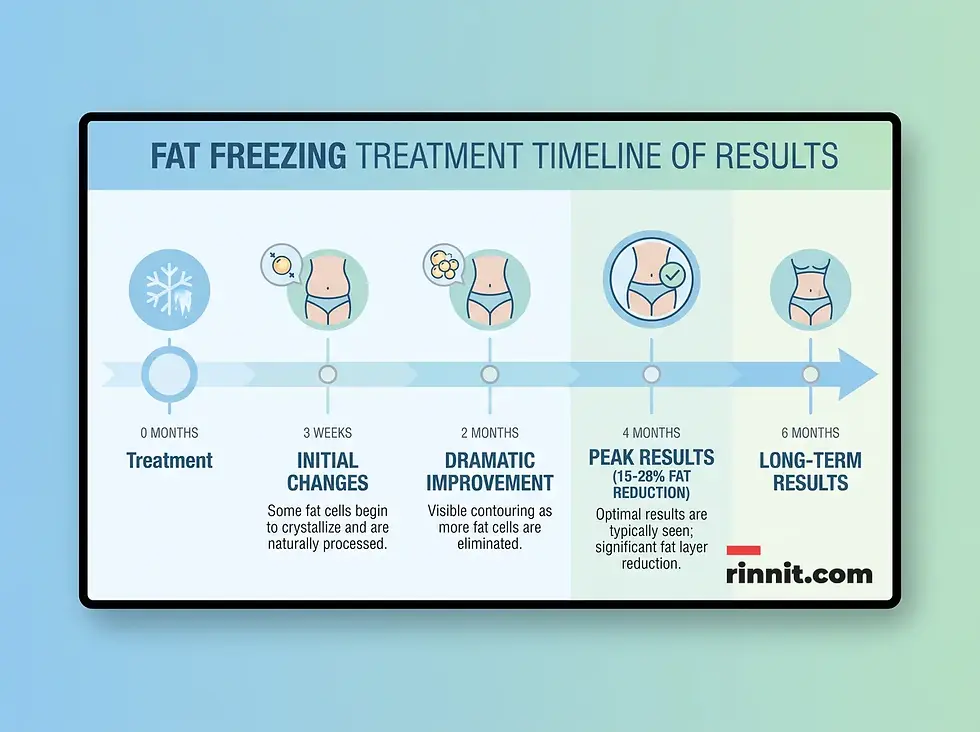
Studies show an average fat reduction of 15% to 28% in the treated area about four months after the first session. Some changes may be visible as early as three weeks, and the most dramatic improvement typically comes around the two-month mark [4].
Risks and considerations
Cryolipolysis is considered very safe, but it is not without potential side effects and contraindications. Temporary symptoms at the treatment site may include redness, swelling, bruising, and localized sensitivity or numbness. These typically resolve within a few days to a few weeks [4].
Rare side effects
A rare but significant complication is paradoxical adipose hyperplasia (PAH), in which the fat cells in the treated area actually increase in size instead of shrinking. It is more common in men and people of Hispanic ethnicity and may require surgical correction [4].
Who should avoid this procedure?
Fat freezing is not suitable for everyone. It should not be performed on skin that is injured or cut, or affected by conditions like dermatitis or severe varicose veins. People with cold-related disorders must also avoid it [4]:
Raynaud’s phenomenon: A condition in which cold severely restricts blood flow to the fingers and toes.
Cryoglobulinemia: A disorder in which blood proteins thicken in response to cold.
Cold urticaria: A condition in which the skin develops hives when exposed to cold.
Paroxysmal cold hemoglobinuria: A rare autoimmune disease triggered by cold.
Cold agglutinin disease: A rare autoimmune hemolytic anemia in which the immune system attacks red blood cells, often triggered or worsened by cold.

Conclusion
Fat freezing offers a reliable, non-surgical way to refine body contours by eliminating stubborn fat. By using the body’s natural response to cold, cryolipolysis permanently removes fat cells with minimal disruption to a busy life. If you have localized fat deposits that have not responded to diet and exercise, talk with a licensed professional to find out whether this procedure is right for your goals.
Frequently Asked Questions
What is fat freezing?
Fat freezing, scientifically known as cryolipolysis, is a nonsurgical fat reduction procedure that uses controlled cooling to target and eliminate localized fat deposits that are resistant to diet and exercise.
How does cryolipolysis work?
The procedure works by cooling fat cells to a temperature that triggers their natural death without harming the surrounding skin or tissue. The body then naturally processes and eliminates these dead cells over several months.
Is fat freezing a weight loss treatment?
No, fat freezing is not a weight loss treatment for obesity. It is a body contouring procedure designed to reduce specific bulges and refine the body’s shape in people who are already near their target weight.
What areas can be treated with fat freezing?
The procedure is FDA-cleared for several areas, including the chin, upper arms, abdomen, flanks (love handles), back, thighs, and the area underneath the buttocks.
How long does a fat freezing session take?
A typical treatment session for one area takes approximately one hour. Multiple areas can often be treated during a single office visit.
When will I see results from fat freezing?
Initial changes may be noticed as early as three weeks after treatment. The most dramatic improvements are typically seen after two months, with final results visible between three and six months.
Are the results of fat freezing permanent?
Yes, the fat cells destroyed during the procedure are permanently removed from the body. However, maintaining a stable weight is essential, as remaining fat cells can still expand if weight is gained.
What does the procedure feel like?
During the first few minutes, you will feel intense cold and a pulling or suction sensation. As the area becomes numb, these sensations typically subside, and the remainder of the procedure is usually comfortable.
Is there any downtime after the procedure?
Most people can resume their normal daily activities, including work and exercise, immediately after a fat freezing session. There are no surgical incisions or recovery periods required.
What are the most common side effects?
Common temporary side effects include redness, swelling, bruising, stinging, and localized numbness or sensitivity in the treated area. These symptoms usually disappear within a few days or weeks.
Related Reading
Liposuction: What It Is, Surgery, Recovery, and Results explains surgical fat removal, recovery and results.
Body Contouring: Surgical vs. Nonsurgical Options, Risks, Recovery and Results describes surgical and nonsurgical ways to reshape the body.
Laser Lipolysis: A Modern Guide to Body Contouring covers laser-based fat reduction and how it compares.
Tummy Tuck (Abdominoplasty): A Guide to Procedure, Recovery, and Results explains surgery that removes loose belly skin and fat.
References
Ingargiola MJ, Motakef S, Chung MT, et al. Cryolipolysis for fat reduction and body contouring: safety and efficacy of current treatment paradigms. Plastic and Reconstructive Surgery. 2015;135(6):1581-1590. PMID 26017594. https://doi.org/10.1097/PRS.0000000000001236
Derrick CD, Shridharani SM, Broyles JM. The safety and efficacy of cryolipolysis: a systematic review of available literature. Aesthetic Surgery Journal. 2015;35(7):830-836. PMID 26038367. https://doi.org/10.1093/asj/sjv039
Nikolis A, Enright KM. A multicenter evaluation of paradoxical adipose hyperplasia following cryolipolysis for fat reduction and body contouring: a review of 8658 cycles in 2114 patients. Aesthetic Surgery Journal. 2021;41(8):932-941. PMID 33216910. https://doi.org/10.1093/asj/sjaa310
Cleveland Clinic. Fat freezing (cryolipolysis). Cleveland Clinic. Medically reviewed January 25, 2019. https://my.clevelandclinic.org/health/treatments/21060-fat-freezing-cryolipolysis
Medical disclaimer
This article was prepared for general information only and is not a substitute for professional medical advice.



Comments