Liposuction: What It Is, Surgery, Recovery, and Results

Updated: 2 days ago
Medically reviewed by Dr. Baraa Alnahhal, MD · Last reviewed: October 2026
Quick Answer
Liposuction is a cosmetic operation that permanently removes fat cells from a chosen body area to smooth its contour. It is not a treatment for weight loss, obesity, cellulite or loose skin. Healthy adults with firm, elastic skin and stubborn localized fat may be candidates. Full healing can take up to six months, and risks include infection, bleeding and scarring. [1]
What the research says
Complications are low overall: According to PubMed, a systematic review and meta-analysis of 39 studies including 29,368 patients (mean age 40.6 years, mean BMI 26.4) found contour deformity was the most common complication at 2.35% (95% CI 1.05 to 5.16). Hyperpigmentation was 1.49%, seroma 0.65%, hematoma 0.27%, infection 0.020%, and venous thromboembolism 0.017%. The authors concluded liposuction is safe with low complication rates. (Comerci et al., Aesthet Surg J, 2024)
Removing very large volumes carries more risk: A meta-analysis of 23 studies (3,583 patients) of large-volume liposuction, with an average of about 7.7 liters removed, found major complications in 3.35% (95% CI 1.07 to 6.84), including blood loss needing transfusion in 2.89% and pulmonary embolism in 0.18%. Minor complications occurred in 11.62%, most often seroma (5.51%). No deaths or fat embolism were reported, but the authors note the evidence lacks high-level trials. (Kanapathy et al., Aesthet Surg J, 2021)
What is liposuction?
Liposuction is a cosmetic fat-removal procedure. It permanently removes fat cells from a selected area and can smooth body contours and address fat deposits that have not responded well to diet and exercise. It is also called lipoplasty or "lipo." It does not remove all body fat, prevent future weight gain, cure obesity, or remove cellulite. [1]
A qualified surgeon must decide whether the procedure is right for you. The decision depends on your health, skin quality, the amount and location of the fat, smoking status, goals, expectations, and your ability to follow recovery instructions. [1]

Liposuction removes localized fat from selected areas to improve contour. It is not a weight-loss procedure.
What can liposuction do, and what can it not do?
Liposuction may | Liposuction does not |
Remove fat cells from a selected area | Treat obesity or work as a full-body weight-loss method |
Improve the contour or smoothness of a body area | Prevent weight gain after surgery |
Address localized fat that has not responded to diet and exercise | Tighten loose, sagging skin by itself |
Leave only small scars in many cases | Remove cellulite, which involves fibrous bands under the skin |
Give a lasting change in the treated area when weight stays stable | Guarantee a particular appearance or remove every fat deposit |
What areas can liposuction treat?
Liposuction can be done wherever there are unwanted fat deposits. Common areas include the abdomen, waist, hips or flanks ("love handles"), back or chest, face, cheeks, chin, neck, buttocks, inner knees, calves, ankles, thighs, and upper arms. [1]
The treatment area matters because it affects the surgical plan, the amount of fat removed, anesthesia needs, and recovery. A consultation should focus on the specific areas rather than a promise of whole-body weight reduction. [1]
Who may be considered for liposuction?
Healthcare professionals look for traits that support a safer and more predictable result. These include average or slightly above-average weight, firm skin with good elasticity, good muscle tone, good general health, localized fat that has not responded well to diet and exercise, nonsmoking status, and realistic expectations. [1]
These are not rules for self-approval. A surgeon needs to review your medical history, skin quality, goals, medicines, allergies, and ability to recover safely before recommending surgery. [1]
Who may not be a good candidate?
Liposuction may be unsuitable or less successful if you are underweight, have a BMI over 25, have a serious condition or one that makes healing difficult, have poor skin quality, or expect an unrealistic result. [1] To understand what a BMI over 25 means, see our guide to overweight and your health.
Liposuction alone cannot fix loose or sagging skin, which is common after major weight loss. In that case a surgeon may discuss excess-skin removal along with liposuction. Age by itself is usually not the deciding factor, although people over 65 may have less firm or elastic skin. People of any sex can have liposuction, and in some men it may be considered for certain types of enlarged male breast tissue. [1]
Why do people consider liposuction?
People may consider liposuction after trying diet and exercise for years while certain areas stay resistant. They may want to smooth a fatty bulge, change how clothes fit, or get a permanent change in the contour of one area. [1]
You also need to be able to set aside time to recover. Plan for about four to six weeks of reduced activity, even though some work and daily activities may resume sooner. [1]
Is liposuction a weight-loss procedure?
No. Liposuction is not a treatment for obesity or excess weight. It removes fat from selected areas, not all of the fat in the body, and it does not prevent future weight gain. While the treatment is permanent, your body can still gain weight afterward. [1] If excess weight is a concern, talk with a healthcare professional about options such as those covered in our guides to obesity and weight loss medications. Liposuction and weight management care address different goals.
What are the types of liposuction?
Different techniques loosen and remove fat in different ways. The technique is chosen based on your treatment goals and the surgeon's assessment. [1]
Technique | How it works |
Tumescent liposuction | The most common type. A saline solution containing medicines is injected into fatty areas, which helps fat removal and reduces blood loss. Other medicines may help with pain. |
Suction-assisted liposuction | A traditional technique that uses a vacuum to remove fat. |
Ultrasound-assisted liposuction | Ultrasonic energy delivered through a metal rod helps liquefy fat before it is removed. |
VASER | A type of ultrasound-assisted technique that uses a grooved cannula and ultrasound waves to help break up and remove fat. |
Power-assisted liposuction | A cannula moves back and forth over the fat to help break it up and make removal more precise. |
Laser-assisted liposuction | Laser light delivered through a small flexible fiber helps break down and liquefy fat. It needs only a small incision. |

Liposuction techniques use different ways to loosen and remove fat. Your surgeon selects the approach.
Which technique is best?
No single technique is best for everyone. Your surgeon should explain which approach fits the area being treated, your goals, your health, and your expected recovery. Ask what the technique involves, why it is recommended, and what alternatives may fit. [1] Related body-contouring options include fat freezing and laser lipolysis.
How do you choose a qualified liposuction surgeon?
Liposuction is performed by a plastic surgeon. At a consultation, ask about specialized training, plastic surgery board certification, experience with the planned technique, hospital privileges, whether you are a candidate, the risks, the likely recovery, and what happens if you are unhappy with the result. [1] Learn more in our guide to the role of a plastic surgeon.
Topic | Questions to bring |
Candidacy | Am I a suitable candidate for this procedure and this treatment area? |
Technique | Which technique do you recommend, and why? |
Experience | What training and experience do you have with this procedure? |
Safety | What complications should I understand before deciding? |
Recovery | When might I work, drive, exercise, and resume normal activities? |
Results | When will swelling decrease, and when should the contour be assessed? |
Alternatives | Would another procedure, such as excess-skin removal, better address my goal? |
Follow-up | How will the surgical site and my recovery be monitored? |
What happens before liposuction?
Before surgery, you and your surgeon discuss your skin type, the most suitable option, expected effectiveness and safety, realistic goals, costs, medical history, allergies, current medicines, and any questions. [1]
Preparation instructions vary. You may be asked to follow diet or alcohol restrictions, take or avoid certain medicines and vitamins, have lab tests, or stop smoking. Follow your treatment team's instructions rather than changing medicines or supplements on your own. [1] Your surgeon should also cover the number and location of treatment areas, the type of anesthesia (see our guide to anesthesia), whether surgery is outpatient, who will drive you home, and what help you may need during the first days of recovery.
What happens during liposuction surgery?
Anesthesia may be local or general. Once it is working, the surgeon makes small incisions and inserts a cannula into the fatty layer between the skin and muscle. The cannula is moved through the area to loosen or liquefy fat, which is then removed with suction or a large syringe. The incisions are closed with dissolvable or non-dissolvable stitches. [1]
The setting depends on the procedure. Some operations are outpatient, while larger-volume fat removal may need a surgery center or hospital and an overnight stay. Someone else must drive you to and from outpatient surgery. How long surgery takes depends on how much fat is removed and how many areas are treated. [1]
Can liposuction be combined with another procedure?
A surgeon may be able to combine liposuction with another cosmetic procedure, such as a facelift, breast reduction, or tummy tuck. Combining procedures can combine healing time, but it can also increase risks, so the decision needs an individual discussion. [1]
What is recovery like?
After surgery, your team explains how to care for the surgical site, which medicines to take, when to come back, and which complications to watch for. Bruising, swelling, and soreness are common signs of healing and generally fade over time. Report severe pain. [1]
You may be advised to wear a compression garment for several weeks to reduce swelling and help your skin adapt to its new contours. Some people temporarily need a drain to remove extra blood or fluid from the incision. Follow your surgeon's specific instructions for garments, activity, and wound care. [1] For information on healing, see our guides to hypertrophic scars and surgical wound infection.
Liposuction recovery timeline
Milestone | What to expect |
First few days | After outpatient surgery, some people can return to work within a few days, depending on the procedure and recovery. |
About two weeks | Many people feel more like themselves around two weeks after surgery. |
Up to six weeks | Returning to regular physical activity such as exercise may take up to six weeks, and the first six weeks may involve reduced activity. |
Three to six months | Swelling and fluid retention continue to decrease, and results become clearer as swelling resolves. |
Up to six months | Complete healing may take up to six months. |
These are general time frames, not promises. The amount of fat removed, the treatment area, the technique, your health, and your body's healing all affect recovery. [1]
Is liposuction painful?
Anesthesia prevents pain during the operation. Afterward, pain, tenderness, or soreness may last a couple of days, and some people describe a burning sensation. Your team may recommend medicine, wraps, or compression garments to help with discomfort and swelling. Do not assume severe or worsening pain is normal. Contact your team if pain is long-lasting, severe, or not improving as expected. [1]
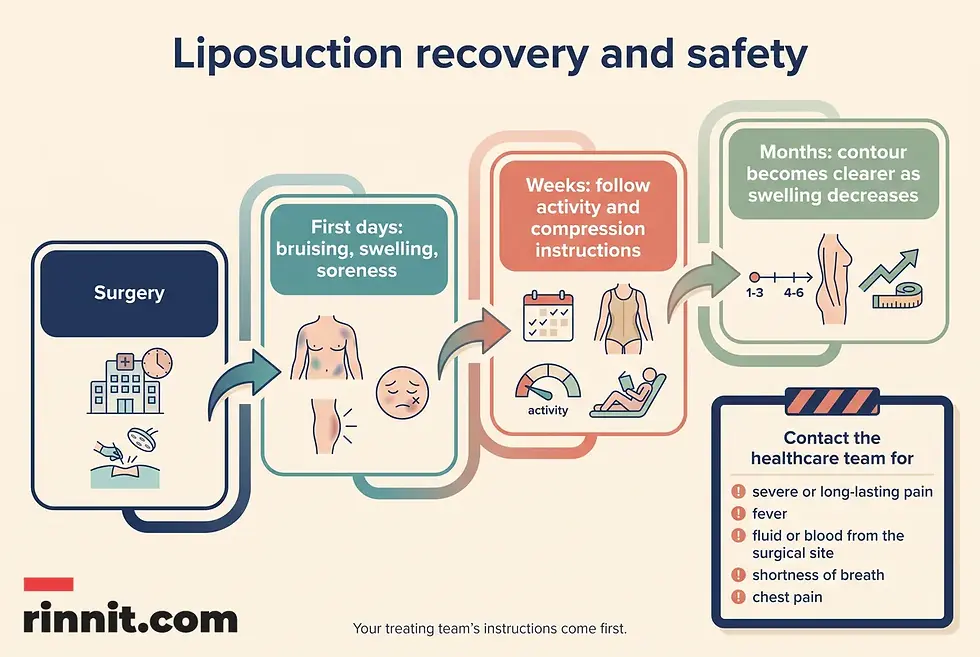
Recovery means following site-care and activity instructions, attending follow-up, and responding to warning signs. Your treating team's instructions come first.
What are the risks and possible complications of liposuction?
Every surgery has risks. Liposuction has a good safety record, and risk is influenced by the size of the treatment area, the amount of fat removed, and the training and experience of the surgeon. Smaller areas mean a shorter procedure with the fewest risks. [1]
Possible issue | What to understand |
Infection | A surgical-site infection may need medical assessment and treatment. |
Skin changes | Discoloration or changes in skin sensation may occur. |
Bruising and swelling | Common during healing, but discuss it if severe or unexpected. |
Poor wound healing | Swelling or poor healing may prolong recovery. |
Pain or discomfort | Pain should improve with healing; long-lasting or severe pain needs a call to your team. |
Scarring | Small scars remain, although many are minimal. |
Bleeding | Bleeding or fluid leaking from the site should be reported. |
Contour deformity | The body contour may be uneven or differ from what you expected. |
When should you contact a healthcare professional after liposuction?
After liposuction, contact your healthcare professional if you have long-lasting or severe pain, swelling, fluid or blood leaking from the surgical site, fever, shortness of breath, or chest pain. [1]
Shortness of breath or chest pain are urgent symptoms. Follow your discharge instructions and use the emergency pathway your treating team gave you if symptoms are severe or quickly getting worse. [1]
Are liposuction results permanent?
Liposuction permanently removes fat cells from treated areas. However, it does not prevent weight gain. If you gain weight afterward, it usually will not be excessive in the area that was treated, but your overall shape can still change. Keeping a stable, healthy weight supports your new contour. [1]
Results are not immediate because swelling and fluid retention hide the final contour. Improvement becomes easier to see as swelling goes down, and complete resolution of swelling may take three to six months. [1]
Does liposuction help with cellulite and loose skin?
Liposuction does not remove cellulite or tighten loose skin, because it removes soft fatty tissue but not the fibrous bands under the skin or sagging skin.
Does liposuction remove cellulite?
No. Liposuction removes soft fatty tissue, while cellulite involves fibrous bands under the skin. Removing fat does not remove those bands, so liposuction is not a cellulite treatment. [1]
Does liposuction tighten loose skin?
No. Liposuction alone cannot improve sagging, loose skin. When loose skin is the main concern, a surgeon may discuss excess-skin removal, sometimes combined with liposuction. [1]
Liposuction versus a tummy tuck
Feature | Liposuction | Tummy tuck |
Main target | Localized fat deposits | Excess abdominal skin and loose abdominal muscles |
Main goal | Improve contour by removing fat cells | Remove excess skin and tighten abdominal muscles |
Weight-loss treatment | No | No |
Loose-skin correction | Not by itself | May be considered when stretched or excess skin is the main concern |
Possible combination | May be combined with a tummy tuck in selected cases | May be combined with liposuction in selected cases |
Read more in our guide to tummy tuck (abdominoplasty). [1]
How much weight can someone lose?
The amount of fat weight removed varies with your goals, the treatment area, and how much fat is removed. Liposuction is not designed to remove all body fat or to reduce overall body weight. A healthcare professional can help you separate two questions: which contour concern do you want to change, and do you need care for excess weight? They may require different plans. [1] If your weight is a concern after major loss, you may also want to read about gastric bypass surgery, a different type of treatment.
Conclusion
Liposuction removes localized fat and improves the contour of selected body areas. It is not a weight-loss treatment, does not remove cellulite, and cannot correct loose skin by itself. The key decision is whether the proposed change, technique, and recovery plan fit your health and goals. Before deciding, schedule a consultation with a qualified plastic surgeon and ask about candidacy, the recommended technique, anesthesia, recovery, risks, alternatives, expected results, and follow-up. If you have already had surgery, contact your treating team for severe or persistent pain, swelling, fever, leaking fluid or blood, shortness of breath, or chest pain. [1] For an overview of other aesthetic procedures, see our guide to cosmetic surgery.
Learn more. Clear visuals help people understand surgery before they decide. Explore the infographic templates in the Rinnit.com marketplace to create professional guides that explain procedures, recovery timelines, and warning signs.
Frequently Asked Questions
Is liposuction safe?
Liposuction has a good safety record, but it is still surgery and carries possible complications, including infection, bleeding, skin changes, poor wound healing, scarring, and contour deformities. Risk depends in part on the treatment area, the amount removed, and the surgeon's training and experience.
How long does liposuction recovery take?
After outpatient surgery, some people return to work within a few days, feel more like themselves in about two weeks, and need up to six weeks before returning to regular physical activity. Complete healing may take up to six months.
When will liposuction results appear?
Your contour improves as swelling and fluid retention decrease. Swelling can take three to six months to go away completely, so early results are not necessarily final.
Will liposuction leave scars?
Yes, but the scars are usually small. Your healthcare team can explain incision care and steps to lower the chance of noticeable scarring or complications.
Can someone gain weight after liposuction?
Yes. Liposuction permanently removes fat cells from treated areas, but it does not prevent future weight gain, and weight changes can affect your overall shape.
Is a second liposuction procedure usually needed?
Most people do not need a second procedure unless they later choose to change their body shape cosmetically. The results are permanent in treated areas, but weight can still change your appearance.
Can liposuction be performed on more than one area?
Yes. Liposuction can treat several areas, and the length and setting of surgery depend on how much fat is removed and how many areas are treated. A surgeon must decide whether a multi-area plan is appropriate and safe for you.
What should I ask before deciding?
Ask whether you are a candidate, which technique is recommended, what risks and complications apply, how long recovery may take, what results are realistic, what alternatives exist, and how follow-up will work.
Is liposuction painful?
Anesthesia prevents pain during the operation. Afterward, soreness or tenderness may last a couple of days, and your team may suggest medicine and compression garments to help.
Does liposuction get rid of cellulite or loose skin?
No. Liposuction removes soft fat but does not remove cellulite or tighten sagging skin. If loose skin is the main concern, ask your surgeon about skin removal surgery.
Related Reading
Monsplasty (Pubic Lift): Surgery, Recovery and Results explains monsplasty (pubic lift) surgery.
Breast Lift (Mastopexy): Incision Types, Recovery and Results explains breast lift surgery and recovery.
Breast Reduction Surgery: Procedure, Recovery and Results explains breast reduction surgery and recovery.
Tummy Tuck (Abdominoplasty): A Guide to Procedure, Recovery, and Results — when skin and muscle, not just fat, are the concern.
Cellulite: What It Is, Why It Happens, and What Actually Works to Reduce It — why liposuction does not treat it.
Laser Lipolysis: A Modern Guide to Body Contouring — a laser-based fat reduction approach.
Understanding Fat Freezing: A Non-Surgical Path to Body Contouring — a nonsurgical alternative.
Understanding the Role of a Plastic Surgeon — training, expertise, and care.
References
Cleveland Clinic. Liposuction: What It Is, Surgery, Recovery & Results. Cleveland Clinic. Last updated October 1, 2022. Accessed October 18, 2026. https://my.clevelandclinic.org/health/treatments/11009-liposuction
Comerci AJ, Arellano JA, Alessandri-Bonetti M, et al. Risks and complications rate in liposuction: a systematic review and meta-analysis. Aesthet Surg J. 2024;44(7):NP454-NP463. PMID 38563572. https://doi.org/10.1093/asj/sjae074
Kanapathy M, Pacifico M, Yassin AM, et al. Safety of large-volume liposuction in aesthetic surgery: a systematic review and meta-analysis. Aesthet Surg J. 2021;41(9):1040-1053. PMID 33252626. https://doi.org/10.1093/asj/sjaa338
Medical disclaimer
This article is for informational purposes only and is not medical advice. Always consult a qualified healthcare professional for diagnosis and treatment decisions.



Comments