Monsplasty (Pubic Lift): Surgery, Recovery and Results

Updated: 2 days ago
Written and medically reviewed by Dr. Baraa Alnahhal, MD · Last reviewed: November 2026 · How we review
Quick Answer
A monsplasty, or pubic lift, is surgery that removes extra skin and fat from the mons pubis, the mound above the pubic bone, to lift, tighten and reshape the area. Extra tissue often comes from aging, pregnancy or major weight loss. Most people go home the same day. Results are usually permanent if your weight stays stable.
What the research says
Monsplasty improved body image and sex life: in a study of 25 people plus 80 earlier cases, patients reported better body image and sexual function, with improved sex life in 48%, genital visualization in 36% and pubic hygiene in 32%, and no major complications (Hamdi M et al., Journal of Plastic, Reconstructive and Aesthetic Surgery, 2023) [2]
Adding monsplasty to a tummy tuck raised satisfaction: in 60 people after massive weight loss, adding monsplasty to a tummy tuck gave higher satisfaction and a better, more stable result, with only 4 minor complications overall (Simone P et al., Journal of Plastic Surgery and Hand Surgery, 2022) [3]
Key takeaways
A monsplasty removes extra skin and fat above the pubic bone.
It can improve comfort, hygiene and confidence.
It's often combined with a tummy tuck or liposuction.
Most people return to desk work in one to two weeks.
Results last if your weight stays stable.
What is a monsplasty?
The mons pubis is the mound in front of the pubic bones, usually covered in pubic hair. A monsplasty is cosmetic surgery, but it may also improve function and comfort. A tummy tuck or liposuction alone doesn't lift the pubic area and can make it look more prominent. Sources: [1]
Why it's done
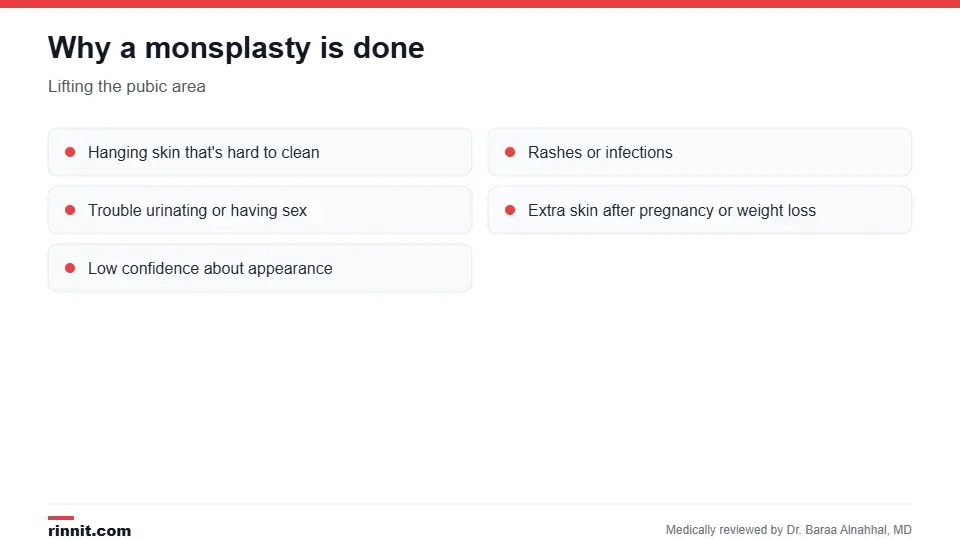
Extra skin can also affect confidence and mood.
Hanging tissue that makes cleaning hard or causes rashes or infections.
Trouble urinating or having sex.
Extra skin from aging, pregnancy or major weight loss.
Stress, anxiety or low confidence from the area's appearance. Sources: [1]
Who's a good candidate
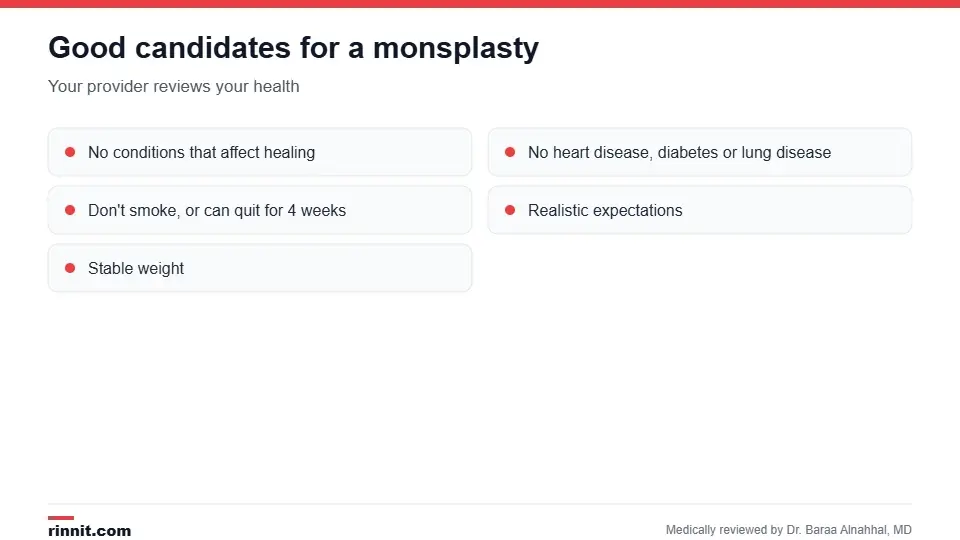
Your provider reviews your health first.
No conditions that affect healing.
No heart disease, diabetes or lung disease.
You don't smoke or can quit for two weeks before and two weeks after surgery.
You have realistic expectations. Sources: [1]
How to prepare
Your provider reviews your health and goals.
Share past surgeries and all medicines and supplements; some raise bleeding risk.
Your provider marks the area while you stand and may take photos. Sources: [1]
What happens during surgery
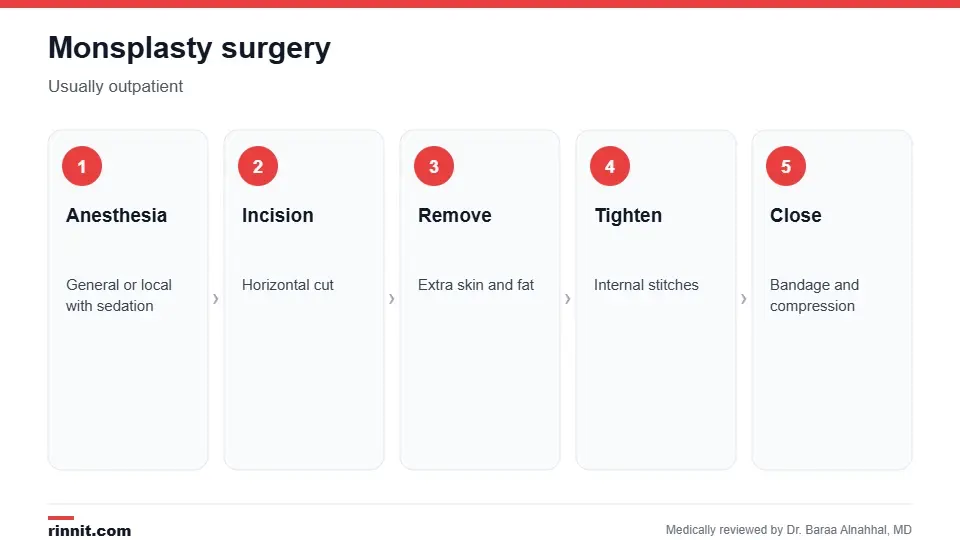
A compression garment may limit swelling.
You get general anesthesia, or local anesthesia with a sedative.
The surgeon makes a horizontal incision.
Extra fat and skin are removed.
Tissues are tightened and shaped with internal stitches.
Small drains may be placed before the incision is closed and bandaged. Sources: [1]
Risks
Healing problems or infection.
Blood or fluid collections (hematoma or seroma).
Numbness or skin discoloration.
Swelling or unfavorable scarring.
Uneven results or skin loosening again. Sources: [1, 3]
Pain and bruising are common, and the incision leaves a scar. The overall risk of complications is relatively low. Sources: [1]
Recovery
Time | What to expect |
First several days | Most painful; swelling, bruising and soreness |
Days 2 to 3 | Start slow, short walks |
Days 5 to 7 | Pain should ease; stitches removed after about a week |
Weeks 1 to 2 | Swelling eases; desk work and light activities |
Weeks 4 to 6 | Return to regular exercise |
Someone must drive you home and stay with you for at least 24 hours. The incision may take eight weeks or more to fully heal. Sources: [1]
Outlook
Most people like their results, which are often permanent if your weight stays stable. Benefits include better confidence, comfort and hygiene. A monsplasty won't flatten your stomach. Sources: [1, 2]
When to call your provider
Get help right away for shortness of breath, chest pain or an irregular heartbeat. Keep all follow-up visits. Sources: [1]
Conclusion
A monsplasty can lift and tighten the pubic area, improving comfort and confidence. Combining it with other body contouring and keeping a stable weight helps you get lasting results.
Keep learning: read about tummy tucks and liposuction.
Frequently asked questions
What is a monsplasty?
Surgery that removes extra skin and fat from the pubic mound.
What is it also called?
A pubic lift.
Can men have a monsplasty?
Yes.
Does a tummy tuck lift the pubic area?
No. A monsplasty may be added for that.
Is it outpatient surgery?
Usually, unless it's combined with other procedures.
When can I go back to work?
About two weeks, or longer for physical jobs.
When can I exercise?
After about four to six weeks.
Will there be a scar?
Yes, but your surgeon tries to keep it small.
Are results permanent?
Often, if your weight stays stable.
Who shouldn't have a monsplasty?
People with conditions that affect healing, or who can't stop smoking.
Related Reading
Tummy Tuck (Abdominoplasty): A Guide to Procedure, Recovery, and Results a common combined procedure.
Liposuction: What It Is, Surgery, Recovery, and Results fat removal surgery.
Tummy Tuck Scar: Types, Healing Timeline, and How to Treat It caring for surgical scars.
Bariatric Surgery: Types, Requirements, Risks, and Recovery weight loss that can leave extra skin.
Breast Reduction Scars: Healing Timeline, Types and Treatment healing after plastic surgery.
References
Cleveland Clinic. Monsplasty (Pubic Lift): Surgery, Recovery & Scars. Cleveland Clinic. Last updated June 28, 2022. https://my.clevelandclinic.org/health/treatments/23372-monsplasty
Hamdi M, Waked K, Deleuze J, et al. The monsplasty: surgical and functional outcomes using an effective and reproducible surgical technique. Journal of Plastic, Reconstructive and Aesthetic Surgery. 2023;84:287-294. PMID 37385140. https://doi.org/10.1016/j.bjps.2023.06.007
Simone P, Savani L, Marchica P, et al. Puboplasty as an integral step in massive weight loss abdominal contouring: a retrospective assessment of results, stability, and patients' satisfaction. Journal of Plastic Surgery and Hand Surgery. 2022;56(6):387-395. PMID 35400280. https://doi.org/10.1080/2000656X.2022.2061500
Medical disclaimer
This article is for general education only and does not replace advice from a qualified healthcare professional. Talk to your doctor about your own diagnosis and treatment, and seek emergency care right away for severe or sudden symptoms.



Comments