Tummy Tuck Scar: Types, Healing Timeline, and How to Treat It

Updated: 6 days ago
Written and medically reviewed by Dr. Baraa Alnahhal, MD · Last reviewed: October 2026 · How we review
Quick Answer: What is a tummy tuck scar?
A tummy tuck scar is the healed line left where the belly was cut and closed during a tummy tuck (abdominoplasty). It is usually thin and may be raised, recessed, pink or lighter than nearby skin. It can't be fully prevented, but wound care, sun protection and treatments like silicone, injections, laser or revision surgery can soften its look. [1]
What the research says
Raised scars after a tummy tuck are uncommon. A meta-analysis that pooled 10 studies with 1,533 patients found hypertrophic (raised) scars in about 2.4% of patients, and 98.2% of patients across the included studies were pleased with their surgery. (Ibrahim et al., Aesthetic Plastic Surgery, 2026) [2]
Silicone gel helps fresh surgical scars settle. In a meta-analysis of 6 randomized trials with 375 patients, topical silicone gel lowered scar color, height and stiffness scores compared with placebo or no treatment, and worked about as well as silicone gel sheets. (Wang et al., International Wound Journal, 2020) [3]
Skin glue over mesh tape may cut wound problems. Across 12 studies of operations including abdominoplasty, breast and joint surgery, closing the skin with glue over a mesh strip lowered infection rates (1.51% vs 2.13%) and delayed healing (0.99% vs 1.79%) compared with standard stitches, staples or glue alone, and the three studies that rated scar appearance reported better results. (Kulkarni et al., Journal of Wound Care, 2025) [4]
Key takeaways
Every tummy tuck leaves a scar; its size and position depend on the type of surgery. [1]
A full tummy tuck scar runs from hip bone to hip bone; a mini tummy tuck scar is about 3 to 6 inches long. [1]
Stopping smoking, managing conditions like diabetes, and reviewing medicines before surgery all support better healing. [1]
Sun protection with SPF 30 for 12 to 18 months helps keep the scar from darkening or thickening. [1]
Steroid injections, laser resurfacing, and scar revision surgery are mostly kept for raised, thick, or keloid scars. [1]
What is a tummy tuck scar?
A tummy tuck scar is the mark that forms where your skin heals after a tummy tuck, the surgery that removes excess skin and fat from the belly. [1] If you're new to the procedure itself, start with our complete tummy tuck guide.
The scar is usually thin. It may sit slightly raised or slightly sunken, and its color can be a little pink or lighter than the skin around it. [1]
What are the different types of tummy tuck scars?
The type of tummy tuck you have decides how long your scar is and where it sits. [1]
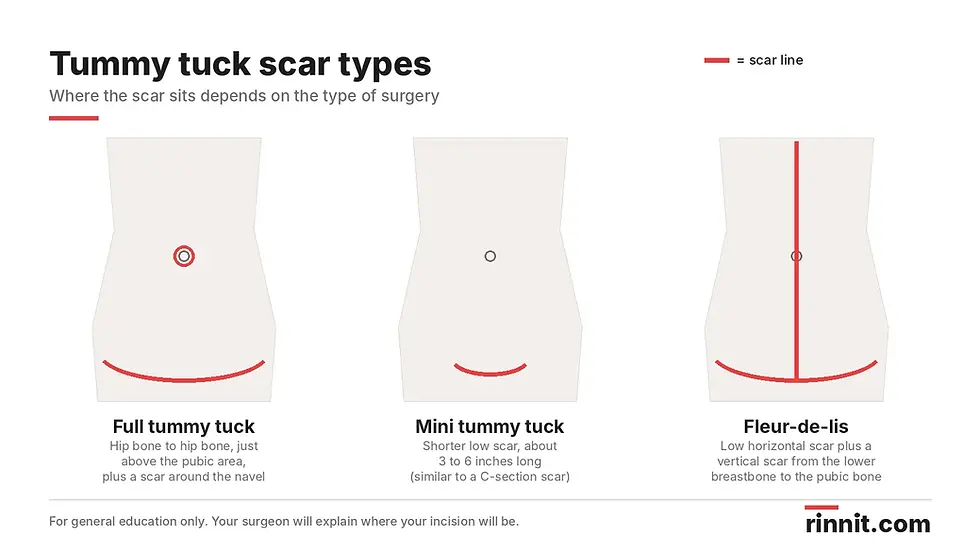
Tummy tuck type | Who it's usually for | Where the scar sits | Typical length |
Full (standard) | Most people having abdominoplasty | Across the lower belly, hip bone to hip bone, just above the pubic area, often with a second scar around the belly button | Hip to hip |
Mini | A small amount of excess fat and tissue below the belly button | Low on the belly, similar to a C-section scar | About 3–6 inches (roughly 8–15 cm) |
Fleur-de-lis | A large amount of loose skin after major weight loss or several pregnancies | A horizontal scar across the belly plus a vertical scar from the lower breastbone to the pubic bone | Two scars |
Source: [1]
Right after surgery, your surgeon will likely cover the incision with special glue, tape, or bandages. These dressings hold the skin edges together and keep the wound moist, which can reduce scarring. [1]
Can you prevent a tummy tuck scar?
A tummy tuck scar can't be prevented completely, but steps taken before surgery help the incision heal well and can make the scar less noticeable. [1]
Step before surgery | Why it matters |
Review corticosteroid medicines with your provider | Some corticosteroids slow wound healing. |
Get chronic conditions under control | Conditions such as diabetes can complicate wound healing. |
Stop smoking several months ahead | Quitting early helps the surgical wound heal. See our guide to nicotine replacement therapy. |
Ask about vitamin A | Your provider may suggest vitamin A in the weeks and months before surgery to speed healing — but check first, as it can interact with other medicines. |
Source: [1]
How can you minimize a tummy tuck scar while the incision heals?
Careful wound care, gentle massage, sun protection, and good nutrition are the main ways to help a tummy tuck incision heal into a softer scar. [1]
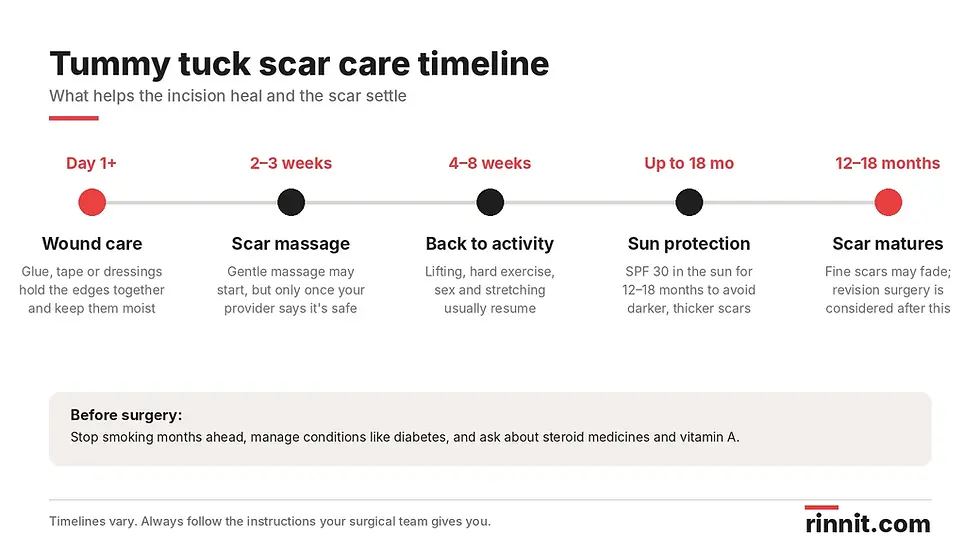
Follow your wound-care instructions
Clean and care for the incision exactly as your surgical team explains. Hold off on heavy lifting, hard exercise, sex, and stretching until your provider clears you — usually four to eight weeks after surgery. [1]
Use the topical products your provider recommends
Your provider may suggest one or more of these on the healing wound: [1]
Antibiotic ointment
Cocoa butter
Petroleum jelly
Scar cream
Silicone gel sheets
Vitamin D
Vitamin E
Try scar massage once you're cleared
About 2 to 3 weeks after surgery, gentle scar massage may help. Massaging the scar and nearby skin boosts blood flow and can break up some tougher scar tissue. Ask your provider before you start. [1]
Keep the scar out of the sun
Ultraviolet light can discolor a healing scar and make it thicker. For 12 to 18 months after your tummy tuck, wear sunscreen with SPF 30 whenever you're in the sun. [1]
Eat for healing
Good nutrition supports wound repair. A provider or registered dietitian can help you get the vitamins and minerals you need and may suggest a daily multivitamin. [1]
Which treatments can improve a tummy tuck scar?
Steroid injections, laser skin resurfacing, and scar revision surgery can improve a tummy tuck scar, and they are mostly used for scars that heal thick, raised, or red. [1]

Treatment | How it works | When it's used | Possible downsides |
Topical care | Ointments, creams, and silicone gel sheets applied to the wound | Fresh incisions and routine scar care | Few significant risks |
Steroid injections | Reduce inflammation in a thick, raised, or red scar | Mostly abnormal scars; some providers inject at surgery or a few weeks after, others wait until the scar forms | Few significant risks |
Laser skin resurfacing | Light or heat prompts new skin cells to grow | Mostly abnormal scars | Swelling, blistering, redness |
Scar revision surgery | The surgeon cuts out the scar and closes the wound with stitches | Hypertrophic or keloid scars, usually 12–18 months after surgery | Infection, bleeding, more scarring |
Source: [1]
Steroid injections
Steroid injections can make a thick, raised, or red tummy tuck scar less noticeable. Most providers save them for abnormal scarring, though some give them during surgery or a few weeks later to calm inflammation. [1]
Laser skin resurfacing
Laser resurfacing uses light or heat to stimulate new skin growth. Beyond improving appearance, it may: [1]
Loosen a tight scar so the skin moves more freely
Help stop a scar from becoming raised
Ease itching, pain, and irritation around the scar
Scar revision surgery
Scar revision surgery removes a problem scar and re-closes the skin with stitches. It is mainly for hypertrophic scars and keloids (see our guide to keloids). [1]
Most people need to wait 12 to 18 months after their tummy tuck. By then the scar is close to its final look, and the skin has relaxed enough to take tension off the scar. [1] Read more in our scar revision guide or this plastic surgeons' overview of scar revision. [5]
What are the benefits and risks of tummy tuck scar treatment?
Tummy tuck scar treatment can make the skin around a scar more elastic, reduce redness or discoloration, and smooth the scar's texture. [1]
Most scar treatments carry few significant risks. Laser resurfacing can cause swelling, blistering, and redness, and surgical scar revision can lead to infection, bleeding, or extra scarring. [1]
How long does a tummy tuck scar take to fade?
A small or fine tummy tuck scar may fade completely after about a year, but most people will still have a visible scar. [1] By 12 to 18 months after surgery, the scar is about as good as it will get, which is why sun protection lasts that long and revision surgery waits until then. [1]
When should you call your doctor about a tummy tuck incision?
Contact your healthcare provider promptly if your tummy tuck incision is: [1]
Bleeding
Infected — pus or foul-smelling drainage from the wound
Swollen
Very painful
Pus or foul-smelling drainage points to a surgical wound infection, which needs prompt treatment.
Conclusion
A tummy tuck scar is a normal, expected part of abdominoplasty. Its size and location depend on whether you have a full, mini, or fleur-de-lis procedure. [1]
You can't avoid the scar, but you can shape how it heals. Prepare your body before surgery, follow your wound-care plan, protect the scar from the sun, and ask about massage and topical care at the right time. If the scar heals thick, raised, or red, injections, laser, or revision surgery can help. [1]
Planning a tummy tuck or living with a scar that bothers you? Bring this guide to your consultation and ask your surgeon which scar type to expect and what aftercare plan fits you. For more clear, doctor-reviewed guides, explore our tummy tuck guide, scar revision guide, and the rest of our health library, and follow us on Instagram and YouTube for new articles.
FAQ
How long does a tummy tuck scar take to fade?
A small or fine tummy tuck scar may fade completely after about a year, though most people still have a visible scar. By 12 to 18 months after surgery, the scar is close to its final look. [1]
Where is a tummy tuck scar located?
A full tummy tuck scar runs across the lower belly from hip bone to hip bone, just above the pubic area, often with a second scar around the belly button. A mini tummy tuck leaves a shorter low scar, and a fleur-de-lis tummy tuck adds a vertical scar from the lower breastbone to the pubic bone. [1]
Can you avoid a tummy tuck scar completely?
A tummy tuck scar can't be avoided completely. Quitting smoking, managing conditions like diabetes, reviewing steroid medicines, and careful wound care can help it heal less noticeably. [1]
When can I start massaging my tummy tuck scar?
Tummy tuck scar massage usually starts about 2 to 3 weeks after surgery. Gentle massage boosts blood flow and can break up tougher scar tissue, but ask your provider before starting. [1]
Does sun exposure make a tummy tuck scar worse?
Sun exposure can make a tummy tuck scar worse by discoloring it or making it thicker. Wear sunscreen with SPF 30 in the sun for 12 to 18 months after surgery. [1]
Does silicone help tummy tuck scars?
Silicone gel sheets are one of the topical treatments providers may recommend for a healing tummy tuck incision. In a review of 6 randomized trials, silicone gel improved scar color, height, and stiffness compared with placebo or no treatment. [1][3]
When can a tummy tuck scar be revised?
Tummy tuck scar revision is usually done 12 to 18 months after surgery. By then the scar is close to its final appearance and the skin has relaxed, taking tension off the scar. [1]
What are the warning signs of an infected tummy tuck incision?
Warning signs of an infected tummy tuck incision include pus or foul-smelling drainage, bleeding, swelling, and severe pain. Contact your healthcare provider promptly if you notice any of these. [1]
Why is my tummy tuck scar red and raised?
Redness and slight raising are normal in the first months as the scar heals, and they usually fade over time. See your provider if the scar keeps getting thicker, itchy or painful, which can be a sign of a raised scar or keloid.
Can you get a tattoo over a tummy tuck scar?
Wait until the scar is fully mature, usually at least a year after surgery, and ask your surgeon first. Tattooing a healing scar can irritate it and give uneven results.
Related Reading
Monsplasty (Pubic Lift): Surgery, Recovery and Results explains monsplasty (pubic lift) surgery.
Breast Reduction Scars: Healing Timeline, Types and Treatment explains how breast reduction scars heal.
References
Cleveland Clinic. Tummy Tuck Scar: Healing, Treatment & Revision. Cleveland Clinic. Last updated August 16, 2022. https://my.clevelandclinic.org/health/treatments/24004-tummy-tuck-scar
Ibrahim AS, Zayid TEB, Nasef MA. Stigmata of Stigmata of Abdominoplasty: A Systematic Review and Meta-Analysis. Aesthetic Plast Surg. 2026;50(17):7239-7247. PMID 42509279. https://doi.org/10.1007/s00266-026-05962-5
Wang F, Li X, Wang X, et al. Efficacy of topical silicone gel in scar management: A systematic review and meta-analysis of randomised controlled trials. Int Wound J. 2020;17(3):765-773. PMID 32119763. https://doi.org/10.1111/iwj.13337
Kulkarni S, Goodbun M, Chowdhury M, et al. Dermabond Prineo: a systematic review and meta-analysis. J Wound Care. 2025;34(3):220-226. PMID 40047817. https://doi.org/10.12968/jowc.2023.0024
American Society of Plastic Surgeons. Scar Revision. American Society of Plastic Surgeons. Accessed October 31, 2026. https://www.plasticsurgery.org/reconstructive-procedures/scar-revision
Medical disclaimer
This article is for general education only and is not medical advice, a diagnosis, or a treatment plan. Always follow the instructions of your surgeon or healthcare provider, and seek prompt care if your incision shows signs of infection or another complication.



Comments