Breast Reduction Scars: Healing Timeline, Types and Treatment

Updated: 2 days ago
Written and medically reviewed by Dr. Baraa Alnahhal, MD · Last reviewed: November 2026 · How we review
Quick Answer
Breast reduction scars are the marks left as the body heals the incisions from breast reduction surgery. Most are thin lines lighter or darker than the surrounding skin. They start red to purple and slightly raised, soften by six months and keep fading over a year or more. They don't disappear completely but can become barely noticeable.
What the research says
Problem scars were uncommon after L-scar breast surgery: in 12 studies of 3,130 patients having L-scar breast surgery, including reductions, thick (hypertrophic) scars occurred in 1.7%, wound splitting in 1.8% and dog-ear deformity in 5%, and 92% of patients were satisfied (Machado Magalhães PL et al., Aesthetic Plastic Surgery, 2026) [2]
Reducing skin tension helped incisions heal: in a randomized trial of 34 women after anchor-pattern breast reduction, 8 weeks of a tension-offloading device cut wound splitting at the T-junction to 1 breast versus 11 with standard closure (Panton J et al., Aesthetic Surgery Journal, 2023) [3]
Key takeaways
Breast reduction always leaves some scarring.
Lollipop and anchor techniques leave different scar patterns.
Scars fade over a year or more but don't vanish.
Silicone, massage and sun protection help scars heal.
Smoking makes scarring worse.
What are breast reduction scars?
During a breast reduction, the surgeon removes tissue, reshapes the breast and closes the incisions. Scar tissue forms as the incisions heal. Surgeons try to hide incision lines, but they can't prevent all scarring. Sources: [1]
Types of scars
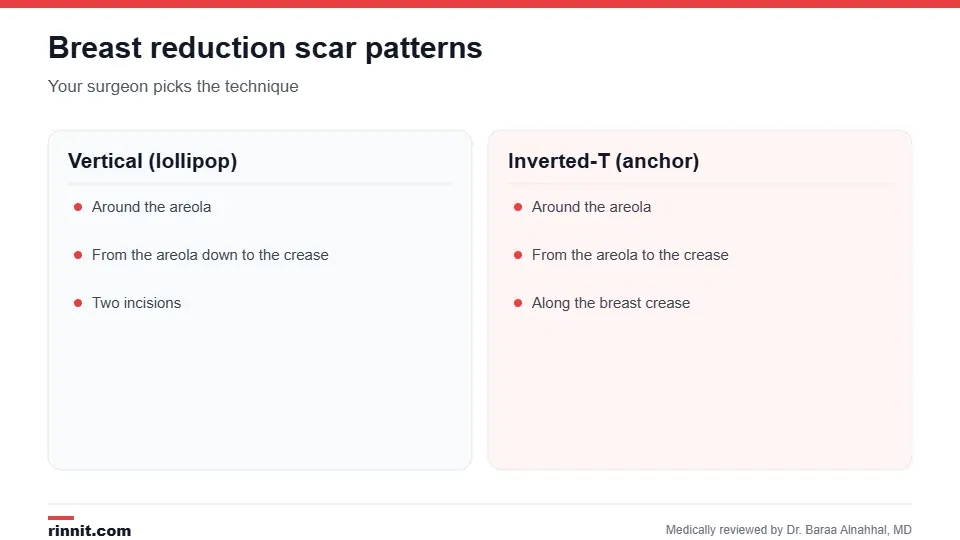
Your surgeon chooses based on your breast size, shape and goals.
Technique | Incisions |
Vertical (lollipop) | Around the areola and from the areola to the breast crease |
Inverted-T (anchor) | Around the areola, from the areola to the crease and along the crease |
Scars can be pink, red, purple, gray or dark brown. Raised scars include keloids, which grow beyond the incision and are more common with darker skin tones, and hypertrophic scars, which appear one to two months after surgery and stay within the incision. Sources: [1]
How scars heal over time
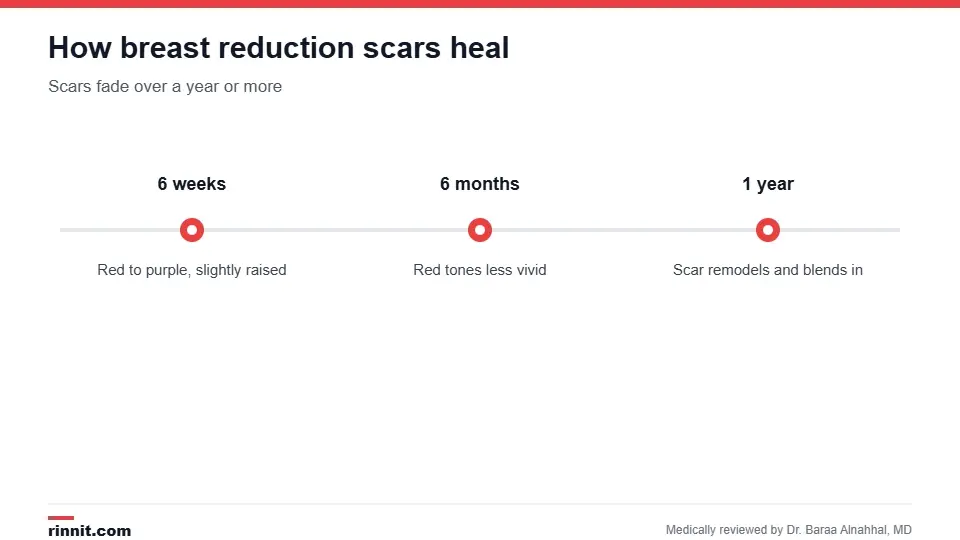
Scars may stay visible for months to years.
Time | What to expect |
Six weeks | Bandage likely; scar red to purple and slightly raised |
Six months | Bandage usually off; red tones less vivid |
One year | Scar remodels and begins to blend in |
Sources: [1]
How to care for scars

Not smoking helps your incisions heal.
Wear a surgical bra or bandages as directed.
Keep the area clean and don't scratch.
Protect scars from the sun with SPF 30 or higher or clothing.
Start scar massage, usually a few weeks after surgery, once your surgeon approves.
Quit smoking, which impairs healing and worsens scarring. Sources: [1, 3]
Scar treatments
Silicone creams, ointments or gel sheets.
Cryotherapy.
Corticosteroid injections for keloids.
Scar massage.
Surgical scar revision, which isn't for everyone. Sources: [1]
There isn't enough evidence that vitamin E oil works. Sources: [1]
Risks of scar treatment
Treatments can cause skin discoloration, scar regrowth, itching, peeling skin, injection-site pain or numbness. Sources: [1]
Outlook
Breast reduction scars don't disappear completely, but they can fade until they're barely noticeable and easy to hide under clothing, including a bikini. Sources: [1, 2]
When to call your provider
Scars that bleed, ooze, swell or turn red.
Numbness or loss of feeling.
An incision that opens or splits.
Scars that are painful, itchy or sensitive. Sources: [1]
Conclusion
Breast reduction scars are a normal part of healing and fade a lot over the first year. Good scar care, sun protection and not smoking help them become as faint as possible.
Keep learning: read about breast reduction and hypertrophic scars.
Frequently asked questions
Does breast reduction leave scars?
Yes, every breast reduction leaves some scarring.
What does a lollipop scar look like?
A scar around the areola and down to the breast crease.
What is an anchor scar?
A lollipop scar plus a scar along the breast crease.
How long do scars take to fade?
They keep fading over a year or more.
Will my scars go away completely?
No, but they can become barely noticeable.
When can I start scar massage?
Usually a few weeks after surgery, once your surgeon approves.
Does silicone help scars?
Silicone gels and sheets are a common scar treatment.
Does vitamin E help?
There isn't enough evidence that it works.
What is a keloid?
A raised scar that grows beyond the incision.
Does smoking affect scars?
Yes. It slows healing and worsens scarring.
Related Reading
Monsplasty (Pubic Lift): Surgery, Recovery and Results explains monsplasty (pubic lift) surgery.
Breast Reduction Surgery: Procedure, Recovery and Results the surgery that causes these scars.
Scar Revision: Improving Skin Appearance and Comfort surgery to improve scars.
Laser Skin Resurfacing: Types, Benefits, Risks, Recovery and Results a laser treatment for scars.
Tummy Tuck Scar: Types, Healing Timeline, and How to Treat It healing another surgical scar.
References
Cleveland Clinic. Breast Reduction Scars: Healing, Appearance & Treatment. Cleveland Clinic. Last updated March 2, 2023. https://my.clevelandclinic.org/health/treatments/24782-breast-reduction-scars
Machado Magalhães PL, Collaco BG, Guerreiro MG, et al. Efficacy and safety of the L-scar technique in breast surgery: a systematic review and meta-analysis. Aesthetic Plast Surg. 2026;50(13):5028-5040. PMID 42115413. https://doi.org/10.1007/s00266-026-05869-1
Panton J, Vingan N, Barillas J, et al. Postoperative mechanomodulation decreases T-junction dehiscence after reduction mammaplasty: early scar analysis from a randomized controlled trial. Aesthet Surg J. 2023;43(12):NP1033-NP1048. PMID 37606245. https://doi.org/10.1093/asj/sjad269
Medical disclaimer
This article is for general education only and does not replace advice from a qualified healthcare professional. Talk to your doctor about your own diagnosis and treatment, and seek emergency care right away for severe or sudden symptoms.



Comments