Bariatric Surgery: Types, Requirements, Risks, and Recovery

Updated: 3 days ago
Written and medically reviewed by Dr. Baraa Alnahhal, MD · Last reviewed: October 2026 · How we review
Quick Answer
Bariatric surgery is an obesity treatment that changes the digestive system so the stomach holds less food, the body absorbs fewer calories and fewer hunger signals reach the brain. Current guidelines recommend it for a BMI of 35 or higher, and it can be considered from a BMI of 30 with conditions such as type 2 diabetes. [1]
What the research says
Surgery was linked to a longer life. A pooled analysis of 17 studies with 174,772 adults found bariatric surgery cut the death rate by 49.2% compared with usual care. Median life expectancy was 6.1 years longer: 9.3 years for people with diabetes and 5.1 years for people without it. (Syn et al., Lancet, 2021) [2]
Sleeve and bypass both gave lasting weight loss at 10 years. In a randomized trial of 240 adults, people lost a median 43.5% of their excess weight after sleeve gastrectomy and 50.7% after gastric bypass. Reflux-related inflammation of the esophagus was more common after the sleeve (31% vs 7%). (Salminen et al., JAMA Surgery, 2022) [3]
Long-term nutrient deficiencies were uncommon with follow-up. Ten years after surgery in the same trial, vitamin D insufficiency affected 11% of people in both groups. Iron deficiency was less common after the sleeve (14%) than after bypass (41%). (Saarinen et al., British Journal of Surgery, 2025) [4]
Key takeaways
Bariatric surgery is a treatment for class III obesity when other weight loss methods haven't worked.
It works in two ways: it limits food intake and lowers hunger hormones.
Most people lose a large share of their excess weight; in one 10-year trial, people kept off a median of about 44% to 51% of it.
It is not a quick fix. You'll prepare beforehand and make lifelong changes afterward.
You'll need follow-up visits and blood tests for at least the first year.
What is bariatric surgery?
Bariatric surgery is an operation that treats obesity by changing how your body digests food. [1]
Your healthcare provider may recommend it if diet, exercise or other weight loss methods haven't worked for you. They may also suggest it if you have a high risk of obesity-related complications.
The surgery changes how your body digests food. These changes:
Limit how many calories your body can take in and absorb
Reduce the hunger signals that travel from your gut to your brain
Help your body keep the weight off when you eat well and stay active
It is not an easy way out. It takes planning and commitment. But for many people, it leads to lasting results.
If you're still exploring options, you can also read about weight loss medications and the nonsurgical intragastric balloon.
Who qualifies for bariatric surgery?
Under current guidelines, you may qualify for bariatric surgery if your BMI is 35 or higher, or 30 to 34.9 with a condition such as type 2 diabetes; some insurers still use older, stricter rules. [1]
The main requirement is a diagnosis of class III obesity. Doctors use your body mass index (BMI) to check this. BMI estimates body fat from your height and weight.
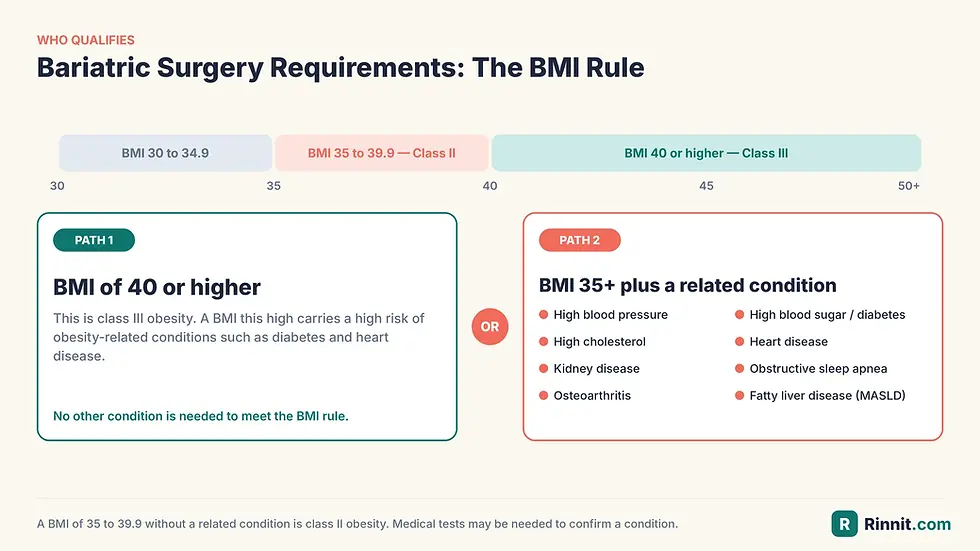
Your BMI | Health conditions | Meets the BMI requirement? |
|---|---|---|
40 or higher | Not required | ✅ Yes, class III obesity |
35 to 39.9 | At least one obesity-related condition | ✅ Yes |
35 to 39.9 | None | ✅ Yes under current guidelines (some insurers still require a condition) |
BMI isn't perfect. But it's currently the best tool to predict weight-related health problems. Your provider may order medical tests to confirm any related conditions.
Which health conditions can bariatric surgery improve?
Obesity-linked conditions whose symptoms can improve a lot after bariatric surgery and weight loss include high cholesterol, high blood pressure, diabetes, heart disease and sleep apnea. [1]
High cholesterol
High blood pressure
High blood sugar and diabetes
Heart disease
Kidney disease
Obstructive sleep apnea
Osteoarthritis
Metabolic dysfunction-associated steatotic liver disease (MASLD)
What are the 4 main types of bariatric surgery?
The four main types of bariatric surgery are sleeve gastrectomy, Roux-en-Y gastric bypass, duodenal switch (BPD/DS) and SADI-S. [1] [5]
Your surgeon will recommend the best type for you. They'll consider your BMI, your other health conditions and the risks of each procedure.

Type | What happens to the stomach | What happens to the intestine | Main effect |
|---|---|---|---|
Sleeve gastrectomy | About 75% removed, leaving a banana-sized tube | Not rerouted | Stomach holds much less food |
Roux-en-Y gastric bypass | A small pouch is made | Pouch connects to the lower small intestine | You feel full faster |
Duodenal switch (BPD/DS) | Sleeve gastrectomy | Most of the small intestine is bypassed | Less food, fewer hunger hormones, fewer nutrients absorbed |
SADI-S | Sleeve gastrectomy | About half of the small intestine is bypassed | Like BPD/DS, but more nutrients are absorbed |
Sleeve gastrectomy
Sleeve gastrectomy is the most common type of bariatric surgery. The surgeon removes about 75% of your stomach. What's left is a narrow tube, or "sleeve," about the size of a banana. Your stomach can now hold much less food. [1]
Roux-en-Y gastric bypass
Roux-en-Y gastric bypass is another common type. The surgeon makes a small pouch at the top of your stomach and connects it to the lower part of your small intestine. Food skips the rest of your stomach, so you feel full sooner. Learn more in our gastric bypass surgery guide and our article on the mini gastric bypass.
Biliopancreatic diversion with duodenal switch (BPD/DS)
Biliopancreatic diversion with duodenal switch combines a sleeve gastrectomy with an intestinal bypass that goes around most of the small intestine. It lowers hunger hormones and limits how much food your stomach holds. It also limits how many nutrients your intestine can absorb. [6]
SADI-S (single anastomosis duodeno-ileal bypass with sleeve gastrectomy)
SADI-S is a modified duodenal switch. It starts with a sleeve gastrectomy, then bypasses only about half of the small intestine. That lets your body absorb more nutrients. Read our full SADI-S surgery guide.
How do you prepare for bariatric surgery?
Preparing for bariatric surgery means making sure you're healthy enough for the operation through medical screening, meetings with specialists and lifestyle changes. [1]
Before surgery, you'll meet with a team of specialists. You may also need to:
Have medical screening tests
Stop using tobacco or recreational drugs, and stop drinking alcohol
Follow a presurgery eating plan for a few weeks to reduce fat in your belly and help your body get ready
How is bariatric surgery done?
Most bariatric surgery is minimally invasive, done through a few small cuts instead of one long cut (open surgery). This usually means:
Faster healing
Less pain during recovery
Minimal scarring
What are the benefits of bariatric surgery?
The main benefits of bariatric surgery are significant long-term weight loss, lower hunger hormones and better cholesterol and blood sugar control. [1]
Significant, long-term weight loss. Surgery is the only treatment proven to work over the long term for class III obesity.
Lower hunger hormones and a better metabolism. Surgery is the only obesity treatment that resets your body's metabolic programming. This helps prevent weight regain.
Better cholesterol and blood sugar control. Surgery often reduces diabetes symptoms. Some people can stop their diabetes medicines.
How successful is bariatric surgery?
Bariatric surgery leads to large, lasting weight loss for most people, though results vary; in one 10-year trial, people kept off a median of about 44% to 51% of their excess weight. [1]
Time after surgery | What usually happens |
|---|---|
First 12 to 15 months | Rapid weight loss |
First 2 years | Steady weight loss |
1 to 3 years | Most people reach their lowest weight |
After 2 years | Weight may stall, or some may come back, usually less than 25% |
What are the risks and side effects of bariatric surgery?
Bariatric surgery carries surgical risks such as bleeding, infection and blood clots, plus digestive side effects such as dumping syndrome and malabsorption. [1]
Your provider will help you weigh the pros and cons. All surgeries carry some risk, and longer, more complex operations may carry more.
Surgical risks | Digestive side effects (post-gastrectomy syndromes) |
|---|---|
Bleeding | |
Infection | Malabsorption (trouble absorbing nutrients) |
Blood clots | Malnutrition |
Small bowel obstruction | Gallstones |
Anastomotic leaks (a leak where two parts were joined) |
If results fade or problems develop, a second operation may be an option. See our guide to gastric bypass revision.
What is the bariatric surgery recovery timeline?
Recovery after bariatric surgery usually means a few days in the hospital and a few weeks at home, with a return to regular eating by up to 12 weeks. Call your surgeon right away or get emergency care for a fast heartbeat, fever, worsening belly or shoulder pain, repeated vomiting, trouble breathing, or a swollen, painful leg, which can signal a leak, blockage or blood clot. [1]

Stage | What to expect |
|---|---|
A few days | Recovery in the hospital |
A few weeks | Recovery at home |
Up to 6 weeks | Avoid intense physical activity |
Up to 12 weeks | Return to eating regularly |
At least 1 year | Regular follow-up visits and blood tests, including screening for nutritional deficiencies |
After 1 year | You may discuss body contouring with your surgeon |
When can you consider body contouring after weight loss?
You may ask your surgeon about body contouring about a year after surgery, once you've reached your target weight and haven't had complications. Body contouring removes extra skin folds and tightens loose tissue. [1]
What questions should you ask your doctor about bariatric surgery?
Good questions to ask your doctor about bariatric surgery cover whether you qualify, which type fits you, the tests and eating plan you'll need, the risks and the follow-up schedule.
Print or save these to guide your next appointment:
Does my BMI and health history meet the requirements for surgery?
Which type of bariatric surgery do you recommend for me, and why?
What medical tests will I need before surgery?
What presurgery eating plan should I follow?
What risks and side effects apply to the type you recommend?
How often will I need follow-up visits and blood tests?
Conclusion
Bariatric surgery can change the course of class III obesity. It limits how much you eat, lowers hunger signals and can improve conditions like diabetes, high blood pressure and sleep apnea. Most people lose weight steadily for about two years and keep most of it off.
It's a big decision, and surgery is only one part of the plan. Preparation, follow-up care and lifelong healthy habits make the results last. If other methods haven't worked for you, it may be a new way forward.
Next step: Take the questions above to your doctor, and keep learning with our guides to class III obesity, gastric bypass surgery and weight loss medications. Explore more trusted, doctor-reviewed health guides on Rinnit.com.
Frequently Asked Questions
What is the most common type of bariatric surgery?
Sleeve gastrectomy is the most common type. The surgeon removes about 75% of the stomach, leaving a banana-sized tube. Roux-en-Y gastric bypass is also common.
What BMI do you need for bariatric surgery?
Current guidelines recommend surgery for a BMI of 35 or higher, and it can be considered from a BMI of 30 with a condition such as type 2 diabetes. Some insurers still use older rules.
How long is recovery after bariatric surgery?
You'll usually spend a few days in the hospital and a few weeks recovering at home. You may need to avoid intense exercise for up to six weeks, and it can take up to 12 weeks to return to eating regularly.
How fast will I lose weight after bariatric surgery?
Weight loss is usually fastest over the first 12 to 15 months. Most people reach their lowest weight between one and three years after surgery.
Can you regain weight after bariatric surgery?
Yes. Many people lose weight steadily for two years, then stall or regain some weight. The regain is usually less than 25%.
Is bariatric surgery safe?
Like all surgery, it carries risks such as bleeding, infection, blood clots, hernias, bowel blockage and leaks. Digestive side effects can include dumping syndrome, malabsorption, malnutrition, bile reflux and gallstones. Your provider will help you weigh these against the benefits.
Can bariatric surgery cure diabetes?
It often reduces diabetes symptoms, and some people can stop their diabetes medicines. Results vary, so follow-up with your care team is important.
Will I need follow-up care after bariatric surgery?
Yes. You'll see your provider regularly for at least a year. Blood tests check your health and screen for nutritional deficiencies.
What can I eat after bariatric surgery?
You will move through stages, starting with clear liquids, then pureed and soft foods, and then regular foods over several weeks. Your care team will give you a detailed plan with small, protein-rich meals.
Will I need to take vitamins after bariatric surgery?
Yes, most people need vitamin and mineral supplements for life. Regular blood tests help your team find and treat any shortages early.
Related Reading
Adolescent Bariatric Surgery: Types, Benefits and Recovery explains bariatric surgery for teens.
Monsplasty (Pubic Lift): Surgery, Recovery and Results explains monsplasty (pubic lift) surgery.
Gastric Band Surgery (Lap-Band): Requirements, Procedure and Results explains gastric band surgery.
Gastric Sleeve Surgery: Requirements, Procedure and Results explains gastric sleeve weight-loss surgery.
Appetite Suppressants: Types, How They Work and Side Effects explains how appetite suppressants support weight loss.
References
Cleveland Clinic. Bariatric Surgery: What It Is, Types & Requirements. Cleveland Clinic. Last updated December 17, 2025. https://my.clevelandclinic.org/health/treatments/bariatric-surgery
Syn NL, Cummings DE, Wang LZ, et al. Association of metabolic-bariatric surgery with long-term survival in adults with and without diabetes: a one-stage meta-analysis of matched cohort and prospective controlled studies with 174 772 participants. Lancet. 2021;397(10287):1830-1841. PMID: 33965067. https://doi.org/10.1016/S0140-6736(21)00591-2
Salminen P, Grönroos S, Helmiö M, et al. Effect of laparoscopic sleeve gastrectomy vs Roux-en-Y gastric bypass on weight loss, comorbidities, and reflux at 10 years in adult patients with obesity: the SLEEVEPASS randomized clinical trial. JAMA Surg. 2022;157(8):656-666. PMID: 35731535. https://doi.org/10.1001/jamasurg.2022.2229
Saarinen I, Strandberg M, Hurme S, et al. Nutritional deficiencies after sleeve gastrectomy and Roux-en-Y gastric bypass at 10 years: secondary analysis of the SLEEVEPASS randomized clinical trial. Br J Surg. 2025;112(7):znaf132. PMID: 40613787. https://doi.org/10.1093/bjs/znaf132
National Institute of Diabetes and Digestive and Kidney Diseases. Types of Weight-loss Surgery. NIDDK Health Information. Last reviewed September 2020. https://www.niddk.nih.gov/health-information/weight-management/bariatric-surgery/types
American Society for Metabolic and Bariatric Surgery. Bariatric Surgery Procedures. ASMBS. Last updated May 2021. https://asmbs.org/patients/bariatric-surgery-procedures
Medical disclaimer
This article is for general education and does not replace advice from your own doctor. Always talk to a qualified healthcare provider before making decisions about surgery or any other treatment.



Comments