Gastric Band Surgery (Lap-Band): Requirements, Procedure and Results

Updated: 2 days ago
Written and medically reviewed by Dr. Baraa Alnahhal, MD · Last reviewed: November 2026 · How we review
Quick Answer
Gastric band surgery (Lap-Band) is a weight-loss surgery that places an inflatable silicone band around the upper stomach to create a small pouch, so you feel full sooner and eat less. It's reversible. People lose about 40% of their excess weight over two years on average, less than with other bariatric surgeries, and long-term removal rates are higher.
What the research says
Bands kept weight off for 10 to 20 years in many people: at 10 or more years, 17 gastric band reports averaged 45.9% excess weight loss versus 56.7% for gastric bypass, and in one center's 8,378 band patients weight loss at 20 years was 48.9% of excess weight (O'Brien PE et al., Obesity Surgery, 2019) [2]
Bands beat diet alone for mild to moderate obesity: in a trial of 80 people with a BMI of 30 to 35, band patients kept off 14.1 kg at 10 years versus 0.4 kg with nonsurgical care, though 30% had pouch enlargement and 12% had the band removed (O'Brien PE et al., Obesity Surgery, 2013) [3]
Key takeaways
A gastric band limits how much food your stomach holds.
It's adjustable and reversible.
Surgery takes about 30 to 60 minutes.
Average weight loss is about 40% of excess weight over two years.
Many bands are removed within 10 years.
What is gastric band surgery?
Gastric band surgery is a restrictive bariatric surgery. It doesn't cut or reroute the stomach or intestines. Lap-Band is the only gastric band brand available in the U.S. and was FDA-approved in 2001. As of 2019, it made up about 0.9% of U.S. bariatric procedures. Sources: [1]
Who it's for
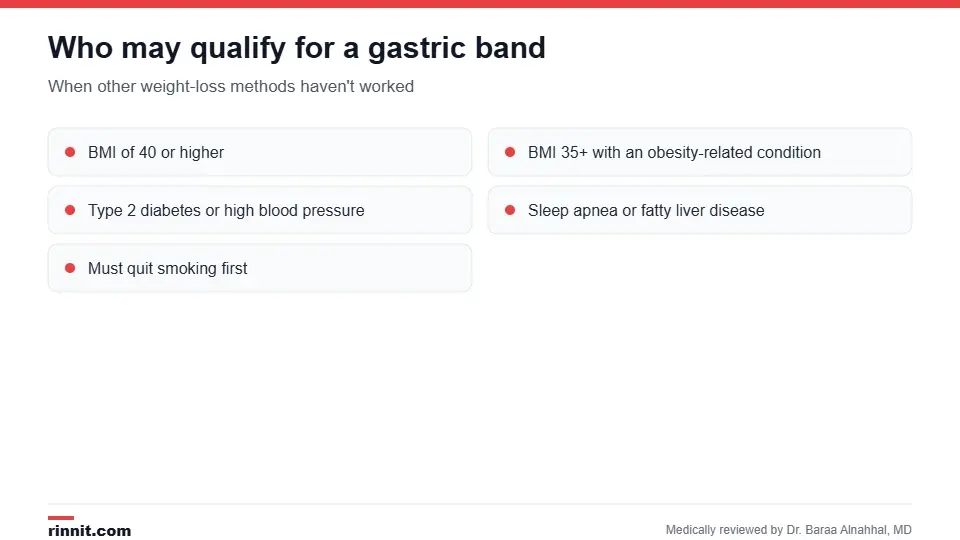
Smokers and people who overuse alcohol or opioids must quit first.
A BMI of 40 or higher.
A BMI of at least 35 with at least one obesity-related disease.
Other weight-loss methods haven't worked. Sources: [1]
Weight loss can help high cholesterol, high blood pressure, heart disease, type 2 diabetes, sleep apnea and fatty liver disease. Sources: [1]
Gastric band vs. other bariatric surgery
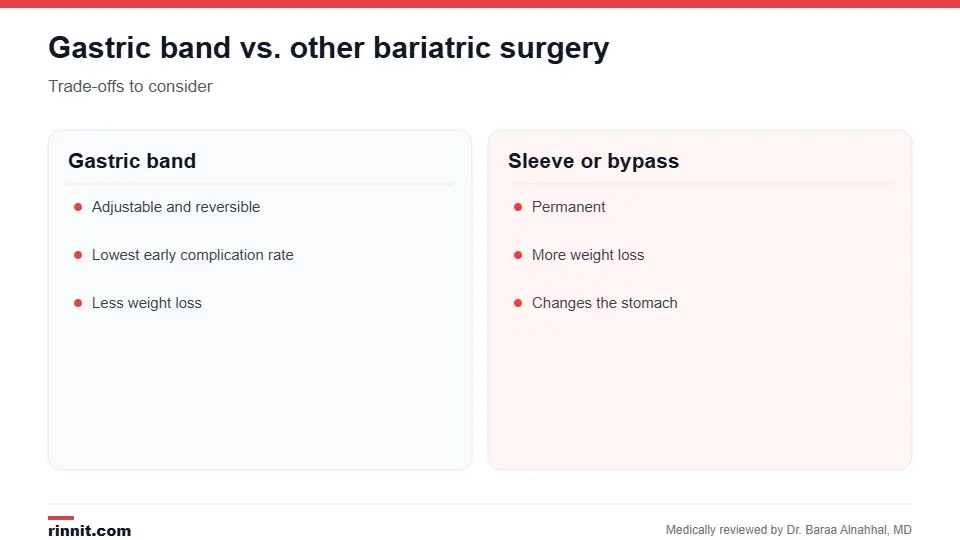
Some people later switch to a more permanent procedure.
Sources: [1, 2]
How to prepare
You'll have physical exams, blood tests and abdominal imaging.
Quit smoking, and stop overusing alcohol or opioids. Sources: [1]
What happens during surgery
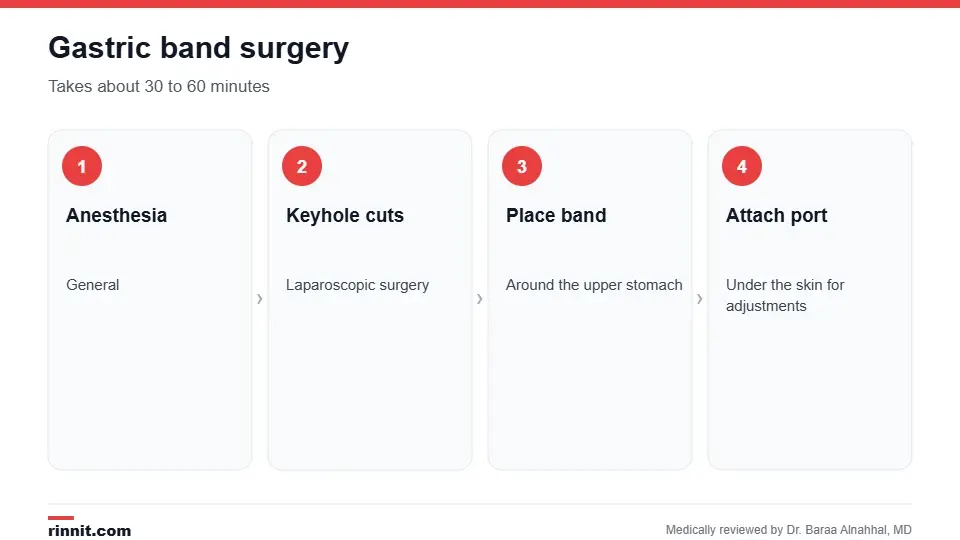
Surgery takes about 30 to 60 minutes.
You get general anesthesia.
The surgeon makes small keyhole incisions and inflates your belly with carbon dioxide.
The band is secured around the upper stomach, creating an hourglass-shaped pouch.
Tubing connects the band to a port under your skin. Sources: [1]
Risks
Nausea, vomiting, constipation or trouble swallowing.
GERD (acid reflux).
Port problems, such as leaks, flipping or infection.
Band slippage, which can be an emergency.
Band erosion, which usually needs removal.
Pouch or esophagus stretching. Sources: [1, 3]
Studies suggest complications in up to 50% of people and repeat procedures in up to 35%. Get medical care right away for severe belly pain, repeated vomiting or being unable to keep food or liquids down, which can be signs of band slippage. Sources: [1]
Recovery
Follow a liquid diet for the first several weeks, then pureed, soft and solid foods.
Eat small portions, chew well and choose nutrient-dense foods.
Expect frequent visits in the first year for band adjustments.
You'll need regular blood tests, nutritional counseling and supplements. Sources: [1]
Outlook
Average weight loss is about 40% of excess weight over two years. The band is designed to last a lifetime, but 35% to 40% of people may have it removed after 10 years, and some switch to a more permanent procedure. Sources: [1, 2, 3]
Conclusion
Gastric band surgery is a less invasive, adjustable way to lose weight, but it needs close follow-up and leads to less weight loss than other bariatric surgeries. Talk with your care team about which option fits your goals.
Keep learning: read about bariatric surgery and gastric sleeve surgery.
Frequently asked questions
What is gastric band surgery?
Weight-loss surgery that places an adjustable band around the upper stomach.
Is the gastric band reversible?
Yes.
How does the band get adjusted?
Saline is added or removed through a port under your skin.
Who qualifies?
People with a BMI of 40 or higher, or 35 or higher with an obesity-related condition.
How long does surgery take?
About 30 to 60 minutes.
How much weight will I lose?
About 40% of excess weight over two years on average.
What can I eat after surgery?
Liquids for several weeks, then pureed, soft and solid foods.
What are the risks?
Band slippage, erosion, port problems and reflux.
How long does a gastric band last?
It's designed to last, but many are removed within 10 years.
Is a gastric band better than a sleeve?
It's less invasive but usually leads to less weight loss.
Related Reading
Bariatric Surgery: Types, Requirements, Risks, and Recovery an overview of weight-loss surgery.
Gastric Sleeve Surgery: Requirements, Procedure and Results another bariatric surgery.
Gastric Bypass Surgery: A Comprehensive Guide to Weight Loss and Recovery another bariatric surgery.
Obesity: Symptoms, Causes, Complications and Treatment — A Complete Guide the condition this surgery treats.
References
Cleveland Clinic. Gastric Band Surgery (LAP-Band): What It Is, Requirements & Procedure. Cleveland Clinic. Last updated April 26, 2022. https://my.clevelandclinic.org/health/treatments/17163-lap--band-surgery
O'Brien PE, Hindle A, Brennan L, et al. Long-term outcomes after bariatric surgery: a systematic review and meta-analysis of weight loss at 10 or more years for all bariatric procedures and a single-centre review of 20-year outcomes after adjustable gastric banding. Obes Surg. 2019;29(1):3-14. PMID 30293134. https://doi.org/10.1007/s11695-018-3525-0
O'Brien PE, Brennan L, Laurie C, et al. Intensive medical weight loss or laparoscopic adjustable gastric banding in the treatment of mild to moderate obesity: long-term follow-up of a prospective randomised trial. Obes Surg. 2013;23(9):1345-1353. PMID 23760764. https://doi.org/10.1007/s11695-013-0990-3
Medical disclaimer
This article is for general education only and does not replace advice from a qualified healthcare professional. Talk to your doctor about your own diagnosis and treatment, and seek emergency care right away for severe or sudden symptoms.



Comments