Gastric Sleeve Surgery: Requirements, Procedure and Results

Updated: 2 days ago
Written and medically reviewed by Dr. Baraa Alnahhal, MD · Last reviewed: November 2026 · How we review
Quick Answer
Gastric sleeve surgery (sleeve gastrectomy) is a weight-loss surgery that removes about 80% of the stomach, leaving a narrow banana-shaped sleeve. It limits how much you can eat and lowers hunger hormones. People lose about 25% to 30% of their body weight in one to two years. It's permanent and requires lifelong vitamins.
What the research says
Sleeve and bypass gave similar long-term weight loss: in the SLEEVEPASS trial of 240 people, excess weight loss at 5 years was 49% after gastric sleeve and 57% after gastric bypass, with fewer complications after sleeve (19% vs. 26%) (Salminen P et al., JAMA, 2018) [2]
Reflux was more common after sleeve: in the SM-BOSS trial of 217 people, 5-year weight loss was similar after sleeve and bypass, but reflux worsened in 31.8% after sleeve versus 6.3% after bypass (Peterli R et al., JAMA, 2018) [3]
Key takeaways
Gastric sleeve surgery removes about 80% of the stomach.
It's for people with a BMI of 35+, or 30+ with a metabolic condition such as type 2 diabetes.
Most people lose 25% to 30% of their body weight.
Serious complications are uncommon.
You'll need lifelong vitamins and diet changes.
What is gastric sleeve surgery?
Gastric sleeve surgery began as the first step of a larger operation but is now usually done on its own. About 150,000 are performed each year in the U.S. It's permanent and can't be reversed. Learn about other bariatric surgery options. Sources: [1]
Who it's for

Screening checks physical and mental readiness.
A BMI of 35 or higher, with or without other health conditions.
A BMI of 30 or higher with a metabolic condition such as type 2 diabetes; some insurers use stricter limits.
Past weight-loss attempts that didn't work; some insurers require 3 to 6 months of a supervised plan.
Physical and mental readiness, checked by dietitians, psychologists and others. Sources: [1]
It can improve or sometimes resolve type 2 diabetes, high blood pressure, high cholesterol, fatty liver disease, sleep apnea and joint pain. Sources: [1]
How it works
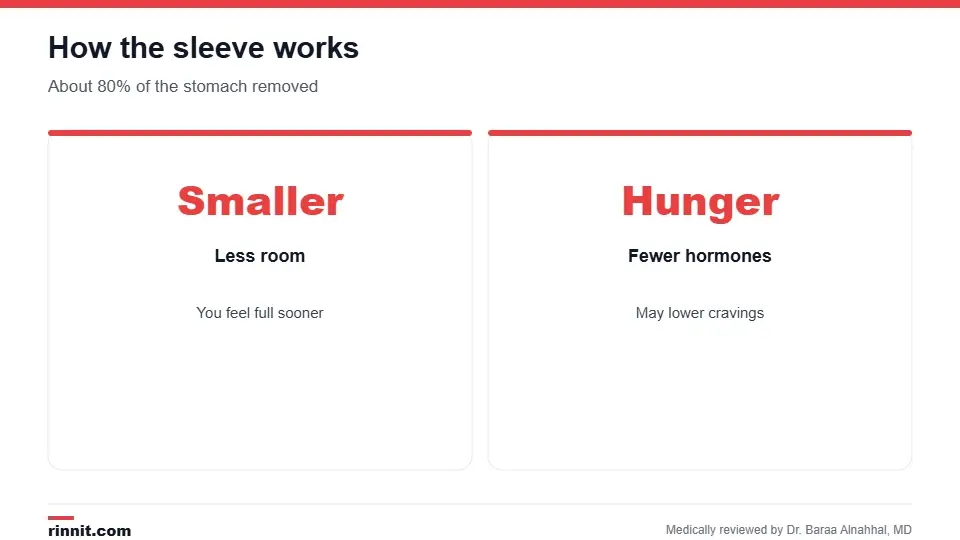
The change is permanent.
Effect | How it helps |
Smaller stomach | You feel full after eating less |
Fewer hunger hormones | May lower appetite and cravings |
Sources: [1]
How to prepare
Complete screening with your bariatric team.
Follow a 2-week liquid diet before surgery to shrink fat around the liver.
Don't eat or drink for 12 hours before the operation. Sources: [1]
What happens during surgery

Surgery takes about 60 to 90 minutes.
You get general anesthesia.
The surgeon makes a small cut in your belly and inflates it with carbon dioxide gas.
A camera (laparoscope) and tools are placed through 1 to 3 more small cuts.
The stomach is measured and divided with a stapler to form the sleeve.
The rest of the stomach is removed, and the cuts are closed. Sources: [1]
Risks
Type | Examples |
Short term | Bleeding, infection, anesthesia problems, leak from the staple line |
Long term | Narrowing of the stomach, nutrient deficiencies, new or worse GERD, gallstones |
Serious complications are uncommon, though in one large trial about 1 in 5 people had some complication over 5 years. Sources: [1, 3]
Recovery
When | What to expect |
1 to 2 days | Hospital stay |
About a month | Most people feel like themselves again |
A few months | Diet moves from liquids to soft foods to a more normal diet |
For life | Daily vitamins and regular follow-up |
Sources: [1]
Results
On average, people lose 25% to 30% of their body weight in the first one to two years, and most keep it off for at least five years. If weight returns, a revision such as gastric bypass may be an option. Sources: [1, 2]
Conclusion
Gastric sleeve surgery is an effective, widely used option for severe obesity that can improve related health problems. Lifelong healthy habits, vitamins and follow-up care help you keep the results.
Keep learning: read about bariatric surgery and gastric bypass.
Frequently asked questions
What is gastric sleeve surgery?
Surgery that removes about 80% of the stomach to help with weight loss.
Who qualifies for gastric sleeve surgery?
Current guidelines: a BMI of 35+, or 30+ with a metabolic condition such as type 2 diabetes; some insurers use stricter limits.
How much weight will I lose?
About 25% to 30% of your body weight in one to two years.
How long does surgery take?
About 60 to 90 minutes.
How long is the hospital stay?
One to two days.
Is gastric sleeve surgery reversible?
No. It's permanent.
What are the risks?
Bleeding, leaks, nutrient deficiencies, GERD and gallstones.
Do I need vitamins after surgery?
Yes, for life.
What is the liquid diet before surgery?
A 2-week diet that shrinks fat around the liver.
Is sleeve better than gastric bypass?
Both work well; sleeve has fewer complications but more reflux.
Related Reading
Adolescent Bariatric Surgery: Types, Benefits and Recovery explains bariatric surgery for teens.
Gastric Band Surgery (Lap-Band): Requirements, Procedure and Results explains gastric band surgery.
Bariatric Surgery: Types, Requirements, Risks, and Recovery an overview of weight-loss surgery.
Gastric Bypass Surgery: A Comprehensive Guide to Weight Loss and Recovery another common weight-loss surgery.
Endoscopic Sleeve Gastroplasty (ESG): How It Works, Recovery, Risks, and Results a nonsurgical sleeve procedure.
Class III Obesity: What It Is, Why It Happens, and How It Gets Treated severe obesity and its treatment.
GLP-1 Agonists: A Comprehensive Guide to Diabetes and Obesity Management weight-loss medicines.
References
Cleveland Clinic. Gastric Sleeve Surgery: What it Is, Requirements. Cleveland Clinic. Last updated April 29, 2022. https://my.clevelandclinic.org/health/treatments/22931-gastric-sleeve-surgery
Salminen P, Helmiö M, Ovaska J, et al. Effect of laparoscopic sleeve gastrectomy vs laparoscopic Roux-en-Y gastric bypass on weight loss at 5 years among patients with morbid obesity: the SLEEVEPASS randomized clinical trial. JAMA. 2018;319(3):241-254. PMID 29340676. https://doi.org/10.1001/jama.2017.20313
Peterli R, Wölnerhanssen BK, Peters T, et al. Effect of laparoscopic sleeve gastrectomy vs laparoscopic Roux-en-Y gastric bypass on weight loss in patients with morbid obesity: the SM-BOSS randomized clinical trial. JAMA. 2018;319(3):255-265. PMID 29340679. https://doi.org/10.1001/jama.2017.20897
Medical disclaimer
This article is for general education only and does not replace advice from a qualified healthcare professional. Talk to your doctor about your own diagnosis and treatment, and seek emergency care right away for severe or sudden symptoms.



Comments