Endoscopic Sleeve Gastroplasty (ESG): How It Works, Recovery, Risks, and Results

Updated: 6 days ago
Written and medically reviewed by Dr. Baraa Alnahhal, MD · Last reviewed: October 2026 · How we review
Quick Answer: What is endoscopic sleeve gastroplasty?
Endoscopic sleeve gastroplasty (ESG) is a weight loss procedure that uses an endoscope passed through the mouth to place about 10 stitches inside the stomach, folding it into a narrow tube about 30% of its original size. It involves no cuts, usually suits people with a BMI of 30 or higher, and typically produces 15% to 20% total weight loss. [1]
What the research says
ESG plus lifestyle changes beats lifestyle changes alone. In a randomized trial of 209 adults with class 1 or 2 obesity, people who had ESG lost 13.6% of their total body weight at one year, compared with 0.8% in the diet-and-exercise-only group. Serious procedure-related problems occurred in 2% of patients, with no deaths. (Abu Dayyeh et al., Lancet, 2022)
Weight loss holds up across many clinics. A pooled analysis of 8 studies and 1,772 patients found average total weight loss of 15.1% at 6 months, 16.5% at 12 months and 17.2% at 18–24 months. Severe side effects affected 2.2% of patients. (Hedjoudje et al., Clin Gastroenterol Hepatol, 2020)
Less weight loss than surgery, but fewer complications. A systematic review comparing 1,451 ESG patients with 203 surgical sleeve patients found 13.7%–15.2% weight loss at 6 months after ESG versus 23.5%–23.6% after surgery. Complication rates were 2.0%–2.7% after ESG versus 9.2%–16.9% after surgery. (Jalal et al., Obes Surg, 2020)
Key takeaways
ESG makes the stomach smaller from the inside using stitches. Nothing is cut or removed. [1]
It is an option for adults with obesity, typically with a BMI of 30 to 50, when diet and exercise have not worked. [1]
The procedure takes 60 to 90 minutes under general anesthesia, and most people go home the next day. [1]
Most people return to work within a week and eat normally again after about a month. [1]
Expected weight loss is about 15% to 20% of total body weight, and the stitches can be removed if needed. [1]
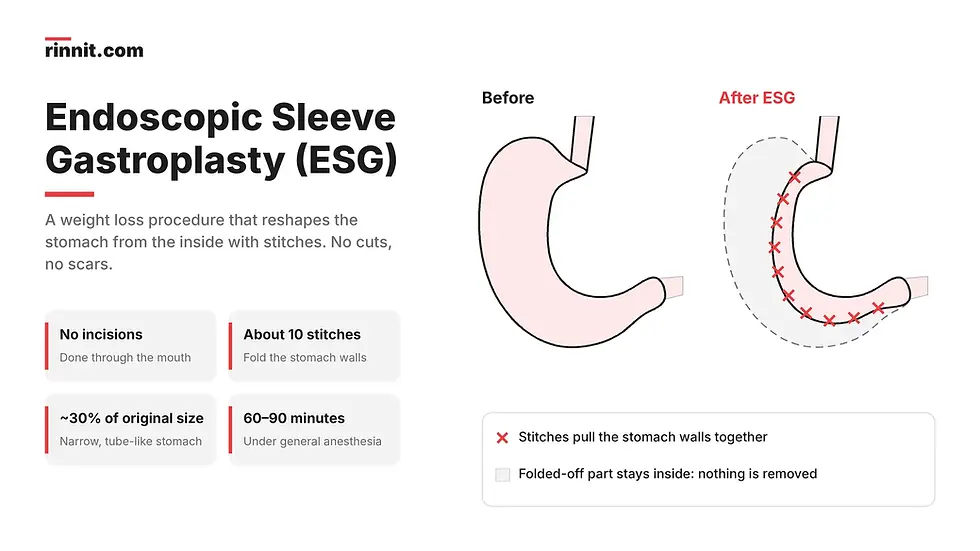
ESG folds the stomach into a narrow sleeve with stitches. The folded part stays inside the body.
Endoscopic sleeve gastroplasty at a glance
Feature | What to know |
Type of procedure | Minimally invasive, done through the mouth with an endoscope [1] |
Incisions or scars | None [1] |
Stomach size after | About 30% of its original size [1] |
Number of stitches | About 10 [1] |
Anesthesia | General (you are asleep) [1] |
Procedure time | 60 to 90 minutes [1] |
Hospital stay | Same day possible; most people stay one night [1] |
Back to work | Usually within the first week [1] |
Expected weight loss | About 15% to 20% of total body weight [1] |
Reversible | Yes, the stitches can be removed if necessary [1] |
What is endoscopic sleeve gastroplasty and how does it work?
Endoscopic sleeve gastroplasty is a weight loss procedure that shrinks the stomach into a narrow, tube-like sleeve using stitches placed from inside the stomach. [1] It is a less invasive alternative to bariatric surgery, including the surgical sleeve.
The doctor reaches the stomach with an endoscope, a long, thin tube with a small camera on the end. The tube goes through the mouth and down the food pipe. No cuts are made in the belly. [1]
ESG helps weight loss in two ways: [1]
Smaller size: The stomach holds less food, so you eat less at each meal.
Narrow shape: The stomach takes longer to empty, so you feel full for longer.
Who is a good candidate for endoscopic sleeve gastroplasty?
Endoscopic sleeve gastroplasty is mainly for adults with obesity, typically defined as a body mass index (BMI) of 30 or higher. [1] It may be an option when diet changes and exercise have not led to enough weight loss. [1]
Your doctor decides whether ESG suits you after reviewing your weight, health conditions and past weight loss attempts. If you are unsure where your weight falls, our guides on overweight and BMI and class III obesity explain the BMI categories.
ESG is one of several non-surgical or less invasive options. Others include the intragastric balloon and prescription weight loss medications.
What happens during endoscopic sleeve gastroplasty?
During endoscopic sleeve gastroplasty, a gastroenterologist or endoscopic surgeon stitches the stomach walls together from the inside while you sleep under general anesthesia. [1] The steps are: [1]
Anesthesia: You are given general anesthesia, so you are fully asleep.
Endoscope placement: The doctor passes the endoscope through your mouth, down your esophagus and into your stomach.
Stomach expansion: Gas is pumped into the stomach to open it up.
Viewing: The camera shows the inside of the stomach on a screen.
Stitching: Using a suturing device on the endoscope, the doctor places about 10 stitches between the front and back walls of the stomach.
Reshaping: The stitches draw the walls together, leaving a narrow, tube-shaped stomach.
The procedure takes 60 to 90 minutes. Some people go home the same day, but most stay overnight for monitoring. [1]
What does recovery after endoscopic sleeve gastroplasty look like?
Recovery after endoscopic sleeve gastroplasty usually takes about a month, with most side effects fading in the first week. [1] Most people can return to work after that first week. [1]

Most people are back at work within a week and eating normally after about a month.
What side effects are normal after ESG?
Mild pain is the most common side effect after ESG as the stomach heals. [1] Some people have stronger pain and nausea for a few days. These symptoms are often manageable with over-the-counter medicines. [1]
What can you eat after endoscopic sleeve gastroplasty?
After endoscopic sleeve gastroplasty, you eat in three stages over about a month while the stomach heals: [1]
Stage | What you eat | Why |
1. Liquid diet | Liquids only | Lets the stitched stomach rest and heal |
2. Soft diet | Soft foods | Reintroduces texture gently |
3. Solid foods | Regular solid foods | Resumes once the stomach has healed, about one month after the procedure |
Your care team will tell you exactly when to move from one stage to the next.
What results can you expect after endoscopic sleeve gastroplasty?
Most people lose 15% to 20% of their total body weight within 12 to 24 months after endoscopic sleeve gastroplasty. [1] For a person weighing 100 kg, that is roughly 15 to 20 kg.
Research supports these numbers. In a randomized trial, 77% of ESG patients lost at least a quarter of their excess weight by one year, and 68% kept that level of loss at two years. [2] Studies also suggest weight loss tends to level off after the first year. [4]
ESG can also improve weight-related health problems: [1]
High blood pressure
High cholesterol
In the same trial, 80% of ESG patients had an improvement in at least one of these metabolic conditions at one year. [2]
Weight regain is possible. Eating nutritious foods and exercising regularly help you keep your results. [1]
What are the risks of endoscopic sleeve gastroplasty?
The main risks of endoscopic sleeve gastroplasty are temporary pain, nausea and heartburn, plus the chance of regaining weight or losing less than expected. [1] Serious problems are uncommon.
Risk | How common or serious |
Pain, nausea and heartburn | Common but temporary [1] |
Weight regain or less weight loss than hoped | Possible [1] |
Bleeding or injury from the endoscope | Minimal risk [1] |
Reaction to anesthesia | Minimal risk [1] |
Severe adverse events overall | About 2.2% in pooled studies [3] |
In pooled research, the most frequent severe events were pain or nausea needing a hospital stay (1.08%), upper digestive bleeding (0.56%) and a leak or fluid collection near the stomach (0.48%). [3]
How does endoscopic sleeve gastroplasty compare with sleeve gastrectomy?
Endoscopic sleeve gastroplasty leads to less weight loss than surgical sleeve gastrectomy but has fewer complications and needs no incisions. [4] In ESG, the stomach is folded with stitches. In a sleeve gastrectomy, part of the stomach is removed through keyhole surgery.

ESG trades some weight loss for a gentler procedure with fewer complications.
Endoscopic sleeve gastroplasty | Surgical sleeve gastrectomy | |
Approach | Endoscope through the mouth [1] | Laparoscopic (keyhole) surgery [4] |
Incisions | None [1] | Several small abdominal cuts |
What happens to the stomach | Folded with about 10 stitches [1] | Part of the stomach is removed |
Total weight loss at 6 months | 13.7% to 15.2% [4] | 23.5% to 23.6% [4] |
Complication rate (beyond minor) | 2.0% to 2.7% [4] | 9.2% to 16.9% [4] |
Reversible | Yes, stitches can be removed [1] | No |
If you want more weight loss and are open to surgery, gastric bypass and other bariatric operations are also worth discussing with your doctor.
Can children and teenagers have endoscopic sleeve gastroplasty?
Endoscopic sleeve gastroplasty has been studied in children and teenagers with obesity, but the FDA has authorized the device only for adults. [1] In a study of 109 young people aged 10 to 21, average total weight loss was 16.2% at 12 months and 13.7% at 24 months. [5] There were no deaths, emergency admissions or blood transfusions. [5]
For families, our guide to childhood obesity covers diagnosis and family-based care.
When should you call your doctor after endoscopic sleeve gastroplasty?
Call your doctor right away after endoscopic sleeve gastroplasty if you notice any of these warning signs: [1]
Fever
Severe belly pain
Nausea or vomiting
Blood in your stool or vomit
Chest pain or shortness of breath
Difficulty swallowing
Chest pain, shortness of breath or vomiting blood need emergency care.
Conclusion
Endoscopic sleeve gastroplasty offers people with obesity a middle path between diet and exercise alone and major weight loss surgery. It reshapes the stomach with stitches, leaves no scars, and usually leads to 15% to 20% weight loss, with recovery measured in weeks rather than months. [1]
It works best as part of lasting changes to eating and activity, and it is not right for everyone. If diet and exercise have not been enough, ask your doctor whether ESG fits your health goals. Bring this guide to your appointment, and explore our complete obesity guide and bariatric surgery guide to compare every option side by side.
FAQ
What is endoscopic sleeve gastroplasty?
Endoscopic sleeve gastroplasty (ESG) is a weight loss procedure that uses an endoscope to stitch the stomach into a narrow tube about 30% of its original size. It is done through the mouth, with no cuts or scars. [1]
Who is a candidate for endoscopic sleeve gastroplasty?
ESG is for adults with obesity, typically a BMI of 30 to 50. It is usually considered when diet and exercise have not led to enough weight loss. [1]
How much weight can you lose with ESG?
Most people lose 15% to 20% of their total body weight within 12 to 24 months. Healthy eating and regular exercise help keep the weight off. [1]
Is endoscopic sleeve gastroplasty painful?
You are asleep under general anesthesia during ESG, so you feel nothing during the procedure. Afterward, most people have mild pain, and some have stronger pain and nausea for a few days that over-the-counter medicines usually control. [1]
How long is recovery after endoscopic sleeve gastroplasty?
Most side effects fade within the first week, and most people return to work then. The stomach needs about a month to heal before you can eat solid food normally. [1]
Is endoscopic sleeve gastroplasty reversible?
Yes. The stitches used in ESG can be removed if necessary, because no part of the stomach is cut away. [1]
Can teenagers have endoscopic sleeve gastroplasty?
ESG has been studied in children and teenagers with obesity, but it is authorized only for adults. In a study of 109 patients aged 10 to 21, average weight loss was 16.2% at one year, with no serious complications. [5]
When should you seek emergency care after ESG?
Seek urgent care for chest pain, shortness of breath, blood in your vomit or stool, severe belly pain, fever or difficulty swallowing. These can signal a complication that needs prompt treatment. [1]
How is ESG different from gastric sleeve surgery?
ESG shrinks the stomach from the inside with stitches, and nothing is cut or removed. Gastric sleeve surgery permanently removes part of the stomach and usually leads to more weight loss, but it is a bigger operation.
What can I eat after endoscopic sleeve gastroplasty?
You start with clear liquids, then move slowly to pureed and soft foods over several weeks. Most people return to a normal diet after about a month. Follow your care team's meal plan closely.
Related Reading
Gastric Sleeve Surgery: Requirements, Procedure and Results explains gastric sleeve weight-loss surgery.
References
Cleveland Clinic. Endoscopic Sleeve Gastroplasty: Procedure & Side Effects. Cleveland Clinic. Last updated December 3, 2025. https://my.clevelandclinic.org/health/treatments/24771-endoscopic-sleeve-gastroplasty
Abu Dayyeh BK, Bazerbachi F, Vargas EJ, et al. Endoscopic sleeve gastroplasty for treatment of class 1 and 2 obesity (MERIT): a prospective, multicentre, randomised trial. Lancet. 2022;400(10350):441-451. PMID 35908555. https://doi.org/10.1016/S0140-6736(22)01280-6
Hedjoudje A, Abu Dayyeh BK, Cheskin LJ, et al. Efficacy and safety of endoscopic sleeve gastroplasty: a systematic review and meta-analysis. Clin Gastroenterol Hepatol. 2020;18(5):1043-1053.e4. PMID 31442601. https://doi.org/10.1016/j.cgh.2019.08.022
Jalal MA, Cheng Q, Edye MB. Systematic review and meta-analysis of endoscopic sleeve gastroplasty with comparison to laparoscopic sleeve gastrectomy. Obes Surg. 2020;30(7):2754-2762. PMID 32304011. https://doi.org/10.1007/s11695-020-04591-4
Alqahtani A, Elahmedi M, Alqahtani YA, et al. Endoscopic sleeve gastroplasty in 109 consecutive children and adolescents with obesity: two-year outcomes of a new modality. Am J Gastroenterol. 2019;114(12):1857-1862. PMID 31658128. https://doi.org/10.14309/ajg.0000000000000440
Medical disclaimer
This article is for general education only and is not a substitute for professional medical advice, diagnosis or treatment. Always talk with a qualified healthcare provider about your own health and before making decisions about any weight loss procedure. If you have a medical emergency, call your local emergency number right away.



Comments