Appetite Suppressants: Types, How They Work and Side Effects

Updated: 2 days ago
Written and medically reviewed by Dr. Baraa Alnahhal, MD · Last reviewed: November 2026 · How we review
Quick Answer
Appetite suppressants are weight-loss medicines that make you feel less hungry or full sooner, so you eat fewer calories. They're for adults with obesity (BMI of 30 or higher) or a BMI over 27 plus a weight-related condition, when diet and exercise alone haven't been enough. They work best with a healthy eating plan and regular activity.
What the research says
Some drugs work better than others: in 132 trials with 48,209 adults, phentermine-topiramate and GLP-1 drugs produced the most weight loss, with semaglutide reaching about 11% extra body weight lost compared with lifestyle changes alone (Shi Q et al., Lancet, 2024) [2]
Phentermine-topiramate helped most people lose 5%: in a 56-week trial of 2,487 adults, the higher dose cut weight by 9.8% versus 1.2% with placebo, and 70% lost at least 5% of their weight versus 21% (Gadde KM et al., Lancet, 2011) [3]
Key takeaways
Appetite suppressants help you feel less hungry or full sooner.
They're for adults with a BMI of 30 or higher, or over 27 with a weight-related condition.
Average weight loss is 5% or more, and up to 6% to 11% with the most effective drugs.
Short-term drugs like phentermine can be habit-forming.
Over-the-counter "diet pills" with ephedra can be dangerous.
What are appetite suppressants?
Appetite suppressants, sometimes called diet pills, are a type of weight-loss medication. They change the hormones and brain chemicals that control hunger, such as ghrelin, leptin, serotonin and GLP-1. Each drug targets different chemicals. Sources: [1]
Who they're for
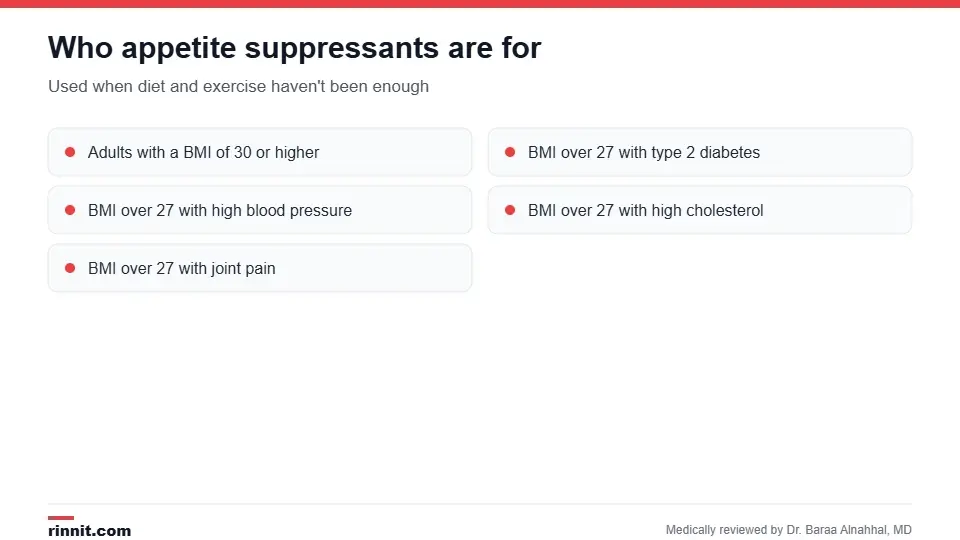
They work best with healthy eating and regular activity.
Adults with obesity, meaning a BMI of 30 or higher.
Adults with a BMI over 27 plus a weight-related condition, such as type 2 diabetes, high blood pressure, high cholesterol or joint pain.
Usually when diet and exercise alone haven't led to enough weight loss. Sources: [1]
Types of appetite suppressants
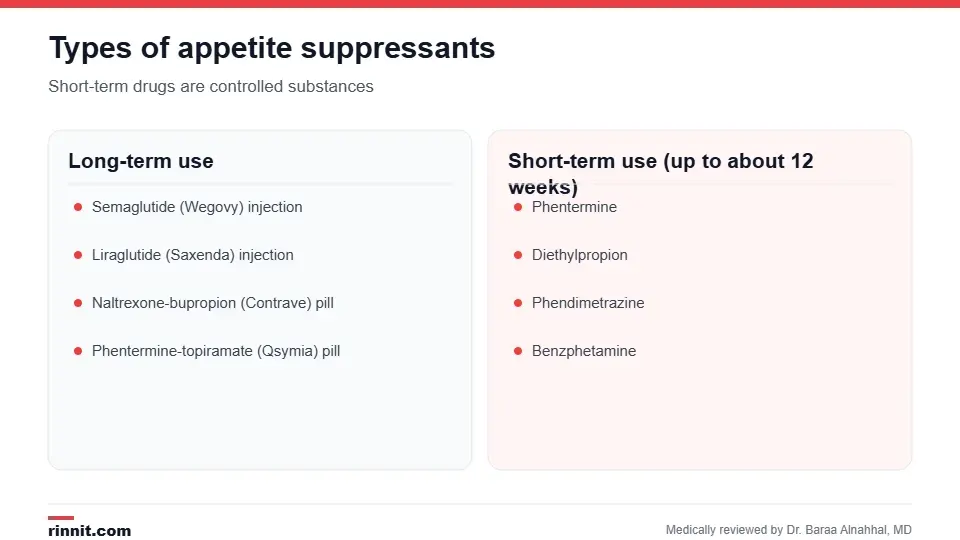
Short-term drugs are controlled substances.
Drug | Brand | Form | Use |
Semaglutide | Wegovy | Injection | Long-term |
Liraglutide | Saxenda | Injection | Long-term |
Naltrexone-bupropion | Contrave | Pill | Long-term |
Phentermine-topiramate | Qsymia | Pill | Long-term |
Phentermine | Adipex-P and others | Pill | Short-term, up to about 12 weeks |
Diethylpropion, phendimetrazine, benzphetamine | Several | Pill | Short-term, up to about 12 weeks |
Semaglutide and liraglutide are GLP-1 agonists. Short-term drugs are controlled substances because they can be habit-forming. Sources: [1]
How to take them
Take pills by mouth or give injections under the skin exactly as prescribed.
Pair the medicine with a lower-calorie eating plan and regular physical activity.
See your provider regularly to check whether it's working. Sources: [1]
Side effects and risks
Drug type | Common side effects |
Long-term drugs | Nausea, constipation, diarrhea, belly pain, indigestion, headache |
Short-term drugs | Fast or irregular heartbeat, dizziness, mood changes, trouble sleeping, dry mouth, nausea, headache |
Short-term drugs can be addictive and can worsen high blood pressure, mood disorders and glaucoma. Some interact with antidepressants and anti-anxiety medicines. Long-term drugs have their own warnings: semaglutide and liraglutide carry a boxed warning about thyroid tumors and aren't for people with a personal or family history of medullary thyroid cancer or MEN2, naltrexone-bupropion carries a boxed warning about suicidal thoughts, and phentermine-topiramate can cause birth defects and must not be used in pregnancy. Tell your provider if you or a family member has had a substance use disorder. Over-the-counter products with ephedra, ephedrine or high doses of caffeine have been linked to heart attack, seizure, stroke and death. Sources: [1]
How well they work
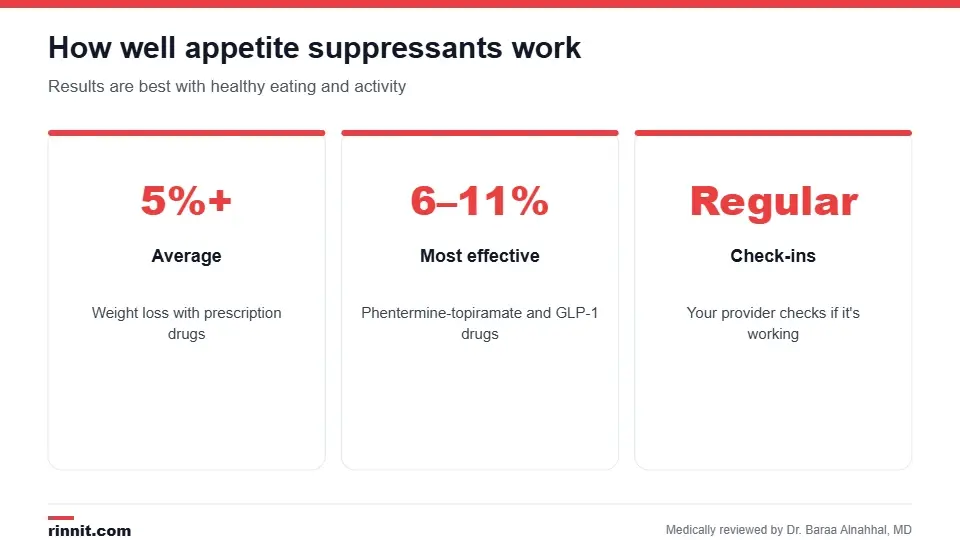
Your provider checks in regularly to see if the drug is working.
Drug group | Typical weight loss |
Prescription appetite suppressants overall | 5% or more of starting weight |
Phentermine-topiramate and GLP-1 drugs | About 6% to 11% |
Even 5% weight loss can improve blood sugar, blood pressure and cholesterol. If the medicine doesn't help enough, other options include bariatric surgery. Sources: [1, 2, 3]
When to call your provider
Irregular heartbeat, confusion or other serious side effects; call right away.
Side effects that don't go away.
Before starting any appetite suppressant, to talk through the benefits and risks. Sources: [1]
Conclusion
Appetite suppressants can help adults with obesity lose a meaningful amount of weight, especially alongside healthy eating and exercise. Your provider can help you choose the safest and most effective option.
Keep learning: read about GLP-1 agonists and weight-loss medications.
Frequently asked questions
What are appetite suppressants?
Weight-loss medicines that make you feel less hungry or full sooner.
Who can take them?
Adults with a BMI of 30 or higher, or over 27 with a weight-related condition.
Which appetite suppressants are approved for long-term use?
Semaglutide, liraglutide, naltrexone-bupropion and phentermine-topiramate.
How long can I take phentermine?
Usually up to about 12 weeks.
How much weight will I lose?
On average 5% or more; 6% to 11% with the most effective drugs.
What are common side effects?
Nausea, constipation, diarrhea, headache and, with short-term drugs, a fast heartbeat.
Are appetite suppressants addictive?
Short-term drugs such as phentermine can be habit-forming.
Are over-the-counter diet pills safe?
Products with ephedra or ephedrine have been linked to heart attack and stroke.
Do I still need to diet and exercise?
Yes. The medicines work best with healthy habits.
What if they don't work?
Your provider may suggest another drug or weight-loss surgery.
Related Reading
Weight Loss Medications: Clinical Options and Management all medicines used for weight loss.
GLP-1 Agonists: A Comprehensive Guide to Diabetes and Obesity Management how semaglutide and liraglutide work.
Obesity: Symptoms, Causes, Complications and Treatment — A Complete Guide the condition these drugs treat.
Bariatric Surgery: Types, Requirements, Risks, and Recovery a surgical option for weight loss.
Class III Obesity: What It Is, Why It Happens, and How It Gets Treated the most severe form of obesity.
References
Cleveland Clinic. Appetite Suppressants: What They Are, Types & Effectiveness. Cleveland Clinic. Last updated November 20, 2023. https://my.clevelandclinic.org/health/treatments/9463-appetite-suppressants
Shi Q, Wang Y, Hao Q, et al. Pharmacotherapy for adults with overweight and obesity: a systematic review and network meta-analysis of randomised controlled trials. Lancet. 2024;403(10434):e21-e31. PMID 38582569. https://doi.org/10.1016/S0140-6736(24)00351-9
Gadde KM, Allison DB, Ryan DH, et al. Effects of low-dose, controlled-release, phentermine plus topiramate combination on weight and associated comorbidities in overweight and obese adults (CONQUER): a randomised, placebo-controlled, phase 3 trial. Lancet. 2011;377(9774):1341-1352. PMID 21481449. https://doi.org/10.1016/S0140-6736(11)60205-5
Medical disclaimer
This article is for general education only and does not replace advice from a qualified healthcare professional. Talk to your doctor about your own diagnosis and treatment, and seek emergency care right away for severe or sudden symptoms.



Comments