Dumping Syndrome Explained: Symptoms, Causes, and the Diet Changes That Help

Updated: 2 days ago
Medically reviewed by Dr. Baraa Alnahhal, MD · Last reviewed: September 2026
Dumping syndrome, sometimes called rapid gastric emptying, is a condition where food moves from the stomach into the small intestine too quickly after eating. It most often follows stomach or esophageal surgery, such as gastric bypass, and comes in two forms: early symptoms (cramps, bloating, diarrhea, dizziness) starting 10 to 30 minutes after a meal, and late symptoms (sweating, weakness, rapid heart rate) caused by low blood sugar 1 to 3 hours after a high-sugar meal. Early dumping syndrome often resolves on its own within three months. Most people can manage symptoms with dietary changes, such as smaller low-sugar meals and fluids between meals; in more serious cases, doctors may prescribe an injectable medicine or recommend surgery.
Quick Answer
What is dumping syndrome? A condition in which food and gastric juices move from the stomach into the small intestine too quickly after eating, also called rapid gastric emptying.
What are early symptoms? Feeling bloated or too full, nausea, vomiting, stomach cramps, diarrhea, flushing, dizziness, and a rapid heart rate, typically 10 to 30 minutes after eating, especially after sugary meals.
What are late symptoms? Sweating, flushing, dizziness, weakness, and rapid heart rate, 1 to 3 hours after a high-sugar meal, caused by a spike in insulin and a resulting drop in blood sugar.
What causes it? Most often changes to the stomach from surgery, including gastric bypass, gastrectomy, and esophagectomy; rarely it occurs without any surgery.
How is it treated? Dietary changes usually help first: smaller meals, more protein and fiber, less sugar, fluids between meals, and lying down after eating. Severe cases may need the injectable medicine octreotide or surgery such as pylorus reconstruction.

What is dumping syndrome?
Dumping syndrome is a condition in which food moves from the stomach into the small intestine too quickly after eating. It is sometimes called rapid gastric emptying.
It most often happens after surgery on the stomach or esophagus. To understand why it happens, it helps to know how digestion normally works.
Your stomach is a muscular sac about the size of a small melon. When you eat or drink, it expands to hold as much as a gallon of food or liquid. Once the stomach pulverizes the food, strong muscular contractions called peristaltic waves push the food toward the pyloric valve, and the food then moves into the duodenum, the upper portion of the small intestine.
When this process happens in an uncontrolled, abnormally fast way, dumping syndrome is the result. The good news is that dietary changes can usually help prevent or ease it, and even the early form often clears up on its own.
Dumping syndrome symptoms
Dumping syndrome comes in two forms, and some people experience both.
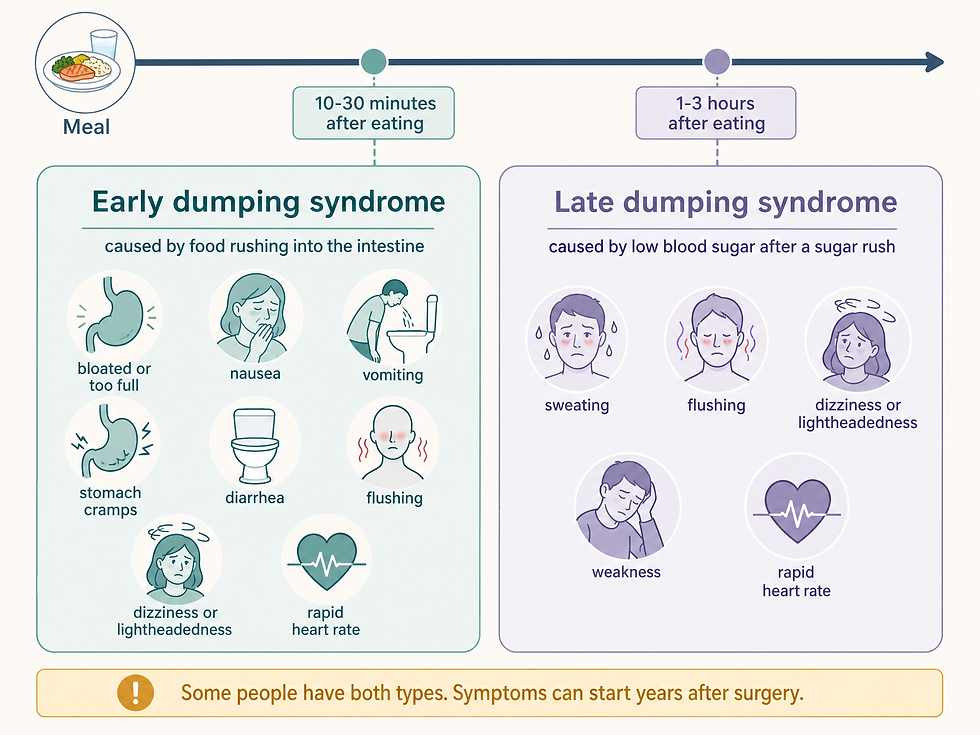
Early dumping syndrome symptoms generally start within minutes after eating, especially after a meal rich in table sugar or fruit sugar. They include feeling bloated or too full after eating, nausea, vomiting, stomach cramps, diarrhea, flushing, dizziness or lightheadedness, and a rapid heart rate. Most people develop these symptoms 10 to 30 minutes after eating.
Late dumping syndrome starts 1 to 3 hours after you eat a high-sugar meal. The delay happens because after you eat, your body releases large amounts of insulin to absorb the sugars entering your small intestine, and the result is low blood sugar. Symptoms can include sweating, flushing, dizziness or lightheadedness, weakness, and a rapid heart rate.
Some people have both early and late symptoms, and dumping syndrome can develop years after surgery.
What causes dumping syndrome?
In dumping syndrome, food and gastric juices move from the stomach to the small intestine in an uncontrolled, abnormally fast manner. This is most often related to changes in the stomach associated with surgery, including any stomach surgery or major esophageal surgery such as esophagectomy, the removal of the esophagus.
In rare cases, dumping syndrome can develop without a history of surgery or any other obvious cause.
Who is at risk?
Surgery that alters the stomach increases the risk of dumping syndrome. These surgeries are most commonly performed to treat obesity, but they are also part of treatment for stomach cancer, esophageal cancer, and other conditions.
Bariatric surgery: especially gastric bypass (Roux-en-Y) or sleeve gastrectomy, performed to treat morbid obesity
Gastrectomy: removal of a portion or all of the stomach
Esophagectomy: removal of all or part of the tube between the mouth and the stomach
Fundoplication: a procedure used to treat gastroesophageal reflux disease (GERD) and hiatal hernia
Vagotomy: surgery to treat stomach ulcers
Pyloroplasty: widening of the pylorus, the valve to the stomach, allowing food to pass through more freely
During gastric bypass, for example, the smaller stomach pouch reduces how much food a person can eat, and food is redirected so it bypasses most of the stomach and the first section of the small intestine, flowing directly into the middle section. This limits calorie absorption but also speeds up how quickly food enters the intestine.
When to see a doctor
Contact a healthcare professional if you develop symptoms that might be due to dumping syndrome, even if you have not had surgery. Also seek care if your symptoms are not controlled by dietary changes, or if you are losing large amounts of weight because of dumping syndrome. In that case, you may be referred to a registered dietitian to help create an eating plan.
How dumping syndrome is diagnosed
A healthcare professional can often diagnose dumping syndrome from a medical history and evaluation of your signs and symptoms, particularly if you have had stomach surgery.
When more confirmation is needed, a few tests can help. An oral glucose tolerance test measures your blood sugar level at the peak time of your symptoms, since low blood sugar is sometimes associated with the late form. A gastric emptying test adds a harmless amount of radioactive material to food to measure how quickly food moves through your stomach.
Treatment options
Early dumping syndrome is likely to resolve on its own within three months. In the meantime, there is a good chance that dietary changes will ease your symptoms. If they do not, medicines or surgery may be recommended.
For persistent symptoms, a doctor may prescribe octreotide, an anti-diarrheal medicine administered by injection under the skin that can slow the emptying of food into the intestine. Possible side effects include nausea, diarrhea, and fatty stools, so your healthcare team can show you the proper way to self-administer it.
If conservative approaches do not help, surgery may be recommended. Depending on your situation, this can include reconstructing the pylorus or surgery to reverse gastric bypass surgery.

Diet changes and self-care
Dietary strategies are the first line of management and can help you maintain good nutrition while minimizing symptoms.
Eat five or six small meals a day rather than three larger ones, and try lying down for 30 minutes after you eat. Because liquids speed things up further, drink most of your fluids between meals: avoid drinking anything for 30 to 60 minutes before and after meals at first, and limit fluid during meals to about half a cup, increasing as you tolerate it. Aim for 6 to 8 cups (1.4 to 1.9 liters) of fluids a day overall.
Change the composition of your meals by eating more protein, including meat, poultry, creamy peanut butter, and fish, and more complex carbohydrates such as oatmeal and other whole-grain foods high in fiber. Limit high-sugar foods such as candy, table sugar, syrup, sodas, and juices.
Be aware that the natural sugar in dairy products, lactose, might worsen your symptoms. Try small amounts at first, or eliminate dairy if you think it is causing problems. You may also want to see a registered dietitian for personalized advice about what to eat.
Increasing fiber intake can help: guar gum and pectin, whether in food or supplements, can delay the absorption of carbohydrates in the small intestine. Finally, check with your healthcare team about drinking alcohol.
Some people also use supplements such as pectin and guar gum to thicken digestive contents and slow its progress through the intestines. If you decide to try a supplement, discuss it with your healthcare team to learn about possible side effects or interactions with other medicines you take.
Preparing for your appointment
If you have symptoms of dumping syndrome, you will likely first see a member of your healthcare team, and may then be referred to a gastroenterologist, a doctor who specializes in treating digestive system disorders.
Before your appointment, ask whether any pre-visit restrictions apply, such as diet limits. Write down your symptoms, including any that seem unrelated, along with key personal information such as major stresses or recent life changes. List all medicines, vitamins, and supplements you take with dosages, and bring your medical records about past treatment, especially stomach surgery. Taking a family member or friend along can help you remember everything.
Good questions to ask include what is likely causing your symptoms, whether other causes are possible, what tests you need, whether you should see a dietitian or specialist, and how your other health conditions can be managed together.
Expect your doctor to ask whether you have had stomach surgery and what kind, when your symptoms began, whether they are continuous or occasional, how long after eating they start, which foods make them worse, how severe they are, and what improves or worsens them.
Bottom line
Dumping syndrome is an uncomfortable but largely manageable condition. It is the digestive version of a plumbing problem: after certain stomach surgeries, the valve system no longer paces the flow of food, so it dumps into the intestine all at once.
The encouraging news is that early dumping syndrome often resolves within about three months, and for most people, thoughtful eating habits do the heavy lifting. Smaller meals, more protein and fiber, less sugar, fluids between meals, and a post-meal rest can keep symptoms in check while your body adapts.
Your next step: If you have had stomach or esophageal surgery and now notice cramps, diarrhea, dizziness, or sweating after meals, keep a food and symptom diary for one to two weeks and book an appointment with your healthcare professional. Bring your surgical records, ask whether an oral glucose tolerance or gastric emptying test makes sense, and ask for a referral to a registered dietitian to build a meal plan that works for you.
FAQ
How do you know if you have dumping syndrome?
The main clue is timing: early symptoms such as cramps, bloating, nausea, and diarrhea starting 10 to 30 minutes after eating, especially after sugary meals, or late symptoms such as sweating and weakness 1 to 3 hours after a high-sugar meal. It most often occurs in people who have had stomach or esophageal surgery, and a doctor can confirm the diagnosis with a medical history review, an oral glucose tolerance test, or a gastric emptying test.
Why does dumping syndrome cause dizziness and sweating hours after eating?
Late dumping syndrome is caused by blood sugar changes. After a high-sugar meal, your body releases a large amount of insulin to absorb the sugars entering the small intestine, and the result is low blood sugar. This low blood sugar triggers sweating, flushing, dizziness, weakness, and a rapid heart rate.
Does dumping syndrome go away on its own?
Early dumping syndrome is likely to resolve on its own within three months for most people, with dietary changes easing symptoms in the meantime. If diet changes are not enough, medicines or, rarely, surgery may be recommended.
What foods should you avoid with dumping syndrome?
Limit high-sugar foods such as candy, table sugar, syrup, sodas, and juices, and be cautious with dairy, since its natural sugar (lactose) can worsen symptoms. Some people also find that alcohol aggravates symptoms, so it is worth checking with your healthcare team. Instead, emphasize protein and complex carbohydrates such as oatmeal and whole grains.
Is dumping syndrome the same after gastric bypass and other surgeries?
The mechanism is similar: any surgery that changes how the stomach empties, from gastric bypass and sleeve gastrectomy to gastrectomy, esophagectomy, fundoplication, and pyloroplasty, can trigger it. In gastric bypass, food bypasses most of the stomach and the first part of the small intestine, which speeds up delivery into the intestine. Dumping syndrome can also rarely occur in people with no surgical history at all.
References
This article is for general informational purposes and is not a substitute for professional medical advice, diagnosis, or treatment. Always consult a qualified healthcare professional about any medical condition.
Comments