Anastomotic Leak: What Happens When a Surgical Connection Fails and How It Is Treated

Updated: 2 days ago
Medically reviewed by Dr. Baraa Alnahhal, MD · Last reviewed: September 2026
An anastomotic leak occurs when a surgical anastomosis — the new connection between two ends of a body channel after part of it has been removed — fails and contents leak out of the connection. It is one of the most serious complications of bowel resection surgery. Leaks appear most often in the first week after surgery, and untreated leaks can cause peritonitis, sepsis, and shock. The condition affects roughly 5% of anastomosis surgeries, with about 75% of leaks linked to colectomy. Treatment starts immediately with antibiotics, then moves to drainage, bowel rest, and sometimes repeat surgery, and hospital stays can run upwards of four weeks.
Quick Answer
What it is: A failure of a surgical anastomosis — the reconnected ends of a body channel do not seal completely, and internal contents leak out.
How common: Reported in about 5% of anastomosis surgeries; roughly 75% of leaks are associated with colectomy.
When it appears: Most leaks show up within the first week after surgery; a leak occurring more than 30 days later is uncommon.
How it is treated: Immediate antibiotics, then drainage, bowel rest with IV nutrition, and — if needed — repeat surgery to repair or bypass the connection with a temporary ostomy.
What Is an Anastomotic Leak?
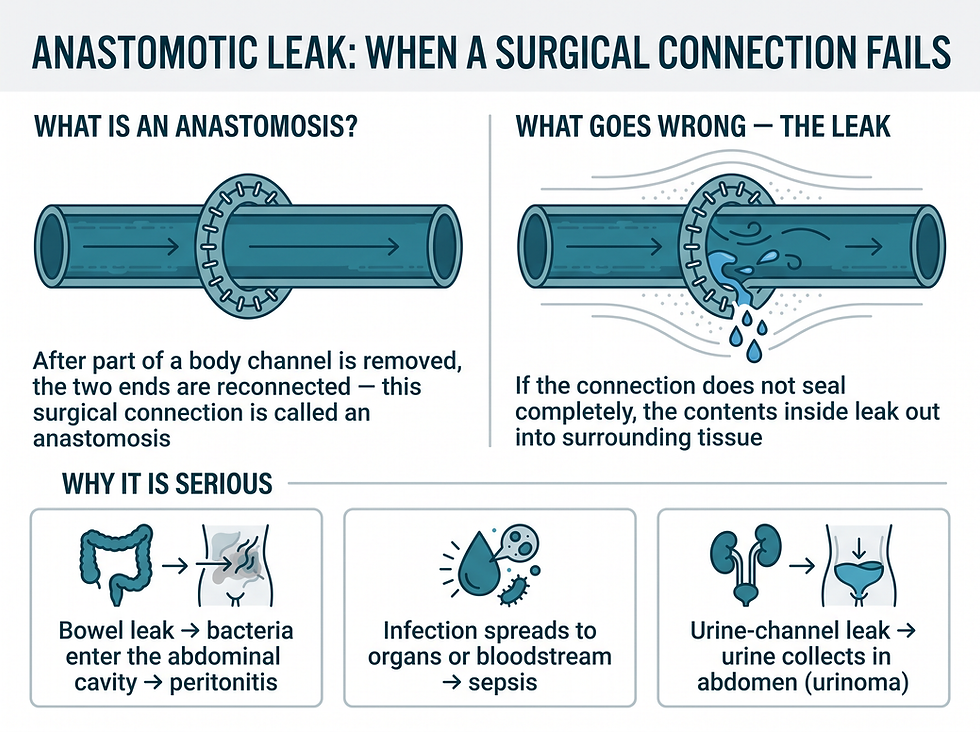
An anastomotic leak is a potentially dangerous complication of anastomosis, a surgical procedure. Anastomosis connects two ends of a channel — a tube or passageway — together. It is usually done after part of the channel has been removed (resected). For example, if you have surgery to remove part of your intestines (bowel resection), the two severed ends of the intestine are reconnected. This connection is called an anastomosis.
An anastomotic leak occurs when the two ends of a channel that have been connected together do not seal completely, and contents from the inside leak out. It is serious because the channels in our bodies are designed to carry substances that do not belong in other parts of the body. For example, digestive contents in your gastrointestinal tract contain bacteria that can infect the abdominal cavity if they leak out.
Key Fact | Detail |
Definition | Surgical anastomosis fails and contents of the reconnected channel leak out |
Where it happens | Any reconnected body channel; most commonly the bowel after bowel resection |
Why it is dangerous | Leaked contents contain bacteria that can infect surrounding tissue |
Prevalence | About 5% of anastomosis surgeries; ~75% of leaks linked to colectomy |
Typical timing | Most leaks appear within the first week after surgery |
What Happens When a Bowel Resection Leaks?
A bowel resection is just one type of operation that involves anastomosis and anastomotic leaks, but it is the most common one. When bowel contents leak into your abdominal cavity, they can cause infection and inflammation of the peritoneum, the tissue that lines your abdominal cavity — a condition called peritonitis.
Infection in your abdomen can spread to other abdominal organs and can enter your bloodstream. Serious infection can lead to sepsis, a life-threatening physical reaction that can include shock, organ failure, or death.
Leaks are not limited to the bowel. Any operation that removes one of the organs connected to your ureter, such as a kidney transplant or a prostatectomy, requires anastomosis. If it leaks, urine can collect inside of your abdominal cavity (urinoma). Infection and sepsis are also risks outside of the abdominal cavity — for example, an anastomotic leak in your esophagus, which is part of the gastrointestinal tract, can infect your chest cavity.
Leaking Channel | Typical Surgery | What Happens If It Leaks |
Intestine (bowel) | Bowel resection / colectomy | Bacteria infect the abdominal cavity → peritonitis → possible sepsis |
Urine channel (ureter) | Kidney transplant, prostatectomy | Urine collects in the abdominal cavity (urinoma) |
Esophagus | Esophageal surgery | Infection can spread to the chest cavity |
When Does an Anastomotic Leak Occur?
A leak may be present at the time of surgery, though surgeons can screen for leaks at this time. It is more likely to occur sometime during the healing process. Most leaks show up within the first week after surgery, but some may occur later. Healthcare providers keep watch for leaks in the weeks following surgery. Smaller, slower leaks may take longer to show their effects. A delayed anastomotic leak, occurring more than 30 days later, is uncommon.
How Common Are Anastomotic Leaks?
Anastomotic leaks are reported in about 5% of anastomosis surgeries. About 75% of anastomotic leaks are associated with colectomy, the removal of some part of the colon. They are most common when the resection is located toward the end of the large bowel — in the rectum or sigmoid colon. This part is narrower and more technically difficult to operate on, especially in men.
Who Does Anastomotic Leak Affect?
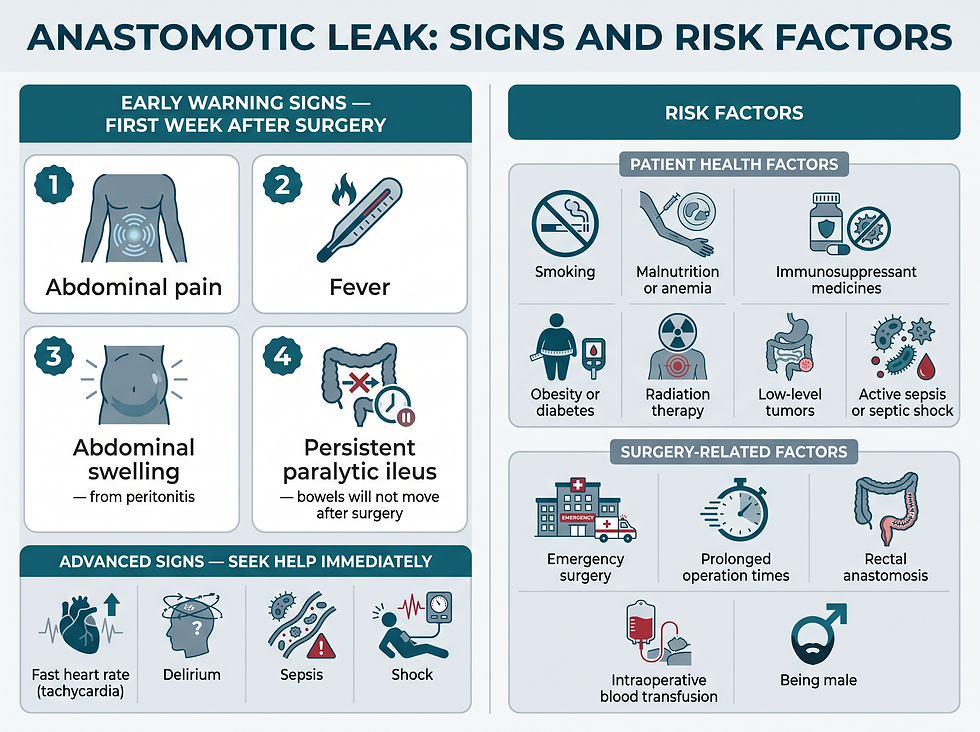
Technically, anyone who has had anastomosis surgery can suffer the complication of an anastomotic leak, but certain risk factors increase the likelihood.
Patient Health Factors | Surgery-Related Factors |
Smoking | Emergency surgery |
Malnutrition or anemia | Prolonged operation times |
Immunosuppressant medicines | Rectal anastomosis |
Obesity or diabetes mellitus | Intraoperative blood transfusion |
Radiation therapy | Being male |
Low-level tumors | |
Active sepsis or septic shock |
What Causes an Anastomotic Leak?
A leak in an anastomosis typically results from a failure in the healing process. There is no one direct cause, but several factors might contribute.
Too much tension at the surgical connection is the main thing surgeons try to avoid to prevent a leak. Tension could theoretically cause the connection to pull and stretch with movement. It is more of a risk when the surgical site is in a narrower place that is more difficult to access.
Preexisting infection in your body cavity causes inflammation and swelling of your body tissues. Long-term inflammation can cause a loss of collagen. Surgeons try to control for infection by rinsing your body cavity with antiseptic and giving you antibiotics, but your tissues may already be weakened at the time of surgery.
Reduced blood flow (ischemia) in the body channel being connected can be a preexisting condition or a reaction to surgery.
Compromised immunity, due to a health condition, smoking, low nutritional status, or the use of immunosuppressants, also contributes. Radiation therapy damages tissues and compromises immunity. Many people having anastomosis surgery are people who have cancer, too.
What Are the Symptoms of an Anastomotic Leak?
The first and most common symptoms are abdominal pain, fever, abdominal swelling (from peritonitis), and persistent paralytic ileus — when your bowels will not move following surgery.
More advanced symptoms may include tachycardia (fast heart rate), delirium, sepsis, and shock.
Stage | Symptoms |
First and most common | Abdominal pain |
First and most common | Fever |
First and most common | Abdominal swelling (from peritonitis) |
First and most common | Persistent paralytic ileus (bowels will not move after surgery) |
More advanced | Tachycardia (fast heart rate) |
More advanced | Delirium |
More advanced | Sepsis |
More advanced | Shock |
How Is an Anastomotic Leak Diagnosed?
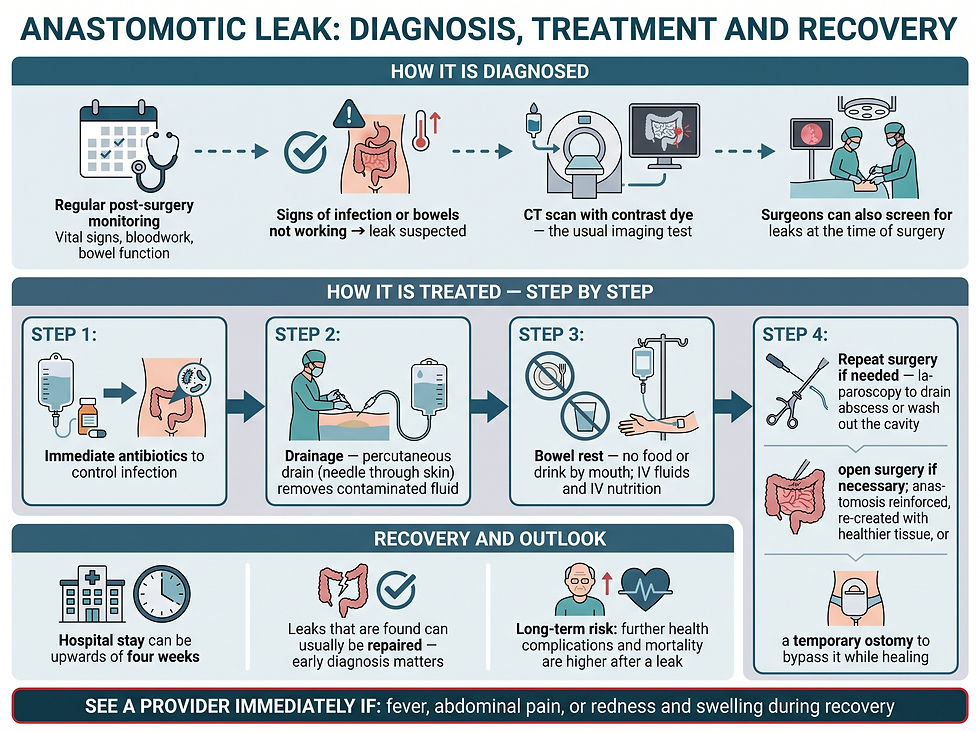
During your visits with your healthcare provider following surgery, your provider will assess your condition carefully. They will check your vital signs, bloodwork, and bowel function on a regular basis. If you show any signs of infection, or if your bowels are not functioning right following colorectal surgery, your healthcare provider will consider the possibility of an anastomotic leak. They will use imaging tests to investigate — usually a CT scan with contrast dye.
Diagnostic Element | What It Involves |
Regular monitoring | Vital signs, bloodwork, and bowel function checked after surgery |
Clinical suspicion | Signs of infection or abnormal bowel function raise concern for a leak |
Imaging | Usually a CT scan with contrast dye |
Intraoperative screening | Surgeons can test for leaks at the time of surgery |
How Is an Anastomotic Leak Treated?
You will be treated immediately with antibiotics to control infection. After that, your treatment will depend on the extent of the leak and how advanced your condition is.
Drainage. Contaminated fluid and/or swelling from inflammation may need to be drained from your body. If possible, your healthcare provider will do this percutaneously — through a hollow needle inserted through your skin.
Bowel rest. If your leak is in your intestines, you will have to avoid eating and drinking by mouth during treatment. Your healthcare provider will give you intravenous fluids and, if necessary, feed you intravenously.
Repeat surgery. Your surgeon may need to revisit the anastomosis in a repeat surgery. When possible, they will use a minimally invasive technique such as a laparoscopy, which examines your abdomen through a tiny camera inserted through a tiny incision. The surgeon can also place tiny tools through the incision to drain an abscess or wash out your cavity with antiseptic. If this does not work, they will have to reopen the body cavity to access the leak.
The anastomosis may need to be reinforced, or it may need to be re-created at another place with healthier tissue. Sometimes, your body channel may need more time to heal before the anastomosis can be recreated. In the case of intestinal surgery, your surgeon may need to redirect part of your intestines to a temporary ostomy, a new opening that bypasses the anastomosis, to give it more time to heal.
Treatment | Purpose |
Antibiotics (immediate) | Controls infection |
Drainage | Removes contaminated fluid, often percutaneously through a needle in the skin |
Bowel rest | No eating or drinking by mouth; IV fluids and IV nutrition support the body |
Laparoscopy | Minimally invasive repeat surgery to drain abscesses or wash out the cavity |
Open repeat surgery | Used when laparoscopy cannot access the leak |
Reinforcement or re-creation | The anastomosis is strengthened or rebuilt with healthier tissue |
Temporary ostomy | Bypasses the healing anastomosis so it gets time to heal |
How Long Is the Recovery?
Hospital stays for anastomotic leaks can be upwards of four weeks.
What Is the Outlook (Prognosis)?
Leaks that are found can usually be repaired, but early diagnosis and intervention are important for managing infections and controlling sepsis. In general, people who suffer anastomotic leaks are more at risk of further health complications and mortality (death) down the road. It is not clear how many of these outcomes result from the anastomotic leak, or whether the leak is a symptom of low health status in general.
Can Anastomotic Leaks Be Prevented?
Screening at the time of surgery will not prevent all leaks, but it can reduce their number and can highlight people who may be more at risk of a recurring leak.
In the case of intestinal surgery, surgeons may be able to prevent the worst effects of a bowel leak by keeping bowel contents out of your bowels during healing. They can do this by creating a temporary colostomy or ileostomy to divert your bowel contents away from the connection and into a bag. This will not prevent an anastomotic leak, but it will prevent bowel contents from infecting your abdominal cavity if a leak occurs.
Ostomies create a new, artificial opening for stool to come out, called a stoma. This allows your bowels to rest and heal without the irritation of stool passing through. Surgeons create temporary, preventative ostomies under certain conditions. Temporary ostomy surgery is recommended as a preventative measure when people are at higher risk of an anastomotic leak.
Living With: What Should You Watch For?
If you are recovering from anastomosis surgery, stay close in touch with your healthcare provider and report any unexpected symptoms. Seek immediate medical attention for any signs of infection, such as fever, abdominal pain, or inflammation (redness and swelling).
What Questions Should You Ask Before Surgery?
If you need anastomosis surgery and you are worried about anastomotic leaks, you can ask your healthcare provider about your personal risk factors, what preventative measures they might take, and what kind of intervention they might recommend. Useful questions include whether your surgery is higher-risk for leaks, whether you are personally at higher risk, how the team controls for leaks, whether they test for leaks at the time of surgery, how you will be screened for leaks following surgery, and what will happen if you have a leak.
Conclusion
An anastomotic leak is among the most serious complications of anastomosis surgery — but it is also manageable when caught early. The core reality is mechanical: a reconnected body channel fails to seal, and contents that belong inside a tube escape into tissue where they do not belong. The bowel is the most common site, which is why peritonitis and sepsis dominate the risk picture.
For patients, the practical lessons are clear. About 5% of anastomosis surgeries are complicated by a leak, most appear within the first week, and the first warning signs — abdominal pain, fever, swelling, and bowels that refuse to move after surgery — should trigger immediate medical attention. Treatment follows a disciplined escalation: antibiotics first, then drainage, bowel rest, and repeat surgery when necessary. While recovery can be long and the long-term outlook sobering, leaks that are found can usually be repaired, and the overall risk remains low.
CTA: If you are scheduled for anastomosis surgery, ask your surgeon before the operation: Is my surgery higher-risk for leaks? Am I personally at higher risk? How will I be screened after surgery? And if you are recovering at home, do not wait — seek immediate medical attention for fever, abdominal pain, or redness and swelling.
Related Reading
FAQ
What is an anastomotic leak?
An anastomotic leak occurs when a surgical anastomosis — the connection between two ends of a body channel after part of it has been removed — fails and the contents of the reconnected channel leak from the surgical connection. It is one of the most serious complications of bowel resection surgery.
How common are anastomotic leaks?
Anastomotic leaks are reported in about 5% of anastomosis surgeries. About 75% of leaks are associated with colectomy, and they are most common when the resection is near the end of the large bowel (rectum or sigmoid colon), where the area is narrower and more technically difficult to operate on.
When does an anastomotic leak occur after surgery?
Most leaks show up within the first week after surgery. A leak may be present at the time of surgery (surgeons can screen for it then), and smaller, slower leaks may take longer to show their effects. A delayed leak occurring more than 30 days later is uncommon.
What are the first symptoms of an anastomotic leak?
The first and most common symptoms are abdominal pain, fever, abdominal swelling (from peritonitis), and persistent paralytic ileus — when the bowels will not move after surgery. More advanced symptoms include a fast heart rate, delirium, sepsis, and shock.
Why is an anastomotic leak dangerous?
Body channels carry substances that do not belong in other parts of the body. Digestive contents contain bacteria that can infect the abdominal cavity (peritonitis) and spread to other organs or the bloodstream, leading to sepsis — a life-threatening reaction that can include shock, organ failure, or death.
How is an anastomotic leak treated?
Treatment begins immediately with antibiotics to control infection. Depending on the extent of the leak, providers may drain contaminated fluid (often percutaneously through a needle), enforce bowel rest with IV fluids and IV nutrition, or perform repeat surgery — laparoscopic or open — to drain an abscess, wash out the cavity, reinforce the connection, re-create it with healthier tissue, or add a temporary ostomy to bypass it while it heals.
How long is recovery from an anastomotic leak?
Hospital stays for anastomotic leaks can be upwards of four weeks.
Can an anastomotic leak be prevented?
Surgeons can screen for leaks at the time of surgery, which reduces their number but does not prevent all of them. For high-risk patients, a temporary colostomy or ileostomy (preventative stoma) diverts bowel contents away from the healing connection — it does not prevent the leak itself, but it prevents bowel contents from infecting the abdominal cavity if one occurs.
References
Disclaimer: This article is for general educational purposes only and is not a substitute for professional medical advice, diagnosis, or treatment. Always consult a qualified healthcare provider for guidance specific to your situation.
Comments